



 Chat with AI
Exam 10: Pathology

Exam 1: Anatomy265 Questions
Exam 2: Behavioral Sciences178 Questions
Exam 3: Biochemistry102 Questions
Exam 4: Embryology59 Questions
Exam 5: Epidemiology, Biostatistics, and Medical Informatics94 Questions
Exam 6: Genetics88 Questions
Exam 7: Histology46 Questions
Exam 8: Immunology147 Questions
Exam 9: Microbiology and Virology330 Questions
Exam 10: Pathology817 Questions
Exam 11: Pharmacology and Toxicology509 Questions
Exam 12: Physiology339 Questions
Exam 13: Psychiatry and Psychotherapy23 Questions
Select questions type


A 72-year-old woman comes to the office due to a persistent cough over the last 2 months that is occasionally associated with scant, white sputum. She has also lost 4.5 kg (10 lb) since the onset of her symptoms. The patient is an ex-smoker with a 25-pack-year history. . Examination shows an enlarged right supraclavicular lymph node. Imaging reveals a large mediastinal mass causing tracheal deviation. The enlarged node is biopsied, and microscopy demonstrates clusters of small, ovoid cells with scant cytoplasm and a high mitotic count. Immunohistochemical staining is positive for chromogranin. This patient most likely has which of the following conditions?
(Multiple Choice)
4.8/5  (70)
(70) A 63-year-old man comes to the physician for the evaluation of difficulty walking for the last 6 months. He reports weakness in his lower legs that improves with exercise and throughout the day. Three months ago, he started adding flax seeds to his breakfast because he is frequently constipated. He has hypertension and type 2 diabetes mellitus. He has smoked 2 packs of cigarettes daily for the last 45 years. His current medications include enalapril and metformin. Vital signs are within normal limits. Examination shows dry mucous membranes. Muscle strength in the lower extremities is decreased. Sensation to pinprick and light touch is normal. Deep tendon reflexes are 1+ bilaterally. Active muscle contraction or repeated muscle tapping increases reflex activity. An x-ray of the chest shows an irregular, poorly demarcated mass at the right hilum. Which of the following is the most likely cause of this patient's muscle weakness?
(Multiple Choice)
4.8/5 (62)
(62) A 60-year-old man comes to the emergency department because of a 3-day history of intermittent shortness of breath and palpitations. The episodes are unprovoked and occur randomly. The day before, he felt lightheaded while walking and had to sit down abruptly to keep from passing out. He has hypertension. He does not drink alcohol or use any illicit drugs. He has smoked one-half pack of cigarettes daily for 20 years. Current medications include aspirin, metoprolol, lisinopril. He appears well. An ECG obtained in the emergency department is shown in the exhibit.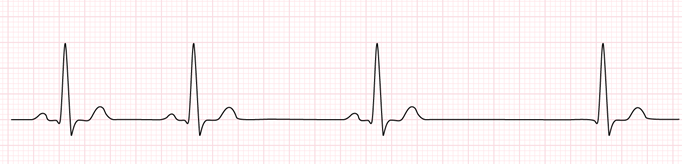 Cell degeneration in which of the following locations is most likely responsible for this patient's current condition?
 (Multiple Choice)
4.9/5 (81)
(81) A 32-year-old woman is brought to the physician by her husband, who is concerned about herabnormal behavior. Last week, she quit her job to start a clothing company. Since then, she has not slept more than 2 hours per night because she has been working on her business plans. Over this same period, she began hearing a voice telling her that she is " The God's of investment " and will need to sacrifice her life. She is not currently taking any medications and uses a copper intrauterine device for contraception. She appears unkempt and agitated while pacing up and down the room. She speaks very quickly about her business ideas, without pausing. She has no suicidal ideation or thoughts of self-harm. Which of the following is the most likely diagnosis in this patient?
(Multiple Choice)
4.9/5 (76)
(76) A 2-year-old child who only just arrived in the country with his family is taken to the office because he is agitated and cries a lot. Although the mother's pregnancy went without a hitch, the patient had to be delivered by cesarean section because of an obstructed labor. According to his mother, he has progressed less quickly than his brother in terms of being able to lift his head, crawl, and walk. Additionally, she has noted that the patient's skull is bigger than that of other kids her age. He is 50th percentile in height, 60th percentile in weight, and 95th percentile in head circumference. The picture below shows a head CT scan. 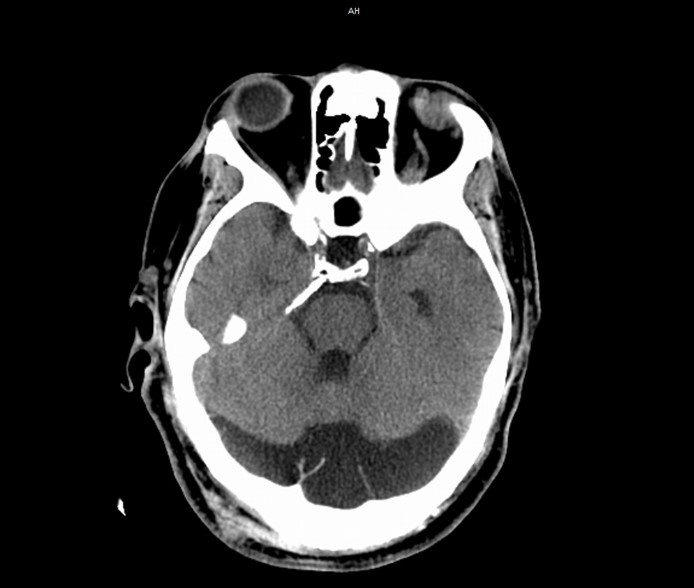 Which of the following is the most likely diagnosis?
 (Multiple Choice)
4.9/5 (78)
(78) A 72-year-old man visits the emergency room with acute dyspnea and chest tightness that started during a family meal 20 minutes earlier. He's never had symptoms like this before. Prostate cancer, type 2 diabetes, hypertension, and hyperlipidemia are among the patient's medical issues. He has no drug sensitivities and uses a number of drugs. The patient had been a pack-a-day smoker for 30 years until quitting 10 years ago. The picture below shows a contrasted chest CT scan. 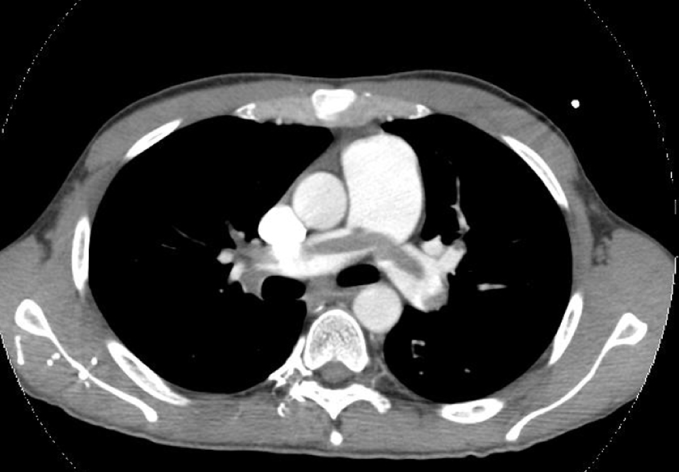 Which of the following factors most likely contributed to this patient's current condition?
 (Multiple Choice)
4.9/5 (73)
(73) A 4-hour-old male newborn has perioral discoloration for the past several minutes. Oxygen by nasal cannula does not improve the cyanosis. The newborn's temperature is 37.1°C (98.8°F), pulse is 170/min, respirations are 55/min, and blood pressure is 80/60 mm Hg. Pulse oximetry shows an oxygen saturation of 85%. Cardiopulmonary examination shows a 2/6 holosystolic murmur along the lower left sternal border. The abdomen is soft and non-tender. Peripheral pulses are normal. A chest radiograph reveals clear lungs and a normal cardiac silhouette but a narrowed mediastinal shadow. Which of the following is the most likely cause of cyanosis in this patient?
(Multiple Choice)
4.9/5 (77)
(77) A previously healthy 30-year-old woman comes to the physician for the evaluation of pain during sexual intercourse for 6 months. She also reports frequent episodes of crampy pelvic pain that starts one day before menses and lasts for 7 days. Her symptoms are not relieved with pain medication. Menses occur at regular 28-day intervals and last 5 days. Her last menstrual period was 2 weeks ago. She is sexually active with her husband. She uses a combined oral contraceptive pill. Her vital signs are within normal limits. Physical examination shows rectovaginal tenderness and nodularity in the posterior cul-de-sac. Cervical and urethral swabs are negative. Surgical biopsy of the pelvic nodules would most likely show which of the following?
(Multiple Choice)
4.8/5 (88)
(88) A 48-year-old man comes to the physician because of difficulty concentrating at work and generalized fatigue for the past 5 months. During this period, he has often fallen asleep while watching his favorite TV show. His wife reports that he snores loudly and sometimes stops breathing for a few seconds while asleep. He has hypertension treated with metoprolol. He has smoked one pack of cigarettes daily for 30 years. He is 168 cm (5 ft 5 in) tall and weighs 87 kg (192 lb); BMI is 31 kg/m2. His temperature is 37.1°C (98.8°F), pulse is 88/min, respirations are 14/min, and blood pressure is 135/85 mm Hg. Physical examination shows no abnormalities. Arterial blood gas analysis is normal. What is this patient's most likely diagnosis?
(Multiple Choice)
5.0/5 (94)
(94) A 42-year-old man comes to the physician for a routine health maintenance examination. He feels well but has had several episodes of "finger pallor" over the past 4 months. During these episodes, the 4th finger of his left hand turns white. The color usually returns within 20 minutes, followed by redness and warmth of the finger. The episodes are mildly painful. The complaints most commonly occur on his way to work, when it is very cold outside. Once, it happened when he was rushing to the daycare center because he was late for picking up his daughter. The patient has gastroesophageal reflux disease treated with lansoprazole. His vital signs are within normal limits. Which of the following antibodies is most likely to be found in this patient?
(Multiple Choice)
4.9/5 (74)
(74) A 34-year-old man comes to the physician for a follow-up examination. One month ago, he underwent splenectomy after being involved in a motor vehicle collision. He recovered uneventfully and was discharged. He received the recommended vaccinations after her surgery and currently feels well. Physical examination shows no abnormalities. A peripheral blood smear reveals many red blood cells of a specific morphology as indicated by the arrow below. 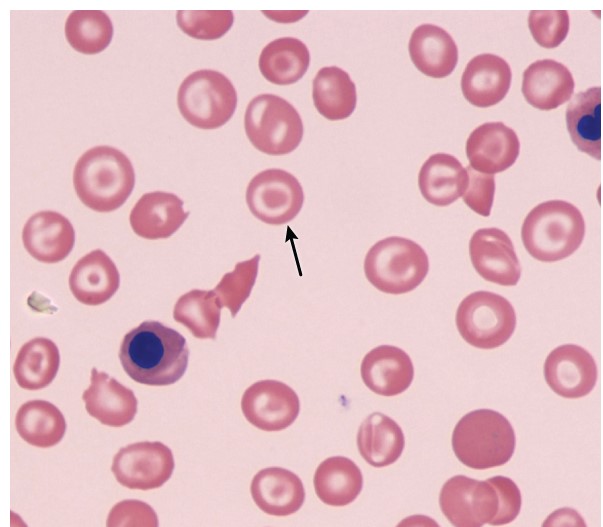 An increase in which of the following features best explains the presence of these abnormal cells?
 (Multiple Choice)
4.7/5 (83)
(83) A 47-year-old lady arrives at the office complaining of an itching rash. She has experienced a slow development of several pruritic lesions at her wrists, legs, and ankles for the previous three months. The patient attempted to treat the lesions using emollients and over-the-counter hydrocortisone but had no alleviation. As seen in the exhibit, examination reveals scattered, scaly, pink papules and plaques.  Which of the following is the most likely diagnosis?
 (Multiple Choice)
4.8/5 (88)
(88) A 64-year-old lady is examined for a 2 year progression of gait abnormality. The patient feels wobbly and as though her feet are "trapped on the floor" when walking. Additionally, she has recently started having frequent urination and has wet herself a few times as a result of having trouble finding time to use the restroom. Due to her inability to focus, the patient stopped working six months ago. She has since lost interest in both her hobbies and social activities. No tremor, vision problems, headaches, nausea, or vomiting have been reported by her. There is a distant history of closed traumatic brain injury in the patient. Vital indicators are in the expected range. On physical examination, there is increased tone in the lower extremities and deep tendon reflexes. It's natural to feel vibration, discomfort, and light touch. The patient's gait is slow with small steps and a wide base. CT scan of the head is shown below. 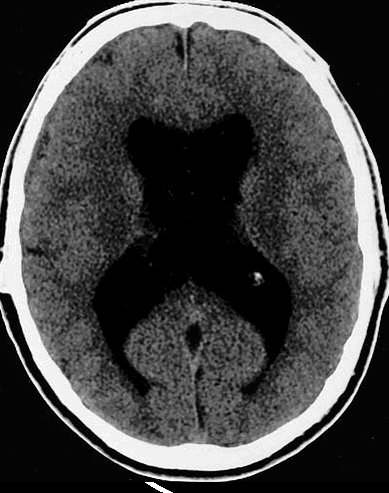 Which of the following is the most likely diagnosis?
 (Multiple Choice)
4.8/5 (71)
(71) A 57-year-old man comes to the hospital due to nausea, vomiting, and severe crampy pain in the left flank. He has had no fever or chills. Several days ago, the patient had similar, but less severe, pain that resolved spontaneously. Medical history is significant for type 2 diabetes mellitus, obesity, hyperlipidemia, hypertension, and gout. Temperature is 37 C (98.6 F), blood pressure is 160/100 mm Hg, and pulse is 98/min. Physical examination shows left flank tenderness. CT scan of the abdomen is shown below: 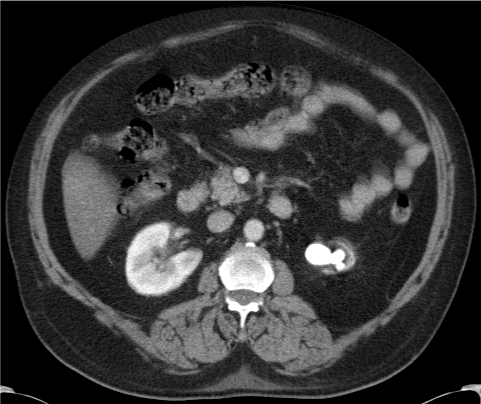 Urinalysis for this patient would most likely show which of the following?
 (Multiple Choice)
4.7/5 (69)
(69) A65-year-old man comes to his physician because of progressively worsening shortness of breath for the past 2 months. He does not experience shortness of breath at rest. He also occasionally has a dry cough. He has not had fever, chills, or night sweats. The patient has smoked a pack of cigarettes daily for 40 years. His temperature is 37°C (98.6°F), pulse is 86/min, respirations are 22/min, and blood pressure is 133/85 mm Hg. Lung auscultation reveals a prolonged expiratory phase and end-expiratory wheezing. Spirometry shows an FEV1:FVC ratio of 62%, an FEV1 of 60% of predicted, and a total lung capacity of 125% of predicted. Which of the following cells most likely played a major role in the pathogenesis of this patient's lung condition?
(Multiple Choice)
4.9/5 (85)
(85) A 20-year-old woman with cystic fibrosis comes to the clinic for routine follow-up. She has no concerns since her last visit 3 months ago. Vital signs are normal. Examination shows a hyperexpanded chest with equal aeration bilaterally. Fasting glucose level is 90 mg/dL. Plasma glucose level 2 hours after oral glucose tolerance testing is 185 mg/dL (normal: <140). Which of the following is the primary mechanism responsible for this patient's abnormal test result?
(Multiple Choice)
4.9/5 (86)
(86) A 54-year-old man arrives to the emergency department complaining of increased shortness of breath during the previous three days. His symptoms began with effort but are now present at rest. Last night, the patient couldn't sleep since he had a choking cough every time he tried to lie down. He believes himself to be in good health and claims, "I've never had to see a doctor for any difficulties." Asthma and hypertension have strong family histories. The blood pressure is 162/86 mm Hg, the pulse rate is 92 beats per minute, and the respiration rate is 26/minute. The display includes an x-ray of the chest. 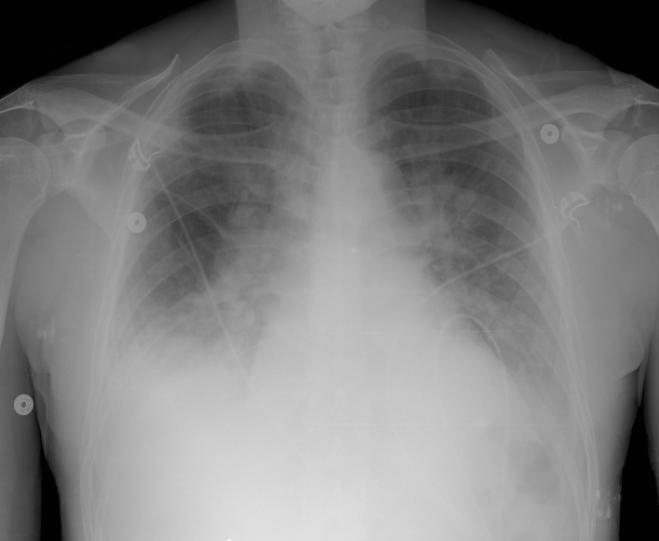 Which of the following is the most likely diagnosis?
 (Multiple Choice)
4.9/5 (81)
(81) A 56-year-old comes to the office for routine health examination. He has hypertension and hyperlipidemia and takes his medication regularly. He has no family history of significate diseases. He smoked one packet daily for 20 years and quit smoking 12 years ago. He was working in construction and shipbuilding for many years. Physical examination shows nothing significant. He is concerned about his risk of developing cancer. Due to his occupational exposure, this patient is at greatest risk of malignancy arising from which of the following?
(Multiple Choice)
4.8/5 (90)
(90) A 20-year-old woman is brought to the emergency department because of severe muscle soreness, nausea, and darkened urine for 2 days. The patient is on the college track team and has been training intensively for an upcoming event. One month ago, she had a urinary tract infection and was treated with nitrofurantoin. She appears healthy. Her temperature is 37.0°C (98.6°F), pulse is 64/min, and blood pressure is 110/70 mm Hg. Cardiopulmonary examination shows no abnormalities. The abdomen is soft and nontender. There is diffuse muscle tenderness over the arms, legs, and back. Laboratory results are as follows: 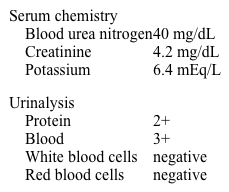 Which of the following is the most likely cause of this patient's kidney injury?
 (Multiple Choice)
4.8/5 (78)
(78) A 26-year-old woman is brought to the emergency department because of a history of lower abdominal pain and vaginal bleeding which started yesterday. Her last menstrual period was 7 weeks ago and she started to have vaginal spotting a few days ago but has had slightly increased bleeding since morning. A urine pregnancy test is positive. A pelvic ultrasound shows a normal appearing uterus with an empty intrauterine cavity and a minimal amount of free pelvic fluid. Which of the following is the most likely underlying cause of this patient's presentation?
(Multiple Choice)
4.7/5 (66)
(66) 
Filters
- Essay(0)
- Multiple Choice(0)
- Short Answer(0)
- True False(0)
- Matching(0)