Multiple Choice
A 64-year-old lady is examined for a 2 year progression of gait abnormality. The patient feels wobbly and as though her feet are "trapped on the floor" when walking. Additionally, she has recently started having frequent urination and has wet herself a few times as a result of having trouble finding time to use the restroom. Due to her inability to focus, the patient stopped working six months ago. She has since lost interest in both her hobbies and social activities. No tremor, vision problems, headaches, nausea, or vomiting have been reported by her. There is a distant history of closed traumatic brain injury in the patient. Vital indicators are in the expected range. On physical examination, there is increased tone in the lower extremities and deep tendon reflexes. It's natural to feel vibration, discomfort, and light touch. The patient's gait is slow with small steps and a wide base. CT scan of the head is shown below. 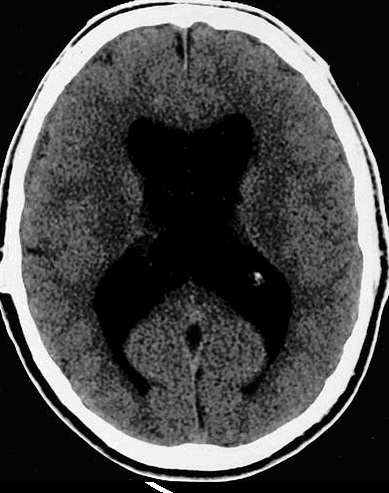 Which of the following is the most likely diagnosis?
A) Alzheimer disease
B) Frontotemporal dementia
C) Idiopathic Parkinson disease
D) Major depressive disorder
E) Normal pressure hydrocephalus
F) Obstructive hydrocephalus
G) Vitamin B12 deficiency
Correct Answer:

Verified
Correct Answer:
Verified
Q188: A previously healthy 30-year-old woman comes to
Q189: A 48-year-old man comes to the physician
Q190: A 42-year-old man comes to the physician
Q191: A 34-year-old man comes to the physician
Q192: A 47-year-old lady arrives at the office
Q194: A 57-year-old man comes to the hospital
Q195: A65-year-old man comes to his physician because
Q196: A 20-year-old woman with cystic fibrosis comes
Q197: A 54-year-old man arrives to the emergency
Q198: A 56-year-old comes to the office for