



 Chat with AI
Exam 10: Pathology

Exam 1: Anatomy265 Questions
Exam 2: Behavioral Sciences178 Questions
Exam 3: Biochemistry102 Questions
Exam 4: Embryology59 Questions
Exam 5: Epidemiology, Biostatistics, and Medical Informatics94 Questions
Exam 6: Genetics88 Questions
Exam 7: Histology46 Questions
Exam 8: Immunology147 Questions
Exam 9: Microbiology and Virology330 Questions
Exam 10: Pathology817 Questions
Exam 11: Pharmacology and Toxicology509 Questions
Exam 12: Physiology339 Questions
Exam 13: Psychiatry and Psychotherapy23 Questions
Select questions type


A 76-year-old man comes to the office due to worsening shortness of breath over the past 10 days. He has had a nonproductive cough for several months. The patient appears ill. Neck veins are nondistended. There is decreased chest expansion on the right side. Auscultation reveals decreased breath sounds over the right lung base. Chest imaging reveals loculated pleural fluid on the right side. Thoracentesis is performed. Laboratory analysis reveals the following: 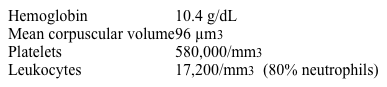 Blood cell counts were normal a month ago at the time of hospital discharge. Which of the following is the most likely underlying cause of this patient's increased platelet count?
 (Multiple Choice)
4.8/5  (71)
(71) A young patient's head was imaged using magnetic resonance imaging, which revealed an angiomatous lesion that included the cerebellum. On abdominal ultrasound, there is also a cystic tumor in the right kidney. Which of the following must be included in the differential diagnosis?
(Multiple Choice)
4.9/5 (90)
(90) A 68-year-old man with bilateral percutaneous nephrostomy tubes is brought to the emergency department by his wife because of altered mental status. The wife says that he is "not his usual self" and responded with nonsensical phrases when she awoke him for breakfast. He appears uncomfortable and diaphoretic. He is oriented to person but not to place or time. His temperature is 36.8°C (98.2°F), pulse is 124/min, respirations are 22/min, and blood pressure is 76/50 mm Hg when supine. Pulse oximetry on room air shows an oxygen saturation of 96%. In the emergency department, a central venous catheter is placed and hemodynamic monitoring shows: 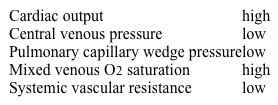 Which of the following is the most likely cause of this patient's hypotension?
 (Multiple Choice)
4.8/5 (90)
(90) A 40-year-old man comes to the physician because of a 2-year history of gradually worsening shortness of breath. He smoked half a pack of cigarettes daily for 10 years but stopped 8 years ago. His pulse is 72/min, blood pressure is 135/75 mm Hg, and respirations are 20/min. Examination shows an increased anteroposterior diameter of the chest. Diminished breath sounds are heard on auscultation of the chest. Spirometry shows an FEV1:FVC ratio of 63% and an FEV1 of 65% of predicted. This patient's lower lung lobes are most likely to demonstrate which of the following findings?
(Multiple Choice)
4.8/5 (74)
(74) A 66-year-old man is brought to the office by his daughter for medical evaluation. The patient reports no chronic medical conditions but has not seen a doctor in many years. He doesn't take any medications. The patient is a retired veteran who recently relocated to be closer to his daughter. He is a nonsmoker who does not consume alcohol or illegal drugs. On room air, oxygen saturation is 98 percent. On physical examination, normal breath sounds are heard throughout both lungs. The exhibit displays the results of a hand examination. 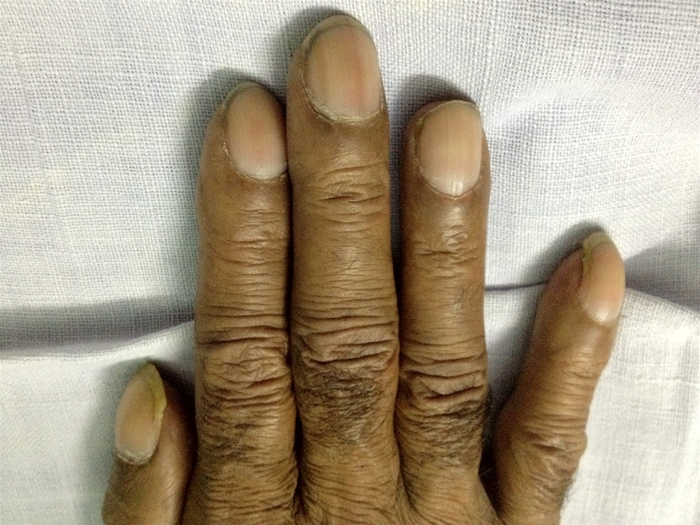 The patient's hand findings are most suggestive of which of the following underlying conditions?
 (Multiple Choice)
4.8/5 (71)
(71) A 72-year-old man is brought into the hospital by paramedics after he was found disoriented and wandering in the street. He has a past medical history of dementia, hypertension, and stroke. Physical examination reveals a disoriented, thin-appearing male. His gingivae are swollen and bleed easily. Ecchymoses are noted on his legs. The laboratory values are provided below: 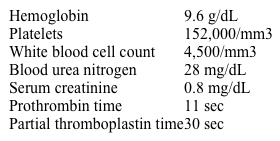 Which of the following is most likely responsible for this patient's ecchymoses?
 (Multiple Choice)
4.9/5 (71)
(71) A 57-year-old man is being assessed for chronic shortness of breath. His respiratory flow-volume curve is shown below in red. 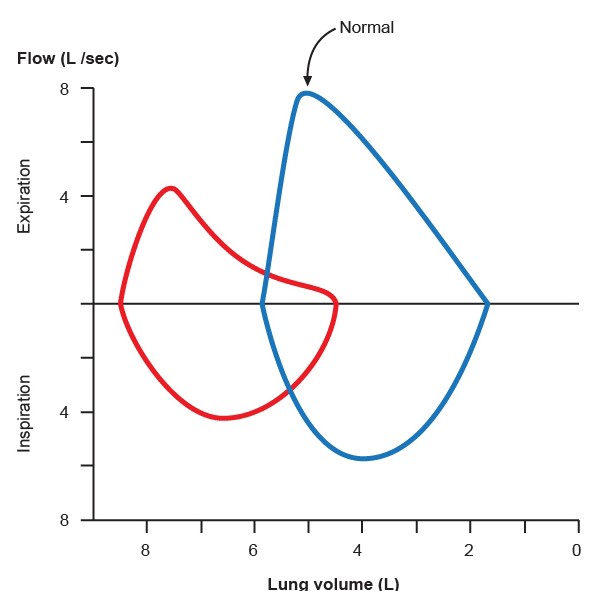 Which of the following pathologic findings is most likely to be present in this patient?
 (Multiple Choice)
4.7/5 (62)
(62) A 37-year-old lady arrives at the emergency room complaining of acute right lower quadrant discomfort and abrupt onset nausea. Following activity, the discomfort started about an hour ago and has since gotten much worse. The patient is healthy and has never undergone surgery before. Her last period was 3 weeks ago, and she does not take contraception. Both the blood pressure and the pulse are 136/94 mm Hg. Over the right lower quadrant of the abdomen, there is palpable tenderness. Right ovarian tumor shown on pelvic ultrasonography; no blood flow to ovary. The picture below displays the specimen made during a right oophorectomy and diagnostic laparoscopy: 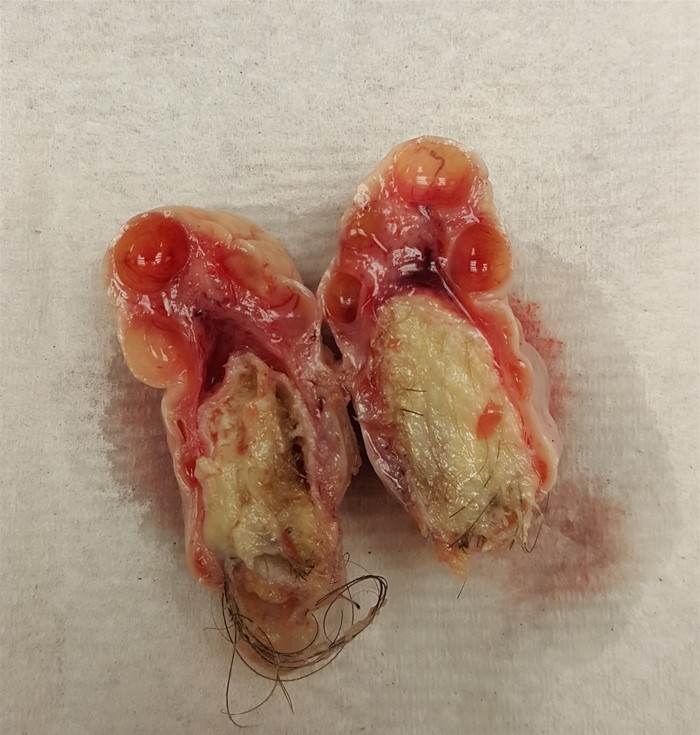 Which of the following is the most likely diagnosis?
 (Multiple Choice)
4.9/5 (77)
(77) A 31-year-old woman arrives at the office complaining of transient visual changes, which are characterized by "loss of vision for a minute" and are frequently caused by bending forward or lifting objects. She has been suffering from migraine-like headaches for the past three months. As needed, the patient takes over-the-counter analgesics. The blood pressure is 140/90 mm Hg, and the pulse rate is 72 beats per minute. 32.4 kg/m2 is the BMI. The image below depicts funduscopic findings in the left eye, with similar findings in the right eye. 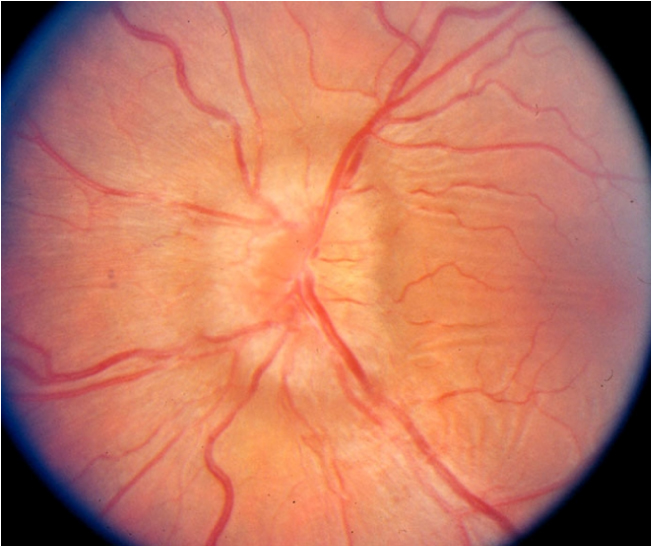 Which of the following is the most likely cause of the observed funduscopic findings in this patient?
 (Multiple Choice)
4.8/5 (80)
(80) A 38-year-old woman comes to the physician because of a 1-month history of fatigue and pruritus. Physical examination shows skin excoriations and mild hepatomegaly. Laboratory results are as follows. 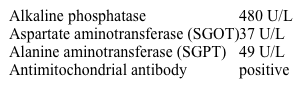 The pathogenesis of this patient's disease process most closely resembles that of which of the following conditions?
 (Multiple Choice)
4.7/5 (84)
(84) A 66-year-old man comes to the office due to increasing shortness of breath over the past 5 days. He has had a nonproductive cough for several months. . The patient appears ill. Neck veins are nondistended. There is decreased chest expansion on the right side. Auscultation reveals decreased breath sounds over the right lung base. Chest imaging shows a right lower lobe infiltrate and a small, free-flowing pleural effusion on the right side. Thoracentesis is performed. Laboratory results are as follows: 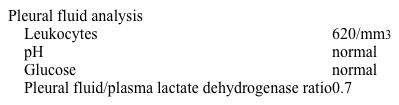 Which of the following processes best explains this patient's pleural fluid findings?
 (Multiple Choice)
4.8/5 (88)
(88) A 28-year-old man comes to the physician because of a mass in his right scrotum. He has had mild lower abdominal discomfort for the past 3 weeks. Vital signs are within normal limits. There is no inguinal lymphadenopathy. There is a firm nontender nodule over the right testicle. When a light is held behind the scrotum, it does not shine through. When the patient is asked to cough, the nodule does not cause a bulge. The abdomen is soft and nontender. Which of the following is the most likely diagnosis?
(Multiple Choice)
4.7/5 (82)
(82) A 45-year-old man with a history of good health visits the office to have a neck tumor examined. While shaving a month ago, the patient first noticed the bulge, which has since gotten bigger. He hasn't experienced a fever, neck discomfort, hoarseness, or any breathing or swallowing issues. The patient does not consume alcohol, tobacco, or illegal substances. Blood pressure is 110/70 mm Hg, temperature is 36.7 C (98 F), and pulse is 78 beats per minute. A nontender, hard nodule is visible on physical examination in the upper left thyroid lobe. Laboratory tests show high serum calcitonin levels and normal serum TSH. A 2-cm hypoechoic thyroid nodule with microcalcifications is shown on a neck ultrasound. Spindle-shaped cells are visible in the nodule's fine-needle aspiration against an amorphous backdrop. Which of the following gene alterations most likely contributed to this patient's current condition?
(Multiple Choice)
5.0/5 (78)
(78) A 2-year-old boy with no chronic medical conditions is brought to the emergency department after he was found unresponsive with vomitus in his mouth. The patient has had muscle aches, cough, rhinorrhea, diarrhea, vomiting, and fever for the past 3 days. His parents gave him aspirin twice daily for symptom control. Vital signs are within normal limits. On examination, the patient is somnolent but withdraws from pain. Pupils are equal in size and reactive to light. Cardiopulmonary examination shows no abnormalities. Hepatomegaly is present. Extremities are well perfused. Laboratory results are as follows: 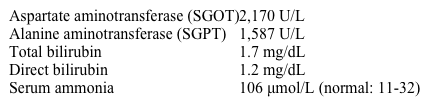 Over the next day, the patient's condition deteriorates and he dies despite supportive care. Examination of the brain would most likely reveal which of the following findings?
 (Multiple Choice)
4.8/5 (84)
(84) A 46-year-old woman comes to the physician because of a 5-month history of severe muscle and joint pain. The pain varies in location and intensity. She also has joint stiffness in the morning and reports fatigue throughout the day that she attributes to not sleeping well. She reports a tingling sensation in the lower limbs. Her bowel habits are unchanged, but she often feels bloated. She has hypertension and occasional tension headaches. She does not smoke cigarettes or drink alcohol. Her medications are hydrochlorothiazide and naproxen. She appears healthy. Vital signs are within normal limits. Examination shows symmetric muscular tenderness at the base of the neck, over the shoulders, and in the lumbosacral area. Strength and deep tendon reflexes are normal. Laboratory studies show no abnormalities. Which of the following is the most likely diagnosis?
(Multiple Choice)
4.9/5 (74)
(74) A 65-year-old man comes to the office due to 4 months of worsening fatigue and constant, low back pain. The patient feels tired with simple household chores. He has a 15-pack-year smoking history and drinks 2 or 3 beers daily. Temperature is 37 C (98.6 F), blood pressure is 134/86 mm Hg, and pulse is 76/min. Physical examination reveals a late systolic ejection murmur with a soft S2. The lungs are clear to auscultation. The abdomen is soft and nontender with no hepatosplenomegaly. There are no focal neurological deficits. Laboratory testing reveals hemoglobin is 9 g/dL and mean corpuscular volume is 93 µm3. 24-hour urinary protein excretion is elevated. Imaging of the spine demonstrates diffuse osteopenia and multiple irregular, radiolucent lesions in the thoracic and lumbar vertebrae. Which of the following histopathologic findings is most likely associated with the development of this patient's bone lesions?
(Multiple Choice)
4.8/5 (72)
(72) A 79-year-old woman arrives at the clinic complaining of bleeding from an ulcerative lesion on her right breast. The itching lesion has been there for several months and is gradually growing in size. The examination reveals a crusty, thickened, erythematous, and ulcerated nodule with hyperpigmentation. The changes have spread to the adjacent areola. Excisional biopsy revealed clusters of big, polygonal, pleomorphic cells with significant mitotic activity and surrounding necrosis. The stains S-100 and HMB-45 are diffusely positive. Which of the following is the most likely diagnosis?
(Multiple Choice)
4.9/5 (85)
(85) A 68-year-old woman comes to the office due to increasing low back pain. The pain is constant and worsens at night. She has also had a 6.8-kg (15-lb) weight loss over the past 3 months. Medical history is significant for osteoporosis and hypothyroidism. Family history is significant for breast cancer in her mother. She has smoked 1 pack of cigarettes daily for 30 years and drinks 1 or 2 glasses of wine every day. Further evaluation of the patient reveals microscopic hematuria. Laboratory results are as follows: 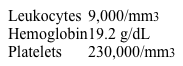 Which of the following is the most likely cause of this patient's hematologic findings?
 (Multiple Choice)
4.9/5 (81)
(81) A 21-year-old woman comes to the physician because of a 6-month history of fatigue and increased thirst. She has no history of serious medical illness and takes no medications. She states" I've been really thirsty and drinking lots of water lately too, and it's causing me to use the bathroom frequently" She is sexually active and has 1 lifetime partner. The patient's father was diagnosed with colon cancer at age 64. Which of the following studies would be the best next step to establish the diagnosis in this patient?
(Multiple Choice)
4.9/5 (80)
(80) A 42-year-old, African woman comes to the office due to pelvic pressure and urinary urgency that has worsened over the past year. She frequently has an uncomfortable sensation of incomplete emptying during voiding. Menses is regular and occurs every 30 days with no pain. BMI is 26 kg/m2. Does examination show irregularly enlarged uterus Which of the following is the most likely etiology of the patient's constipation?
(Multiple Choice)
4.8/5 (86)
(86) 
Filters
- Essay(0)
- Multiple Choice(0)
- Short Answer(0)
- True False(0)
- Matching(0)