



 Chat with AI
Exam 10: Pathology

Exam 1: Anatomy265 Questions
Exam 2: Behavioral Sciences178 Questions
Exam 3: Biochemistry102 Questions
Exam 4: Embryology59 Questions
Exam 5: Epidemiology, Biostatistics, and Medical Informatics94 Questions
Exam 6: Genetics88 Questions
Exam 7: Histology46 Questions
Exam 8: Immunology147 Questions
Exam 9: Microbiology and Virology330 Questions
Exam 10: Pathology817 Questions
Exam 11: Pharmacology and Toxicology509 Questions
Exam 12: Physiology339 Questions
Exam 13: Psychiatry and Psychotherapy23 Questions
Select questions type


A 21-year-old college student is brought to the emergency department by ambulance after he crashed his car into a tree. He explains that he was trying to escape from federal agents who were attempting to frame him for murder. Despite having several facial lacerations, the patient states, "I feel great!" He denies hallucinations or suicidal ideation. His past medical history includes anxiety. The patient's temperature is 98.2°F (36.8°C), blood pressure is 132/88 mmHg, pulse is 80/min, and respirations are 16/min. Physical exam reveals a pleasant, non-agitated young man. A neurologic exam shows normal muscle tone without involuntary muscle movement. Marijuana intoxication is suspected. Which of the following physiologic effects is most likely to be observed in this patient?
(Multiple Choice)
4.9/5  (89)
(89) A 35-year-old man is brought to the emergency department after experiencing a seizure. According to his girlfriend, he has had fatigue for the last 3 days and became confused this morning, after which he started having uncontrollable convulsions throughout his entire body. He was unconscious throughout the episode, which lasted about 4 minutes. He has not visited a physician for over 10 years. He has smoked one pack of cigarettes daily for 12 years. Imaging of the brain shows a solitary mass within the temporal lobe. Biopsy of the mass reveals uniform cells containing the Epstein-Barr virus genome. This patient most likely suffers from which of the following?
(Multiple Choice)
4.8/5 (72)
(72) A 65-year-old man arrives at the emergency department after complaining of headaches in the right temporal region for three days. The headaches are accompanied by blurred vision in both eyes on and off. He has also been fatigued for the past week, with shoulder and hip stiffness. The temperature is 37.5 degrees Celsius, according to the examination (99.5 F). As shown in the illustration, there is tenderness on palpation of the right temporal region, with enlargement of the underlying artery. 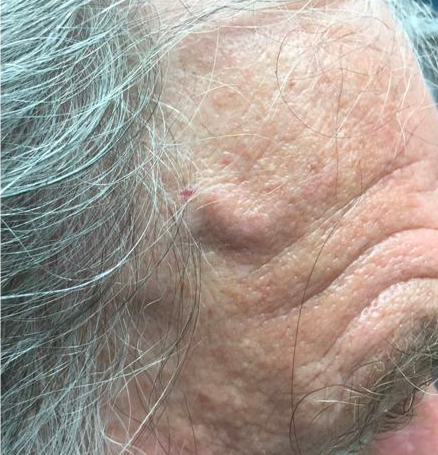 Funduscopic examination reveals edematous optic discs in both eyes. The patient has limited active abduction of the shoulder joints bilaterally. Laboratory studies show an erythrocyte sedimentation rate of 115 mm/hr. Which of the following is the most important mediator of this patient's current condition?
 (Multiple Choice)
4.8/5 (89)
(89) A 59-year-old man is brought to the office by his wife because of depressed mood and increased forgetfulness for the past 4 months. His wife notes that during this time, he has had difficulty remembering his daily schedule at work. He has smoked one pack of cigarettes daily for 30 years. Vital signs are within normal limits. His Mini-Mental State Examination score is 22/30. Examination discloses involuntary muscle twitching. On neurologic examination, deep tendon reflexes are 3+ bilaterally. Babinski sign is present bilaterally. Electroencephalography shows triphasic periodic sharp wave complexes. An MRI of the brain shows signal hyperintensity in the basal ganglia and temporal and frontal cortices. Histologic analysis of the patient's brain tissue would most likely show accumulation of which of the following?
(Multiple Choice)
4.9/5 (70)
(70) After a fall, a 70-year-old man arrives at the emergency department with severe right-sided chest pain and shortness of breath. The patient fell off a ladder while doing yard work, striking his back on several large stones. He immediately felt sharp pain over his posterior chest and struggled to catch his breath. The blood pressure is 120/80 mm Hg, the pulse rate is 88/minute, and the respiration rate is 24/minute. The exhibit includes a chest x-ray. 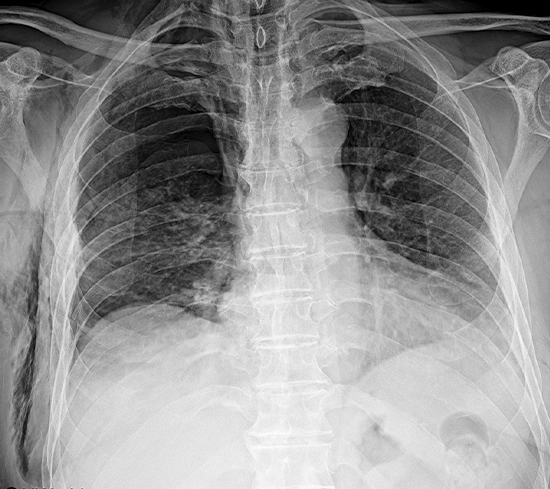 Physical examination of the right side of the chest would most likely reveal which of the following?
 (Multiple Choice)
4.8/5 (75)
(75) A 27-year-old woman comes to the physician for a dull aching pain and paresthesia over her left hand for the last few weeks. The pain radiates to her shoulder and is worse at night. Her hand feels numb upon waking up in the morning. Vital signs are within normal limits. When the wrist is passively held in full flexion, aggravation of paresthesia is perceived immediately. Which of the following is the most likely mechanism of this patient's condition?
(Multiple Choice)
4.9/5 (74)
(74) A 5-year-old girl is brought to the clinic due to 2 days of dark red urine. Blood pressure is 130/80 mm Hg Physical examination is normal with the exception of bilateral periorbital edema. Laboratory results are as follows: 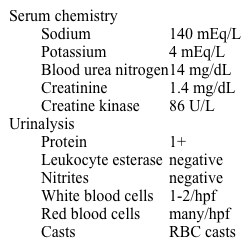 Which of the following is the most likely diagnosis?
 (Multiple Choice)
4.8/5 (58)
(58) A 72-year-old woman is brought to the emergency department due to right lower extremity weakness. The patient developed difficulty with walking this morning. She does not complain of headaches, nausea, disturbed vision, or back pain. The patient has a medical history of hypertension, diabetes mellitus, and coronary disease. Temperature is 37 C (98.6 F), blood pressure is 150/95 mm Hg, pulse is 120/min, and irregularly irregular. On examination, right lower extremity power is 0/5, deep tendon reflex is +2. The Babinski sign is present. Otherwise, the left side examination is normal. A thrombus involving which of the following structures explains the patient's symptoms?
(Multiple Choice)
4.8/5 (82)
(82) A 55-year-old man is brought to the emergency department because of sharp chest pain for the past 3 hours. He does not take any medications. He has smoked one pack of cigarettes daily for 35 years. Arterial blood gas analysis shows that the patient's alveolar-arterial gradient (PAO2 - PaO2) is markedly increased. Although the patient receives 100% oxygen via a face mask, she has persistent hypoxemia and respiratory distress. Consequently, she is intubated and placed on mechanical ventilation with 100% oxygen and positive end-expiratory pressure (PEEP). Results of arterial oxygen measurements are as follows:  The patient's improved oxygenation following PEEP application is most likely due to a decrease in which of the following?
 (Multiple Choice)
4.7/5 (84)
(84) A 50-year-old woman, gravida 0 para 0, arrives at the office for a check-up. She has no cancer in her family. Breast examination is commonplace. A screening mammogram detects microcalcifications in the patient. She had a breast biopsy as a result of this discovery. Histopathology exhibits pleomorphic cells distended ducts with significant central necrosis. The lesion is limited to the ductal basal membrane. Which of the following is the most likely cause of the lesion? 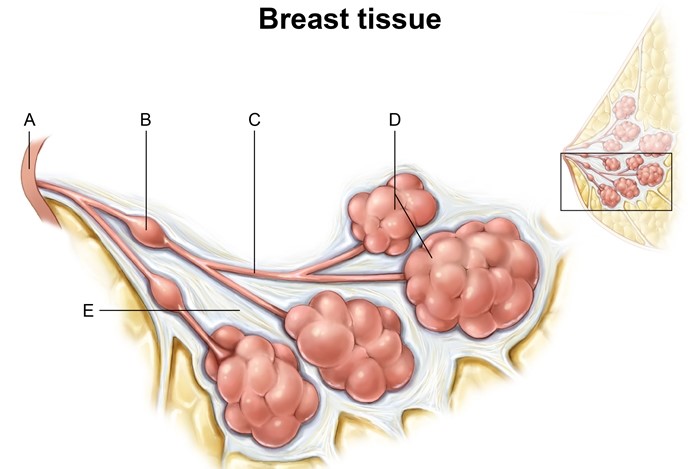
(Multiple Choice)
4.8/5 (74)
(74) A previously healthy 20-year-old girl is brought to the emergency department by her roommate because of abdominal pain, nausea, and vomiting for 6 hours. Over the past 6 weeks, she has also had increased frequency of urination, and she has been drinking more water than usual. She has lost 6 kg (13 lb) over the same time period despite having a good appetite. Her temperature is 37.8 C (100 F), blood pressure is 96/58 mm Hg, and pulse is 112/min She appears lethargic. Physical examination shows dry mucous membranes and her urine has a strong, fruity odor. Laboratory results are as follows: 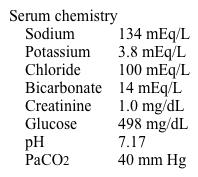 Based on the current laboratory findings, which of the following is most likely occurring in this patient?
 (Multiple Choice)
4.9/5 (96)
(96) A 12-year-old girl is brought to the physician by her mother because of a 2-day history of high fever and swelling of the left ankle and knee. She had a sore throat 3 weeks ago. There is no family history of serious illness. Her immunizations are up-to-date. She appears ill. Her temperature is 38.8°C (102.3°F), pulse is 87/min, and blood pressure is 98/62 mm Hg. Examination shows swelling and tenderness of the left ankle and knee; range of motion is limited. Lungs are clear to auscultation. A grade 3/6 holosystolic murmur is heard best at the apex. Abdominal examination shows no abnormalities. Antistreptolysin O titers are 400 Todd units/mL (normal: <300 Todd units/mL). The patient is admitted to the hospital. During her hospitalization, this patient is at greatest risk of dying from which of the following complications?
(Multiple Choice)
4.9/5 (71)
(71) A 65-year-old man presented to the emergency department complaining of severe tearing chest pain radiating to the back, unrelieved by analgesics. It started a few hours ago, with nausea, vomiting, and excessive sweating. The patient is a known case of essential hypertension since he was 25 years old. He is not compliant with his drugs. He has COPD with 35-pack-year smoking history. He has chronic kidney disease. On examination, BP 200/100, Heart rate 120 pulse/min, O2 sat 98%. ECG showed signs of left ventricular hypertrophy, with no ischemic changes. He has normal chest expansion bilaterally, with normal tactile fremitus and normal breath sounds. What is the most likely diagnosis?
(Multiple Choice)
4.8/5 (90)
(90) A 35-year-old guy visits the doctor with a skin rash. The patient was admitted to the hospital six months ago for Pneumocystis pneumonia and severe mouth ulcers. He does not take any prescriptions, but he routinely consumes alcohol and engages in recreational drug usage. Physical examination reveals a broad rash with lesions similar to the one depicted in the figure below. 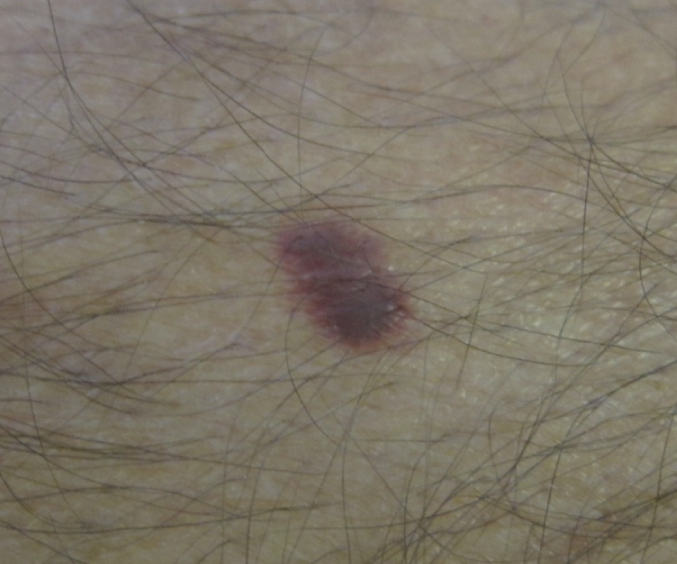 Which of the following is the most likely cause of this patient's current condition?
 (Multiple Choice)
4.7/5 (63)
(63) A 75-year-old woman is evaluated in the emergency department due to sudden-onset weakness in the left side of the body. She can speak but has an abnormality in pronouncing the words properly. Blood pressure is 165/95 mm Hg and pulse is 75/min. On physical examination, the power is 2/5 in the upper and lower left extremities. When she is asked to protrude her tongue, it deviates to the right. Which of the following is the site of injury in this patient?
(Multiple Choice)
4.8/5 (83)
(83) A 28-year-old woman comes to the physician because she has not had a menstrual period for 3 months. Menarche occurred at the age of 12 years and menses have occurred at 45 to 90-day intervals. She is 155 cm (5 ft 1 in) tall and weighs 79 kg (174 lb); BMI is 33 kg/m2. Physical examination shows facial acne and excessive hair growth on the upper lip and chin. Which of the following pathologic findings is most likely to be seen in this patient?
(Multiple Choice)
4.8/5 (78)
(78) A 44-year-old woman comes to the physician because of diplopia and progressive weakness for the past month. She has noticed increasing difficulty performing household chores and walking her dog. Sometimes, she feels too fatigued to cook dinner. receiving low-dose pyridostigmine for treatment of her condition and claims good compliance without significant side effects. Physical examination reveals fatigable asymmetric ptosis and binocular horizontal diplopia. Infusion of edrophonium elicits a significant improvement in her symptoms. The pathogenesis of this patient's disease is most similar to which of the following conditions?
(Multiple Choice)
4.8/5 (78)
(78) A 55-year-old man comes to the physician because of progressive weakness of his arms over the past 8 months. His temperature is 37.1°C (98.8°F), pulse is 88/min, and blood pressure is 118/70 mm Hg. Examination shows dysarthria. There is mild atrophy and twitching of the tongue. Muscle strength is decreased in all extremities. Muscle tone is decreased in the right lower extremity and increased in the other extremities. Deep tendon reflexes are absent in the right lower extremity and 4+ in the other extremities. Plantar reflex shows an extensor response on the left. Over the course of his illness, this patient will most likely develop which of the following?
(Multiple Choice)
4.9/5 (85)
(85) A 78-year-old man is brought to the emergency department by his daughter because of a diffuse headache and vertigo. There is no history of head trauma. He drinks 1-2 beers daily and occasionally more on weekends. His vital signs are within normal limits. He describes it as a throbbing that localizes to the back of his head, with associated vertigo and mild nausea. he has hypertension, atrial fibrillation, and type 2 diabetes mellitus. Current medications include enalapril, amlodipine, insulin, and warfarin. Noncontrast head CT reveals an acute hemorrhage in the cerebellar vermis without mass effect or midline shift. Which of the following neurologic findings is most likely to be present during this patient's physical examination?
(Multiple Choice)
4.8/5 (79)
(79) A 16-year-old boy comes to the physician because his parents are concerned about gynecomastia. Physical examination shows bilateral gynecomastia, sparse pubic hair. Genital examination shows microphallus and bilateral swelling in the groin region.. Serum studies show increased levels of luteinizing hormone and normal follicle-stimulating hormone and an increased serum testosterone. Semen analysis reveals severe oligospermia. Which of the following mechanisms is the most likely cause of this patient's condition?
(Multiple Choice)
4.7/5 (76)
(76) 
Filters
- Essay(0)
- Multiple Choice(0)
- Short Answer(0)
- True False(0)
- Matching(0)