



 Chat with AI
Exam 10: Pathology

Exam 1: Anatomy265 Questions
Exam 2: Behavioral Sciences178 Questions
Exam 3: Biochemistry102 Questions
Exam 4: Embryology59 Questions
Exam 5: Epidemiology, Biostatistics, and Medical Informatics94 Questions
Exam 6: Genetics88 Questions
Exam 7: Histology46 Questions
Exam 8: Immunology147 Questions
Exam 9: Microbiology and Virology330 Questions
Exam 10: Pathology817 Questions
Exam 11: Pharmacology and Toxicology509 Questions
Exam 12: Physiology339 Questions
Exam 13: Psychiatry and Psychotherapy23 Questions
Select questions type


A 20-year-old man comes to the office for evaluation of abnormal behavior. Over the past 4 months, the patient has had several episodes of unresponsiveness, during which he would stare blankly while smacking his lips. He spontaneously becomes responsive after about 2 minutes and has no recollection of the event. The patient says these episodes are often preceded by an uneasy sensation in his upper abdomen and the pungent smell of something burning. He has had no falls or jerky movements of the extremities. The patient has no history of recent fever, headaches, head trauma, nausea, vomiting, or focal neurologic deficit. He had seizures in early childhood precipitated by high fevers but has had none since then and reports no other medical conditions. Cranial nerve examination reveals no abnormalities. Motor strength, sensation, and deep tendon reflexes are normal throughout. Neuroimaging is most likely to reveal an abnormality in which of the following locations in the brain?
(Multiple Choice)
4.8/5  (80)
(80) A 61-year-old man arrives at the office after 4 months of easy fatigability, anorexia, and an unintentional weight loss of 4.5 kg (10 lb). His occult blood testing in the stool is positive, and laboratory studies reveal microcytic hypochromic anemia. A 6-cm (2.4-in) mass in the descending colon is discovered during a colonoscopy. Adenocarcinoma is confirmed by biopsy samples obtained during the procedure. A CT scan of the abdomen reveals multiple metastatic liver lesions. Monoclonal antibodies that bind to epidermal growth factor receptors on malignant cells are being considered for treatment. An activating mutation in which of the following will most likely make this therapy ineffective?
(Multiple Choice)
4.9/5 (80)
(80) A 28-year-old man comes to the physician because of a swollen, tender left knee for the past 4 days. During this period, the patient has had pain with urination. He has no history of serious illness and takes no medications. He is sexually active with two male partners and they use condoms inconsistently. His older sister has systemic lupus erythematosus. He is 180 cm (5 ft 11 in) tall and weighs 98 kg (216 lb); BMI is 30 kg/m2. His temperature is 37°C (98.6°F), pulse is 83/min, and blood pressure is 140/75 mm Hg. Examination shows conjunctivitis bilaterally. The left knee is warm, erythematous, and tender to touch; range of motion is limited. Laboratory studies show an erythrocyte sedimentation rate of 62 mm/h. Urinalysis shows WBCs. Which of the following is most likely associated with this patient's joint symptoms?
(Multiple Choice)
4.8/5 (91)
(91) A 64-year-old woman gravida 2, para 2, comes to the physician because of fatigue and an increase in abdominal girth despite a 5-kg (11.0-lb) weight loss over the past 6 months. She takes no medications and has received all recommended vaccinations. BMI is 30kg/m2. Abdominal examination shows shifting dullness. There is tenderness to palpation of the left lower quadrant but no guarding or rebound. Bimanual palpation shows a small uterus and a left adnexal mass. Her blood work shows a marked elevation of CA-125. Which of the following most likely would have reduced the risk of this patient's condition?
(Multiple Choice)
4.7/5 (79)
(79) A 55-year-old man with a seizure disorder is brought to the emergency department by a friend because of progressive confusion over the past two weeks. He is unable to provide any history. His vital signs are within normal limits. He appears lethargic and is only oriented to person. Oral mucosa is moist. There is no jugular venous distention. A basic metabolic panel shows a serum sodium concentration of 115 mEq/L but is otherwise normal. Which of the following is the most likely cause of this patient's hyponatremia?
(Multiple Choice)
4.7/5 (80)
(80) Due to chronic epistaxis, a 9-year-old girl is brought to the emergency room. The youngster claims that just before the bleeding began, she picked her nose. After the epistaxis remained for 20 minutes despite persistent compression of the nasal alae, her parents made the decision to take her to the emergency room. The patient frequently experiences longer than 10-minute nosebleeds. Her family history is significant for a grandfather who had an unspecified bleeding disorder. Laboratory tests are requested due to the history of protracted, recurring nosebleeds, and the results are as follows: 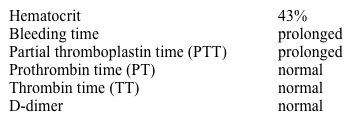 Which of the following is the most likely diagnosis?
 (Multiple Choice)
4.7/5 (81)
(81) A 38-year-old man is evaluated for bloody stools, weight loss, and anemia. The patient's medical history is unremarkable, and he does not take any medications. He smokes and consumes alcohol "socially." The patient's father died of colon cancer at the age of 40. His younger sister is afflicted with endometrial cancer. Examination reveals minimal right-sided abdominal tenderness without guarding against deep palpation. The stool tests positive for occult blood. A colonoscopy reveals a right-sided ulcerative colon mass. There are no polyps discovered. Adenocarcinoma is discovered after a mass biopsy.A mutation in which of the following genes is most likely responsible for this patient's condition?
(Multiple Choice)
4.9/5 (66)
(66) A research center studying cardiovascular pathology is conducting trials in which experimental rabbits are fed sweet peas containing substances that alter connective tissue synthesis and maturation. The animals are monitored for several weeks prior to euthanasia. Autopsy shows myxomatous degeneration with pooling of proteoglycans in the media layer and an intact intima layer in large arteries. The pathologic findings seen in the experiment are most similar to which of the following conditions?
(Multiple Choice)
4.9/5 (69)
(69) For the past several months, a 43-year-old man has been evaluated for retrosternal discomfort and dysphagia. He smokes a pack of cigarettes every day and consumes alcohol on weekends. His body mass index (BMI) is 32.8 kg/m2. The physical exam is unremarkable. Esophageal manometry is performed; the tracings appear as shown in the image below after a single swallow of 5 mL of water. 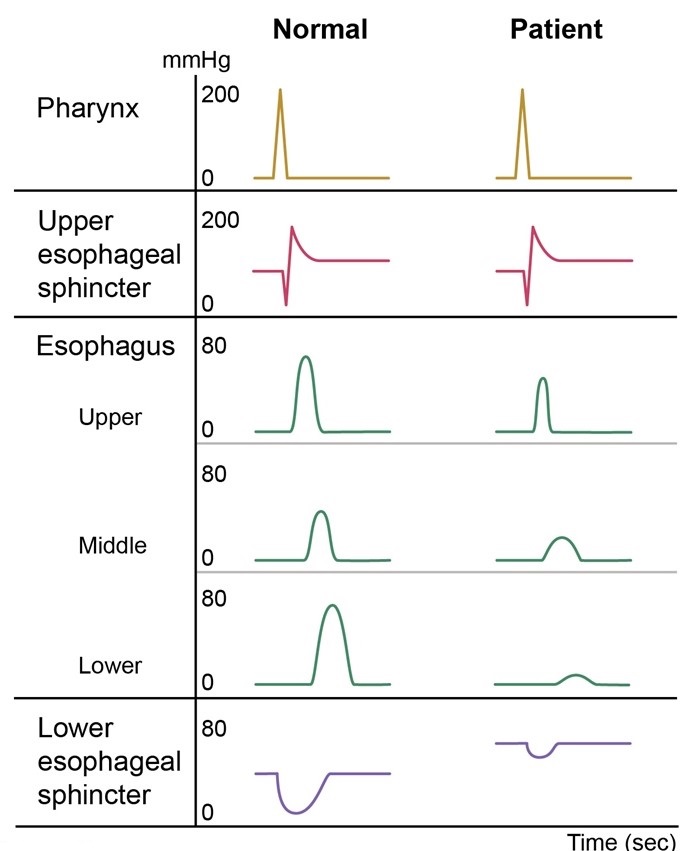 Which of the following is the most likely diagnosis in this patient?
 (Multiple Choice)
4.9/5 (80)
(80) A 54-year-old man is brought to the emergency department by his wife because of progressive lethargy and confusion for the past 10 hours. His temperature is 36.7 C (98 F), blood pressure is 86/48 mm Hg, pulse is 120/min, and respirations are 12/min. Arterial blood gas results show pH 7.54, PaCO2 49 mm Hg, and PaO2 85 mm Hg. Which of the following laboratory studies would be the most useful in determining the cause of this patient's acid-base abnormality?
(Multiple Choice)
4.9/5 (78)
(78) A 22-year-old man comes to the physician because of a fall associated with a 6-month history of increasing difficulty walking. Over the last year, his friends have also noticed his speech becoming slower. During this period, he also gave up his hobby of playing video games because he has become clumsy with his hands. His father died of esophageal varices at the age of 40 years. The patient does not smoke or drink alcohol. He takes no medications. Which of the following diagnostic studies would be the most helpful for confirming the diagnosis in this patient?
(Multiple Choice)
4.8/5 (81)
(81) An 82-year-old woman was taken to the emergency department due to sudden onset severe headache, nausea, and vomiting. The patient was recently diagnosed with glioblastoma multiforme in the left frontal lobe of the brain. He is receiving palliative care. He has a blood pressure of 130/80 mmHg, a pulse of 110 / min, and a respiratory rate of 21 / min. The patient is conscious but slightly drowsy An emergency CT scan of the head shows that bleeding within the tumor causes significant surrounding edema. The left cingulate gyrus is seen herniating beneath the falx cerebri Based on these radiological findings, what findings you would expect in this patient?
(Multiple Choice)
4.8/5 (86)
(86) A 30-year-old man comes to the physician for a follow-up examination. He is being evaluated for high blood pressure readings that were incidentally recorded at a routine health maintenance examination 1 month ago. He has no history of serious illness and takes no medications. His pulse is 88/min and blood pressure is 165/98 mm Hg. Physical examination shows no abnormalities. The rest of the physical examination is unremarkable. Laboratory evaluation shows very low plasma renin activity. Overactivity of which of the following structures is most likely responsible for this patient's symptoms?
(Multiple Choice)
4.8/5 (71)
(71) A 7-year-old boy is brought to the physician because of a 3-week history of progressive fatigue. One year ago, a peripheral blood smear performed during workup of fatigue revealed erythrocytes without central pallor. His father had gallstones, for which he underwent cholecystectomy at the age of 26 years. Examination shows pallor of the mucosal membranes, mild scleral icterus. Laboratory studies show anemia, reticulocytosis, and increased indirect bilirubin. A peripheral blood smear shows red blood cells without central pallor. This patient is most likely to have which of the following additional findings?
(Multiple Choice)
4.8/5 (97)
(97) A 9-year-old boy is brought to the physician for a follow-up examination after the removal of a tooth. During the procedure, he had prolonged bleeding that did not resolve with pressure and gauze packing and eventually required suture placement. Physical examination shows a soft and nontender abdomen. The spleen is not palpable. Laboratory results are as follows:  This patient most likely has a deficiency involving which of the following factors?
 (Multiple Choice)
4.9/5 (83)
(83) A 25-year-old woman comes to the physician because of a severe headache for 1 hour. Every day of the past week, he has experienced 3-4 episodes of severe pain over his left forehead. Each episode lasts around 30-45 minutes. He has been using acetaminophen for these episodes, but it has provided only minimal relief. He has no history of serious illness and takes no other medications. He has smoked one pack of cigarettes daily for 7 years. He appears anxious. Vital signs are within normal limits. There is conjunctival injection and tearing of the left eye with ptosis. The remainder of the physical examination is unremarkable. Which of the following findings is most suggestive of cluster headache in this patient?
(Multiple Choice)
5.0/5 (83)
(83) A 57-year-old man is brought to the emergency department for crushing substernal chest pain at rest for the past 2 hours. The pain began gradually while he was having an argument with his wife and is now severe. He does not take any medications. He has smoked one pack of cigarettes daily for 35 years. He is diaphoretic. His temperature is 37.1°C (98.8°F), pulse is 62/min, respirations are 21/min, and blood pressure is 85/64 mm Hg. Pulse oximetry on room air shows an oxygen saturation of 97%. ECG shows ST-segment elevation in leads II, III, and aVF. Chest x-ray is unremarkable. Emergent cardiac catheterization reveals complete occlusion of the proximal right coronary artery. He is persistently hypotensive in the cardiac catheterization laboratory. Which of the following hemodynamic findings is most likely to be observed in this patient? 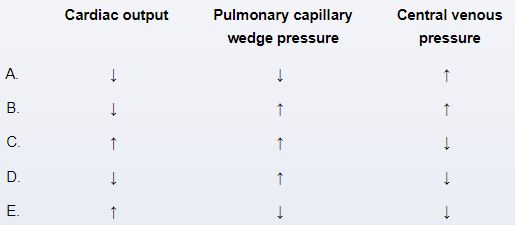
(Multiple Choice)
4.8/5 (74)
(74) A 44-year-old woman arrives at the clinic due to a breast mass. A hard, fixed mass in the right breast with palpable ipsilateral axillary lymphadenopathy is discovered on physical examination. A spiculated right-sided breast lesion is seen on mammography. The patient has a mass removed and axillary lymph nodes dissected. Histopathologic examination reveals ductal adenocarcinoma with axillary node involvement. The ability of the tumor to reach draining lymph nodes is facilitated by which of the following changes at the primary tumor site?
(Multiple Choice)
4.9/5 (62)
(62) A 17-year-old boy comes to the office due to a skin rash that has been present for a day. One week ago, he had a sore throat that improved with oral penicillin therapy. Skin examination shows several violaceous, raised, nonblanchable lesions distributed over the bilateral lower extremities. Histologic findings of the biopsied rash are shown in the image below. 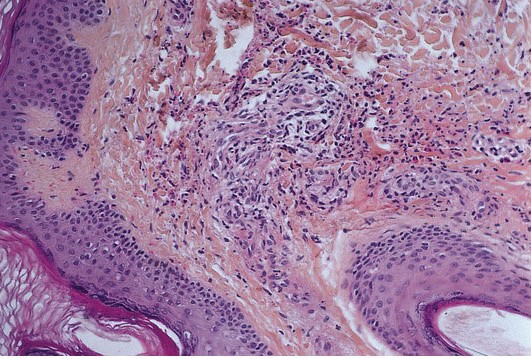 Which of the following is the most likely diagnosis in this patient?
 (Multiple Choice)
4.9/5 (83)
(83) A 2-month- boy is brought to the office by his mother because she has noticed that the baby is not feeding adequately. She received adequate prenatal care and admits to smoking one pack of cigarettes daily while pregnant. The boy's temperature is 36.3°C (97.3°F), pulse is 171/min and respirations are 60/min. Pulse oximetry on room air shows an oxygen saturation of 92%. Examination shows facial plethora. Capillary refill time is 3 seconds. The patient has a 4/6, harsh systolic, crescendo-decrescendo murmur best heard at the left upper sternal border. Laboratory studies show: 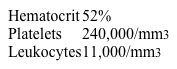 Which of the following is the most likely explanation for this patient's elevated hematocrit?
 (Multiple Choice)
4.8/5 (88)
(88) 
Filters
- Essay(0)
- Multiple Choice(0)
- Short Answer(0)
- True False(0)
- Matching(0)