



 Chat with AI
Exam 10: Pathology

Exam 1: Anatomy265 Questions
Exam 2: Behavioral Sciences178 Questions
Exam 3: Biochemistry102 Questions
Exam 4: Embryology59 Questions
Exam 5: Epidemiology, Biostatistics, and Medical Informatics94 Questions
Exam 6: Genetics88 Questions
Exam 7: Histology46 Questions
Exam 8: Immunology147 Questions
Exam 9: Microbiology and Virology330 Questions
Exam 10: Pathology817 Questions
Exam 11: Pharmacology and Toxicology509 Questions
Exam 12: Physiology339 Questions
Exam 13: Psychiatry and Psychotherapy23 Questions
Select questions type


A 28-year-old woman comes to the physician because she has had intermittent episodes of headache, nausea, abdominal pain, and tingling of her fingers. She also complains of dark urine during the episodes. Her mother and maternal uncle have similar symptoms and her father is healthy. Laboratory tests show normal liver function tests. Intravenous dextrose is administered and her symptoms improve significantly. Dextrose infusion most likely improved this patient's condition by affecting which of the following pathways?
(Multiple Choice)
4.8/5  (58)
(58) A 20-year-old college student comes to the physician because she has been extremely sad for the past 3 weeks and cries constantly. Three weeks ago, her boyfriend of 4 years left her. She has no appetite and has had a 2.3-kg (5.1-lb) weight loss. She has missed several classes because she could not get out of bed or stop crying. She thinks about her ex-boyfriend all of the time. She says that she experienced similar symptoms for about 2 months after previous relationships ended. The patient is 158 cm (5 ft 2 in) tall and weighs 45 kg (100 lb); BMI is 18 kg/m2. Her temperature is 36.1°C (97°F), pulse is 65/min, and blood pressure is 110/60 mm Hg. Physical examination shows no abnormalities. On mental status examination, she appears sad and cries easily. Which of the following is the most likely diagnosis?
(Multiple Choice)
4.8/5 (65)
(65) A 60-year-old man comes to the physician because of two painless masses in his neck, which he says appeared 4 months ago and are progressively increasing in size. The mass is nonpainful, and the patient has no associated dysphagia, chest pain, weight loss, or fever. He reports that his clothes have become looser over the past few months. He drinks alcohol occasionally. His temperature is 38.0°C (100.4°F), pulse is 90/min, and blood pressure is 105/60 mm Hg. Physical examination shows two nontender, fixed cervical lymph nodes on either side of the neck, which are approximately 2.2 cm and 4.5 cm in size. Biopsy of the mass reveals abnormal cells with a t(14;18) chromosomal translocation. This chromosomal change is most likely to cause which of the following abnormalities?
(Multiple Choice)
4.8/5 (82)
(82) A 32-year-old woman arrives to the emergency room with a worsening cough, shortness of breath, and low-grade fevers that had persisted for four weeks. She has also lost 4.5 kg (10 lb) unintentionally during the last three months. The temperature is 37.1 degrees Celsius (98.8 degrees Fahrenheit), the blood pressure is 120/70 mm Hg, the pulse is 102/min, and the respirations are 22 per minute. On ambient air, pulse oximetry showed an 86 percent saturation. Auscultation of the lungs revealed bilateral crackles. There are no murmurs in the heart, and the jugular venous pressure is normal. An x-ray of the chest indicates widespread interstitial infiltrates. The patient has a bronchoscopy; the picture shows methenamine silver staining of the bronchoalveolar lavage material. 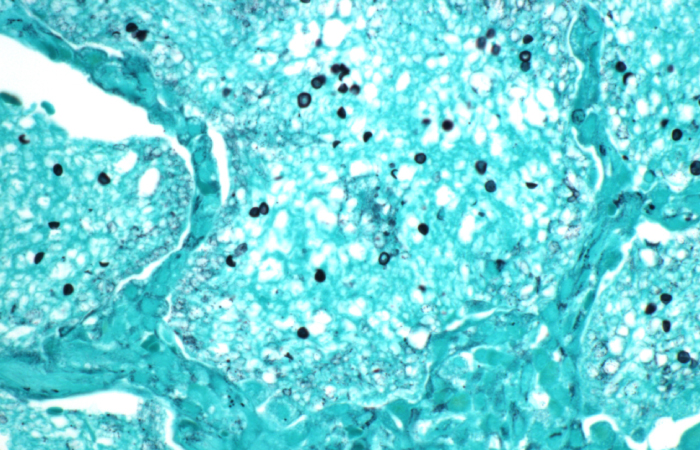 Which of the following is the most appropriate pharmacotherapy for this patient's current condition?
 (Multiple Choice)
4.8/5 (66)
(66) A 68-year-old man arrives at the office complaining of ongoing back pain for several months. He's a retired veteran who hasn't seen a doctor in years. He has smoked a pack of cigarettes every day for the past 36 years. His blood pressure is 145/85 mm Hg, and his pulse rate is 88 beats per minute. The cardiopulmonary exam is unremarkable. The abdomen is nontender and soft. Tenderness is present over the 10th rib and the L1-L2 vertebral region. The neurologic exam is normal. Increased activity in multiple vertebrae and ribs, corresponding to the patient's painful areas, is revealed by radionuclide bone imaging. Sclerotic lesions matching bone scan areas of increased uptake on routine radiographs are highly suspicious for metastatic cancer. Which of the following additional findings is most likely to be seen in this patient?
(Multiple Choice)
4.9/5 (76)
(76) A 37-year-old woman is brought to the physician for worsening depressive mood and irritability. Her mood changes began several months ago. Her husband has also noticed shaky movements of her limbs and trunk for the past year. The patient has no suicidal ideation. She has no history of serious illness and takes no medications. Her father died by suicide at the age of 45 years. Her temperature is 37.0°C (98.6°F), pulse is 76/min, and blood pressure is 128/72 mm Hg. She speaks slowly and quietly and only looks at the floor. She registers 3/3 words but can recall only one word 5 minutes later. Examination shows irregular movements of the arms and legs at rest. Extraocular eye movements are normal. Muscle strength is 5/5 throughout, and deep tendon reflexes are 2+ bilaterally. The loss of neurons supplying which of the following neurotransmitters is most specific for this patient's disease process?
(Multiple Choice)
4.8/5 (78)
(78) A 29-year-old lady visits the clinic because she has been experiencing sporadic nappy discharge for the previous few weeks. She hasn't experienced a fever or breast soreness. Despite having unprotected sexual contact, the patient has never become pregnant. She hit menarche at the age of twelve. The patient's menstrual periods reduced to 2- to 3-month intervals starting a year ago and ended altogether six months later. She does not use any drugs and has no further medical issues. At the age of 60, the patient's mother was found to have metastatic breast cancer; she recently passed away. 31 kg/m2 is the BMI. On physical inspection, both nipples are expressing white discharge. The rest of the physical examination is conducted within typical bounds. Testing for -hCG in urine is negative. Which of the following is the most likely diagnosis in this patient?
(Multiple Choice)
4.9/5 (73)
(73) An epileptic guy in his 30s visits the office for follow-up care. He has a history of recurring seizures, which initially manifest as repetitive, jerky movements of his left leg before eventually spreading to affect the entire left side of his body. The patient regularly passes out, and a widespread tonic-clonic seizure has been seen in the patient. The right motor region has a localized lesion, according to neuroimaging. Although he has received treatment with a number of antiepileptic medications, his seizures have remained poorly under control. When the lesion is surgically removed, the brain tissue that was removed reveals a 1.5-cm mass made up of engorged purple clusters. Numerous dilated capillaries with an endothelial lining are visible under a microscope, each one separated by a thin layer of fibrous connective tissue. Which of the following is the most likely diagnosis?
(Multiple Choice)
4.9/5 (77)
(77) A 40-year-old man comes to the physician because of a 6-week history of increasing shortness of breath, fatigue, and fever. He has had a cough productive of foul-smelling sputum for 4 weeks. He was hospitalized for alcohol intoxication twice over the past 6 months. He has smoked one pack of cigarettes daily for 20 years and drinks 6 alcoholic beverages daily. He appears malnourished. His temperature is 38.3°C (100.9°F), pulse is 118/min, respirations are 24/min, and blood pressure is 147/96 mm Hg. Chest imaging reveals a nonspecific pulmonary lesion. A transthoracic needle aspiration is performed. The specimen is cultured and grows several bacterial species, including Peptostreptococcus and Fusobacterium. Which of the following predisposing factors is most likely responsible for this patient's condition?
(Multiple Choice)
4.9/5 (69)
(69) A 64-year-old woman arrives at the emergency department after experiencing worsening abdominal pain for two days. She has a history of gallstones but has avoided surgery due to the high surgical risk. Chronic obstructive pulmonary disease, hypertension, and remote cervical cancer treated with surgery and chemotherapy are among her medical history. A CT scan of the abdomen reveals multiple dilated small bowel loops, a decompressed distal ileum, and an abnormal bowel, as indicated by the arrow below: 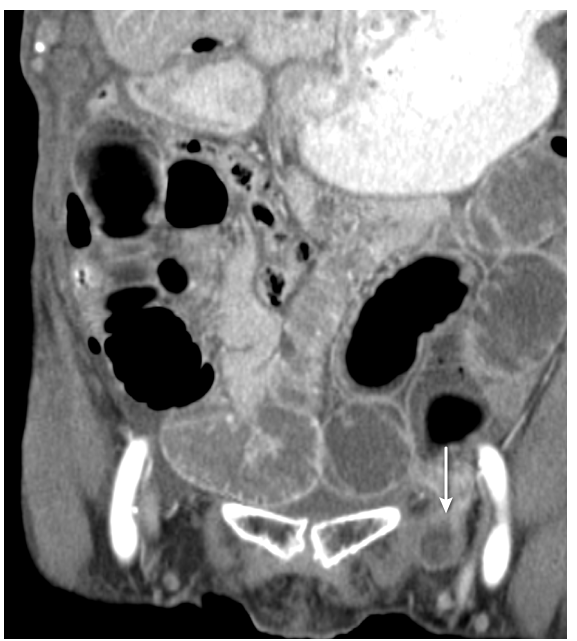 Which of the following is the most likely cause of this patient's current condition?
 (Multiple Choice)
4.8/5 (74)
(74) A 45-year-old lady is sent to the emergency room following an incident in which she suddenly lost consciousness, had rhythmic jerking of the limbs, and then experienced some bewilderment. Over the past two years, the patient has had minor everyday headaches accompanied by nausea. She occasionally wakes up at night because of the headaches. There have been no head injuries, vision abnormalities, paralysis, numbness, or difficulties speaking or eating reported by the patient. She doesn't drink or use illegal substances. There is no history of seizures in the family. The picture below shows a biopsy of an intracranial tumor that was found using neuroimaging. 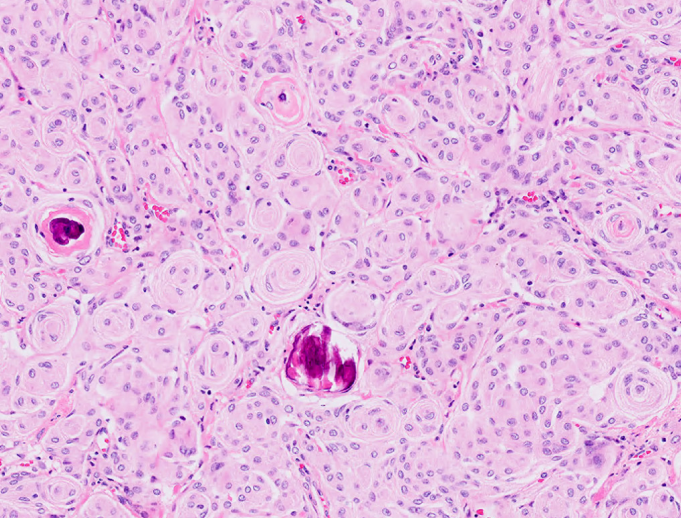 Which of the following is the most likely diagnosis?
 (Multiple Choice)
4.9/5 (75)
(75) A 75-year-old man comes to the physician because of fatigue and low back pain. He takes ibuprofen as needed for lower back pain. He has no prior medical history and takes no medications. Physical examination shows tenderness to palpation over the lumbar spine. There is pedal edema. Radiographs reveal lytic bone lesions. Laboratory results are as follows: 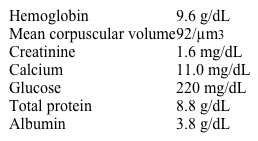 Urine dipstick is negative for protein, but quantitative measurement reveals elevated 24-hour urinary protein excretion. Urine electrophoresis is most likely to detect which of the following?
 (Multiple Choice)
4.9/5 (91)
(91) A 25-year-old man is brought to the emergency department by his wife because of a 2-week history of abnormal behavior. The patient has not slept in over a week and has been partying each night. He has never done this before. The patient has also been skipping work and purchased a car last week with money they had saved for their vacation. He normally drinks one or two beers on weekends but has been drinking 6-10 beers per day for the past week. He appears agitated and is wearing bright-colored mismatched clothing. This patient is most likely to exhibit which of the following additional findings?
(Multiple Choice)
4.7/5 (87)
(87) An 8-month-old boy is brought to the hospital for progressive dyspnea and fever. He has no medical diseases and takes no medications. He lives with his parent and 2 siblings. His father smokes 2 packest of cigarettes. Temperature is 38.5 C (101.3 F) and respirations are 36/min. Pulse oximetry is 96% on room air. Chest auscultation reveals mild subcostal retractions and focal crackles in the left lower lobe. Which of the following underlying factors is most likely contributing to this patient's current condition?
(Multiple Choice)
4.9/5 (84)
(84) A 55-year-old man is brought to the physician because of inappropriate behavior for the past 6 months. He has been making inappropriate comments and jokes while talking to friends and family members. He was arrested 3 weeks ago while trying to kiss strangers on the street. He also has lost interest in talking to his daughter or playing with his grandchildren. During this period, he has developed a strong desire for chocolate pudding and potato chips and has gained 10 kg (22 lb). He appears unkempt. Vital signs are within normal limits. Physical examination is unremarkable. Mental status examination shows apathy and a blunt affect. This patient's condition is most likely due to abnormal accumulation of which of the following?
(Multiple Choice)
4.8/5 (70)
(70) A 20-year-old woman comes to the office due to intermittent pain and swelling of both knees over the past 3 months. She has no fever, chills, or abnormal vaginal discharge. The patient has no other medical conditions and is not sexually active. Temperature is 37.2 C (99 F), blood pressure is 150/90 mm Hg, and pulse is 78/min. Small, nontender oral ulcers are present. Examination shows mild tenderness of the knee joints but no effusion. The remainder of the examination shows no abnormalities. Laboratory results reveal anemia, thrombocytopenia, and elevated serum creatinine. Urinalysis shows proteinuria and red blood cell casts. Which of the following pathogenic mechanisms is most likely responsible for this patient's renal disease?
(Multiple Choice)
4.8/5 (79)
(79) A home health care nurse discovers a 70-year-old lady who has a history of seizures and unilateral limb weakening unconscious at home. She is pronounced dead when emergency medical personnel arrive because they discover she has no pulse or spontaneous breathing. A sizable thrombus blocking the left anterior descending coronary artery is visible at autopsy. The display includes more research related to the brain. 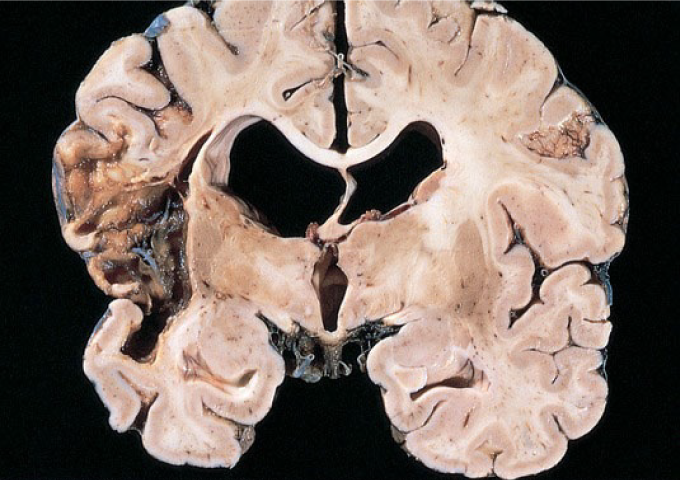 Which of the following most accurately describes the pathogenesis of this patient's brain lesion?
 (Multiple Choice)
4.8/5 (66)
(66) A 32-year-old woman comes to the emergency department with sudden-onset left flank pain and nausea. The pain radiates to the left groin and she is unable to find a comfortable position on the examination table. The pain is intermittent and waxes and wanes in severity. Temperature is 36.7 C (98 F), blood pressure is 140/90 mm Hg, and pulse is 92/min. She has mild tenderness to percussion over the left flank. Bowel sounds are hypoactive. Laboratory results are as follows: 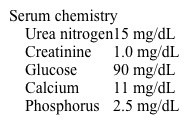 Which of the following is the most likely cause of this patient's current condition?
 (Multiple Choice)
5.0/5 (86)
(86) A 58-year-old man is admitted to the hospital 12 hours after the onset of severe abdominal pain and vomiting. He has a history of alcohol use disorder, with several previous admissions for intoxication and acute pancreatitis. Few hours after admission, he has worsening dyspnea. His temperature is 38.3°C (100.9°F), pulse is 120/min, respirations are 30/min, and blood pressure is 100/60 mm Hg. Pulse oximetry on room air shows an oxygen saturation of 85%. The patient is intubated and mechanically ventilated, but the patient dies in the next day due to respiratory failure. Which of the following autopsy findings is most likely in this patient?
(Multiple Choice)
4.8/5 (88)
(88) A 66-year-old woman comes to the physician because of a 3-month history of a painless lump on her neck. She says that the lump has gradually increased in size and is hard to the touch. Family history is unremarkable. She appears healthy. Examination shows a 2.5-cm (1-in) firm, irregular swelling on the left side of the neck that moves with swallowing. There is painless cervical lymphadenopathy. Ultrasound of the neck shows a solitary left lobe thyroid mass with increased vascularity and hypoechoic thyroid nodule . Fine-needle aspiration biopsy shows clusters of cells with large, overlapping nuclei containing finely dispersed chromatin. Numerous intranuclear inclusion bodies and grooves are also seen. Which of the following is the most likely diagnosis?
(Multiple Choice)
4.9/5 (83)
(83) 
Filters
- Essay(0)
- Multiple Choice(0)
- Short Answer(0)
- True False(0)
- Matching(0)