



 Chat with AI
Exam 10: Pathology

Exam 1: Anatomy265 Questions
Exam 2: Behavioral Sciences178 Questions
Exam 3: Biochemistry102 Questions
Exam 4: Embryology59 Questions
Exam 5: Epidemiology, Biostatistics, and Medical Informatics94 Questions
Exam 6: Genetics88 Questions
Exam 7: Histology46 Questions
Exam 8: Immunology147 Questions
Exam 9: Microbiology and Virology330 Questions
Exam 10: Pathology817 Questions
Exam 11: Pharmacology and Toxicology509 Questions
Exam 12: Physiology339 Questions
Exam 13: Psychiatry and Psychotherapy23 Questions
Select questions type


A 59-year-old man comes to the physician because of a 3-month history of frequent urination. He has to urinate every 1-2 hours during the day and wakes up at least 2-3 times at night to urinate. His pulse is 72/min, and blood pressure is 158/105 mm Hg. Prostate-specific antigen concentration is higher than normal range level and urinalysis shows no abnormalities. Digital rectal examination reveals an indurated prostate with no palpable nodules. The remainder of the examination is normal. Prostate biopsy is planned. Which of the following is the best way to obtain a diagnosis in this patient?
(Multiple Choice)
4.8/5  (73)
(73) A 43-year-old man comes to the physician for evaluation of a headache that he has had for the past 6 months. The patient reports that nothing helps to relieve the headache and that it is more severe in the morning. During the past 2 months, he has been unable to maintain an erection and he has had decreased sexual desire. There is no personal or family history of serious illness. His temperature is 37.0°C (98.6°F), pulse is 80/min, and blood pressure is 150/90 mm Hg. Examination shows an enlarged nose, forehead, and jaw and widened hands, fingers, and feet. His hands are sweaty. His serum glucose concentration is 260 mg/dL. Which of the following is most likely to be associated with this patient's condition?
(Multiple Choice)
4.8/5 (81)
(81) A 31-year-old man comes to the physician because of a 1-week history of flank pain and blood in his urine. Three weeks ago, he was treated for a urinary tract infection. He has a 6-month history of hypertension treated with enalapril. His father died at the age of 43 years of a subarachnoid hemorrhage from a ruptured cerebral aneurysm. He is 180 cm (5 ft 11 in) tall and weighs 105 kg (231 lb); BMI is 32 kg/m2. Temperature is 36.7°C (98°F), pulse is 80/min, and blood pressure is 132/85 mm Hg. Physical examination shows no abnormalities. CT scan of the abdomen with contrast is shown below. 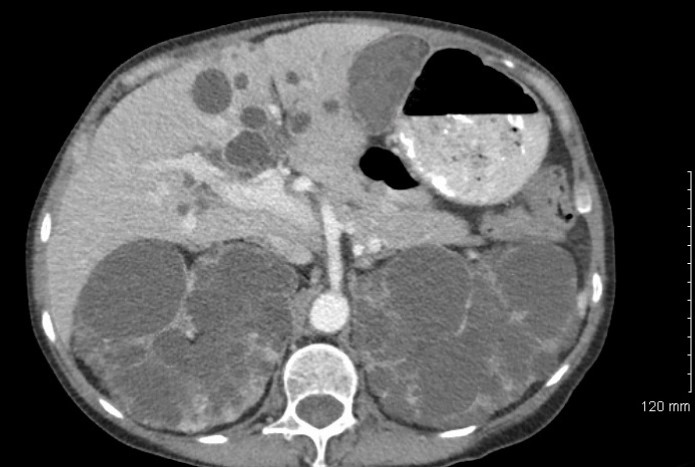 Which of the following is the most likely diagnosis?
 (Multiple Choice)
5.0/5 (78)
(78) A 2-year-old boy is brought to the physician because of for poor weight gain. He eats 3 meals and has 3 to 4 bowel movements daily with bulky stools that float. He had recurrent episodes of sinusitis in infancy. Both parents are healthy and have no similar symptoms. He is at the 15th percentile for height and 5th percentile for weight. Examination shows pale conjunctivae. A few scattered expiratory crackles are heard in the thorax. There is abdominal distention. Which of the following is most likely present in this patient?
(Multiple Choice)
4.8/5 (69)
(69) A 76-year-old woman comes to the physician because of a left-sided headaches and pain in the jaw while chewing over the past 2 months. . She has been having great difficulty getting out of bed in the morning. She has had a 4-kg (9-lb) weight loss and has not been sleeping well during this period. Her temperature is 38.0°C (100.4°F), pulse is 101/min, and blood pressure is 128/88 mm Hg. . Appropriate therapy is immediately started, and an arterial biopsy is performed. Histopathology shows multinuclear giant cells and internal elastic membrane fragmentation. Prompt institution of therapy in this patient most likely reduces the risk of which of the following complications?
(Multiple Choice)
4.8/5 (80)
(80) A 56-year-old woman comes to the physician because of a 4-month history of fatigue, dry mouth, blurry vision, and a persistent nonproductive cough. She does not have shortness of breath, a rash, or joint pain. She has no history of serious illness and takes no medications. She does not smoke or drink alcoholic beverages. Temperature is 37.2°C (99.0°F), pulse is 76/min, respirations are 12/min, and blood pressure is 124/72 mm Hg. Physical examination shows mild conjunctival erythema and cracking of the lips. There is diffuse, nontender thyroid enlargement, which is unchanged from prior examination. The remainder of the examination is normal. Biopsy of the lip mucosa is most likely to reveal which of the following findings?
(Multiple Choice)
4.9/5 (83)
(83) A 50-year-old man comes to the office for evaluation of a nodule in his palm just proximal to the third metacarpophalangeal joint. It has grown larger since it first appeared several months ago and he now has mild flexion of the finger, which he is unable to straighten. The patient reports that his mother had similar problems with her fingers. Examination of the affected hand is shown in the exhibit. 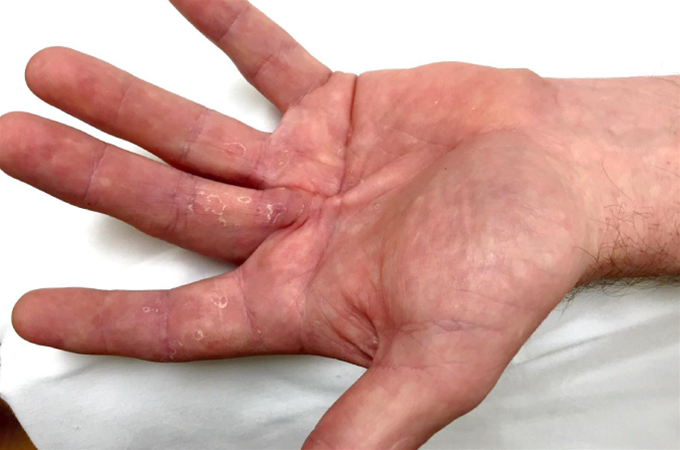 Which of the following pathologic processes is most likely involved in this patient's condition?
 (Multiple Choice)
4.8/5 (84)
(84) Due to nausea and stomach ache, a 6-year-old child is taken to the clinic by her mother. Despite having Down syndrome, the patient is overall in good health. Upon abdominal examination, the liver edge is shown to be 3 cm below the costal margin and the spleen tip to be above the umbilicus. A subsequent peripheral blood smear showed many lymphoblasts and a leukocyte count of 104,000/mm3. Acute lymphoblastic leukemia has been identified in the patient, and combination cytotoxic chemotherapy is being considered. Which of the above laboratory alterations is most likely to be observed in this patient after the start of treatment? 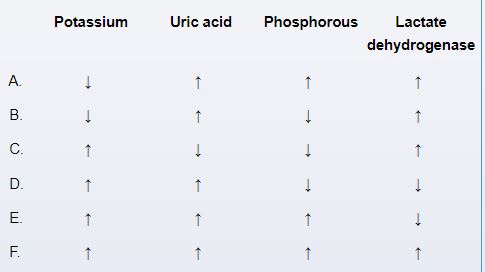
(Multiple Choice)
4.8/5 (91)
(91) A 68-year-old man comes to the emergency department due to lower abdominal pain and nausea. His symptoms started the prior evening, when he began to feel abdominal fullness and discomfort. This progressed to pain over the lower abdomen and constant nausea without vomiting. The patient last urinated >24 hours ago. He has had difficulty initiating urination and a feeling of incomplete voiding for the last year but avoided seeing a physician. Temperature is 36.7 C (98 F), blood pressure is 150/90 mm Hg, and pulse is 95/min. Physical examination shows suprapubic tenderness and fullness without guarding or rebound. Rectal examination reveals an enlarged, smooth prostate. Serum creatinine is 2.6 mg/dL and blood urea nitrogen is 22 mg/dL. A urinary catheter is placed, with immediate collection of 800 mL of urine and relief of the patient's symptoms. The following day, serum creatinine is improved. This patient's condition is associated with increased risk for which of the following?
(Multiple Choice)
5.0/5 (72)
(72) A 35-year-old pregnant woman at 8 weeks gestation comes to the emergency department due to persistent nausea and vomiting. The patient has had intermittent nausea for the past week and vomiting for the past 3 days. Now, she is unable to tolerate solids or liquids. Temperature is 36.7 C (98 F), blood pressure is 90/64 mm Hg, pulse is 108/min, and respirations are 14/min. Mucous membranes are dry and capillary refill time is delayed. Cardiac examination shows sinus tachycardia and no murmurs. The abdomen is nontender and nondistended. Compared to her baseline, which of the following sets of serum electrolyte concentration abnormalities are most likely present in this patient? 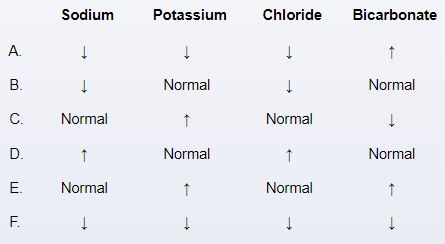
(Multiple Choice)
4.9/5 (87)
(87) A 74-year-old man is brought to the emergency department 30 minutes after being involved in a high-speed motor vehicle accident as a restrained driver. Several attempts are made to resuscitate him but are unsuccessful. The patient had no significant past medical history and took no medications. He was known to be in good health and tolerant of moderate levels of physical activity. Electrocardiogram findings at his last office visit showed no abnormalities. At autopsy, heavy calcifications of the aortic valve are seen. Which of the following most likely preceded the aortic valve changes observed in this patient?
(Multiple Choice)
4.9/5 (84)
(84) A 24-year-old man is brought to the emergency department after his head was hit with a bat during a baseball game. His teammates state that he was unresponsive after the incident but regained consciousness after 15 minutes. The patient initially refused to go to the hospital and sat on the bench for the remainder of the game. He initially appeared fine but became increasingly confused. He appears lethargic but opens his eyes to loud verbal commands. He is oriented to person and place. His temperature is 37.1°C (98.8°F), pulse is 78/min, respiratory rate is 16/min, and blood pressure is 148/87 mm Hg. Examination shows an area of soft-tissue swelling over the left temporal region. The left pupil is mildly dilated. Brain imaging would most likely reveal blood accumulating between which of the following tissues?
(Multiple Choice)
4.8/5 (82)
(82) A 41-year-old woman comes to the physician because of difficulty sleeping, restlessness, and excessive worrying for the past 8 months. She worries about paying for her children's education, her parents' health, and her own performance at work. Constant anxiety interferes with her ability to concentrate. The patient is diagnosed with generalized anxiety disorder and treated with a selective serotonin reuptake inhibitor. On follow up, the paitent's symptoms are improved excpet for bedtime anxiety that keep her awake. Which of the following medications is most appropriate for this patient's condition?
(Multiple Choice)
5.0/5 (77)
(77) A 16-year-old boy is brought to the emergency department 20 minutes after collapsing while playing basketball. There is no personal or family history of serious illness. On arrival, there is no palpable pulse and no respiratory effort is seen. Blood pressure is 125/75 mm Hg and pulse is 55/min. Transthoracic echocardiogram results are as follows: 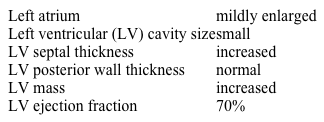 The right ventricle appears normal and there are no valvular lesions. Which of the following best explains this patient's echocardiogram findings?
 (Multiple Choice)
4.8/5 (86)
(86) A newborn is receiving care in the neonatal intensive care unit. The patient was born at 36 weeks gestation. Approximately 1 hour after delivery, a 2/6 systolic murmur could be heard at the left upper sternal border. At age 8 hours, the murmur could be heard during both systole and diastole. Examination at age 24 hours revealed no murmur. Which of the following is most likely responsible for the disappearance of this patient's murmur?
(Multiple Choice)
4.7/5 (66)
(66) A 71-year-old man comes to the physician accompanied by his wife because of a 6-month history of worsening episodic upper abdominal pain and an 8-kg (17.6-lb) weight loss. The pain is dull, nonradiating, worse after eating, and occasionally associated with bloating and diarrhea. His symptoms have not improved despite 4 weeks of treatment with omeprazole. He attributes his weight loss to recently eating very small portions and avoiding fatty foods. He has hypertension and hypercholesterolemia. Current medications include lisinopril, metoprolol, atorvastatin, and aspirin. He has smoked a pack of cigarettes daily for 40 years. Blood pressure is 175/105 mm Hg and pulse is 70/min and regular. The abdomen is soft and nontender. CT scan of the abdomen reveals the renal findings shown in the image below. 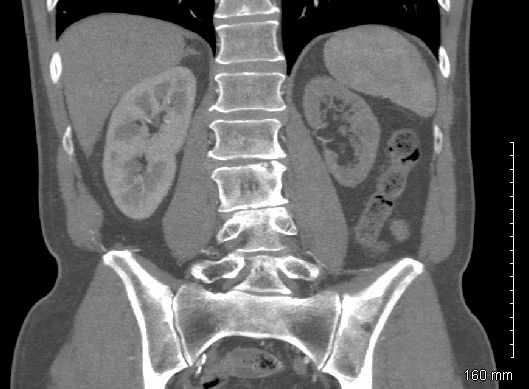 This patient most likely suffers from which of the following conditions?
 (Multiple Choice)
4.8/5 (72)
(72) A 5-month-old boy is brought to the emergency department by his mother because his lips turned blue for several minutes while playing earlier that evening. She reports that he has had similar episodes during feeding that resolved quickly. He was born at term following an uncomplicated pregnancy and delivery. He is at the 25th percentile for length and below the 5th percentile for weight. His temperature is 37°C (98.6°F), pulse is 130/min, respirations are 42/min, and blood pressure is 83/55 mm Hg. Pulse oximetry on room air shows an oxygen saturation of 90%. During the examination, he sits calmly in his mother's lap. He appears well. Which of the following is the major determinant of symptom severity in this condition?
(Multiple Choice)
5.0/5 (74)
(74) A 58-year-old man comes to the office due to exertional dyspnea and cough. His symptoms started 6 months ago and have progressively worsened. The patient has no significant medical history and takes no medications. He smoked a pack of cigarettes daily for 27 years but quit 2 years ago. Vital signs are normal. Physical examination shows bilateral inspiratory crackles and digital clubbing. CT scan of the chest is shown in the exhibit.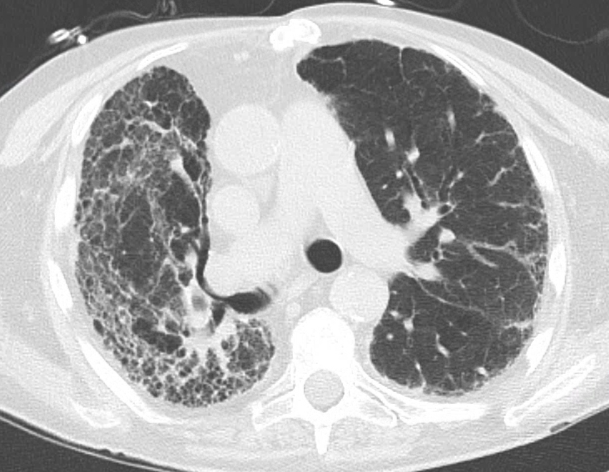 Which of the following changes are most likely present in this patient's lung tissue?
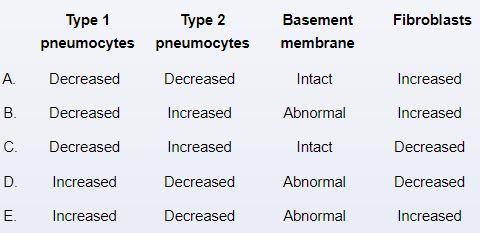
Which of the following changes are most likely present in this patient's lung tissue? (Multiple Choice)
4.9/5 (75)
(75) A 34-year-old nulliparous woman comes to the physician because of a 5-month history of heavy menstrual bleeding. She has a monthly cycles lasting 7-10 days and normal blood flow with the passage of large clots. . Pelvic examination shows an asymmetrically enlarged, fibroid uterus, and she is found to have significant anemia due to blood loss. A urine pregnancy test is negative. The patient is prescribed continuous leuprolide therapy. After several weeks, which of the following sustained hormonal changes are expected to have occurred as a result of the treatment? 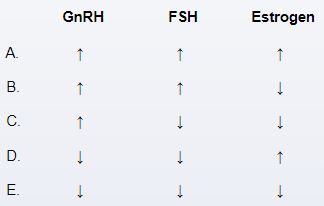
(Multiple Choice)
4.9/5 (78)
(78) A 22-year-old man comes to the emergency department because of the onset of a pruritic rash after 1 hour after eating some trail mix. He does not have shortness of breath or hoarseness. He has never had a similar episode before. He has asthma treated with an albuterol inhaler, which he uses less than once a month. His pulse is 90/min, respirations are 25/min, and blood pressure is 125/80 mm Hg. Pulse oximetry on room air shows an oxygen saturation of 99%. He also has a history of allergy to dog and cat dander. Which of the following would be the most appropriate medication to treat this patient's acute symptoms?
(Multiple Choice)
5.0/5 (79)
(79) 
Filters
- Essay(0)
- Multiple Choice(0)
- Short Answer(0)
- True False(0)
- Matching(0)