



 Chat with AI
Exam 10: Pathology

Exam 1: Anatomy265 Questions
Exam 2: Behavioral Sciences178 Questions
Exam 3: Biochemistry102 Questions
Exam 4: Embryology59 Questions
Exam 5: Epidemiology, Biostatistics, and Medical Informatics94 Questions
Exam 6: Genetics88 Questions
Exam 7: Histology46 Questions
Exam 8: Immunology147 Questions
Exam 9: Microbiology and Virology330 Questions
Exam 10: Pathology817 Questions
Exam 11: Pharmacology and Toxicology509 Questions
Exam 12: Physiology339 Questions
Exam 13: Psychiatry and Psychotherapy23 Questions
Select questions type


A 34-year-old guy arrives to the clinic with a lingering skin rash. He has a 6-month history of a scaly rash on his upper and lower limbs, which is accompanied by moderate pruritus. The patient has tried topical antihistamines and emollients without success. Childhood asthma and orolabial herpes simplex virus infection stand out in the patient's medical history. He does not smoke or drink and works as a sales associate for a home improvement business. The patient was found to have skin lesions, as indicated in the photograph below. On histology, psoriasis is distinguished by hyperkeratosis and confluent parakeratosis of the stratum corneum (which results in the typical silvery scales visible on visual examination), as well as widespread epidermal hyperplasia with elongated and clubbed rete ridges. 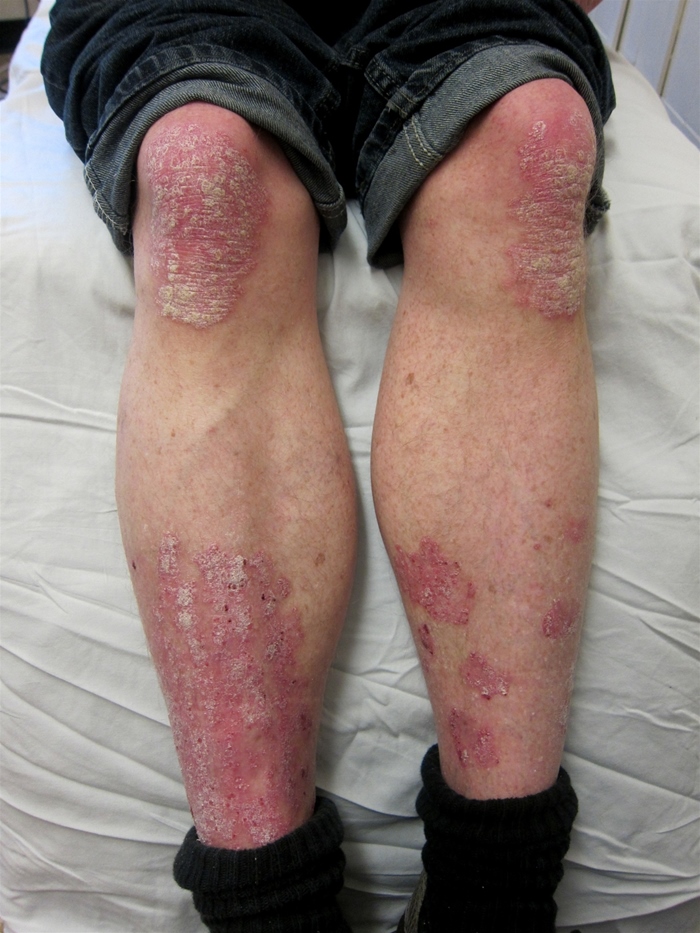 This patient's disorder is most likely associated with which of the following extradermal complications?
 (Multiple Choice)
4.7/5  (79)
(79) A 17-year-old girl is brought to the office to have a right wrist mass evaluated. She first noticed swelling on the top of her wrist about three months ago, but it didn't bother her until she was teased about it at school. She has no other worries. A nontender, rounded mass on the dorsal wrist that transilluminates with a penlight is discovered during examination. The following image depicts the mass: 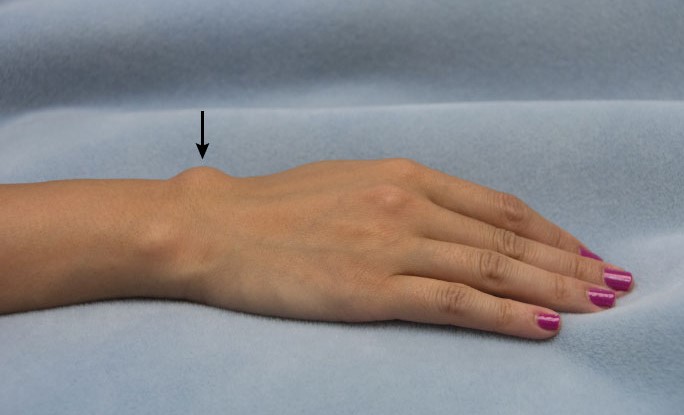 Which of the following is the most likely underlying etiology?
 (Multiple Choice)
4.9/5 (64)
(64) A 55-year-old woman presented to the clinic complaining of fever and skin rash of 3 days duration. She does not complain of cough, dyspnea, angina, vomiting, or dysuria. The patient was recently diagnosed with gastroesophageal reflux disease and has been taking omeprazole for the last two weeks. Temperature is 38.1 C (100.6 F), blood pressure is 135/95 mm Hg, and pulse is 88/min. Examination shows a diffuse, maculopapular skin rash. No mucosal lesions are found on examination. There are no cardiopulmonary deficits on physical examination. Costovertebral angle tenderness is absent. Serum creatinine is 2.5 mg/dL (baseline 1.2 mg/dL, 2 weeks ago). Urinalysis shows numerous white blood cells/hpf. Which of the following is the most likely cause of this patient's acute renal dysfunction?
(Multiple Choice)
4.9/5 (70)
(70) An 8-year-old child is brought to the clinic because he has had a lower extremities skin rash for three days. The rash started as sensitive papules and swiftly developed into vesicles and flaccid bullae that ruptured readily. The patient has no mucosal lesions or other rashes and has never before experienced such symptoms. He has had all necessary vaccines and does not taking any drugs. The results of the skin examination are displayed below. 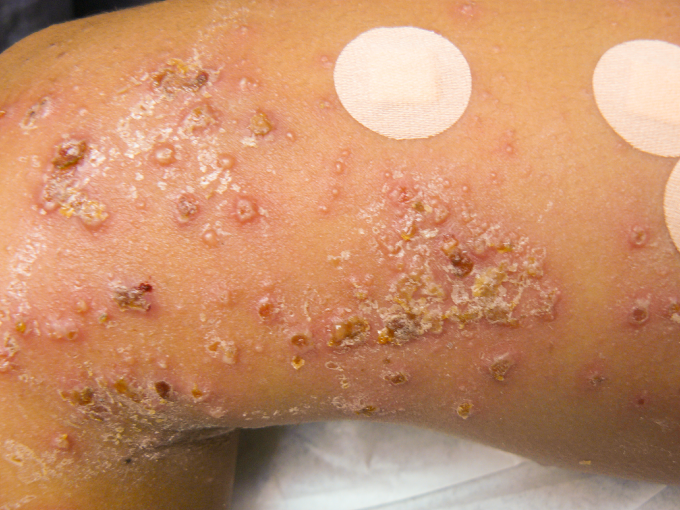 Which of the following is the most likely cause of this patient's skin findings?
 (Multiple Choice)
4.9/5 (92)
(92) A 63-year-old woman dies of congestive heart failure. An autopsy reveals a dilated heart with brownish pigmentation of the myocardium. The image below shows light microscopy of her liver after Prussian blue staining: 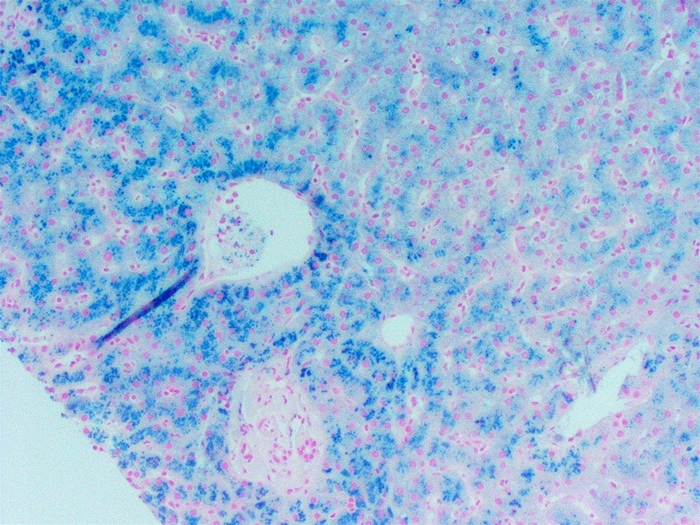 At the age of 43, the patient's brother died from severe upper gastrointestinal bleeding. Assuming this patient's disorder is hereditary, which of the following most likely contributed to her disease's delayed onset compared to her brother?
 (Multiple Choice)
4.7/5 (91)
(91) A 45-year-old man comes to the physician because of numbness and tingling in his fingers and toes for the past month. He also describes difficulty with balance while walking. For the past 5 years, he eats only vegetables, fruits, and grains. Medical history is unremarkable. The patient takes no medications or nutritional supplements. He does not use tobacco or alcohol. his patient is at increased risk for deficiencies of which of the following nutrients? 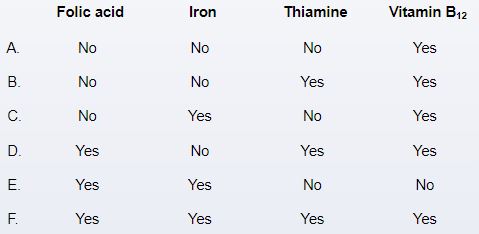
(Multiple Choice)
4.9/5 (69)
(69) Further evaluation shows decreased von Willebrand factor activity in the patient's serum. This protein normally binds to which of the following?
(Multiple Choice)
4.8/5 (88)
(88) A 65-year-old man who has a lengthy history of smoking visits the emergency room complaining of chronic moderate cough and shortness of breath. Over the past week, his symptoms progressively worsened, but today they abruptly got worse. The patient has hypertension that is treated with hydrochlorothiazide. His temperature is 36.7 C (98 F) during examination, and his blood pressure, pulse, and respirations are 135/85 mm Hg and 94/min, respectively. On room air, pulse oximetry displays 86 percent. There are less breath noises coming from his right chest. The picture below shows an x-ray of his chest. 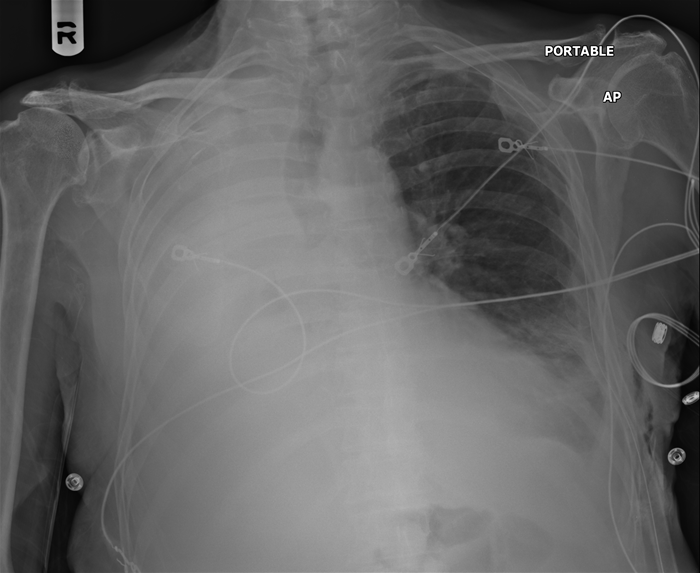 Which of the following is the most likely cause of this patient's radiographic findings?
 (Multiple Choice)
4.8/5 (87)
(87) A 7-year-old boy is brought to the emergency department by his mother because of difficulty breathing for 20 minutes. He was having lunch with his mother when she noticed a rash and swelling of his tongue and lips. Two years ago, he was diagnosed with asthma. His mother has had atopic dermatitis since she was 12 years old. The patient's only medications are inhaled beclomethasone and inhaled albuterol. His temperature is 37°C (98.6°F), pulse is 169/min, respirations are 28/min, and blood pressure is 90/50 mmHg. Pulse oximetry on room air shows an oxygen saturation of 92%. Examination shows generalized hives, swelling of his tongue and lips, and labored breathing with intercostal retractions.Which of the following drugs should be administered next to this patient?
(Multiple Choice)
4.8/5 (89)
(89) A 40-year-old man comes to the office due to several months of abdomen discomfort and crampsHe also reports a progressive itching after showers and rash which is increased after scratching. He has feels fatigue all the time and he is frequently dizzy and light-headed after prolonged standing. He has no prior medical conditions and takes no medictions The patient does not use tobacco, alcohol, or illicit drugs. Vital signs are normal. Skin examination shows a maculopapular rash. Skin biopsy shows large clusters of mast cells that are positive for KIT (CD 117). Which of the following additional findings are most likely present in this patient?
(Multiple Choice)
4.9/5 (60)
(60) A 5-year-old girl is brought to the office by her parents for concerns about her behavior. Since the parents started taking their child to daycare, they have become concerned that their daughter has not been behaving like other children her age. She seldom responds when her name is called at home or at daycare. Additionally, she has been getting in trouble with the day care staff for not following directions but instead demanding to play with the train set at all time. . The patient was born at full term, and developmental milestones were within normal range. The patient has ample vocabulary, but speaks in a singsong voice mostly to herself and does not engage during the exam. Which of the following is the most likely diagnosis?
(Multiple Choice)
4.7/5 (65)
(65) A previously healthy 20-year-old man is brought to the emergency department because of a 36-hour history of fever and profuse, watery diarrhea. He appears lethargic. His temperature is 38.1°C (100.6°F), pulse is 115/min, respirations are 25/min, and blood pressure is 90/58 mm Hg. Examination shows sunken eyes and dry mucous membranes. Capillary refill time is 3 seconds. Abdominal examination shows no abnormalities. Which of the following physiologic changes in kidney function would be most likely in this patient?
(Multiple Choice)
4.8/5 (73)
(73) A 40-year-old man comes to the physician due to right abdominal pain especially severe after fatty meals. He has a hsitory of recurrent same episodes which is localized to the upper quadrent. Two year ago, he had a penetrate abdominal trauma for which an extensive bowel was resected. Examination shows right upper quadrant tenderness on deep palpation. Initial laboratory studies show moderate leukocytosis with normal hepatic transaminase, amylase, and lipase levels. Ultrasound of the abdomen reveals new several mobile echogenic foci within the gallbladder lumen. . Which of the following is most likely responsible for the development of gallstones in this patient?
(Multiple Choice)
4.8/5 (77)
(77) A 54-year-old man is admitted to the hospital with an acute myocardial infarction and goes into cardiac arrest. The patient is successfully resuscitated and transferred to the cardiac intensive care unit, where he is hemodynamically stable. On the second day of his hospitalization, however, his urine flow drops to 400 mL/day. The blood pressure is 115/68 mm Hg, and the pulse rate is 78 beats per minute. Laboratory results are as follows: 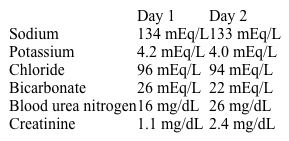 Urine sediment microscopy reveals muddy brown casts. Which of the following renal structures are most likely to demonstrate signs of ischemic injury?
 (Multiple Choice)
4.8/5 (70)
(70) A 65-year-old man comes to the emergency department 1 hour after a loss of consciousness. His wife said he suddenly fainted while she was adjusting his necktie. He regained consciousness within 30 seconds and was fully alert and oriented. He has had two similar episodes in the last year. His temperature is 37.2°C (98.9°F), pulse is 70/min and regular, respirations are 13/min, blood pressure is 130/82 mm Hg when supine and 122/80 mm Hg while standing. Physical examination reveals no heart murmurs or carotid bruits. ECG shows normal sinus rhythm. The patient is given an ambulatory ECG monitoring device. During symptomatic episodes, the device is most likely to show which of the following?
(Multiple Choice)
4.8/5 (80)
(80) A 70-year-old man comes to the emergency room for worsening leg pain and a rash consistent with wet gangrene. He has no history of skin infections but has type 2 diabetes mellitus and has smoked 2 packs of cigarettes daily for 20 years. Three days after admission, he becomes increasingly hypoxic and tachypneic. Endotracheal intubation is performed for respiratory support. Despite aggressive resuscitation, the patient dies 24 hours later. Autopsy examination of the lungs shows protein-rich fluid within the alveolar airspaces. Breakdown of the barrier formed by which of the following cells most likely contributed to this patient's pulmonary pathology?
(Multiple Choice)
4.8/5 (76)
(76) A 6-year-old girl is brought to the office by her mother due to a concern about her rapid growth. She is the tallest student in her class. Physical examination reveals Tanner Stage 3 breast development and coarse pubic hair. The child's height is in the 96th percentile. You explain to her mother that, although this girl is very tall now, she will ultimately be shorter than average if she does not get treatment. Which of the following is the physiologic explanation for the information you provided?
(Multiple Choice)
4.7/5 (87)
(87) A 68-year-old man is admitted to the intensive care unit after open abdominal aortic aneurysm repair. The patient has received 4 units of packed red blood cells during the surgery. During the first 24 hours following the procedure, he has only passed 200 mL of urine. He has congestive heart failure and hypertension. Laboratory results reveal elevated blood urea nitrogen. The patient is given aggressive intravenous fluid hydration. After 24 hours of therapy, urine output is increased and blood urea nitrogen declines toward normal. Which of the following additional laboratory abnormalities suggests that this patient's initial oliguria is a compensation for volume contraction?
(Multiple Choice)
4.7/5 (79)
(79) What is the most likely valve abnormality in this patient?
(Multiple Choice)
4.8/5 (69)
(69) A 32-year-old lady is examined for right flank discomfort and a noticeable lump. Imaging tests show that the right kidney is producing a sizable mass, while the left kidney is producing comparable but smaller masses. The picture below shows a cross section of the specimen after surgery to remove the right kidney and tumor on the right side. 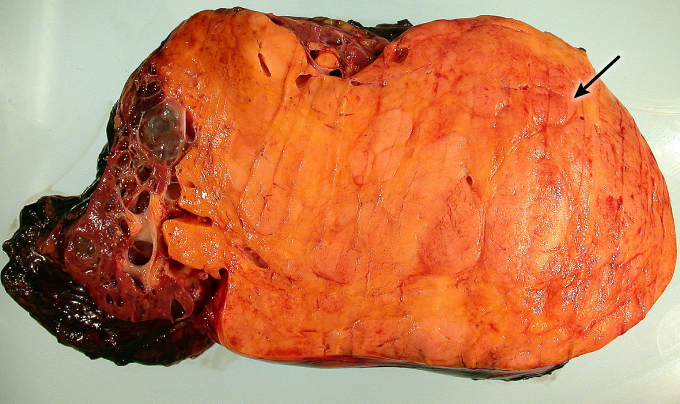 A histopathologic analysis reveals that the bulk is made up of blood vessels, smooth muscle, and fat. Which additional discovery is most likely present in this patient?
 (Multiple Choice)
4.8/5 (57)
(57) 
Filters
- Essay(0)
- Multiple Choice(0)
- Short Answer(0)
- True False(0)
- Matching(0)