



 Chat with AI
Exam 10: Pathology

Exam 1: Anatomy265 Questions
Exam 2: Behavioral Sciences178 Questions
Exam 3: Biochemistry102 Questions
Exam 4: Embryology59 Questions
Exam 5: Epidemiology, Biostatistics, and Medical Informatics94 Questions
Exam 6: Genetics88 Questions
Exam 7: Histology46 Questions
Exam 8: Immunology147 Questions
Exam 9: Microbiology and Virology330 Questions
Exam 10: Pathology817 Questions
Exam 11: Pharmacology and Toxicology509 Questions
Exam 12: Physiology339 Questions
Exam 13: Psychiatry and Psychotherapy23 Questions
Select questions type


A 65-year-old woman who experienced syncope after standing for a long time is currently being assessed. She used to work out at the neighborhood gym, but now she has trouble staying awake. The patient occasionally passes black stools. Due to "low appetite," she has lost 5 kg (11 lb) in the last few weeks. She doesn't smoke, drink, or use illegal substances. There is no family history of cancer. Orthostatic hypotension is modest, according to vital signs. Physical examination is uneventful, however occult blood in the stool is detectable. Two polyps are found during coloscopy. One polyp has advanced adenomatous alterations, and the other has adenocarcinoma, according to the pathology report. A mutation in which of the following genes is most likely responsible for the transformation from advanced adenoma to adenocarcinoma in this patient?
(Multiple Choice)
4.9/5  (68)
(68) A 28-year-old woman, gravida 1 para 0, comes to the office for an initial prenatal visit. The patient has had no vaginal bleeding or abdominal pain and has not yet felt fetal movement. Menarche occurred at age 13. She sometimes has heavy menstrual bleeding with passage of clots, and other times she skips her menses. The patient's estimated gestational age based on her last menstrual period is 16 weeks. She has type 1 diabetes mellitus that is controlled with insulin. She smokes a pack of cigarettes daily. As part of her prenatal laboratory screening, a second-trimester maternal serum quadruple screen is performed and reveals an elevated alpha-fetoprotein level. Which of the following is the most likely etiology of this patient's abnormal screening result?
(Multiple Choice)
4.9/5 (64)
(64) A 51-year-old woman comes to the physician because of fatigue and progressive pain and stiffness in her hands for the past 3 months. She used to play tennis but stopped 1 month ago because of difficulties holding the racket and her skin becoming "very sensitive to sunlight." Her last menstrual period was 1 year ago. She has diabetes mellitus controlled with insulin. She does not smoke or drink alcohol. Vital signs are within normal limits. Physical examination shows generalized hyperpigmentation. The second and third metacarpophalangeal joints of both hands are tender to palpation and the range of motion is limited. Which of the following is the most likely diagnosis?
(Multiple Choice)
4.9/5 (94)
(94) A 65-year-old man visits the office because he has skin lesions on his back. He initially saw the marks five years ago and claims that they are getting increasingly common. The lesions are occasionally itchy, but typically are asymptomatic. The patient had previously declined evaluation because he "didn't care about them," but arranged an appointment today at the demand of his wife. The patient's medical history includes hypertension, hyperlipidemia, and type 2 diabetes mellitus. There are several pigmented plaques on inspection, as illustrated in the photograph below. 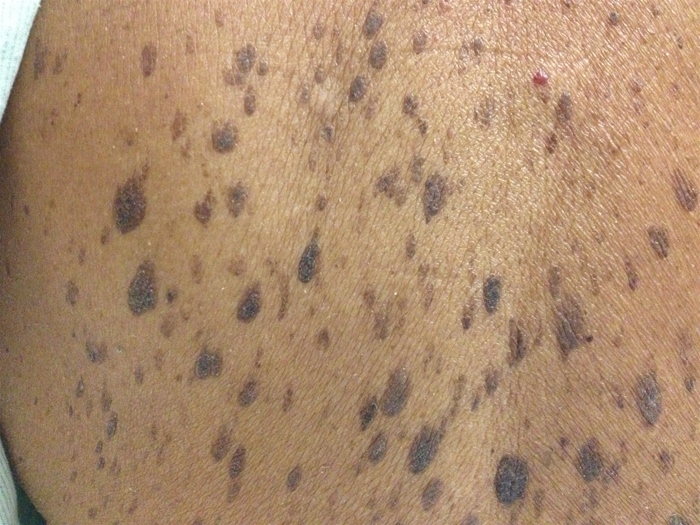 Which of the following is the most likely diagnosis?
 (Multiple Choice)
4.8/5 (70)
(70) At autopsy, the heart of an 80-year-old man has a small left ventricular cavity and thickening of the left ventricle walls, which measure 1.7 cm (normal: 0.7-1.1) at the posterior and septal wall locations. Microscopic examination shows diffusely enlarged cardiomyocytes, with prominent nuclei evident at low power. Increased expression of which of the following substances most likely contributed to these pathologic findings?
(Multiple Choice)
5.0/5 (84)
(84) A 26-year-old man presented to the office complaining of jaw pain while chewing food. The pain has been present for the last 6 months. The patient has been complaining of ear pain and decreased hearing in the left ear. His girlfriend noticed that he is grinding on his teeth while sleeping. Physical examination shows decreased ability to open the mouth fully, and pain during jaw movements. Otoscopic examination is clear without any findings. Involvement of which of the following nerves could explain the patient's symptoms?
(Multiple Choice)
5.0/5 (71)
(71) 45-year-old woman comes to the physician because of a 1-year history of episodic abdominal cramps, and loose stools. She has had a 4-kg (8-lb 12-oz) weight loss during this period despite no changes in appetite. Examination of the abdomen shows no abnormalities. The patient eats a balanced diet that includes a variety of fruits and vegetables, meats, whole grains, and dairy products. Serum chemistry panel, complete blood count, and thyroid function tests are normal. Which of the following is the best next step for assessing for impaired nutrient absorption in this patient?
(Multiple Choice)
4.9/5 (64)
(64) A 70-year-old woman comes to the physician for the evaluation of loss of urine for the last several months. She loses small amounts of urine without warning after coughing or sneezing. The patient has type 2 diabetes mellitus and was recently diagnosed with chronic obstructive pulmonary disease after evaluation for a chronic cough. Her only surgeries were 2 cesarean deliveries in her 20s. BMI is 30 kg/m2. Pelvic examination shows leakage of urine from the urethra during the Valsalva maneuver. Postvoid residual volume and urinalysis are normal. Which of the following is the most likely cause of this patient's clinical presentation?
(Multiple Choice)
4.8/5 (70)
(70) A 62-year-old man is examined because his cough, breathlessness, and episodic hemoptysis have gotten worse during the previous six months. In the same time frame, the patient also lost 15 kg (33 lb) of weight without changing his diet or level of activity. He has smoked 50 packs a year for the past 50 years, but he doesn't drink or use drugs. 18 kg/m2 is the BMI. The patient displays temporal wasting, widespread loss of muscular mass, and cachectic appearance. Chest x-ray reveals a large lung mass with mediastinal lymphadenopathy and pleural effusion. Which of the following cellular processes is most likely responsible for this patient's muscle loss?
(Multiple Choice)
4.8/5 (73)
(73) A 57-year-old woman is brought to the office due to a history of persistent vertigo and nausea. She has been unable to walk due to dizziness and has vomited once since this morning. She has no history of similar symptoms and no recent trauma. Physical examination reveals stability in the Romberg position and during tandem walk. Proprioception is intact. Dysfunction of which of the following structures best explains this patient's symptoms?
(Multiple Choice)
4.9/5 (80)
(80) A 30-year-old man is evaluated in the office due to tinnitus for the last month. He complains of diminished hearing in his right ear. He did not have any recent trauma or ear infection. Otoscopic examination is normal. The hearing function is decreased on the right side. Physical examination shows facial muscles weakness on the right side, diminished sensation, and absent corneal reflex. The patient's presentation is suggested by a tumor found in which of the following locations?
(Multiple Choice)
4.9/5 (74)
(74) A 36-year-old man comes to the emergency department because of nausea and shortness of breath that started 1 hour ago. He also reports lightheadedness that started earlier in the day. He has type 2 diabetes mellitus, for which he takes metformin and sitagliptin. He has smoked 1 pack of cigarettes daily for 20 years. Temperature is 38.1 C (100.6 F), blood pressure is 180/106 mm Hg in the right arm and 182/104 mm Hg in the left arm, pulse is 110/min, and respirations are 20/min. Physical examination shows bilaterally dilated pupils, normal heart and lung sounds, and a nontender abdomen. ECG shows sinus tachycardia with ST-segment depression in the precordial leads. Cardiac enzymes are normal. Sublingual nitroglycerin and benzodiazepine therapy relieve the symptoms. Which of the following is the most likely cause of this patient's chest pain?
(Multiple Choice)
4.9/5 (74)
(74) A 34-year-old woman comes to the emergency department because of a sudden midsternal chest pain, shortness of breath, and cough with bloody sputum for the past 3 hours. She is admitted to the intensive care unit but dies despite treatment efforts. Lung autopsy findings are shown in the image below. 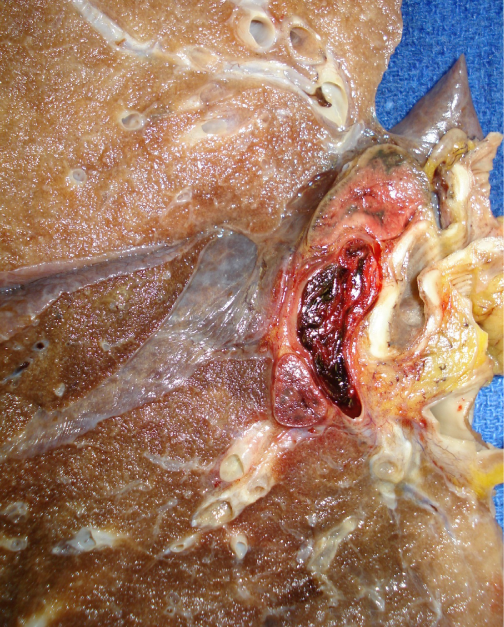 Which of the following is the most likely inciting event that led to this patient's death?
 (Multiple Choice)
4.9/5 (86)
(86) A 35-year-old guy who first observed nontender cervical lymphadenopathy while shaving is currently undergoing evaluation. Following a biopsy, the histology of the lymph nodes may be seen in the low-magnification picture below. 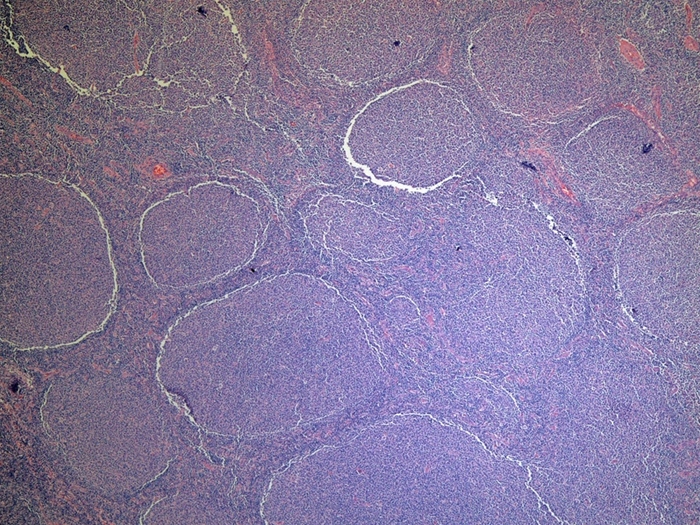 Which of the following patterns would be most likely to be seen using cytogenetic analysis?
 (Multiple Choice)
4.8/5 (81)
(81) A 60-year-old woman comes to the emergency department due to left flank pain radiates to the left groin. Medical history is significant for recurrent urinary tract infections and hypothyroidism. Blood pressure is 130/80 mm Hg and pulse is 80/min. Physical examination shows left flank tenderness. Which of the following recommendations would most likely prevent a recurrence of this patient's condition?
(Multiple Choice)
4.8/5 (92)
(92) A 65-year-old man arrives at the emergency department after experiencing acute, severe right flank pain, nausea, and vomiting for the past hour. Prostate cancer and membranous nephropathy are among his medical conditions. The blood pressure is 148/60 mm Hg, and the pulse rate is 95 beats per minute. The patient appears to be in moderate pain and diaphoretic on physical examination. There is tenderness at the right costovertebral angle. Urinalysis reveals hematuria. A contrast-enhanced CT scan of the right kidney reveals a wedge-shaped perfusion defect. The affected renal tissue is most likely to develop which of the following histologic changes over the next several days?
(Multiple Choice)
4.7/5 (94)
(94) A 25-year-old woman comes to the hospital for the evaluation of blindness in her right eye that suddenly started 1 hour ago. She has no feeling of pain, pressure, or sensation of a foreign body in the right eye. She has a history of major depressive disorder treated with fluoxetine. She does not use tobacco, alcohol, or illicit drugs. She appears anxious. Her vital signs are within normal limits. Ophthalmologic examination shows a normal-appearing eye with no redness. Slit-lamp examination and fundoscopy show no abnormalities. A visual field test shows nonspecific visual field defects. An MRI of the brain shows no abnormalities. Which of the following is the most likely diagnosis?
(Multiple Choice)
4.8/5 (98)
(98) A 32-year-old woman comes to the physician because of flank pain, myalgia, and reddish discoloration of her urine for the past 2 days. She is otherwise healthy and has no history of serious illness. Her younger sister has sickle cell disease. Her temperature is 37.9°C (100.2°F), pulse is 70/min, and blood pressure is 128/75 mm Hg. Physical examination shows a soft abdomen and no costovertebral angle tenderness. . There is a faint maculopapular rash over the trunk and extremities. Serum creatinine is 2.4 mg/dL. Which of the following is the most likely cause of this patient's hematuria?
(Multiple Choice)
4.9/5 (80)
(80) A 75-year-old man is sent to the emergency room after experiencing left-sided chest discomfort and dyspnea for two hours. Since suffering from right-sided hemiplegia, hemi-sensory loss, and aphasia four months ago, the patient has resided in a nursing home. He has a history of hypertension, diabetes mellitus, and high cholesterol. The patient goes into ventricular fibrillation when an ECG is being taken, and despite efforts to revive him or her, he or she passes away. The picture below depicts a coronal slice of the brain following an autopsy. 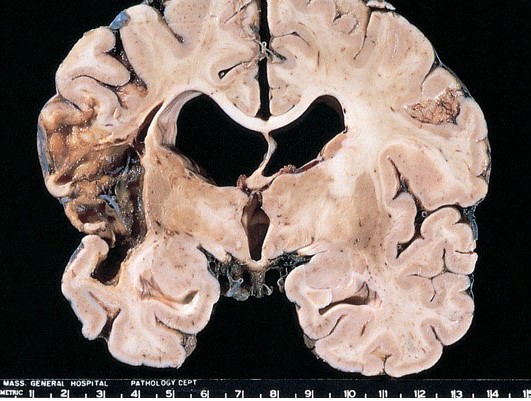 The walls of the brain lesion are most likely composed of which of the following?
 (Multiple Choice)
4.8/5 (89)
(89) A 32-year-old woman comes to the physician because of weight gain, generalized weakness, and irregular menstrual cycles for the past 6 months. More recently, she has been having difficulties rising from a chair. She has a 2-year history of hypertension. Current medication is hydrochlorothiazide. She is 168 cm (5 ft 6 in) tall and weighs 100 kg (220 lb). BMI is 36 kg/m2. Her pulse is 92/min, respirations are 18/min, and blood pressure is 134/76 mm Hg. She appears tired and has a full, plethoric face and central obesity. Which of the following sets of laboratory findings are most likely to be seen in this patient? 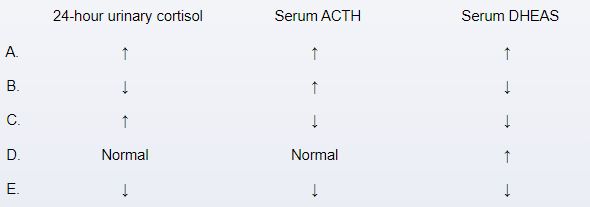
(Multiple Choice)
4.7/5 (73)
(73) 
Filters
- Essay(0)
- Multiple Choice(0)
- Short Answer(0)
- True False(0)
- Matching(0)