



 Chat with AI
Exam 10: Pathology

Exam 1: Anatomy265 Questions
Exam 2: Behavioral Sciences178 Questions
Exam 3: Biochemistry102 Questions
Exam 4: Embryology59 Questions
Exam 5: Epidemiology, Biostatistics, and Medical Informatics94 Questions
Exam 6: Genetics88 Questions
Exam 7: Histology46 Questions
Exam 8: Immunology147 Questions
Exam 9: Microbiology and Virology330 Questions
Exam 10: Pathology817 Questions
Exam 11: Pharmacology and Toxicology509 Questions
Exam 12: Physiology339 Questions
Exam 13: Psychiatry and Psychotherapy23 Questions
Select questions type


A 40-year-old woman comes to the physician because of a 1-month history of tingling in her feet and poor balance. Her only medical problem is hypothyroidism for which she takes levothyroxine. Physical examination shows conjunctival pallor and an ataxic gait. Proprioception and sense of vibration are decreased in her toes bilaterally. Physical examination shows mild conjunctival pallor.Laboratory results are as follows: 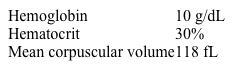 Further evaluation shows a very low vitamin B12 level and a normal folate level. Which of the following sets of physiologic alterations is most likely to be present in this patient?
 (Multiple Choice)
4.8/5  (73)
(73) A 63-year-old man is subjected to a sleep study in which he is closely monitored for the duration of the night. Several physiologic parameters are continuously recorded, including oxygen saturation, heart rhythm, cerebral electrical activity, respiratory airflow, and movements of the chest and upper abdominal walls. The graph below depicts a recording obtained over several minutes: 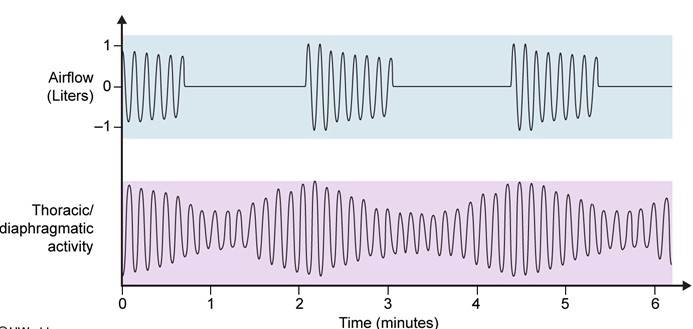 Which of the following is the most likely cause of the observed findings?
 (Multiple Choice)
4.8/5 (82)
(82) A 45-year-old woman arrives at the office complaining of persistent back pain after two weeks. Over the past few months, she has also experienced severe exhaustion, anorexia, and unintended weight loss. Although the patient has no prior medical issues, there is a family history of cancer. The T10 vertebral body has a lytic lesion, according to imaging studies. The biopsy sample's analysis reveals a cell lineage with abnormally high propensity for replication. An activating mutation is caused by a single nucleotide alteration, according to genetic studies. Which of the following genes is most likely involved in this patient's disease?
(Multiple Choice)
4.8/5 (69)
(69) A 33-year-old man comes to the emergency department because of repeated episodes of severe headache for the past 3 days. He is currently having his 2nd episode of the day. He usually has his first episode in the mornings. The pain is severe and localized to his right forehead and right eye. He had similar symptoms last summer. Physical examination shows drooping of the right eyelid, tearing of the right eye, and rhinorrhea. Which of the following is the most likely cause of this patient's current symptoms?
(Multiple Choice)
4.9/5 (64)
(64) A 54-year-old man comes to the hospital due to acute-onset right flank pain associated with nausea. Five years ago, the patient had nephrolithiasis; the renal calculi passed spontaneously with intravenous fluids. Review of systems is positive for occasional palpitations. Other medical problems include hypertension, obesity, and obstructive sleep apnea. Temperature is 38 C (100.4 F), blood pressure is 170/98 mm Hg, pulse is 90/min, and respirations are 18/min. Cardiopulmonary examination shows no abnormalities. Right flank tenderness is present. Urinalysis demonstrates 2+ red blood cells and no white blood cells or protein. A representative kidney specimen is shown below: 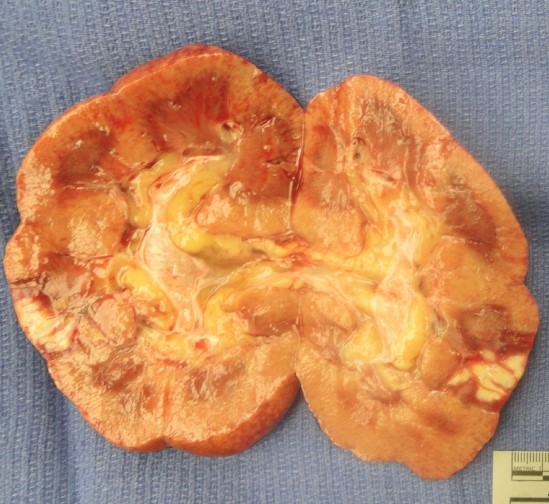 Which of the following is the most likely diagnosis?
 (Multiple Choice)
4.9/5 (98)
(98) A 32-year-old woman comes to her physician due to severe pain in the posterior aspect of the right foot that interferes with walking. She also has an increasing back pain for the past 10 months. The pain is worse in the morning when she wakes up and improves with activity. She used to practice yoga, but stopped 5 months ago as bending forward became increasingly difficult. She has also had bilateral hip pain for the past 4 months. She has not had any change in urination. Which of the following is the most probable location of the pathologic process responsible for this patient's foot pain?
(Multiple Choice)
4.8/5 (87)
(87) A 58-year-old man comes to the office due to urinary symptoms. Over the past year, he has had difficulty initiating urination and a weakened urine stream. He also has frequent nocturnal voiding. The patient has not passed any visible blood clots and has had no dysuria, fever, recent illnesses, or urinary trauma. He has no other medical conditions and takes no medications. Vital signs are within normal limits. He is a business management consultant and motivational speaker. Vital signs are normal. BMI is 27 kg/m2. The patient's kidneys are most likely to demonstrate which of the following findings?
(Multiple Choice)
4.9/5 (81)
(81) A 20-year-old man comes to the office due to occasional palpitations. He describes them as "skipped beats." He has no chest pain or shortness of breath. Medical history is unremarkable. On physical examination, he has wide, fixed splitting of the second heart sound (S2). No murmurs are heard. Chest x-ray reveals enlargement of the right heart contour. Echocardiogram is consistent with a congenital heart defect. Repair of this patient's congenital disease is aimed at preventing irreversible changes to which of the following?
(Multiple Choice)
4.9/5 (68)
(68) A 17-year-old girl is brought to the physician for the evaluation of fatigue for the past 6 months. During this period, she has had a 5-kg (11-lbs) weight loss. She states that she has no friends. When she is not in school, she spends most of her time in bed. She has no history of serious illness. Her mother has major depressive disorder. She appears pale. Her BMI is 19 kg/m2. Her temperature is 37.0°C (98.6°F), pulse is 65/min, and blood pressure is 110/70 mm Hg. Examination shows dry skin, brittle nails, and calluses on the knuckles. The remainder of the examination shows no abnormalities. Laboratory studies show: 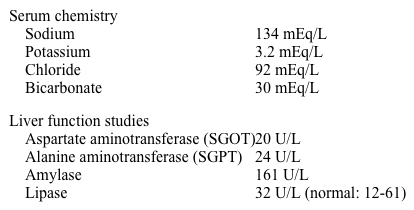 Which of the following is the most likely cause of this patient's condition?
 (Multiple Choice)
5.0/5 (82)
(82) A 64-year-old woman comes to her nephrologist for a regular follow-up appointment. The patient's medical problems include diabetes mellitus for 20 years and stage IV chronic kidney disease with a glomerular filtration rate <30 mL/min. She takes daily insulin and has made lifestyle modifications. Recently, her blood glucose has been well controlled. The patient's other medical problems include hypertension and dyslipidemia, which are controlled with medication. Her BMI is 27 kg/m2. Cardiopulmonary examination is normal. Lower extremity examination shows trace bilateral edema and 2+ pulses. This patient is at greatest risk for which of the following long-term complications of her renal disease?
(Multiple Choice)
4.8/5 (82)
(82) A 42-year-old woman is brought to the hospital because of difficulty breathing and progressive palpitation. Despite the emergency team intervention, she dies. She had a history of atrial fibrillation treated with anticoagulation therapy. Autopsy reveals a large epidural hemorrhage with brain herniation; spinal cord evaluation reveals symmetric myelin layer vacuolization and axonal degeneration involving the posterior columns and the lateral corticospinal tracts. Which of the following is the most likely cause of this patient's spinal cord findings?
(Multiple Choice)
5.0/5 (85)
(85) A 23-year-old woman comes to the physician because of a 3-day history of increasing pain and swelling of her hands and wrists. She has been unable to continue her daily activities like writing or driving. She has had a nonpruritic generalized rash for 4 days. She had a fever and a runny nose one week ago which resolved with over-the-counter medication. She is sexually active with a male partner and uses condoms inconsistently. She works as an attendant at an amusement park. Her temperature is 37.1°C (98.8°F), pulse is 90/min, and blood pressure is 118/72 mm Hg. Examination shows swelling and tenderness of the wrists as well as the metacarpophalangeal and proximal interphalangeal joints. Range of motion of the wrists is limited. A lacy macular rash is noted over the trunk and extremities. The remainder of the examination shows no abnormalities. Laboratory studies, including erythrocyte sedimentation rate and antinuclear antibody and anti-dsDNA serology, show no abnormalities. Which of the following is the most likely diagnosis?
(Multiple Choice)
4.8/5 (73)
(73) A 5-week-old infant born at 32 weeks' gestation is receiving care in the neonatal intensive care unit. Cardiopulmonary examination shows a grade 4/6 continuous murmur heard best at the left infraclavicular area. Echocardiography reveals a patent ductus arteriosus and a dilated left atrium. During surgical ligation of the ductus arteriosus, the surgeons perform a left-sided thoracotomy, visualize the ductus, and place a small metal clamp across the vessel. Which of the following changes is most likely to take place immediately after ligation?
(Multiple Choice)
5.0/5 (77)
(77) A 45-year-old man comes to the physician because of numbness and tingling in his fingers and toes for the past month. He also describes difficulty with balance while walking. For the past 5 years, he eats only vegetables, fruits, and grains. Medical history is unremarkable. The patient takes no medications or nutritional supplements. He does not use tobacco or alcohol. his patient is at increased risk for deficiencies of which of the following nutrients? 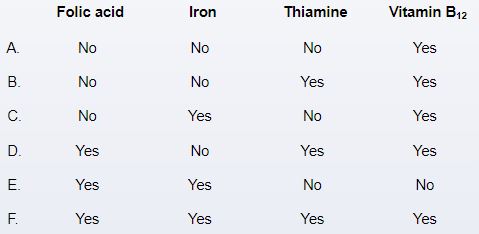
(Multiple Choice)
4.8/5 (81)
(81) A 65-year-old man comes to the physician because of several-month history of progressive fatigue and abdominal pain. The patient has not seen a physician for many years. He does not use tobacco, alcohol, or illicit drugs. Physical examination shows pale mucous membranes and splenomegaly. Hemoglobin concentration is 9.1 g/dL and leukocyte count is 3,400/mm3. Peripheral blood smear shows nucleated red blood cells and teardrop poikilocytosis. Bone marrow aspiration is attempted but yields no marrow. Which of the following histopathological features is most likely to be present in this patient's spleen?
(Multiple Choice)
4.9/5 (73)
(73) A 16-year-old boy is brought to the physician by his parents because they are worried about his behavior. For the past year, he has been setting mail boxes on fire in their neighborhood. Three months ago, he brought a box of matches to school and threatened to burn down a classroom. His father says, "We've tried everything, but he won't listen to us anymore. The last straw was when he broke into someone's car yesterday and stole a laptop!" The patient has no history of serious illness and takes no medications The patient does not smoke cigarettes. He drinks one to three beers on weekends. He has experimented with cocaine but has never used intravenous drugs. On mental status examination, he has an angry mood and anxious affect. He is fully oriented. Which of the following is the most likely diagnosis in this patient?
(Multiple Choice)
4.8/5 (75)
(75) A 40-year-old man comes to the physician because of fever, cough productive of foul-smelling sputum and increasing shortness of breath. He was hospitalized for alcohol intoxication twice over the past 6 months. He has smoked one pack of cigarettes daily for 20 years and drinks 6 alcoholic beverages daily. He appears malnourished. Temperature is 39 C (102.2 F), blood pressure is 114/62 mm Hg, and pulse is 116/min. Physical examination reveals crackles in the right lower lung. Repeat chest x-ray reveals a round density with an air-fluid level in the lower lobe of the right lung. Which of the following is the most important contributor to the observed lung lesion in this patient?
(Multiple Choice)
4.8/5 (89)
(89) A 2-day-old male newborn is brought to the emergency department by his mother because of irritability and vomiting for two hours. During this period, he has vomited dark green emesis three times. He has not yet passed stool. He was born via normal spontaneous vaginal delivery at 39 weeks gestation to a primigravid mother. The mother has breastfed the newborn every two hours. The abdomen is distended. Digital rectal examination shows no abnormalities. An x-ray of the abdomen with contrast shows dilated small bowel loops, a microcolon, a mixture of gas and meconium located in the right lower quadrant. Contrast enema fails to relieve the obstruction, and the patient is taken for emergency laparotomy, which shows an inspissated, green fecal mass obstructing the distal ileum. The infant recovers from the surgery uneventfully. Which of the following will be the most likely cause of mortality in this patient?
(Multiple Choice)
4.8/5 (91)
(91) A 75-year-old man is discovered unconscious in his home. The neighbor summons emergency medical services, but the patient is pronounced dead at the scene. The patient had a history of hypertension, type 2 diabetes, and coronary artery disease, as well as a smoking history of 25 packs per year. He used to work in a coal mine and retired as an auto mechanic 15 years ago. An autopsy is performed; below is a section of lung tissue stained with hematoxylin and eosin. 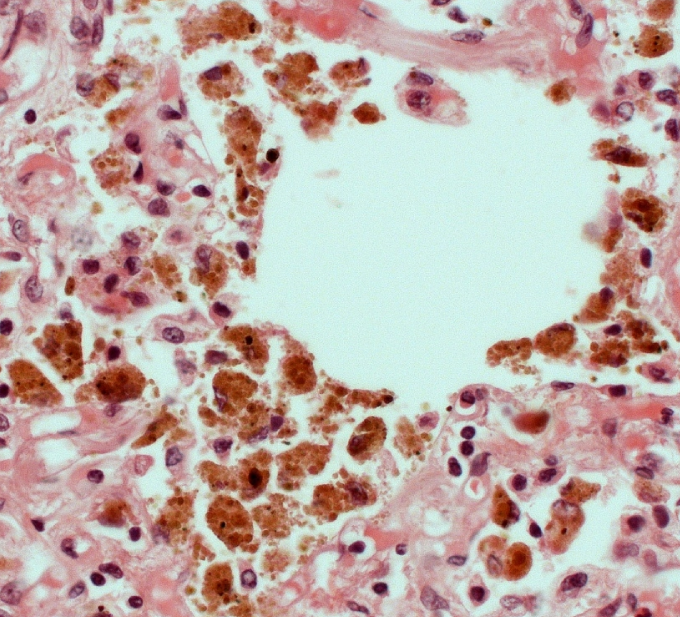 Which of the following is the most likely cause of this patient's abnormal histopathology findings?
 (Multiple Choice)
4.8/5 (78)
(78) A previously healthy 30-year-old woman comes to the physician because of a 6-month history of a recurring rash on her face, arms, and hands. She has also noticed several ulcers in her mouth. She is sexually active with one male partner and they use condoms inconsistently. Her mother has end-stage renal disease. The patient does not smoke or drink alcohol. Her vital signs are within normal limits. Physical examination shows an erythematous rash across the cheeks and extensor surface of the arms and hands as shown in the image below. . There are three small ulcers on the hard palate. 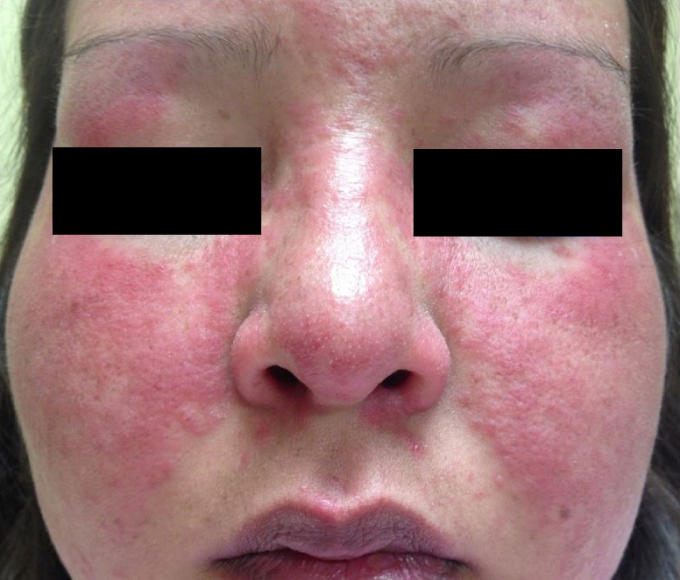 Which of the following laboratory findings is most likely to be seen in this patient's condition?
 (Multiple Choice)
4.7/5 (84)
(84) 
Filters
- Essay(0)
- Multiple Choice(0)
- Short Answer(0)
- True False(0)
- Matching(0)