



 Chat with AI
Exam 10: Pathology

Exam 1: Anatomy265 Questions
Exam 2: Behavioral Sciences178 Questions
Exam 3: Biochemistry102 Questions
Exam 4: Embryology59 Questions
Exam 5: Epidemiology, Biostatistics, and Medical Informatics94 Questions
Exam 6: Genetics88 Questions
Exam 7: Histology46 Questions
Exam 8: Immunology147 Questions
Exam 9: Microbiology and Virology330 Questions
Exam 10: Pathology817 Questions
Exam 11: Pharmacology and Toxicology509 Questions
Exam 12: Physiology339 Questions
Exam 13: Psychiatry and Psychotherapy23 Questions
Select questions type


A 55-year-old woman with acute onset renal failure is evaluated on the ward. She presented with acute abdominal pain. Her abdominal pain was not proportionate to her physical examination findings. Therefore, she was sent for angiography which confirmed the diagnosis of acute mesenteric ischemia. Today, she was reported to have elevated blood urea nitrogen and serum creatinine levels. The patient does not complain of fever, dyspnea, or palpitations. She has stable vital signs. Physical examination shows no new findings. Which of the following pathologic findings is most likely present in this patient?
(Multiple Choice)
4.8/5  (78)
(78) A 67-year-old man presented to the emergency with right-sided weakness. The patient has a history of hypertension. The patient was diagnosed with atrial fibrillation 3 years ago, but he did not seek medical advice, nor did he take any medication. On physical examination, BP 165/100 mm Hg and pulse are 150/min and irregular. On physical examination, he has right-sided hemiparesis, with a right-sided facial droop. Brain CT scan of the patient confirmed the diagnosis of ischemic stroke, with no evidence of hemorrhage. The stroke is believed to be caused by an embolic event that originated in?
(Multiple Choice)
4.7/5 (91)
(91) A 52-year-old woman comes to the emergency department because of epigastric abdominal pain that started after her last meal and has become progressively worse over the past 6 hours. She has had intermittent pain similar to this before, but it has never lasted this long. Her temperature is 39°C (102.2°F). Examination shows a soft abdomen with normal bowel sounds. The patient has sudden inspiratory arrest during right upper quadrant palpation. Laboratory assessment shows a serum bilirubin of 0.8 mg/dL and a serum alkaline phosphatase of 100 U/L. Which of the following diagnostic test results would be most specific for acute cholecystitis?
(Multiple Choice)
4.9/5 (83)
(83) A 65-year-old man arrives at the clinic for a normal visit with a history of hypertension and type 2 diabetes mellitus. The patient had smoked 15 packs over the course of 15 years. He runs three miles each day. 28.5 kg/m2 is the BMI. History of the family is unremarkable. Below are the auscultation results above the heart apex. The auscultation findings are best explained by which of the following?
(Multiple Choice)
4.9/5 (71)
(71) A research scientist injects hepatocellular carcinoma cells into the liver parenchyma of an experimental guinea pig. Serial observations show that the tumor cells progressively proliferate and invade the liver parenchyma to form a large mass. After some time, malignant cells begin to penetrate the vascular basement membrane to gain access to the circulation During the process of basement membrane invasion, expression of which of the following substances is most likely to be increased in the tumor cells?
(Multiple Choice)
4.9/5 (72)
(72) A 59-year-old guy arrives at the clinic complaining of back discomfort and three months of increased weariness. Back discomfort is mostly brought on by movement or changes in posture. Upon physical examination, the middle and lower backs are painful along the midline. According to a laboratory analysis, the serum calcium level is 12 mg/dL and the hemoglobin level is 10.2 g/dL. The results of a bone marrow aspiration are displayed below, along with the histopathological findings. 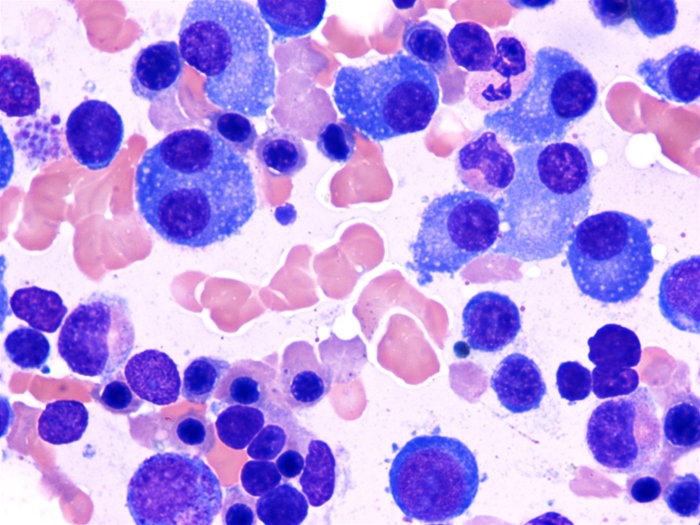 This patient is at greatest risk for developing which of the following conditions?
 (Multiple Choice)
4.9/5 (63)
(63) A 33-year-old man comes to the emergency department due to 3 days of shortness of breath, profound fatigue, and chills. The patient has a history of intravenous drug use. He was enrolled in a methadone program but admits to relapsing last week. Temperature is 40 C (104 F), blood pressure is 75/40 mm Hg, pulse is 122/min and regular, and respirations are 40/min. He is admitted to the intensive care unit but dies despite treatment efforts. Lung autopsy findings are shown in the image below. 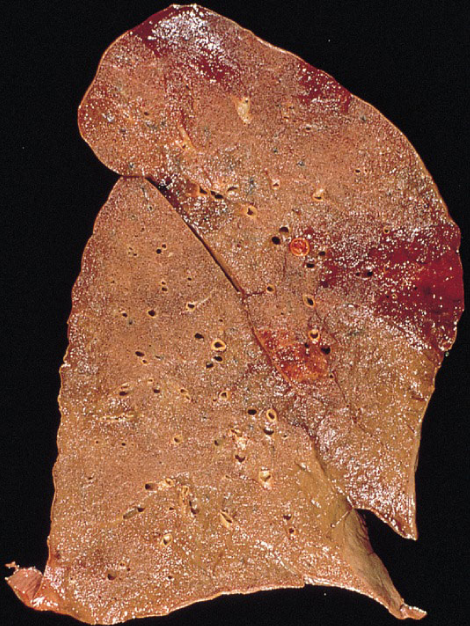 Which of the following is the most likely diagnosis in this patient?
 (Multiple Choice)
4.8/5 (81)
(81) A 1-month-old girl is brought to the physician because her mother has noticed that the girl's head is always tilted to the right. She appears healthy. She is at 60th percentile for length and weight. Examination shows the head tilted toward the right, and the chin rotated towards the left. Range of motion of the neck is limited. There is a palpable, firm, well-circumscribed mass in the right lower side of the neck. The remainder of the examination shows no abnormalities. Which of the following conditions was most likely present prenatally?
(Multiple Choice)
4.9/5 (82)
(82) A 55-year-old woman with rheumatoid arthritis comes to the physician because of a 3-month history of worsening fatigue and dyspnea. She has felt short-of-breath when walking up the stairs to her apartment. Menopause occurred 5 years ago. The patient appears chronically ill and has mucosal pallor. There are thick, white plaques over the buccal mucosa and soft palate. Anterior and posterior cervical lymphadenopathy is present. The lungs are clear to auscultation. The abdomen is soft and nontender. There is no organomegaly. Laboratory results are as follows: 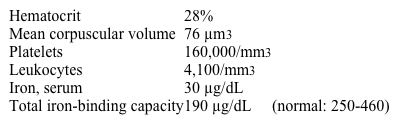 Which of the following is the most likely underlying cause of this patient's anemia?
 (Multiple Choice)
4.7/5 (81)
(81) A 76-year-old woman comes to the physician because of a 4-month history of increasing muscle pain and stiffness, weakness of her shoulders and legs, and generalized fatigue. She has been having great difficulty getting out of bed in the morning. On two occasions, her son had to come over and help her stand up. She has had a 4-kg (9-lb) weight loss and has not been sleeping well during this period. She has had multiple episodes of left-sided headaches and pain in the jaw while chewing over the past 2 months. Her temperature is 38.0°C (100.4°F), pulse is 101/min, and blood pressure is 128/88 mm Hg. Examination shows conjunctival pallor. Range of motion of the shoulder and hip is mildly limited by pain. Muscle strength in bilateral upper and lower extremities is normal. Deep tendon reflexes are 2+ bilaterally. Which of the following is the best initial test for this patient?
(Multiple Choice)
4.8/5 (95)
(95) A 52-year-old woman comes to the physician because of a 3-month history of pain and a burning sensation in both feet. The symptoms worsen when she tries to fall asleep at night. She has hypertension, type 2 diabetes mellitus, and chronic knee pain. Current medications are enalapril, hydrochlorothiazide, metformin, sitagliptin, and tramadol. She does not smoke, drink alcohol, or use illicit drugs. She is 165 cm (5 ft 5 in) tall and weighs 77 kg (170 lb); BMI is 28 kg/m2. Her temperature is 36.8°C (98.2°F), pulse is 78/min, and blood pressure is 130/84 mm. On physical examination, ankle reflexes are absent and sensation of joint position is decreased in the toes. Romberg sign is present. A lesion involving which of the following best explains this patient's findings?
(Multiple Choice)
4.9/5 (78)
(78) A 24-year-old woman comes to the physician because of intermittent episodes of stabbing facial pain for 4 months. The pain occurs over her left cheek, is 9 out of 10 in intensity, radiates towards her mouth, and lasts around half a minute before subsiding. These episodes commonly occur when she washes her face, brushes her teeth, or eats a meal. She does not have visual disturbances, weakness of her facial muscles, or hearing loss. She had a tooth extracted about 2 months ago, but the facial pain has persisted. She has hypothyroidism and vitiligo. Her mother has major depressive disorder. Current medications include levothyroxine and herbal cream. She appears anxious. Vital signs are within normal limits. Cardiopulmonary examination shows no abnormalities. Neurological examination shows no focal findings. Which of the following is the most likely cause of this patient's condition?
(Multiple Choice)
5.0/5 (85)
(85) A 60-year-old man is brought to the emergency department because of a 1-hour history of abnormal face shape. The patient has a history of hypertension, hyperlipidemia, and type 2 diabetes mellitus. Vital signs are within normal limits. Physical examination shows facial asymmetry with drooping of the left corner of the mouth and loss of the left nasolabial fold. Which of the following additional examination findings on the affected side would be most suggestive of central nervous system involvement?
(Multiple Choice)
4.8/5 (81)
(81) A 22-year-old woman comes the office due to 2 days of a burning sensation with urination. She had sexual intercourse with her partner last week and used a condom for contraception. She has also noticed scant vaginal discharge. The patient has never had these symptoms before. She has no chronic medical conditions, and she takes a combination oral contraceptive pill daily. A urine sample is obtained for urinalysis and culture. Which of the following additional findings would be most suggestive of a diagnosis of pyelonephritis?
(Multiple Choice)
4.9/5 (75)
(75) A 39-year-old man comes to the emergency department with anterior chest pain. He had felt well until the pain developed 4 days ago. The patient says the pain is sharp and makes it difficult to take a deep breath. Since yesterday, he has also felt out of breath. Medical history is unremarkable. The patient's father died of a heart attack at age 52, and his mother suffers from rheumatoid arthritis. He does not use alcohol or tobacco. Temperature is 37.4 C (99.3 F), blood pressure is 112/65 mm Hg, and pulse is 103/min and regular. Bedside ultrasound examination demonstrates a moderate pericardial effusion. Which of the following is the most likely cause of this patient's current condition?
(Multiple Choice)
4.7/5 (89)
(89) A 63-year-old man comes to the physician because of generalized fatigue and malaise for 2 months. He has been unable to engage in his daily activities. Three months ago, he was treated for a urinary tract infection with trimethoprim-sulfamethoxazole. He has hypertension, asthma, and chronic lower back pain. Current medications include hydrochlorothiazide, an albuterol inhaler, naproxen, and an aspirin-caffeine combination. Vital signs are within normal limits. Examination shows conjunctival pallor. The remainder of the examination shows no abnormalities. Laboratory results show blood counts within normal limits, blood urea nitrogen of 12 mg/dL, and serum creatinine of 2.0 mg/dL. Urinalysis reveals 1+ protein and 3-4 white blood cells/hpf. Renal ultrasound demonstrates bilateral shrunken and irregular kidneys with a few papillary calcifications. Which of the following is the most likely cause of this patient's renal dysfunction?
(Multiple Choice)
4.9/5 (65)
(65) A 64-year-old man gets examined because his cough and shortness of breath are getting worse. The patient has a history of type 2 diabetes mellitus and hypertension. He consumes alcohol sporadically and smokes a pack of cigarettes every day. Blood pressure is 140/82 mm Hg, temperature is 38 C (100.4 F), and pulse is 92 bpm. abnormal breath sounds are revealed by lung auscultation. Below is an x-ray of the chest. 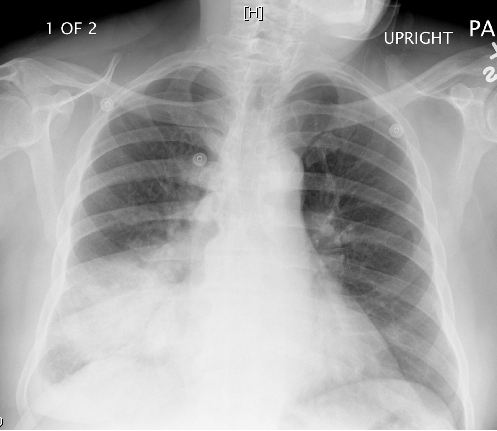 Which of the following is the most likely cause of the observed pulmonary findings in this patient?
 (Multiple Choice)
5.0/5 (85)
(85) A 65-year-old man is brought to the emergency department due to sudden loss of sensation in the left side of the body. The patient is knowns to have hypertension and diabetes mellitus. He has been smoking two packs of cigarettes for the last 20 years. Physical examinations show decreased touch, temperature, and vibratory sensation in the left side of the body and the face. The motor examination is normal. This patient is most likely having a stroke in which of the following structures?
(Multiple Choice)
4.8/5 (80)
(80) A 2-year-old boy is brought to the emergency department by his mother 1 hour following a seizure which stopped spontaneously after 1 minute. He was sleepy initially but is now awake and alert. His mother reports that he has had a fever and runny nose for the past 3 days. His temperature is 40.1°C (104.2°F). Physical examination shows no abnormalities. Analysis of his cerebrospinal fluid shows 3 cells/mm3, a glucose concentration of 68 mg/dL, and a protein concentration of 35 mg/dL. Which of the following is the most likely underlying cause of this patient's seizure?
(Multiple Choice)
5.0/5 (80)
(80) A 7-month-old boy is brought to the emergency department by his mother due to decrease his activity and difficult to awake him. Over the past 2 weeks, he has become increasingly irritable and within the past day has taken more daytime naps and appears much less responsive and interactive. His mother denies any history of fever or trauma at home. He appears lethargic. His temperature is 37.8°C (100.1°F), pulse is 140/min, respirations are 18/min, and blood pressure is 90/55 mm Hg. The abdomen is soft and nontender. Auscultation of the heart and lungs shows no abnormalities. The anterior fontanelle is tense and bulging. Fundoscopic examination shows bilateral retinal hemorrhage. Which of the following should be strongly suspected in this patient?
(Multiple Choice)
4.7/5 (87)
(87) 
Filters
- Essay(0)
- Multiple Choice(0)
- Short Answer(0)
- True False(0)
- Matching(0)