



 Chat with AI
Exam 10: Pathology

Exam 1: Anatomy265 Questions
Exam 2: Behavioral Sciences178 Questions
Exam 3: Biochemistry102 Questions
Exam 4: Embryology59 Questions
Exam 5: Epidemiology, Biostatistics, and Medical Informatics94 Questions
Exam 6: Genetics88 Questions
Exam 7: Histology46 Questions
Exam 8: Immunology147 Questions
Exam 9: Microbiology and Virology330 Questions
Exam 10: Pathology817 Questions
Exam 11: Pharmacology and Toxicology509 Questions
Exam 12: Physiology339 Questions
Exam 13: Psychiatry and Psychotherapy23 Questions
Select questions type


A 74-year-old woman arrives at the emergency department after experiencing left leg pain and numbness for two days. She has a history of atrial fibrillation and high blood pressure. Her left lower limb is palpably pale and cold below the knee. A left femoral embolectomy is performed after an arterial Doppler ultrasound reveals an occluding thrombus. The dorsalis pedis and posterior tibial pulses become palpable after the procedure. Several hours later, the patient complains of severe left calf pain. The left calf is swollen, tense, and tender on re-examination, and the pain worsens with dorsiflexion of the left foot. Distal pulses are also missing. The doctor suspects that the reperfused muscles were injured as a result of an excess of reactive oxygen species. Which of the following enzymes is most likely to help neutralize these toxic molecules?
(Multiple Choice)
4.9/5  (84)
(84) A 52-year-old lady arrives at the clinic complaining of pain when chewing and swallowing meals for the past two months. The woman did not seek therapy because she believed the lesions would resolve on their own, but they did not. There are erosions of the buccal and gingival mucosa on inspection, as illustrated in the figure below. Several flaccid bullae with erosions are strewn around her trunk. With pressure, the blisters develop laterally, and tension on seemingly uninvolved skin causes blistering. Autoantibodies against which of the following structures are most likely to blame for this process? 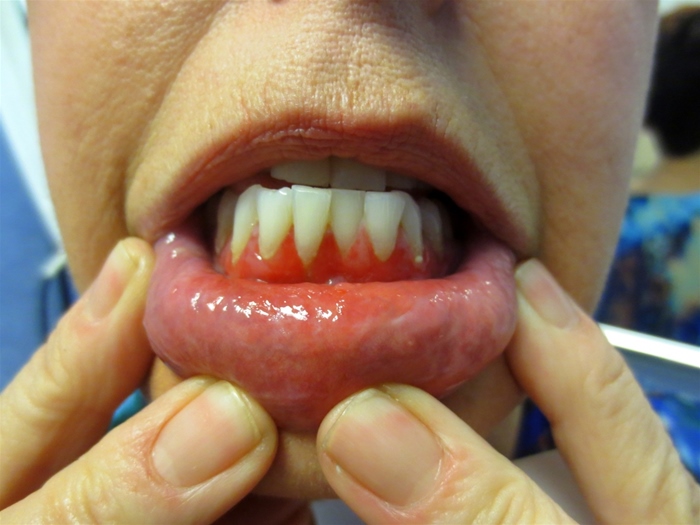
(Multiple Choice)
5.0/5 (86)
(86) A 45-year-old Caucasian female comes to the office due to progressive dyspnea. She also wears warm gloves indoors because her fingers turn blue when they are cold. She also complains of retrosternal burning and regurgitation, especially when supine. Cardiac examination reveals an accentuated S2 over the upper left sternal border. The abdomen is soft with mild hepatomegaly. Pulmonary function test results are as follows: 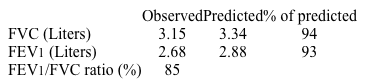 Which of the following is the most likely cause of this patient's dyspnea?
 (Multiple Choice)
5.0/5 (81)
(81) A 15-year-old boy is brought to the physician because of left-sided groin pain and difficulty walking for 3 weeks. He reports having pain at rest and increased pain with activity. He recently started playing flag football but does not recall any trauma. Medical history is significant for sickle cell disease. He is at the 25th percentile for height and 20th percentile for weight. His temperature is 37.0°C (98.6°F), pulse is 90/min, and blood pressure is 120/80 mm Hg. Examination shows tenderness over the lateral aspect of the left hip with no swelling, warmth, or erythema. There is a decrease in an active and passive internal and external rotation, extension, and abduction. Imaging of the hip is shown in the exhibit. 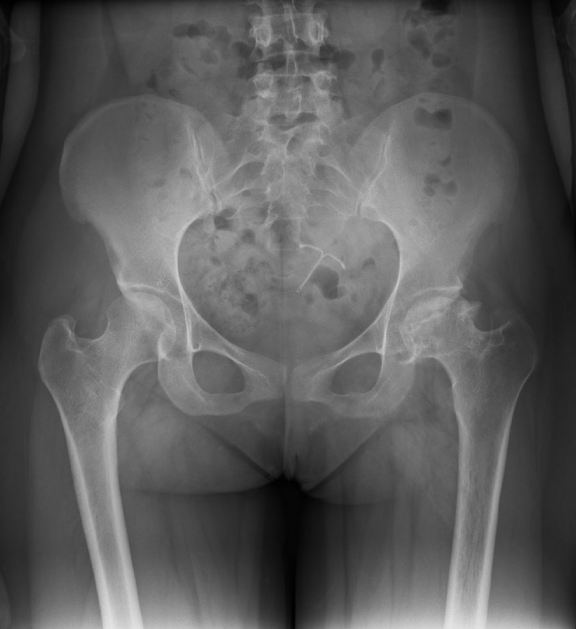 Which of the following is the most likely cause of this patient's pain?
 (Multiple Choice)
4.8/5 (83)
(83) A 42-year-old woman is admitted to the hospital after experiencing fever and chills following hemodialysis. The patient has a history of end-stage kidney disease caused by IgA nephropathy and has recently started intermittent dialysis via a tunneled catheter. She has a history of depression, for which she takes citalopram. The temperature is 38.4 C (101.1 F), the blood pressure is 130/80 mm Hg, and the pulse rate is 94 bpm. There is no erythema or tenderness at the catheter site, and the rest of the physical exam is normal. Blood cultures are taken, and an empiric course of vancomycin and ceftazidime is started. The patient reports a burning, itching sensation while receiving the intravenous vancomycin infusion. The vital signs remain unchanged, but a repeat examination reveals an erythematous rash on the face and neck. She reports no history of drug allergy but has never received these antibiotics. Which of the following is the most likely underlying cause of this patient's current condition?
(Multiple Choice)
4.9/5 (72)
(72) A 38-year-old woman is being evaluated because of pain and stiffness in both of her hands for the past 2 weeks. The pain is most severe early in the day and does not respond to ibuprofen. She has no other medical problems. Family history is significant for hypertension on her maternal side. Vital signs are within normal limits. Examination shows swelling and tenderness of the wrists and metacarpophalangeal joints bilaterally. Range of motion is decreased due to pain. There are subcutaneous, nontender, firm, mobile nodules on the extensor surface of the forearm. Autoantibodies against which of the following components are most specific for this patient's condition?
(Multiple Choice)
4.8/5 (73)
(73) A 29-year-old woman comes to the physician because of a 1-month history of headaches and fatigue. She also reports intermittent muscle cramping. She does not smoke cigarettes and drinks one to two beers on weekends. She is 171 cm (5 ft 7 in) tall and weighs 65 kg (143 lb); BMI is 22 kg/m2. Temperature is 36.5°C (97.7°F), pulse is 72/min, respirations are 12/min, and blood pressure is 177/90 mm Hg. Physical examination shows no abnormalities. Laboratory evaluation shows low plasma renin activity and normal serum creatinine levels. CT scan of the abdomen reveals a solitary, hypodense, 1.5-cm right adrenal mass. Which of the following patterns of serum electrolyte concentrations would most likely be seen in this patient? 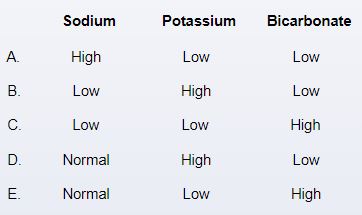
(Multiple Choice)
4.8/5 (91)
(91) A 68-year-old woman comes to the physician with increasing fatigue and shortness of breath for 2 weeks. She has only passed very small amounts of urine over the past few days. During this time, she has also noticed that her feet appear unusually puffy for a few hours every morning. She has a 6-month history of lower back and thoracic pain, for which she takes ibuprofen daily. Her only other medication is a laxative for constipation, which she first experienced 8 months ago. Her temperature is 37.9°C (98.9°F), pulse is 110/min, respirations are 22/min, and blood pressure is 150/100 mm Hg. Laboratory results are as follows: 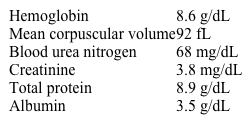 Renal biopsy is performed and light microscopy shows atrophic tubules, many of which contain large, obstructing, waxy casts that stain intensely with eosin. Which of the following is the most likely diagnosis in this patient?
 (Multiple Choice)
4.8/5 (81)
(81) A 53-year-old man arrives at the emergency room after experiencing severe heartburn and difficulty swallowing for several weeks. He has had mild to moderate heartburn for several years and has tried weight loss, elevating the head of his bed while sleeping, and proton pump inhibitor therapy for several months. Hypertension and hypothyroidism are two other medical issues. The temperature is 36.7 C (98.1 F), the blood pressure is 130/80 mm Hg, the pulse rate is 78 bpm, and the respirations rate is 16/ min. The BMI is 25 kg/m22. The physical exam is unremarkable. An upper gastrointestinal endoscopy is performed, and an esophageal biopsy reveals columnar epithelium with goblet cells interspersed. A similar adaptive response can be seen in which of the following scenarios?
(Multiple Choice)
4.8/5 (91)
(91) A 40-year-old man is brought to the emergency department by police officers due to inappropriate public behavior. He was at a pharmacy demanding to speak with the manager so he could discuss a business deal. Two weeks ago, he left his wife of 10 years and moved from another city in order to pursue his dreams of being an entrepreneur. He has not slept for more than 3-4 hours a night in the last 2 weeks. Mental status examination shows accelerated speech with flight of ideas. The patient has had 2 previous depressive episodes. Which of the following medications is the most appropriate agent for long-term management of this patient?
(Multiple Choice)
4.9/5 (80)
(80) A 56-year-old man comes to the physician because of progressive worsening of vision in both eyes over the past 6 months. The patient reports that during this period he has had blurry vision and a glare in the evenings. He works as a tower crane operator and spends most of his day outdoors. Ophthalmologic examination shows visual acuity of 20/100 in both eyes. Which of the following is the most likely etiologic factor for this patient's eye condition?
(Multiple Choice)
4.9/5 (81)
(81) A 67-year-old man is brought to the physician because of increasing forgetfulness, unsteadiness, and falls over the past year. He reports that these symptoms seem to worsen with each fall. Initially, he could not remember directions to his home but now cannot remember recent conversations or appointments he has made. He often repeats questions that he asked shortly before. He has long-standing hypertension, coronary artery disease, and hypercholesterolemia. Current medications include aspirin, carvedilol, enalapril, and atorvastatin. Examination shows a bruise over the left temple and an unsteady gait. On mental status examination, he is oriented to person and place only. Short-term memory is impaired; he can recall 0 out of 5 objects after 10 minutes. Long-term memory is intact. He has no delusions or hallucinations. Muscle strength is decreased in the left lower extremity. Which of the following is the most likely pathophysiologic process underlying this patient's condition?
(Multiple Choice)
4.9/5 (81)
(81) A 66-year-old man is evaluated in the emergency department due to weakness and loss of speech. The patient is known to have hypertension and diabetes Mellitus. He has been smoking 1 pack of cigarettes for the last 30 years. The wife was waking him up when she found him unable to speak or move. Physical examination shows a normal pupillary response. The horizontal eye movements are impaired, with an intact vertical gaze. There is a loss of the motor power of the four extremities. A lesion in which of the following sites would explain the patient's symptoms?
(Multiple Choice)
4.7/5 (94)
(94) A 55-year-old man is brought to the emergency department because of sharp chest pain for the past 3 hours. He does not take any medications. He has smoked one pack of cigarettes daily for 35 years. An ECG shows diffuse ST elevations in leads I, aVL, and V3-V6. During the next several hours, the patient develops progressive shortness of breath that worsens when lying flat. Which of the following histologic features is most likely to be present in this patient's lung tissue?
(Multiple Choice)
4.9/5 (94)
(94) A 44-year-old man comes to the emergency department because of a severe headache and blurry vision for the past 3 hours. He has hypertension treated with hydrochlorothiazide. He has missed taking his medication for the past week as he was traveling. He is only oriented to time and person. His temperature is 37.1°C (98.8°F), pulse is 92/min and regular, and blood pressure is 245/115 mm Hg. Twenty minutes after intravenous hydralazine is administered, blood pressure is 145/95 mm Hg. Over the following 24 hours, serum creatinine increases from 1.1 to 1.6 mg/dL. Urine sediment demonstrates abundant granular casts. Which of the following processes best explains this patient's acute kidney injury?
(Multiple Choice)
4.9/5 (67)
(67) A 32-year-old woman comes to the physician because of a 6-week history of fatigue and weakness. Examination shows marked pallor of the conjunctivae. She has a history of systemic lupus erythematosus and is noncompliant with therapy. The remainder of the examination shows no abnormalities. Laboratory results are as follows: 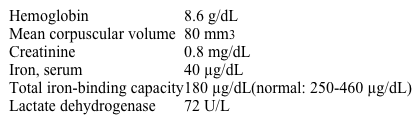 Which of the following is the most likely underlying cause of her current condition?
 (Multiple Choice)
4.8/5 (70)
(70) A 39-year-old woman comes to the physician because of a 3-day history of headaches, and fatigue. She has a hsitory of hypertension for which she takes lisinopril. The patient does not appear to be in acute distress. Evaluation reveals severe thrombocytopenia. Thrombotic thrombocytopenic purpura is suspected. Which of the following findings is required to make the diagnosis?
(Multiple Choice)
4.8/5 (80)
(80) A 12-year-old girl is taken to the emergency room after experiencing lethargy and worsening exertional dyspnea for several days. The patient takes hydroxyurea and has a history of sickle cell illness. A systolic ejection murmur can be heard during a physical exam, along with mucosal pallor. Hemoglobin testing in the lab reveals a level of 5.6 g/dL. Following a bone marrow biopsy, the results indicate diminished erythroid precursors and oversized pronormoblasts with inclusions, as illustrated below. 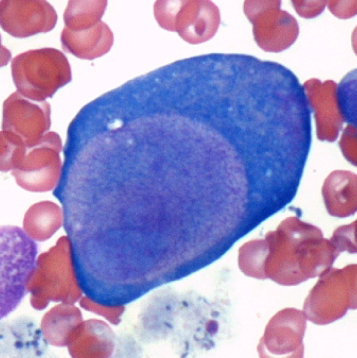 Which of the following is the most likely cause of this patient's current condition?
 (Multiple Choice)
4.9/5 (86)
(86) A 77-year-old woman is brought to the emergency department by her husband because of increasing confusion and unusual behavior for 2 days. She has been mumbling to herself and wandering around the neighborhood. These symptoms are worse in the evenings and she has hardly slept at night. She has not been eating or drinking much for the past 6 days. She has hypertension treated with hydrochlorothiazide. She was diagnosed with breast cancer 12 years ago and was treated with left-sided mastectomy. The patient is oriented to person but not to place or time. Her temperature is 37.1°C (98.8°F), pulse is 78/min, respirations are 18/min, and blood pressure is 122/80 mm Hg. Physical examination shows a supple neck. Neurologic examination shows psychomotor agitation. Attention and concentration are impaired; she makes multiple errors while performing the serial sevens test. Her speech is disorganized. Her fingerstick blood glucose concentration is 122 mg/dL. Which of the following is the most likely cause of his current condition?
(Multiple Choice)
4.9/5 (84)
(84) A 65-year-old man comes to the emergency department because of a 2-hour history of palpitations and lightheadedness. He has no chest pain or dyspnea. He has had 3 episodes of symptomatic atrial fibrillation that self-terminated within last week. He has hypertension treated with lisinopril. He is 183 cm (6 ft 0 in) tall and weighs 100 kg (220 lb); BMI is 30 kg/m2. Temperature is 37.0°C (98.6°F), pulse is 150/min, and blood pressure is 130/85 mm Hg. Cardiac examination demonstrates tachycardia with irregularly irregular heartbeats. ECG confirms atrial fibrillation. The patient's ventricular rate is controlled with beta blocker therapy, but the arrhythmia fails to resolve as in previous episodes. Which of the following factors is most likely involved in the progression of this patient's arrhythmia?
(Multiple Choice)
4.7/5 (88)
(88) 
Filters
- Essay(0)
- Multiple Choice(0)
- Short Answer(0)
- True False(0)
- Matching(0)