Multiple Choice
A 28-year-old man comes to the physician because of a 2-day history of intermittent bloody urine. He has not had dysuria or abdominal pain. There has been no change in urine output or urinary frequency. He has also had a runny nose, dry cough, and a sore throat for the past 4 days. He has no history of serious illness and takes no medications. His temperature is 38.1°C (100.6°F) , pulse is 70/min, respirations are 14/min, and blood pressure is 140/80 mm Hg. Cardiopulmonary and abdominal examinations show no abnormalities. There is flank tenderness to palpation bilaterally. Urinalysis results are as follows: 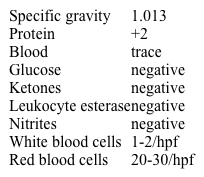 A renal biopsy is performed Which of the following findings is most likely to be seen on microscopic evaluation?
A) Apple-green birefringent mesangial deposits
B) Crescent formation with linear IgG deposits
C) Effacement of podocyte foot processes
D) Granular IgG and C3 deposits
E) Lamellated basement membrane
F) Mesangial deposition of IgA
G) Sclerosis of a portion of some glomeruli
H) Thin basement membrane
Correct Answer:

Verified
Correct Answer:
Verified
Q376: A 3-year-old boy is brought to clinic
Q377: A 75-year-old man presented to the clinic
Q378: A 15-year-old boy is brought to the
Q379: A 3-year-old boy is brought to the
Q380: A 42-year-old woman is brought to the
Q382: A 57-year-old woman comes to the physician
Q383: A 12-month-old girl is brought to the
Q384: A 54-year-old woman comes to the physician
Q385: A 42-year-old previously healthy woman comes to
Q386: A 40-year-old woman presented to the emergency