



 Chat with AI
Exam 3: Office/Health Center

Exam 1: Emergency Department218 Questions
Exam 2: In-patient Facilities128 Questions
Exam 3: Office/Health Center900 Questions
Select questions type


A 20-year-old woman is assessed at the insistence of her parents, who are worried about her weight loss and changes in behavior. The patient returned home from college having lost over 13.6 kg (30 lb) during the academic year. She is an excellent student and is highly active in leadership roles and public speaking. She insists that "appearance is everything" and is concerned that she looks "fat." The patient is now an avid cook and frequently bakes desserts for the family but consumes only small amounts of fruits and vegetables daily. She also runs at least 2 hours a day when not working as an assistant in a dentist's office. Her parents are worried and say, "She is too focused on her appearance and looks too thin." Meanwhile, the patient says she just wants "everyone to stop worrying about me." Her last menstrual period was 4 months ago.
Vital signs are within normal limits. BMI is 17.5 kg/m2.
The patient is referred for nutritional rehabilitation and psychotherapy. Despite these interventions, she returns for a 2-month follow-up having lost an additional 4.5 kg (10 lb).
Which of the following medications is most appropriate for this patient's condition?
(Multiple Choice)
4.9/5  (69)
(69) A 68-year-old man is admitted with acute severe chest pain and ST-segment elevation in the inferior electrocardiogram leads. Coronary angiogram shows complete occlusion of the mid right coronary artery, which is successfully treated with a drug-eluting stent. It also shows 50% stenosis of the mid left anterior descending artery and 30% stenosis of the left circumflex artery. His other medical problems include hypertension and hyperlipidemia. Echocardiogram shows inferior wall hypokinesis with left ventricular ejection fraction of 50%. On the third day of hospitalization, the patient feels well and wants to go home. His blood pressure is 122/70 mm Hg and heart rate is 60/min. His current medications include atorvastatin, metoprolol, lisinopril, aspirin, and ticagrelor.
Which of the following is the best management for this patient?
(Multiple Choice)
4.8/5 (84)
(84) A 45-year-old woman comes to the office for follow-up after thyroid surgery. The patient was recently diagnosed with metastatic papillary thyroid cancer and underwent total thyroidectomy 4 weeks ago, followed by radioactive iodine treatment. She had no operative or immediate postoperative complications and was discharged home on thyroid hormone replacement therapy. At the time of discharge, her serum calcium level was within normal limits and the patient was advised to take over-the-counter calcium and vitamin D supplements. Today, she feels well and reports no hoarseness, dysphagia, or neck mass. The patient had no prior medical conditions until she was found to have the thyroid cancer. Family history is significant for papillary thyroid cancer in her sister.
Vital signs are within normal limits. On physical examination, the neck incision is well healed. There is no palpable thyroid tissue and no cervical lymphadenopathy. The remainder of the physical examination is normal.
Laboratory results reveal a TSH of 2.5 µU/mL. The treatment plan is to increase the dose of levothyroxine to suppress TSH below normal levels to prevent thyroid cancer recurrence.
This patient is at greatest risk of developing which of the following conditions in the future?
(Multiple Choice)
4.8/5 (73)
(73) A 45-year-old man comes to the office for blood pressure follow-up. He has hypertension that has been difficult to control over the last 2 years. The patient has been following a low-salt diet and exercising to lose weight. He occasionally gets muscle cramps while exercising, but otherwise has excellent exercise tolerance and generally feels well. Current medications are lisinopril, hydrochlorothiazide, amlodipine, potassium chloride, and carvedilol. The patient is compliant with clinic visits and regularly fills his prescriptions. He has no other medical conditions, no significant family history of cardiovascular disease, and does not use tobacco, alcohol, or illicit drugs.
Blood pressure is 162/94 mm Hg and pulse is 64/min. BMI is 27 kg/m2. After 30 minutes, blood pressure is 160/95 mm Hg. During the previous visit, blood pressure was also in this range. The remainder of the physical examination is unremarkable.
Laboratory results are as follows:
 An echocardiogram performed 6 months ago revealed mild left atrial dilation, left ventricular hypertrophy, and a left ventricular ejection fraction of 65%.
Which of the following is the most likely cause of this patient's hypertension?
An echocardiogram performed 6 months ago revealed mild left atrial dilation, left ventricular hypertrophy, and a left ventricular ejection fraction of 65%.
Which of the following is the most likely cause of this patient's hypertension? (Multiple Choice)
4.9/5 (85)
(85) A 72-year-old man comes to the physician with a scaly rash on his scalp. He says it has been there for "a while" but his daughter insisted on having it examined. The patient has a history of colon cancer treated with left hemicolectomy 7 years ago. He takes daily vitamin D and calcium supplements. Physical examination findings are shown in the photograph below.
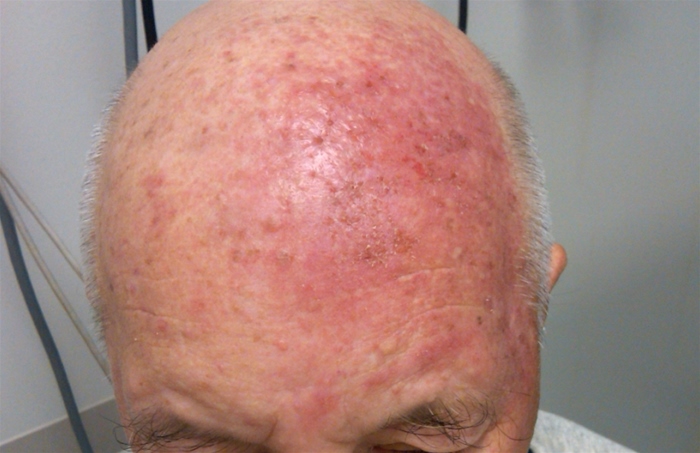 Which of the following is the most likely diagnosis?
 (Multiple Choice)
4.9/5 (77)
(77) A 54-year-old man comes to the physician for evaluation of a thyroid nodule found on routine physical examination. He has no current complaints. His past medical history is significant for long-standing hypertension, hyperlipidemia, and glucose intolerance without overt diabetes mellitus. The patient's medications include amlodipine, simvastatin, and low-dose aspirin. He has no family history of thyroid disease or cancer.
Ultrasound reveals a 2-cm nodule in the right thyroid lobe. Fine-needle aspiration findings are consistent with medullary thyroid cancer. MRI of the neck shows no local extension or lymph node involvement.
Laboratory results are as follows:
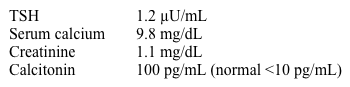 Plasma fractionated metanephrines are within normal range.
Which of the following is the best next step in managing this patient?
Plasma fractionated metanephrines are within normal range.
Which of the following is the best next step in managing this patient? (Multiple Choice)
4.7/5 (74)
(74) A 46-year-old woman comes to the physician because of right heel pain that is particularly severe upon getting out of bed in the morning. The pain has been present on and off for 6 weeks, but has recently intensified. It sometimes persists most of the day and can make walking difficult. She denies pain at night, foot numbness, or any recent trauma to the area. She is not a runner/jogger and has not recently worn any new footwear. She denies any history of back pain or stiffness or pain in other joints. Her review of systems is otherwise negative. She has tried over-the-counter NSAIDS with limited relief. She was diagnosed with breast cancer 3 years ago and was treated with lumpectomy followed by chemoradiation. Her current medications include tamoxifen and a multivitamin.
Her vital signs are normal. BMI is 29 kg/m2. There is good range of motion at both ankles. There is no warmth, swelling, or deformity of either foot or ankle. There is no pain/discomfort when tapping with a reflex hammer inferior to the medial malleolus on either foot. She has pain in the right central heel that is increased by dorsiflexion of the toes. The Achilles tendon is not tender throughout its length. Lateral compression of the calcaneus does not elicit pain.
Which of the following is the most likely cause of her heel pain?
(Multiple Choice)
4.8/5 (70)
(70) A 19-year-old woman comes to the office due to infrequent menstrual cycles and excessive body hair. Menarche was at age 11 and her cycles have since been irregular. The patient has <6 menstrual periods per year with very heavy bleeding. Her last menstrual period was 4 months ago. She also reports increased hair growth on her face and trunk. The patient has no other medical conditions and takes no medications. She does not use tobacco, alcohol, or illicit drugs. She is not sexually active. Family history is significant for hypertension and coronary artery disease in her father and hypertension in her mother. There is no family history of diabetes mellitus.
Blood pressure is 134/88 mm Hg. BMI is 30 kg/m2. Acanthosis is present on the nape of the neck. Significant terminal hair is noted on the face, upper chest, lower abdomen, and lower back. There are pale striae on the abdominal wall. The remainder of the physical examination is within normal limits.
Laboratory results are as follows:
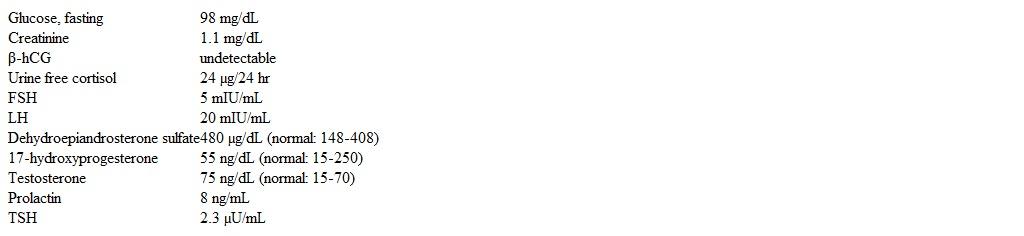 Which of the following is the best next step in management of this patient?
 (Multiple Choice)
4.8/5 (67)
(67) A 65-year-old Asian woman comes to the office because of a red right eye. She has severe pain in the eye and has developed decreased vision with halos around bright objects. Her symptoms started a few hours ago while attending a movie. She does not wear contact lenses and has had no purulent discharge from the eye. She denies a foreign body sensation in the eye and has not experienced any eye trauma. She had a recent upper respiratory tract infection for which she self-medicated with an over-the-counter medication.
Examination reveals a red right eye and a moderately dilated pupil with sluggish light reaction. There is pain with eye movement. Her vision is markedly reduced and she can count fingers at two feet.
Which of the following is the most likely cause of her symptoms?
(Multiple Choice)
4.9/5 (78)
(78) A 45-year-old man is evaluated for recurrent urolithiasis. He underwent a Roux-en-Y procedure for morbid obesity two years ago. He passed his first kidney stone one year ago and has passed several since then. He has lost approximately 15 kg (33 lb) since the surgery and feels well otherwise. His current medications include lisinopril for hypertension, esomeprazole for gastro-esophageal reflux disease, and a daily multivitamin. He has no family history of kidney stones.
Which of the following factors is most likely responsible for this patient's kidney stone formation?
(Multiple Choice)
4.8/5 (82)
(82) A 78-year-old woman comes to the urgent care center due to the abrupt onset of fever, sore throat, a nonproductive cough, and muscle pain that began yesterday morning. Several of her social friends have been sick, including one who was hospitalized with influenza. The patient received an influenza vaccine 2 months ago and has no history of influenza infection. Medical history includes hypertension, coronary artery disease, and ischemic cardiomyopathy with a left ventricular ejection fraction of 35%. She is a lifetime nonsmoker.
Temperature is 38.3 C (100.9 F), blood pressure is 122/76 mm Hg, pulse is 95/min, and respirations are 14/min. Oxygen saturation is 98% on room air. The patient appears uncomfortable but is in no acute distress. No pharyngeal erythema or tonsillar exudates are present, and there is no cervical lymphadenopathy. Auscultation of the lungs reveals no abnormalities.
Rapid influenza antigen test is negative, and chest x-ray reveals no infiltrates. The patient asks to go home.
Which of the following is the most reasonable next step in management of this patient?
(Multiple Choice)
4.9/5 (81)
(81) A 67-year-old man seeks medical attention because of unsteadiness and near-falls over the last several weeks. He has noticed some numbness in his hand and urinary urgency more frequently than what he usually experiences. He also describes many months of neck pain, shoulder discomfort, and lower back pain. There is no history of neck or back trauma. He has had no fever, chills, or weight loss. He denies any headaches, vertigo, vision loss, or difficulty swallowing.
He rides an indoor exercise bicycle for 45 minutes three times a week and goes for 3-4 hour outdoor rides on his bicycle both weekend days. He had a normal colonoscopy within the past five years. He takes no medications other than a daily multivitamin. He does not smoke or drink alcohol.
His temperature is 37.0 C (98.6 F), blood pressure is 155/84 mm Hg, pulse is 85/min, and respirations are 14/min. There is 4/5 muscle strength in his bilateral lower extremities with 3+ reflexes. Upper extremity examination is normal except for mildly decreased sensations in both hands. No muscle atrophy or fasciculations are present. His Mini Mental Status Exam score is 29/30.
Laboratory data reveal the following:
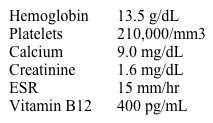 EKG shows sinus rhythm with left ventricular hypertrophy. Chest X-ray shows mild cardiomegaly but clear lung fields. A cervical spine series demonstrates degenerative changes in the C5, 6, and 7 areas.
Which of the following is the most likely diagnosis?
EKG shows sinus rhythm with left ventricular hypertrophy. Chest X-ray shows mild cardiomegaly but clear lung fields. A cervical spine series demonstrates degenerative changes in the C5, 6, and 7 areas.
Which of the following is the most likely diagnosis? (Multiple Choice)
4.9/5 (75)
(75) A 64-year-old man comes to the office for a preventive visit. The patient has type 2 diabetes mellitus, which is being managed with lifestyle modification. He has had no polyuria, polydipsia, or changes in weight but states that he has had trouble seeing distant objects for the past several months. He has never had vision problems before and reports normal near vision. Two weeks ago the patient saw an optometrist who prescribed glasses with −2.5 diopter lens on the right and −0.75 diopter lens on the left that have improved his vision. Dilated eye examination 6 months ago was unremarkable. His glycated hemoglobin level is 6.8%.
Which of the following is the most likely cause of this patient's visual symptoms?
(Multiple Choice)
4.8/5 (70)
(70) A 72-year-old man presents with 4 weeks of central low back pain. His pain was initially mild and relieved by recumbency. Over the past two weeks, the pain has increased in severity and occurs at night without relief by lying down. The pain does not radiate and he has neither sensory loss nor weakness in his legs.
The patient has benign prostatic hyperplasia with significant outlet obstruction. He is scheduled for a transurethral prostatectomy soon. He was treated for a urinary tract infection both 3 years ago and two months ago. He has a history of stable coronary artery disease, hypertension, and degenerative joint disease. He has no history of cancer.
His temperature is 37.8 C (100.1 F), blood pressure is 140/72 mm Hg, and pulse is 84/min. Cardiac, pulmonary, and abdominal exams are unremarkable. There is decreased range of motion in all aspects of his back. Point tenderness is present over the third and fourth lumbar processes. There are no sensory or motor deficits in his lower extremities. Deep tendon reflexes are symmetric. Perineal sensation and rectal tone are normal. An enlarged, non-tender rubbery prostate is palpated on digital rectal examination.
The patient's labs reveal:
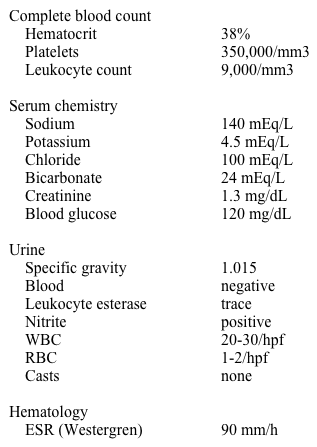 Which of the following is the most appropriate next step in management?
 (Multiple Choice)
4.8/5 (94)
(94) A 47-year-old man comes to the physician with skin changes and joint pain. He underwent human leukocyte antigen-matched allogeneic stem cell transplant for acute myeloid leukemia from his sister 1 year ago and was treated with methotrexate, sirolimus, and prednisone postoperatively. Prednisone was tapered off and stopped 6 months ago. Two months ago, he noticed progressively worsening skin changes. He has difficulty using his fingers and complains of small joint pain. He currently uses artificial tears for eye dryness and albuterol as needed for mild intermittent asthma.
Vital signs are within normal limits. Skin examination shows extensive skin thickening with areas of hypopigmentation (Exhibit). 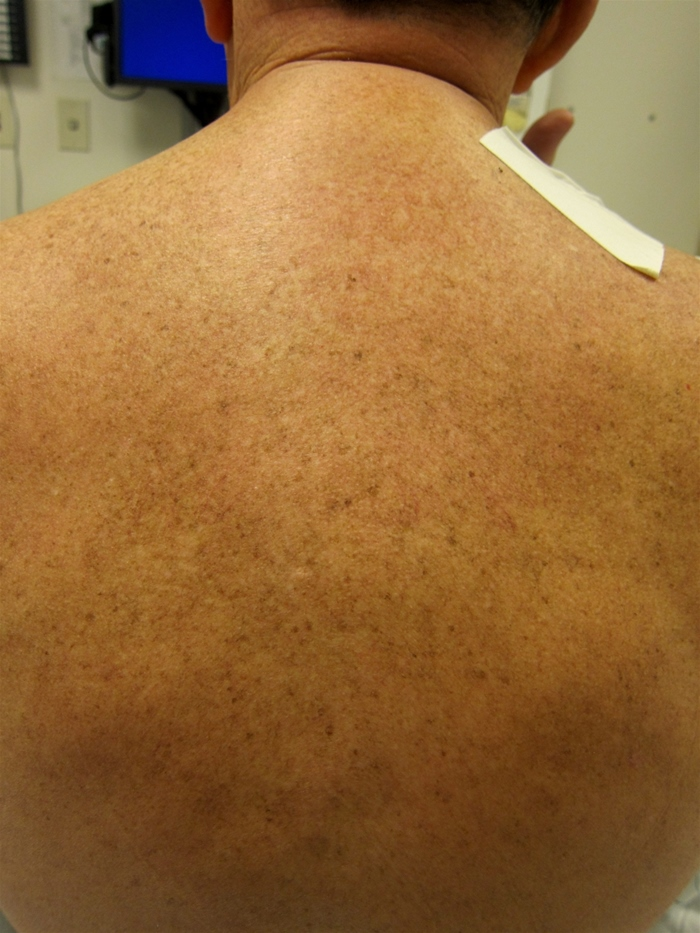 The hand joints have limited mobility without redness or swelling. The remainder of the examination is within normal limits.
Laboratory results are as follows:
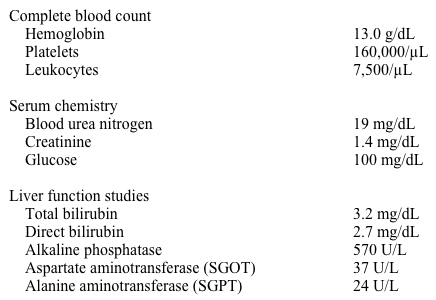 Which of the following is the most likely diagnosis?
The hand joints have limited mobility without redness or swelling. The remainder of the examination is within normal limits.
Laboratory results are as follows:
Which of the following is the most likely diagnosis? (Multiple Choice)
4.8/5 (85)
(85) A 45-year-old man comes to the physician for a twisted ankle. It occurred while he was playing basketball, but he cannot recall if he everted or inverted his ankle. He ambulates with difficulty but is able to bear weight in the physician's office as he walks to the examination room. His general health is good and he takes no medications.
On examination, there is limited range of motion of the ankle in all directions. Significant ecchymosis and edema are visible at the lateral aspect of the ankle. There is no tenderness at the posterior edge or tip of either malleoli. There is no pain at the base of his fifth metatarsal, and palpation of the navicular area of his foot does not elicit pain.
Which of the following is the most appropriate next step in evaluating this patient's injury?
(Multiple Choice)
4.7/5 (81)
(81) A 22-year-old African American man is evaluated for an abnormal ECG obtained at a health fair. He has no complaints and says that he has been healthy all his life. He runs 6-8 miles a day and plays basketball for several hours every weekend. The patient has no symptoms during physical activity. His paternal uncle suffered from diabetes mellitus and died of a heart attack at age 50. His mother had a minor stroke at age 40.
Examination shows a muscular, well-built man. His blood pressure is 132/90 mm Hg on the right arm and 137/85 mm Hg on the left. His pulse is 54/min. Lungs are clear on auscultation, he has normal first and second heart sounds, and peripheral pulses are full and symmetric.
ECG shows high voltage in precordial leads and downsloping ST-segment depression with T-wave inversion in leads V4-V6. An echocardiogram shows left ventricular hypertrophy with septal thickness of 18 mm and posterior wall thickness of 12 mm (normal ≤10 mm). There is no valvular disease, systolic anterior motion of the mitral valve, or left ventricular outflow tract gradient at rest or with Valsalva maneuver.
Which of the following is the most likely diagnosis?
(Multiple Choice)
4.9/5 (83)
(83) A 34-year-old man comes to the emergency department after coughing up blood-streaked, white sputum this morning, following a week of malaise and productive cough. Two months ago, he was evaluated for weight loss and oral thrush and was diagnosed with HIV infection. His initial CD4 count was 55/mm3, and HIV viral load was 1 million copies/mL. Interferon-gamma release assay testing was indeterminate at that time, and he was started on combination antiretroviral therapy and trimethoprim/sulfamethoxazole. The patient is adherent with his medication regimen.
Temperature is 38 C (100.4 F), blood pressure is 110/70 mm Hg, pulse is 96/min, and respirations are 16/min. BMI is 17 kg/m2. Oxygen saturation is 95% on room air. No thrush is present and no enlarged lymph nodes are palpable. Coarse rhonchi are heard over the left upper lung field. There are no skin rashes or edema. Leukocyte count is 5,500/mm3, and chest x-ray reveals a dense consolidation in the left upper lobe. CD4 count is now 240/mm3.
Which of the following is the best next step in management of this patient?
(Multiple Choice)
4.9/5 (76)
(76) A 35-year-old man is evaluated for pain and swelling behind his right foot that is exacerbated by walking. He reports chronic back pain that occurs mostly in the morning and at night. The pain improves during the day and with exercise, but not with rest. He takes over-the-counter ibuprofen with significant back pain relief. The patient has no fatigue, headaches, vision problems, or abdominal complaints. He has no other medical problems. His mother suffers from rheumatoid arthritis.
Laboratory results are as follows:
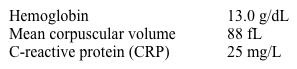 Physical examination should focus specifically on which of the following?
 (Multiple Choice)
4.9/5 (76)
(76) A 40-year-old woman comes to the office for follow-up. She received a living-related donor kidney transplant a year ago for membranoproliferative glomerulonephritis. The patient feels well and has been consistent with follow-up and medications. Other medical issues include hypertension and diet-controlled type 2 diabetes mellitus. Current medications include tacrolimus, prednisone, mycophenolate mofetil, lisinopril, and amlodipine, as well as fluconazole for recurrent vaginal candidiasis.
Temperature is 36.9 C (98.4 F), blood pressure is 152/100 mm Hg, and pulse is 82/min. Physical examination reveals mild cushingoid features. The abdomen is soft with no graft tenderness.
Laboratory results are as follows:
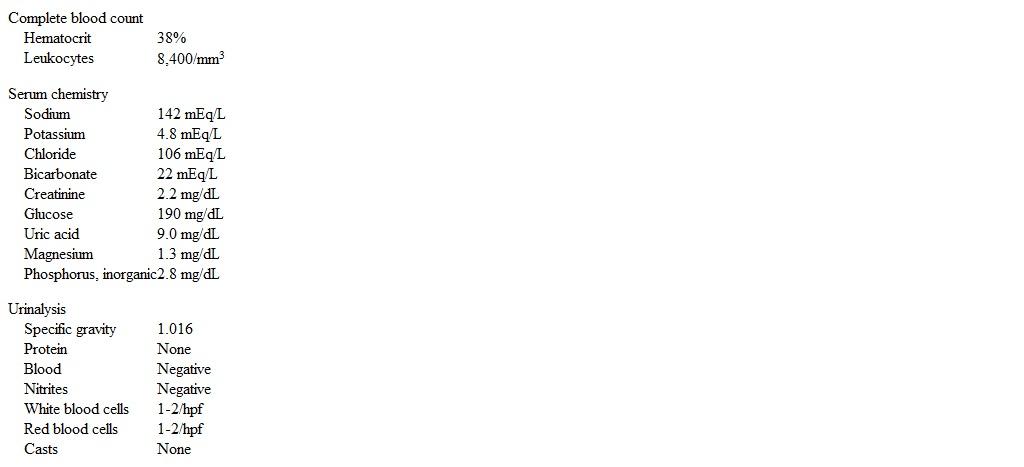 The patient's creatinine was 1.4 mg/dL 3 months ago. Which of the following is the most likely cause of the acute renal dysfunction in this patient?
 (Multiple Choice)
4.7/5 (82)
(82) 
Filters
- Essay(0)
- Multiple Choice(0)
- Short Answer(0)
- True False(0)
- Matching(0)