



 Chat with AI
Exam 3: Office/Health Center

Exam 1: Emergency Department218 Questions
Exam 2: In-patient Facilities128 Questions
Exam 3: Office/Health Center900 Questions
Select questions type


A 52-year-old man comes to the physician for follow-up on cadaveric renal transplantation done 10 months ago for polycystic kidney disease. His postoperative course was complicated by 2 episodes of acute rejection and an episode of lower gastrointestinal bleeding. These events prompted revision of his immunosuppressive regimen, which now includes prednisone, tacrolimus, mycophenolate, and acyclovir. The patient has no new symptoms. His only other medical problem is diet-controlled type 2 diabetes mellitus.
His blood pressure is 122/70 mm Hg and pulse is 78/min. His BMI is 29 kg/m2. There are no skin rashes. The spleen tip is not palpable. There is no lymphadenopathy.
Laboratory results are as follows:
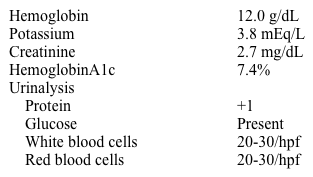 Urine sediment analysis shows cellular casts. Cytology demonstrates atypical cells with intranuclear inclusions.
Which of the following is the most likely diagnosis?
Urine sediment analysis shows cellular casts. Cytology demonstrates atypical cells with intranuclear inclusions.
Which of the following is the most likely diagnosis? (Multiple Choice)
4.8/5  (64)
(64) A 22-year-old college student comes to the office due to a rash. She found an oval, pink spot on her chest while taking a shower a week ago. The next day, the spot developed a slight scale and began to itch. Three days later, several additional smaller lesions appeared on her upper chest; then the rash spread downward over the rest of the trunk. The lesions are mildly pruritic. The patient has no blisters, bullae, mucous membrane involvement, or lesions on the palms or soles. Medical history is unremarkable, and she does not use tobacco, alcohol, or illicit drugs. The patient is sexually active with 1 partner, and her only medication is an oral contraceptive.
Vital signs are normal. Examination findings are shown in the image.
 Which of the following is the most likely diagnosis in this patient?
 (Multiple Choice)
4.8/5 (67)
(67) A 66-year-old woman comes to the clinic for a routine follow-up visit. The patient immigrated to the United States from Haiti 6 years ago. Medical history includes osteoarthritis of the knees, lumbar spinal stenosis, and hypertension. At age 45, she underwent a supracervical hysterectomy, leaving an intact cervix. Her last mammogram, performed several months ago, was normal. The patient is up to date with colonoscopy screening. She received influenza and pneumonia vaccines last year. Her last two Pap tests with human papillomavirus (HPV) cotesting were normal 1 and 6 years ago. The patient's only other Pap test, which was normal, was performed just before the hysterectomy. She had a new sexual partner since her last visit.
Vital signs and physical examination are within normal limits.
Which of the following is the best next step for cervical cancer screening in this patient?
(Multiple Choice)
5.0/5 (84)
(84) A 30-year-old woman with a history of episodic migraine headaches comes to the office due to worsening of her headaches. She started having infrequent migraine headaches in her early twenties. However, her migraine headaches have become more severe over the past 1 year and have started to occur >15 days/month. She has been taking ibuprofen on a daily basis for months to treat the headaches, which have only worsened and now occur on a daily basis. Recent MRI of her brain showed no abnormalities. She has not had any fevers, neck stiffness, vision changes, head trauma, double vision, dysarthria, dysphasia, weakness, numbness, or difficulty with balance. Her headaches are not affected by changes in head position, cough, or Valsalva maneuvers; but are made worse by physical activity and are associated with photophobia, and nausea. She works as a secretary and has needed to take leave from work due to her severe headaches. She does not use tobacco, alcohol, or illicit drugs.
Her seated blood pressure is 128/76 mm Hg and pulse is 76/min. Her BMI is 32 kg/m2.
Neurologic examination shows no abnormalities except for marked photophobia. Which of the following is the most appropriate next step in the management of this patient?
(Multiple Choice)
4.9/5 (80)
(80) A 54-year-old woman comes to the office due to irritability, insomnia, headache, and fatigue. The patient's medical conditions include hypothyroidism, treated with a stable dose of levothyroxine, and major depressive disorder. She had been doing well on paroxetine for 2 years but decided to stop the medication 3 days ago due to concerns about sexual side effects and weight gain. Since then, the patient has been very worried as she already feels "terribly anxious and depressed." She describes frequent tearfulness, feeling panicky, and body aches and pains.
Temperature is 37 C (98.6 F), blood pressure is 130/80 mm Hg, and pulse is 88/min. Physical examination is normal. Mental status examination shows an anxious, irritable mood with a full range of affect. The patient has no suicidal ideation.
Which of the following is the most appropriate next step in management of this patient?
(Multiple Choice)
4.9/5 (91)
(91) A 79-year-old man comes to the physician for follow-up 6 months after hospitalization for acute decompensated heart failure. He reports mild fatigue, weakness, and frequent muscle cramps but no shortness of breath. The patient has non-ischemic cardiomyopathy with a left ventricular ejection fraction of 40%. His medications include carvedilol (25 mg twice daily), lisinopril (20 mg daily) and furosemide (80 mg daily). He also takes daily lansoprazole for non-ulcer dyspepsia.
Blood pressure is 122/80 mm Hg and pulse is 78/min. Jugular venous pressure is estimated at 5 cm H2O. The lungs are clear to auscultation bilaterally. Peripheral pulses are 2+ bilaterally with trace peripheral edema. Neuromuscular examination shows 5/5 muscle strength in both upper and lower extremities, mildly increased reflexes, and no muscle tenderness.
Laboratory results are as follows:
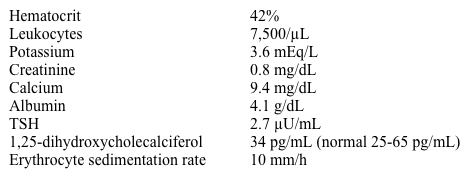 Which of the following is the best next step in evaluation of this patient's symptoms?
 (Multiple Choice)
4.9/5 (80)
(80) A 62-year-old woman comes to the office for follow-up on hypertension. She has no history of heart disease or stroke and currently takes no medications. The patient has a sedentary lifestyle, is a lifetime nonsmoker, and drinks 2 or 3 glasses of wine each evening. She typically salts her food before tasting it; her diet is high in snacks, processed meats, and saturated fat, and low in fruits and vegetables.
Recent blood pressure readings are 145-155/88-95 mm Hg. BMI is 28 kg/m2.
Laboratory results are as follows:
 The patient previously had a "bad reaction to many different blood pressure pills" and would like to lower her blood pressure through healthier lifestyle habits rather than medication. Which of the following would most likely result in the greatest decrease in this patient's blood pressure?
 (Multiple Choice)
4.9/5 (81)
(81) A 22-year-old man living in Connecticut comes to the physician after finding a tick on his shoulder this morning. He cleared brush and mowed the lawn in his backyard yesterday morning. Before yesterday, he does not recall spending any prolonged time outdoors in the past 2 weeks.
The patient's temperature is 37.4 C (99 F), blood pressure is 112/72 mm Hg, pulse is 84/min, and respirations are 14/min. He is comfortable but anxious. There are no skin rashes. On his left shoulder, there is an attached 1.5 mm-long brown tick. The tick is removed carefully using forceps and the area is disinfected. No remnants of the tick are observed on the skin following removal.
Which of the following would be an appropriate next step in management?
(Multiple Choice)
4.8/5 (81)
(81) A 56-year-old woman comes to the office due to breast pruritus. The patient reports increasing pruritus around the right areola over the last 3 months that has not resolved with topical emollients. The pruritus is continuous and she is constantly scratching the breast. The patient has now noticed a lesion around the nipple and serosanguinous discharge on her clothing. She has had no change in skin products or detergents.
The patient has type 2 diabetes mellitus controlled with metformin. She has had no previous surgeries and has no known allergies. Her last mammogram, 2 years ago, was normal. The patient does not use tobacco, alcohol, or illicit drugs.
Vital signs are normal. The right breast has an ulcerative lesion over the right nipple and areola that does not extend to the surrounding tissue; there are no palpable masses or axillary lymph nodes. Serous fluid is expressed from the nipple. Examination of the left breast is unremarkable.
Which of the following is the most likely diagnosis in this patient?
(Multiple Choice)
4.7/5 (73)
(73) A 62-year-old man comes to the physician complaining of dysphagia for both solids and liquids for the past 3 months. He also reports a bad taste in his mouth and frequent regurgitation. He has lost 10 pounds (4.5 Kg) in the last 2 months. His past medical history is significant for hypertension, chronic low back pain, and diverticulitis. There is no family history of malignancy. He has a 20-pack-year smoking history and drinks 2-3 beers daily.
The patient's blood pressure is 142/78 mm Hg and pulse is 92/min. His BMI is 25 kg/m2. Physical examination shows poor dentition and halitosis. The remainder of the examination is within normal limits.
His barium swallow is shown in this exhibit. 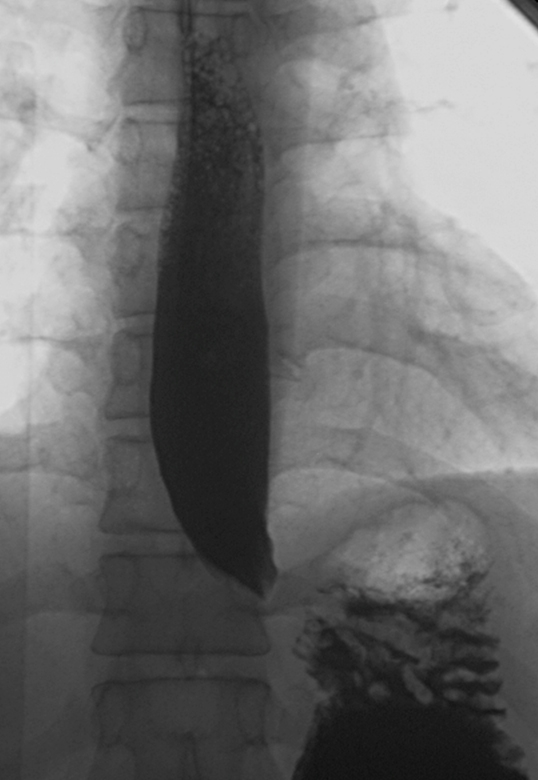 Which of the following is the best next step in management of this patient?
 (Multiple Choice)
4.9/5 (82)
(82) A 75-year-old woman comes to the office due to increasing forgetfulness and difficulty concentrating. Her memory has always been sharp, but over the last several months her friends have noticed that she has been forgetful. The patient used to visit them regularly at the community center, but now she prefers to stay home most days. She mentions difficulty with focusing and easy fatigability. She falls asleep earlier than usual and has frequent nighttime awakenings. The patient's husband died from a stroke 6 months ago, and she has been living alone since. Her children live far away and have not been checking up on her regularly.
Vital signs are normal. Mini-Mental State Examination score is 26/30, with difficulties in delayed recall, concentration, and attention. Physical examination is unremarkable. Laboratory studies, including vitamin B12 levels and thyroid function, are normal.
Which of the following is the best next step in management of this patient?
(Multiple Choice)
4.9/5 (77)
(77) An 84-year-old man is brought to the office by his daughter for increased confusion and agitation. He has a history of moderate Alzheimer dementia with worsening cognitive and functional status over the past 6 months. He now requires 24-hour supervision that involves shifts of family members and caregivers. The daughter notes that the patient frequently wanders and has been more restless and agitated, especially in the evenings. He frequently yells when he can't find misplaced objects. He is increasingly paranoid and accuses the caregivers of stealing his money and important papers. The patient has no pain or discomfort. Medications include donepezil, multivitamins, tamsulosin, and acetaminophen.
Vital signs are within normal limits. Physical examination is unremarkable. The patient is oriented to person and recognizes his daughter but is disoriented to time and place. He recalls 0 of 3 objects after 5 minutes.
Complete blood count and comprehensive chemistry panel are within normal limits.
Which of the following is the most appropriate next step in management of this patient's neuropsychiatric symptoms?
(Multiple Choice)
4.9/5 (75)
(75) A 38-year-old man comes to the office stating that "my skin is being eaten away by flesh-eating bacteria." He has repeatedly used a stiff brush to apply antibacterial soap and disinfectant to the skin he insists is infected. The patient describes a progression of itching and redness followed by intense, burning pain at infected sites that spreads almost daily to new body areas. The patient systematically inspects his skin twice a day and records detailed descriptions of the affected areas. He is able to fall asleep at night but awakens sometimes to scratch his skin. He works as an accountant and has had a stable job performance. Current medications include a multivitamin and acetaminophen as needed. He drinks alcohol socially and does not use tobacco or illicit drugs.
Temperature is 36.5 C (97.7 F), blood pressure is 122/76 mm Hg, and pulse is 62/min. Physical examination reveals scattered lesions on his extremities that appear to have been caused by intense, abrasive scrubbing. The remainder of the physical examination is unremarkable.
Which of the following is the patient's most likely psychiatric diagnosis?
(Multiple Choice)
4.9/5 (79)
(79) A 52-year-old man comes to the physician with leg ulcers. Two months ago a small ulcer appeared on the right medial malleolus, and now there are 2 additional ulcers on both legs. He was diagnosed with seropositive rheumatoid arthritis 15 years ago and has been on oral prednisone, sulfasalazine, and hydroxychloroquine since then. Eight years ago methotrexate was discontinued due to liver toxicity. Five years ago he received etanercept for a few months, but this was discontinued due to frequent sinus infections.
The patient's other medical problems include gastritis, type 2 diabetes mellitus, and colon polyps. He is a cattle farmer and does not use tobacco, alcohol, or illicit drugs.
He is afebrile and vital signs are normal. Skin examination is notable for several nodules on the extensor surface of the elbows. There are 3 shallow ulcers on both legs in various stages of healing. Heart and lung sounds are normal. Spleen is palpable 2 cm below the left costal margin. There are rheumatoid deformities of both hands and feet with decreased range of motion in wrists, elbows, and ankle joints. Neurologic examination is normal.
Laboratory results are as follows:
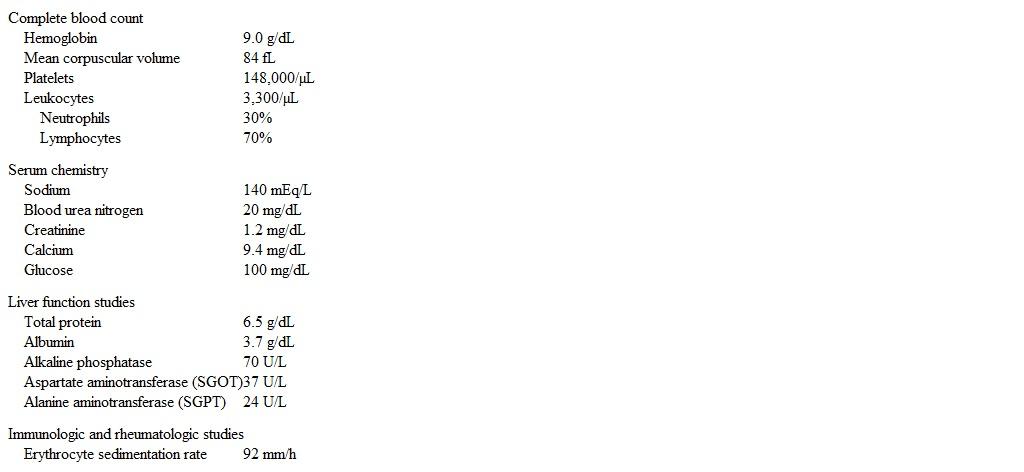 Which of the following conditions is the most likely diagnosis?
 (Multiple Choice)
4.7/5 (78)
(78) A 70-year-old man comes to the physician due to generalized weakness and headaches. He has also had intermittent episodes of blurry vision and a 6.8-kg (15-lb) weight loss over the past 3 months. His other medical problems include hypertension, congestive heart failure, type 2 diabetes mellitus, and hypercholesterolemia. The patient underwent coronary artery bypass surgery for triple-vessel disease 4 years ago. His medications include insulin detemir, ramipril, simvastatin, low-dose aspirin, metoprolol, furosemide, and naproxen as needed for headaches.
The patient's temperature is 37.2 C (99 F), blood pressure is 140/90 mm Hg, and pulse is 73/min. Eye examination is normal. He has decreased breath sounds at the left lung base. The liver edge is palpable at the costal margin. There is no adenopathy. There is trace peripheral edema bilaterally. The prostate is mildly enlarged, soft, and nontender on rectal examination. Fecal occult blood testing is negative.
Laboratory results are as follows:
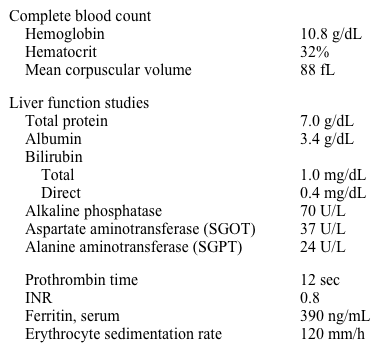 Chest x-ray reveals cardiomegaly and a left-sided pleural effusion <1 cm. Which of the following is the most appropriate next step in management of this patient?
 (Multiple Choice)
4.8/5 (76)
(76) A 22-year-old woman comes to the office due to dysuria and urinary frequency. She has had no fever, chills, nausea, or vomiting. In the last 8 months, the patient has had 2 urinary tract infections that began shortly after intercourse, despite immediate postcoital voiding. The first infection was complicated by pyelonephritis that responded to oral antibiotics; urine culture at that time grew pan-susceptible Escherichia coli. She has no other medical problems and has had no surgeries. Current medications include oral contraceptives.
Vital signs are normal. There is mild suprapubic tenderness but no costovertebral angle tenderness.
Urinalysis results are as follows:
 In addition to oral antibiotics for the current infection, which of the following is the best next step in management of this patient?
 (Multiple Choice)
5.0/5 (81)
(81) A 32-year-old man is evaluated for a 3-month history of abdominal discomfort and diarrhea. He has had 3-4 loose stools per day and abdominal cramping that is relieved by bowel movements. The patient has also had blood in the stool during the past week. He has had no fevers or night sweats. Four months ago, the patient was diagnosed with Clostridium difficile colitis after taking antibiotics for a sore throat and was prescribed oral vancomycin. He has no other chronic medical conditions and takes no medications. He does not use tobacco, alcohol, or illicit drugs.
Temperature is 37.2 C (99 F), blood pressure is 112/76 mm Hg, and pulse is 88/min. The abdomen is soft with mild tenderness in the periumbilical and left lower-quadrant areas. There is no rebound tenderness or rigidity. Rectal examination shows guaiac-positive stool.
Laboratory results are as follows:
 Which of the following is the most appropriate next step in management of this patient?
 (Multiple Choice)
4.8/5 (87)
(87) An ultrasound evaluation of the extracranial portion of the internal carotid artery can predict significant (> 70%) angiographic stenosis with a sensitivity of 100% and a specificity of 72%. When this test is applied to a large population of patients with multiple cardiovascular risk factors, which of the following test parameters is expected to be closest to 100%?
(Multiple Choice)
4.8/5 (93)
(93) A 55-year-old man comes to the physician complaining of joint pain. He has had 2 years of intermittent and mild arthralgias of his hands, wrists, and shoulders at night. He recently developed pain in his wrists and hand pain with flexion mainly at the second and third metacarpophalangeal joints. He has no morning stiffness or warmth or redness around his joints. There is no history of fever, weight loss, or subcutaneous nodules. His medical problems include type 2 diabetes mellitus diagnosed 5 years ago and hypertension and hyperlipidemia diagnosed 3 years ago. Mild liver function abnormalities were detected and attributed to possible fatty liver 2 years ago. His medications include metformin, lisinopril, and rosuvastatin.
The patient's vital signs are within normal limits. BMI is 34 kg/m2. There is swelling of the metacarpophalangeal joints bilaterally. He has no synovial swelling or abnormalities of his proximal and distal interphalangeal joints. There are no abnormalities of the wrists, shoulders, or hips.
X-rays of the hands and wrists reveal narrowing of the third, fourth, and fifth metacarpophalangeal joints with hook-shaped osteophytes at the metacarpal heads. Erythrocyte sedimentation rate is 15 mm/hr.
Which of the following would most likely show the cause of this patient's current symptoms?
(Multiple Choice)
4.9/5 (71)
(71) A 40-year-old woman comes to the physician because of concerns about her legs. She states that she develops a warm burning sensation and redness involving her feet and legs during the night and sometimes when lying on the couch. Her symptoms are worse in the winter when her feet are covered. Elevating her legs and keeping them uncovered either prevents or reduces her symptoms. She considers herself to be in good health otherwise and has no other symptoms.
Physical examination including complete neurologic examination is unremarkable.
Laboratory results are as follows:
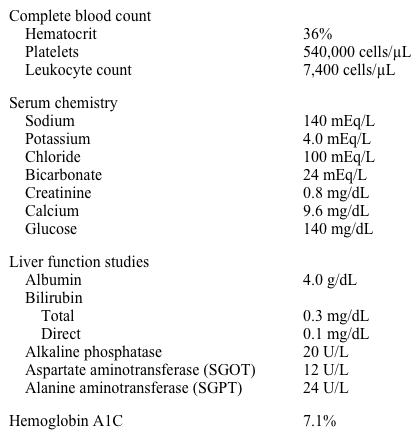 Which of the following is most likely to relieve this patient's symptoms?
 (Multiple Choice)
4.7/5 (95)
(95) 
Filters
- Essay(0)
- Multiple Choice(0)
- Short Answer(0)
- True False(0)
- Matching(0)