



 Chat with AI
Exam 3: Office/Health Center

Exam 1: Emergency Department218 Questions
Exam 2: In-patient Facilities128 Questions
Exam 3: Office/Health Center900 Questions
Select questions type


A 43-year-old man comes to the physician because of weakness and arthralgias for the last four months. He also has a pruritic rash on his legs that appeared two months ago. He denies fever or chills and his weight has been stable.
His blood pressure is 140/90 mm Hg and pulse is 84/min. A rash is present on both lower extremities below the knees that consist of many erythematous macules.
Laboratory results are as follows:
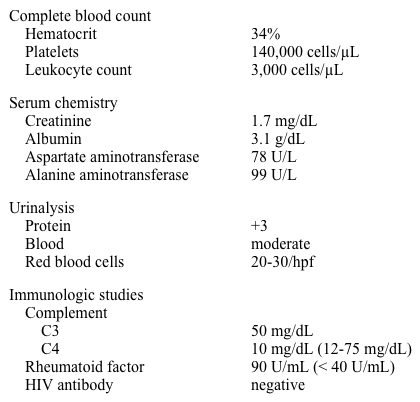 Which of the following would be most helpful in establishing the diagnosis in this patient?
 (Multiple Choice)
4.8/5  (89)
(89) A 44-year-old man with HIV infection is evaluated for persistent fevers, progressive generalized fatigue, poor appetite, and marked weight loss over the last 2 months. He has no chest pain or shortness of breath. He has been noncompliant with antiretroviral therapy, and his last CD4 count 6 months ago was 90/µL.
His temperature is 38.3 C (101 F), blood pressure is 91/53 mm Hg, pulse is 105/min, and respirations are 21/min. Examination shows a pale conjunctiva and dry mucous membranes.
Laboratory results are as follows:
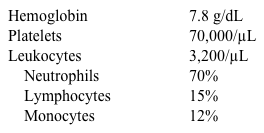 A CT scan of the chest and abdomen reveals lucencies in the skeleton and bulky mediastinal and abdominal lymphadenopathy.
Bone marrow biopsy in this patient would most likely show which of the following?
A CT scan of the chest and abdomen reveals lucencies in the skeleton and bulky mediastinal and abdominal lymphadenopathy.
Bone marrow biopsy in this patient would most likely show which of the following? (Multiple Choice)
4.9/5 (87)
(87) A 74-year-old woman comes to the office for a new patient visit, accompanied by her son. The patient's first language is Spanish, but she indicates that she is also comfortable speaking English. She points to a nonhealing ulcer on her right forearm that has been present for approximately a year. The patient is otherwise in good health and takes no medications. She does not use tobacco, alcohol, or illicit drugs.
Physical examination shows an irregular, 1-cm erythematous scaly papule that is concerning for squamous cell carcinoma. As the physician explains the diagnostic possibilities and need for a biopsy, it becomes apparent that the patient is having difficulty understanding the information presented in English. The physician recommends using a medical interpreter, but the son suggests that his mother would be most comfortable if he served as her interpreter. The patient's nurse also offers to interpret, stating that he knows some Spanish.
Which of the following is the most appropriate next step?
(Multiple Choice)
4.8/5 (92)
(92) A 55-year-old man comes to the physician for follow-up after an episode of acute pancreatitis. Four weeks ago, he presented to the hospital with severe epigastric pain and vomiting after an episode of binge drinking. Ultrasound revealed no evidence of gallstones. He was hospitalized for 3 days and tolerated oral feeds on the day of discharge. He currently feels well and has a good appetite. The patient reports mild fullness in the abdomen but no nausea or vomiting. He has refrained from alcohol consumption. His other medical problems include hypertension and gout.
Vital signs are within normal limits. There is mild tenderness in the epigastric region on deep palpation. The remainder of the physical examination is within normal limits.
Laboratory results are as follows:
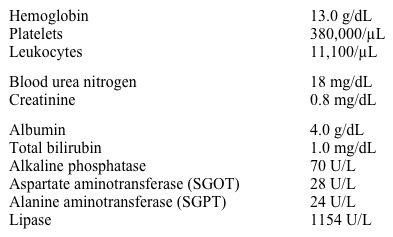 Which of the following is the most likely diagnosis?
 (Multiple Choice)
4.7/5 (83)
(83) A 69-year-old woman with a long history of rheumatoid arthritis (RA) is brought to the physician by her daughter because of gait instability and near-falls. She was previously able to walk outdoors with the use of a cane, but she has required a walker for the past three months. She also notes that her mother has been holding onto the furniture when she walks from room to room. The patient denies any new joint pain or discomfort, muscle pain, or numbness in her arms and legs.
The patient had RA treatment in the past with methotrexate. She underwent right-sided knee replacement seven years ago. Recent x-rays of the replaced joints did not demonstrate any fractures or prosthesis loosening. Her other medical problems include hypertension, hyperlipidemia, and lactose intolerance. Her current medications include low-dose prednisone, ibuprofen, lisinopril, hydrochlorothiazide, simvastatin, calcium, and vitamin D.
Her blood pressure is 135/85 mm Hg supine and 130/90 mm Hg standing. Her pulse is 85/min and regular. Joint examination shows subluxation of the metacarpophalangeal joints and ulnar deviation bilaterally. There is mild synovitis of both wrists. Flexion is moderately restricted at the right hip. The knees show full range of motion. Motor strength is 4/5 in the proximal muscles of both upper and lower extremities. Deep tendon reflexes are 3+ in both the upper and lower extremities bilaterally with a few beats of unsustained clonus at the ankles. Her gait is unsteady. She cannot walk heel-to-toe without assistance. Proprioception is decreased at both ankles.
Which of the following is the most appropriate next step?
(Multiple Choice)
4.9/5 (70)
(70) An analysis of results from 18,317 patients pooled from 5 large randomized controlled trials on drug X revealed the following relative rates (RR) for drug X compared to the control:
RR of cardiovascular mortality = 0.90 (95% confidence interval [CI], 0.73-1.38)
RR of heart failure = 2.09 (95% CI, 1.52-2.88)
RR of myocardial infarction = 1.18 (95% CI, 0.86-1.31)
Based on the results of this meta-analysis, there is a statistically significant increase in which of the following events among patients taking drug X?
(Multiple Choice)
4.9/5 (96)
(96) A 34-year-old woman comes to the office due to a 10-day history of malaise, fever, headache, and nasal discharge. Her symptoms initially improved with an oral decongestant and nasal glucocorticoid spray but then worsened. Medical history is notable for moderate, persistent asthma and gastroesophageal reflux disease. The patient is allergic to penicillin and experienced a skin reaction when given penicillin as a child.
Temperature is 38.3 C (101 F). Physical examination shows focal tenderness over the right frontal sinus. The lungs are clear to auscultation.
Trimethoprim-sulfamethoxazole is prescribed. Five days later, the patient calls to report that the headaches have improved but she has developed redness and "some blisters" on her arms. Which of the following is the best response to this patient's concerns?
(Multiple Choice)
4.9/5 (83)
(83) A 23-year-old-man comes to the clinic seeking treatment for a facial lesion. He has had similar lesions that resolved spontaneously. He has no associated pain, itching, or burning. The patient works as a meat packer. He would like the lesion removed as he has started dating and thinks that the "bump" on his face would hinder this process. He has no previous medical problems and takes no medications.
The lesion is shown in the photograph below:
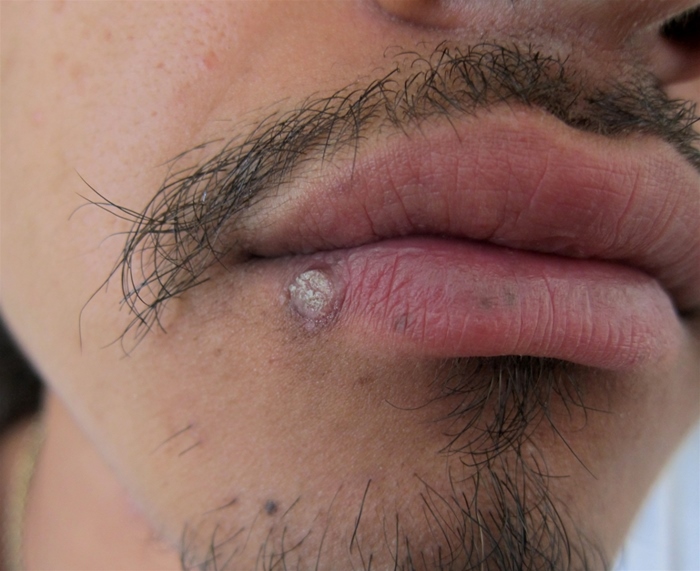 What is the best treatment option for this patient?
 (Multiple Choice)
4.7/5 (83)
(83) A 34-year-old man comes to the office with 2 weeks of left forefoot pain. He is a runner and has participated in many marathons without any problem. For the past 2 months, he has been training for a cross-country race with hill runs. His pain has worsened to the point that he has had to stop in the middle of many training sessions. The pain improves with rest. Holding the left second toe and pushing it in toward the foot produces pain. X-rays of the left foot are normal.
Which of the following is the most likely diagnosis?
(Multiple Choice)
4.7/5 (81)
(81) A 22-year-old man comes to the physician because he is concerned about developing Lyme disease. He found a tick on his right leg during a hike in Connecticut five days ago. He describes a two millimeter red dot on his leg where he removed the tick, which has since disappeared. He has no current complaints and a comprehensive review of systems is negative. He has no other medical conditions and takes no medications.
His temperature is 36.5 C (97.7 F), blood pressure is 120/70 mm Hg, pulse is 82/min, and respirations are 14/min. Skin examination shows no rashes and a healed area on his right leg at the site of the tick bite. The remainder of the examination shows no abnormalities.
Which of the following is the best advice for the patient?
(Multiple Choice)
4.7/5 (90)
(90) A 38-year-old man comes to the physician with intermittent abdominal pain for several months. The pain is in the epigastric area and is often worse with food intake. He has tried over-the-counter antacids and H2 blockers with minimal relief. He reports occasional nausea but denies vomiting, hematemesis, or melena.
His past medical history is significant for asthma diagnosed 2 years ago, for which he uses an albuterol inhaler. Two months ago, he was hospitalized for pneumonia and asthma exacerbation and was treated with steroids and antibiotics. The patient immigrated to the United States 5 years ago from Laos. He does not use tobacco, alcohol, or illicit drugs. He denies HIV risk factors and known exposure to tuberculosis.
His temperature is 36.7 C (98 F), blood pressure is 122/70 mm Hg, and pulse is 77/min. Physical examination is unremarkable.
Laboratory results are as follows:
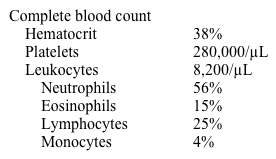 Serum chemistry and liver function tests are normal. Chest CT is unremarkable. Two stool samples for ova and parasites are negative.
What is the best next step in management of this patient?
Serum chemistry and liver function tests are normal. Chest CT is unremarkable. Two stool samples for ova and parasites are negative.
What is the best next step in management of this patient? (Multiple Choice)
4.9/5 (81)
(81) A 74-year-old man is admitted to the intensive care unit due to progressive shortness of breath for the last several days. He has a past medical history of coronary artery bypass grafting at age 50, mitral valve repair at age 64, ischemic cardiomyopathy with left ventricular ejection fraction of 20%, atrial fibrillation, type 2 diabetes mellitus, peripheral vascular disease, and stage III chronic kidney disease. The patient has had several hospital admissions for decompensated congestive heart failure over the past 2 years.
His temperature is 37.2 C (99 F), blood pressure is 90/60 mm Hg, pulse is 96/min, and respirations are 22/min. The patient's pulse oximetry is 88% on room air. He is in mild respiratory distress. Jugular venous pressure is elevated at 15 cm H2O. Lung examination reveals decreased breath sounds at the bases with bibasilar crackles up to the middle of the chest. Cardiac examination reveals irregular heart tones and a II/VI holosystolic murmur heard over the cardiac apex. There is 3+ lower extremity edema up to the mid thighs.
ECG shows atrial fibrillation at a rate of 94/min and low-voltage QRS complexes in the precordial leads. Chest x-ray reveals cardiomegaly and significant pulmonary vascular congestion in addition to small bilateral pleural effusions.
Which of the following best describes the benefits of milrinone infusion in this patient?
(Multiple Choice)
4.8/5 (83)
(83) A 76-year-old woman comes to the office for preoperative evaluation. She has had worsening pain in her left knee with occasional swelling over the past several months. Her daughter has had to assist with household chores because the patient has difficulty using the stairs due to pain. Two weeks earlier she was seen by an orthopedic surgeon who recommended knee replacement surgery. The patient has no chest pain, although she admits she is not very active due to the knee pain. She also has no palpitations or shortness of breath while lying flat. Her other medical problems include obesity, hypertension, type 2 diabetes mellitus, obstructive sleep apnea, and history of peptic ulcer disease. Current medications include metformin, atorvastatin, and lisinopril. The patient monitors her blood glucose at home, with values around 110 mg/dL. She had a femoral hernia surgery 12 years ago without complications.
Blood pressure is 132/76 mm Hg and pulse is 72/min. BMI is 33.1 kg/m2. Examination shows normal jugular venous distension and no carotid bruits. Heart sounds are normal and the lungs are clear to auscultation.
Hemoglobin is 12.2 g/dL, creatinine is 0.7 mg/dL, and potassium is 4.3 mEq/L. ECG shows normal sinus rhythm with T-wave inversion in lead III.
Which of the following is the most appropriate next step before surgery?
(Multiple Choice)
5.0/5 (83)
(83) A 73-year-old woman comes to the office because of achiness. She began to notice pain around her shoulders and hips six weeks ago. The symptoms developed abruptly without an antecedent illness. She notes considerable stiffness around her neck and shoulders in the morning when she gets out of bed and has difficulty dressing herself. She has some soreness in both hips, but these symptoms slowly clear by midday. She denies any cranial complaints. She has never had similar muscle or joint achiness before. She has no fever, chills, weight loss, or headache. She tried over-the-counter ibuprofen, which did not relieve her pain.
Her past medical history is notable for hypertension, hyperlipidemia, coronary artery disease, transient ischemic attack. Her medications include aspirin, hydrochlorothiazide, hydralazine, isosorbide, a statin, and a beta blocker. She has had no medication changes in the last year. She is allergic to angiotensin converting enzyme inhibitors.
Physical examination is within normal limits except for some mild restriction of bilateral shoulder abduction. She does not have any swollen joints.
Her laboratory results are as follows:
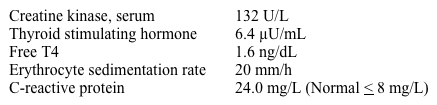 Her complete blood count, serum electrolytes, and liver and kidney function studies are normal.
Which of the following is the most appropriate next step in management?
Her complete blood count, serum electrolytes, and liver and kidney function studies are normal.
Which of the following is the most appropriate next step in management? (Multiple Choice)
4.7/5 (90)
(90) An 82-year-old woman comes to the physician due to sadness, anxiety, tearfulness, insomnia, and weight loss. She lies awake at night worrying and no longer has any interest in her usual hobby of playing bridge or visiting her grandchildren. She has lost 6.8 kg (15 lb) over the past 2 months. Physical examination and laboratory results, including thyroid function tests, are normal.
Which of the following medications would be best to treat this patient's symptoms?
(Multiple Choice)
4.8/5 (78)
(78) A 36-year-old man comes to the physician for a routine visit. He has no complaints except for gradual weight gain over the past few years. He is an administrative assistant in a law firm and spends most of his time working at his desk. He eats mainly fast food for lunch and drinks a few beers while watching television on weekends. The patient does not use tobacco or recreational drugs. He has no family history of coronary heart disease, hypertension, or diabetes mellitus. His father died at age 47 in a ski accident. His mother is 66 years old and has no medical problems.
The patient's blood pressure is 124/70 mm Hg, pulse is 70/min, and body mass index is 30 kg/m2. He has no other notable physical findings such as acanthosis, skin or tendon xanthomas, or thyromegaly. Examination of his fundi is normal.
Fasting laboratory results are as follows:
 His serum creatinine, liver function tests, and thyroid-stimulating hormone are normal. His calculated 10-year risk of cardiovascular disease is approximately 1%.
In addition to lifestyle modification, which of the following is the most appropriate next step in management of this patient?
His serum creatinine, liver function tests, and thyroid-stimulating hormone are normal. His calculated 10-year risk of cardiovascular disease is approximately 1%.
In addition to lifestyle modification, which of the following is the most appropriate next step in management of this patient? (Multiple Choice)
5.0/5 (80)
(80) A 29-year-old man comes to the physician because of high fevers, headache, and muscle pains mainly in the lower back and thighs. His symptoms began abruptly 2 days ago. He returned from a two-week vacation in Costa Rica 6 days ago, and did not receive any vaccinations prior to travel. During his trip, he ate local foods, drank alcohol, visited the beach, and participated in a 4-day river rafting excursion. He denies any sick contacts and reports no direct contact with animals. He has no past medical history.
His temperature is 39.4 C (103 F), blood pressure is 120/70 mm Hg, pulse is 90/min, and respirations are 14/min. Examination reveals an uncomfortable appearing man in no acute distress. His skin is warm and flushed, but there is no rash. Eye examination reveals bilateral redness of the conjunctiva. There is no lymphadenopathy. The abdomen is soft with mild right upper quadrant tenderness. The liver edge is palpable 2 cm below the costal margin. There is no rebound tenderness or involuntary guarding. There is tenderness over the lumbar paraspinal muscles bilaterally. The remainder of the examination is unremarkable.
Laboratory results are as follows:
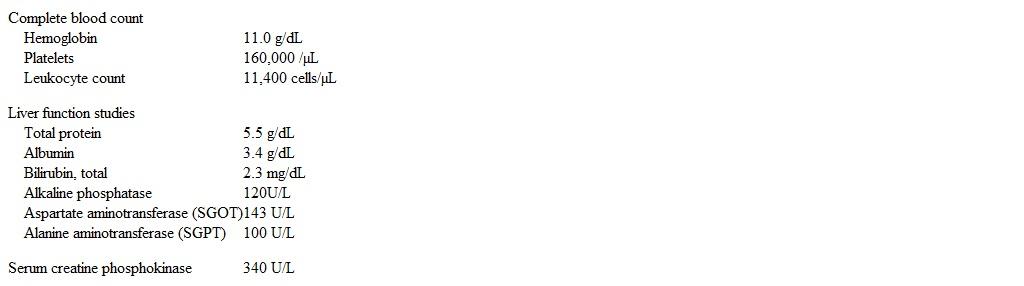 Urinalysis shows 10-20 WBC/hpf and 2+ proteinuria.
Which of the following is the most likely cause of this patient's illness?
Urinalysis shows 10-20 WBC/hpf and 2+ proteinuria.
Which of the following is the most likely cause of this patient's illness? (Multiple Choice)
4.7/5 (76)
(76) An 18-year-old woman with a history of acne comes to her primary care physician because of headaches for the past 3 months. The headaches are holocranial and pulsatile in quality. They are worsened by lying flat and improved by sitting up. She also experiences blurry vision and a "whooshing sound" occurring with the headaches. She denies photophobia, fever, nausea, and vomiting during the headaches. The headaches occur daily and fluctuate in intensity. Her current medications include isotretinoin for her acne. She has no known drug allergies. She does not use alcohol, tobacco, or illicit drugs.
Her blood pressure is 130/70 mm Hg and pulse is 70/min. Her BMI is 34 kg/m2.
Which of the following should be closely examined during the neurologic evaluation of this patient?
(Multiple Choice)
4.9/5 (77)
(77) A 45-year-old woman comes to the physician with a facial rash she has had for the last several months. She also has occasional facial flushing. The patient has no systemic or musculoskeletal problems, takes no medications, and has regular menstrual periods. She has no significant past medical history. Her mother has disabling rheumatoid arthritis. The general physical examination is unremarkable. The skin findings are shown in the photograph below.
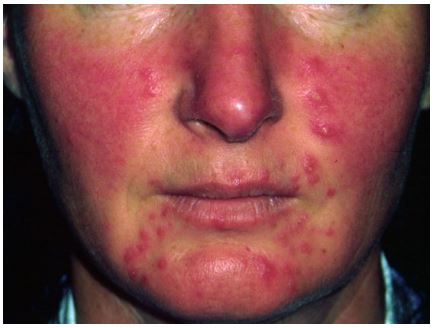 Which of the following is the best next step in the management of this patient?
 (Multiple Choice)
4.9/5 (88)
(88) An 87-year-old woman is brought to the office for a lesion on her back. She lives by herself and is very reluctant to seek medical care. Her daughter, who is visiting from out of state, found a foul-smelling discharge coming from the lesion. The lesion has gradually enlarged over the past 3-4 years, and the patient has cleaned it with over-the-counter antiseptics. She has a history of sunburn in the area many years ago. She has no pain or fever. The patient has no other medical conditions. She does not use tobacco or alcohol.
The lesion is shown in the image below. She has no other masses or lymphadenopathy.
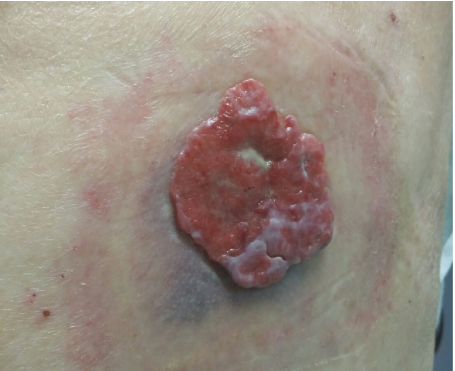 Which of the following is the most likely diagnosis?
 (Multiple Choice)
4.7/5 (80)
(80) 
Filters
- Essay(0)
- Multiple Choice(0)
- Short Answer(0)
- True False(0)
- Matching(0)