



 Chat with AI
Exam 3: Office/Health Center

Exam 1: Emergency Department218 Questions
Exam 2: In-patient Facilities128 Questions
Exam 3: Office/Health Center900 Questions
Select questions type


A 38-year-old man comes to the physician because of difficulty walking for the past 1 week. His medical problems include hypertension, type 2 diabetes mellitus, hyperlipidemia, and osteoarthritis of the left hip. He underwent gastric bypass surgery 5 weeks ago for morbid obesity.
Neurological examination shows a left foot drop with strength in the left leg as follows: dorsiflexion 1/5, foot eversion 2/5, foot inversion 5/5, and plantar flexion 5/5. Sensory examination shows decreased pin prick sensation over the dorsum of the left foot. The remainder of the neurological examination is unremarkable.
Which of the following sites has this patient most likely injured?
(Multiple Choice)
4.7/5  (87)
(87) An 18-year-old man comes to the physician with bilateral breast enlargement. He has not seen a physician for the past 6 years. He says that his puberty was "somewhat delayed." The patient has no past medical problems and takes no medications. He does not use tobacco, alcohol, or illicit drugs. He has not used any "steroids" to build muscle.
The patient is 6' 2" (188 cm) tall and weighs 187 lbs (85 kg). He has sparse facial hair. His axillary and pubic hair is normal. He has Stage 3 bilateral gynecomastia without any mass or nipple discharge. Visual fields are normal on confrontation. The testes are firm and small (8 mL).
Laboratory evaluation shows normal hematocrit and basic metabolic profile. Serum luteinizing and follicle-stimulating hormones are elevated and testosterone is low. Serum prolactin and thyroid-stimulating hormone are normal.
The patient is at highest risk for a malignancy at which of the following sites?
(Multiple Choice)
4.7/5 (99)
(99) A 61-year-old postmenopausal woman comes to the office due to leakage of urine. The patient reports increased urinary frequency and voids 1 or 2 times per hour. She often awakens at night with an immediate need to void and occasionally does not make it to the bathroom in time.
The patient has mild intermittent asthma controlled with an albuterol inhaler. Her other medications include low-dose aspirin and a multivitamin. She had 2 cesarean deliveries, the last of which was complicated by a venous thromboembolism after delivery.
Vital signs are normal. BMI is 27 kg/m2. Pelvic examination reveals a thin, atrophic vagina. Cough stress test is negative and postvoid residual volume is 65 mL. Urinalysis and urine culture are normal.
Which of the following is the best next step in management of this patient?
(Multiple Choice)
5.0/5 (89)
(89) A 65-year-old woman comes to the physician because of worsening right shoulder stiffness for the last 3 months. She denies any trauma or previous shoulder problems. She also reports a history of chronic low back pain and knee pain. She works as a librarian and has been lifting more books recently since her library expanded its book collection. Her other medical problems include diabetes, hypertension, and hypercholesterolemia.
Her temperature is 36.5 C (97.7 F), blood pressure is 130/80 mm Hg, pulse is 85/min, and respirations are 14/min. Her lungs are clear and her heart sounds are normal. Muscle strength is 5/5 in the lower extremities with intact sensation and 5/5 in the biceps bilaterally. She has markedly decreased passive and active range of motion in right shoulder. Her reflexes are 2+ throughout and she has a normal gait. The remainder of her physical examination is within normal limits.
Which of the following is most appropriate next step in management?
(Multiple Choice)
4.8/5 (87)
(87) A 35-year-old woman with no significant past medical history comes to the physician due to muscle and joint pains over her entire body for the past 6 months. She feels as if she has "the flu" all the time. The patient also experiences fatigue, mental slowness, and occasional headaches. Vital signs are within normal limits. On examination, she has tenderness to gentle palpation over the muscles of her neck, shoulders, and back. There is no synovitis. Laboratory results show normal electrolytes, complete blood count, erythrocyte sedimentation rate, and thyroid function.
Which of the following is the best initial therapy to improve this patient's symptoms?
(Multiple Choice)
4.9/5 (82)
(82) A 65-year-old man comes to the physician for evaluation of a recent x-ray abnormality. Three months ago, he experienced a mild episode of diverticulitis. An abdominal film at that time revealed an abnormality in the pelvis. His diverticular disease has abated and he presents for follow-up. The patient occasionally has some mild aching pain in his left hip and groin area that he attributes to arthritis. He has chronic low back pain that is worse on arising in the morning and improves after ambulation.
The patient has had no fever, chills, or weight loss. He gets up to urinate about three times a night and says that his urine stream isn't what it used to be. He has intermittent gastroesophageal reflux and hypertension. His current medications include lisinopril, lansoprazole, ibuprofen, baby aspirin, and a multivitamin.
The patient appears healthy on examination. His temperature is 36.9 C (98.5 F), blood pressure is 138/88 mm Hg, pulse is 72/min, and respirations are 14/min. BMI is 29 kg/m2. His general examination is within normal limits. Digital rectal examination shows normal sphincter tone and a mildly enlarged soft prostate. There is good range of motion of his hips. There is limited range of motion of his back. He has no motor or sensory deficits of his lower extremities, and reflexes are 2+ and symmetrical.
Laboratory results are as follows:
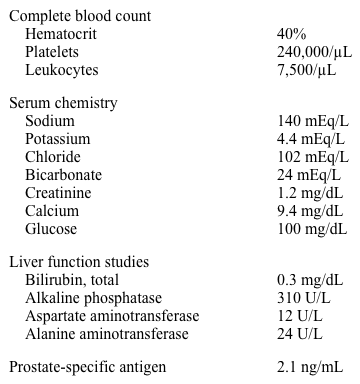 A review of the x-rays reveals thickening of the femoral neck and diffuse sclerosis of bone that is most prominent in the left hemi-pelvis.
Which of the following would be the most appropriate next step?
A review of the x-rays reveals thickening of the femoral neck and diffuse sclerosis of bone that is most prominent in the left hemi-pelvis.
Which of the following would be the most appropriate next step? (Multiple Choice)
4.9/5 (83)
(83) A 50-year-old woman seeks follow-up for chronic kidney disease diagnosed during routine laboratory workup before knee surgery. A 24-hour urine shows 1.5 g/day of proteinuria, and urinalysis shows a few granular casts. Her history, physical examination, and screening laboratory findings do not indicate a cause for her chronic kidney disease. A renal ultrasound reveals echogenic kidneys measuring about 9 cm bilaterally without evidence of obstructive uropathy. She takes no medications.
Her blood pressure is 152/92 mm Hg and pulse is 79/min. The physical examination is within normal limits.
The patient's most recent laboratory results are as follows:
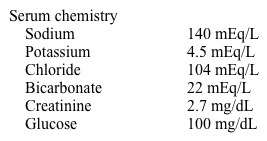 Which of the following would be the best therapeutic agent for this patient?
 (Multiple Choice)
5.0/5 (64)
(64) A 65-year-old man comes to the physician for difficulty falling asleep. He experiences discomfort in the lower extremities and a strong urge to move his legs, which occurs just as he is about to fall asleep. His wife is awakened because of his excessive leg movements. The patient has no headaches, tremors, weakness, or numbness. He has hypertension and takes lisinopril and daily low-dose aspirin. He is a chronic smoker but does not use alcohol or illicit drugs.
Vital signs and neurological examination are unremarkable.
A complete blood count and serum iron studies are normal.
Which of the following is the best initial treatment for this patient's condition?
(Multiple Choice)
5.0/5 (73)
(73) A 35-year-old man comes to the office due to fatigue, palpitations, and weight loss. He has lost more than 4.5 kg (10 lb) in the last few months. He has been under a lot of stress at work, and his sleep is poor. The patient also has bilateral eye irritation, excessive tearing, and redness. He has no fever, shortness of breath, bone pain, or abdominal symptoms. He takes lisinopril for hypertension.
The patient tested negative for HIV 5 months ago after a new sexual encounter. He takes no over-the-counter medications. He smoked cigarettes for a year when he was in his early 20s. The patient drinks a glass of red wine every Friday. He works as a manager in a department store. His father died of prostate cancer at age 65, and his mother had a lumpectomy for breast cancer.
Temperature is 37.2 C (99 F), blood pressure is 150/80 mm Hg, pulse is 104/min and regular, and respirations are 18/min. The patient has no enlarged lymph nodes, and his spleen is not palpable. There is swelling of soft tissues around his eyes but no proptosis. The remainder of the physical examination is unremarkable.
Laboratory results are as follows:
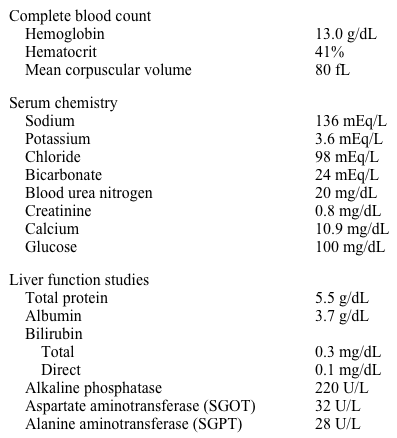 Repeat serum calcium is 10.8 mg/dL. Serum parathyroid hormone is 7 pg/mL, 1,25-dihydroxyvitamin D is 19 pg/mL (25-65 pg/mL), and 25-hydroxyvitamin D is 30 ng/mL (15-80 ng/mL).
Which of the following is most likely to provide the etiology for this patient's hypercalcemia?
Repeat serum calcium is 10.8 mg/dL. Serum parathyroid hormone is 7 pg/mL, 1,25-dihydroxyvitamin D is 19 pg/mL (25-65 pg/mL), and 25-hydroxyvitamin D is 30 ng/mL (15-80 ng/mL).
Which of the following is most likely to provide the etiology for this patient's hypercalcemia? (Multiple Choice)
4.9/5 (74)
(74) A 69-year-old man comes to the office with a 4-week history of fatigue. He feels "drained" by the end of the day. He has no chest pain, shortness of breath, or body aches but does have decreased exercise tolerance. He reports good appetite and no recent weight changes. His medications include amlodipine for hypertension and rosuvastatin for hyperlipidemia. His temperature is 36.8 C (98.3 F) and blood pressure is 144/90 mm Hg. Body mass index is 22 kg/m2.
Initial laboratory studies show hemoglobin of 14.2 g/dL, serum potassium of 4.6 mEq/L, and serum creatinine of 0.8 mg/dL. Fasting glucose level is 98 mg/dL. Electrocardiogram is shown here.
Which of the following is the best next step in management of this patient?
(Multiple Choice)
4.8/5 (74)
(74) A 63-year-old man comes to the physician because of high blood glucose levels on home monitoring. His medical problems include type 2 diabetes mellitus, hypertension, hyperlipidemia, obstructive sleep apnea, and obesity. His current medications include metformin, glyburide, hydrochlorothiazide, amlodipine, lisinopril, simvastatin, and aspirin. He was diagnosed with type 2 diabetes 14 years ago, and he has been non-compliant with his diet and exercise plan. He uses CPAP every night.
For the last few weeks, his fasting glucose levels on home monitoring averaged around 250 mg/dL. He complains of excessive urination and a 6 lb (2.7 kg) weight loss over the last few months. He seems to be motivated to do whatever it takes to decrease his blood glucose levels.
His blood pressure is 130/80 mm Hg, pulse is 92/min, and respirations are 16/min. The patient's body mass index is 30 kg/m2. The remainder of the physical examination is within normal limits, except for trace pitting edema to his ankles bilaterally.
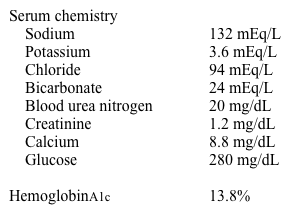 In addition to implementing rigorous lifestyle changes, which of the following is the most appropriate treatment modification?
 (Multiple Choice)
4.9/5 (83)
(83) A 60-year-old man comes to the office for presurgical evaluation before right-sided total knee replacement. He has pain and limited mobility due to severe knee osteoarthritis, and has gained 4.5 kg (10 lb) over the last 6 months due to decreased physical activity. Other medical problems include coronary artery disease, hypertension, and hyperlipidemia. Four months ago, the patient underwent sirolimus-eluting stent implantation into the left anterior descending artery due to angina. Current medications are low-dose aspirin, prasugrel, metoprolol, valsartan, and rosuvastatin.
ECG shows sinus rhythm with no pathologic Q waves or ST-segment abnormalities. Echocardiogram shows normal left ventricular systolic function and no wall motion abnormalities.
Which of the following is the best recommendation for this patient before surgery?
(Multiple Choice)
4.8/5 (79)
(79) A previously healthy 35-year-old woman comes to the physician due to daily headaches of 3 months duration. Her headaches are unilateral, throbbing, and associated with ipsilateral lacrimation and conjunctival injection. The headaches occur 6-10 times a day, and each lasts about 10 minutes. They are always at the same location in the left temporal region and are unpredictable. The patient has not had head or neck trauma, photophobia, phonophobia, nausea, vomiting, neck stiffness, fevers, or visual symptoms. She has been taking acetaminophen on an as-needed basis (<3 days a week) without any improvement. The patient has no other medical problems.
Her vital signs are within normal limits. Neurologic examination is nonfocal.
An MRI of the brain reveals no abnormalities. The patient is started on a trial of indomethacin 75 mg daily, and her headaches dramatically improve.
Which of the following is the most likely diagnosis?
(Multiple Choice)
4.9/5 (77)
(77) A 44-year-old man comes to the office due to transient vision loss in his right eye. He has experienced fatigue, warmth, and unintentional weight loss over the last 2 months. HIV testing 4 weeks ago was negative. Family history is unremarkable.
The patient's blood pressure is 122/70 mm Hg and pulse is 78/min. A faint diastolic murmur is heard at the apex.
ECG shows T-wave inversion in the lateral leads. Two sets of blood cultures are negative.
Which of the following is the most likely diagnosis in this patient?
(Multiple Choice)
4.8/5 (74)
(74) A 36-year-old woman comes to the office due to weight gain of 9 kg (20 lb), facial hair growth, easy bruising, and muscle weakness over the last 4 months. She has no other medical problems and takes no medications.
Blood pressure is 148/90 mm Hg and pulse is 80/min. BMI is 31 kg/m2. The patient has an unusually round face with deposition of fat in the supraclavicular and posterior neck areas. There is coarse terminal hair on her face and lower abdomen. Skin examination reveals wide striae on the abdomen. There is also mild proximal muscle weakness.
Laboratory results are as follows:
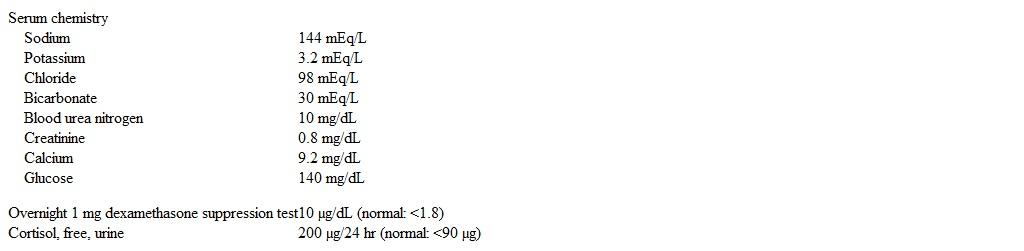 Pregnancy test is negative.
Which of the following is the most appropriate next step in management of this patient?
Pregnancy test is negative.
Which of the following is the most appropriate next step in management of this patient? (Multiple Choice)
4.8/5 (72)
(72) A 78-year-old man comes to the office due to depressed mood, decreased appetite, difficulty concentrating, and hypersomnia. He has lost interest in his hobby of woodworking and no longer enjoys socializing with friends and family. The patient has no previous psychiatric history. His other medical problems include hypertension, dyslipidemia, type II diabetes, and peripheral neuropathy that has seemed "a lot more painful lately." He takes lisinopril, atorvastatin, metformin, sitagliptin, and pregabalin.
Physical examination shows distal loss of sensation to pinprick, light touch, and vibration in the feet and lower legs bilaterally. Laboratory studies are unremarkable. Based on this presentation, the patient is diagnosed with major depressive disorder.
Which of the following antidepressant medications would be best for this patient?
(Multiple Choice)
4.9/5 (88)
(88) A 69-year-old woman comes to the physician with right calf pain when walking. The pain has been present for several months but is now starting to limit her daily walks and shopping. It is described as a deep ache or cramp. The pain initially occurred after the patient walked 6 blocks, but now occurs after 2 blocks. It dissipates rapidly with rest. She has no chest pain or leg edema. The patient has a history of hypertension, hyperlipidemia, diet-controlled type 2 diabetes mellitus, and cigarette use. She has reduced her smoking to about 10 cigarettes a day. Her medications include simvastatin, ramipril, aspirin, calcium, and vitamin D.
The patient's blood pressure is 128/77 mm Hg and pulse is 72/min. Cardiac, lung, and abdominal examinations are unremarkable. Her femoral pulses are 2+ and symmetrical. Popliteal and dorsalis pedis pulses on the right feel diminished relative to the left. Her ankle-brachial index is 0.7 on the right and 0.9 on the left.
Electrocardiogram shows normal sinus rhythm and non-specific ST-segment and T-wave changes.
After smoking cessation, aggressive risk factor modification, and a supervised incremental walking program, which of the following would be the best next step in management if life-style-limiting claudication persists?
(Multiple Choice)
5.0/5 (86)
(86) A 49-year-old woman comes to the physician for evaluation of a rash on her back and shoulders. She initially noticed the rash nearly 2 years ago. The rash began as a red scaly area that progressed from the shoulders to the neck region and upper back. There was no pruritus, and the rash spontaneously resolved after a few days. The patient has had a recurrence of the rash every 2-3 months since that time.
Skin examination (Image shown below) shows erythematous and scaly papules with crusted margins. There is no drainage from the lesions or tenderness to palpation. The remainder of her physical examination is normal.
 Which of the following is the most likely diagnosis?
 (Multiple Choice)
4.7/5 (83)
(83) A 57-year-old man complains of right-sided leg and thigh pain and fatigue while walking. He has no chest pain, syncope, nausea, or abdominal pain. He has developed moderate erectile dysfunction over the past year. The patient's other medical problems include chronic kidney disease, hypertension, hyperlipidemia, gout, and gastroesophageal reflux disease. He also has a 40-pack-year smoking history and continues to smoke.
His blood pressure is 144/92 mm Hg, pulse is 67/min, and body mass index is 29 kg/m2. A bruit is heard over the right carotid artery. Peripheral pulses are palpable bilaterally. There is a small ulcer at the tip of the right big toe. The ankle-brachial index is 1.0 bilaterally (normal 0.9-1.3). Laboratory results are significant for serum creatinine of 1.6 mg/dL and HbA1c of 7.5%.
Which of the following is the most appropriate next step in management of this patient's leg pain?
(Multiple Choice)
4.8/5 (86)
(86) A 56-year-old man from Southeast Asia comes to the physician because of fatigue, low grade fever, and left upper abdominal discomfort for the past 1 month. He denies bleeding, recent infections, or previous hospitalizations. His other medical problems include hypertension, for which he is taking hydrochlorothiazide and atenolol.
Vital signs are within normal limits. Examination shows massive splenomegaly and moderate hepatomegaly. There is no lymphadenopathy. Cardiopulmonary examination is normal. The remainder of the examination is within normal limits.
Laboratory results are as follows:
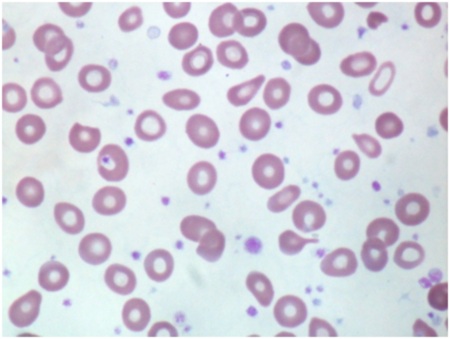
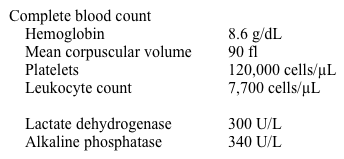 Peripheral blood smear is shown below:
 Which of the following is the most likely diagnosis?
Peripheral blood smear is shown below:
Which of the following is the most likely diagnosis? (Multiple Choice)
4.8/5 (81)
(81) 
Filters
- Essay(0)
- Multiple Choice(0)
- Short Answer(0)
- True False(0)
- Matching(0)