



 Chat with AI
Exam 3: Office/Health Center

Exam 1: Emergency Department218 Questions
Exam 2: In-patient Facilities128 Questions
Exam 3: Office/Health Center900 Questions
Select questions type


A 64-year-old woman comes to the emergency department with a 3-day history of intermittent fever, cough with blood-tinged sputum, night sweats, and generalized malaise. She also reports right-sided chest pain on deep inspiration over the last 24 hours. The patient was diagnosed with breast cancer and is undergoing combination chemotherapy. Her other medical problems include moderate chronic obstructive pulmonary disease and hypothyroidism.
Her temperature is 38.2 C (100.8 F), blood pressure is 107/64 mm Hg, pulse is 110/min, and respirations are 18/min. Pulse oximetry is 93% on room air. Physical examination is notable for pale conjunctiva. Lung examination shows scattered rhonchi, and cardiac examination is significant for tachycardia without murmurs. The abdomen is soft and nontender without organomegaly. There are no skin rashes.
Laboratory results are as follows:
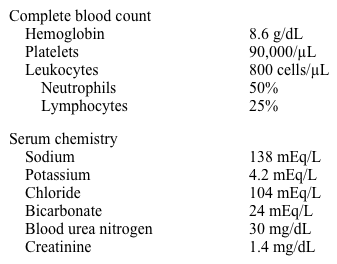 The patient is started on vancomycin and piperacillin/tazobactam and fails to improve clinically after 3 days of treatment. Computed tomography scan of the chest shows several small (1-2 cm) nodular lesions scattered throughout the lung with surrounding ground-glass attenuation.
Blood and sputum cultures are negative, and bronchoscopy and bronchoalveolar lavage are performed for cultures and cytology.
Which of the following is the best next step in management of this patient?
The patient is started on vancomycin and piperacillin/tazobactam and fails to improve clinically after 3 days of treatment. Computed tomography scan of the chest shows several small (1-2 cm) nodular lesions scattered throughout the lung with surrounding ground-glass attenuation.
Blood and sputum cultures are negative, and bronchoscopy and bronchoalveolar lavage are performed for cultures and cytology.
Which of the following is the best next step in management of this patient? (Multiple Choice)
4.8/5  (71)
(71) A 65-year-old woman comes to the office to discuss the results of a screening DXA test. She has been healthy all her life, has no chronic medical conditions, and takes no medications. The patient experienced menopause at age 52; she was treated with combined estrogen/progestin menopausal hormone therapy due to hot flashes but discontinued the treatment after a few months due to concerns regarding adverse effects. She has experienced a 1 cm (0.4 in) loss of height since that time. The patient quit smoking 30 years ago and drinks wine only on social occasions. She lives alone and has no children. Her mother died of breast cancer at age 56 and her father died at age 82 from a stroke.
BMI is 22 kg/m2. Physical examination is unremarkable.
DXA reveals a T score of −2.1 and −2.6 at femoral neck and lumbar spine, respectively. Complete blood count, comprehensive metabolic panel, and serum phosphorus are normal.
Which of the following additional investigations should be performed for this patient at this time?
(Multiple Choice)
4.8/5 (72)
(72) A 36-year-old man comes to the physician with decreased appetite, right-sided facial pain, and fever. He also complains of scant nasal discharge. He has had 3 episodes of sinusitis over the last year that responded well to amoxicillin-clavulanate. Six months ago, he was hospitalized with pneumonia and treated with intravenous antibiotics. His past medical history is unremarkable. He does not use tobacco, alcohol, or illicit drugs. He lives with his girlfriend and has 1 child.
His temperature is 38.3° C (101° F), blood pressure is 144/90 mm Hg, and pulse is 90/min. The right maxillary sinus is tender to palpation. He has 3 small, mobile submandibular nodes. Cardiopulmonary examination is within normal limits. Both upper extremities and the chest have areas of hypopigmented skin.
Laboratory results are as follows:
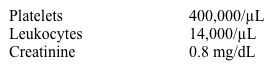 Urinalysis is unremarkable. Rapid HIV test is negative.
Which of the following conditions is the most likely diagnosis?
Urinalysis is unremarkable. Rapid HIV test is negative.
Which of the following conditions is the most likely diagnosis? (Multiple Choice)
4.8/5 (77)
(77) A 32-year-old woman comes to the office to follow up abnormal liver function tests. She is experiencing mild fatigue but has no abdominal symptoms. The patient's other medical problems include gastroesophageal reflux disease, vitiligo, hypothyroidism, and iron deficiency anemia attributed to heavy menses. The patient takes iron supplements, levothyroxine, and a daily multivitamin. She has no family history of liver problems. She does not smoke and drinks alcohol socially.
BMI is 22.5 kg/m2. Examination shows a 5-cm area of skin depigmentation on the right arm. The thyroid gland is not enlarged and there is no nodularity. The lungs are clear to auscultation. No hepatosplenomegaly is noted. Peripheral pulses are 2+ bilaterally throughout.
Laboratory results are as follows:
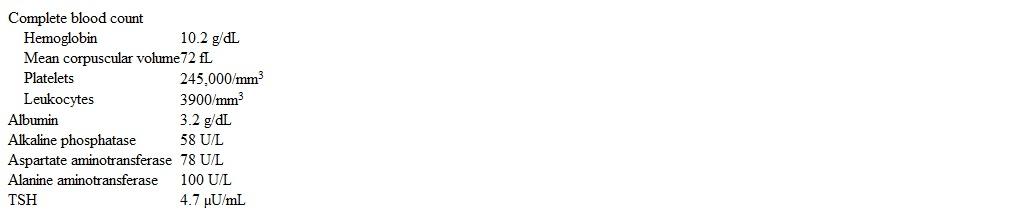 Viral hepatitis serologies are negative.
Which of the following is the most likely diagnosis?
Viral hepatitis serologies are negative.
Which of the following is the most likely diagnosis? (Multiple Choice)
4.8/5 (81)
(81) A 34-year-old man comes to the physician due to high fever, malaise, and intermittent headaches for the last 4-5 days. He has no nausea, vomiting, abdominal pain, or neck stiffness. He recently returned from hiking for several days in wooded areas in Missouri. His past medical history is unremarkable.
The patient's temperature is 38.9 C (102 F), blood pressure is 118/78 mm Hg, pulse is 100/min, and respirations are 16/min. Physical examination shows a faint, non-pruritic, maculopapular rash confined to the trunk without central clearing. The remainder of the physical examination is unremarkable.
Laboratory results are as follows:
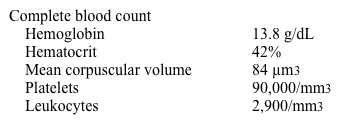 Which of the following is the most likely cause of his current condition?
 (Multiple Choice)
4.9/5 (85)
(85) A 51-year-old woman comes to the office due to excessive sweating at night. She has had type 2 diabetes mellitus for the past 10 years and was started on insulin therapy 3 years ago due to suboptimal glycemic control (hemoglobin A1c 11%) on glipizide and metformin; metformin was continued but glipizide was stopped at that time. In addition to metformin, the patient currently takes 34 units of insulin glargine at bedtime and 6 units of insulin lispro before meals 3 times a day. She also eats a bedtime snack daily and has gained about 3.2 kg (7 lb) since insulin therapy was started. The patient has no chronic complications of diabetes mellitus. Medical history is notable for obstructive sleep apnea, hypertension, dyslipidemia, and obesity. She does not work, has a sedentary lifestyle, and does not use tobacco or alcohol.
Blood pressure is 140/90 mm Hg and pulse is 80/min. BMI is 34 kg/m2. Jugular venous pressure is not elevated. There is trace pedal edema. The remainder of the physical examination is normal.
Hemoglobin A1c is 6.7%. Fingerstick blood glucose levels (mg/dL) for the 4 days prior to the office visit are as follows:
 Which of the following is the most appropriate next step in management of this patient's diabetes mellitus?
 (Multiple Choice)
4.9/5 (66)
(66) An 80-year-old man comes to the office due to generalized weakness and intermittently feeling "dizzy" and unsteady over the past year. He fell 9 months ago when he tripped over a step. The patient has had no syncope or chest pain and has not attempted to use any mobility aids. History is notable for hypertension, type 2 diabetes mellitus, hypercholesterolemia, osteoarthritis, coronary artery disease, and gastroesophageal reflux disease. Current medications include metformin, glipizide, hydrochlorothiazide, aspirin, atenolol, simvastatin, and omeprazole. The patient does not use tobacco or alcohol.
Blood pressure is 150/90 mm Hg and pulse is 68/min. There are no orthostatic changes. BMI is 30 kg/m2. Examination shows normal jugular venous pressure, clear lung fields, and normal S1 and S2. The abdomen is soft and nontender. There is no tenderness to palpation of the lower back. There are symmetric joint deformities of both knees and generalized arthritic changes in both hands. Cranial nerve examination is normal. Muscle power is 4/5 in both upper and lower extremities. Pinprick and light touch sensations are mildly decreased in both feet. Achilles reflexes are absent bilaterally.
Complete blood count, basic metabolic panel, and vitamin D levels are normal. Hemoglobin A1c is 8.2%. ECG shows normal sinus rhythm and old Q waves in lateral leads.
Which of the following is the most effective strategy to decrease this patient's risk for falls?
(Multiple Choice)
4.8/5 (79)
(79) A 29-year-old woman, gravida 1 para 0 aborta 1, comes to the office due to amenorrhea. Prior to initiation of oral contraceptives 7 years ago, she had regular menses every 31 days consisting of 5 days of heavy bleeding. While the patient was on oral contraceptives, her menses continued to be regular. She stopped taking oral contraceptives 8 months ago in anticipation of pregnancy but has yet to have a menstrual period. The patient has also had pain during intercourse and episodes of anxiety and flushing, which she attributes to "relationship problems." She has had no headaches, galactorrhea, or changes in vision.
Medications include levothyroxine for primary hypothyroidism. The patient's only surgery was a suction curettage for an elective termination of pregnancy at age 17. Her father has hypothyroidism and her brother has type 1 diabetes mellitus. The patient does not use tobacco, alcohol, or illicit drugs. She runs 5 miles a day.
Vital signs are within normal limits. BMI is 30 kg/m2. The thyroid gland is diffusely enlarged and firm. The remainder of the examination is within normal limits.
A urine pregnancy test is negative. Laboratory evaluation reveals normal prolactin and TSH levels. FSH is 66 mIU/mL and serum estradiol is low.
Which of the following is the most likely diagnosis in this patient?
(Multiple Choice)
4.9/5 (83)
(83) A 28-year-old woman comes to the office due to bilateral breast discomfort that occasionally interferes with physical activity. The pain begins the week prior to menses and subsides on the first day of her menstrual cycle, which occurs every 30 days; her last menstrual period was 3 weeks ago. Two years ago, she was diagnosed with leg vein thrombosis after an ankle fracture and was treated with a direct oral anticoagulant for 3 months. Family history is significant for osteoporosis in her grandmother and aunt.
Vital signs are normal. BMI is 26 kg/m2. Physical examination reveals bilateral, mildly tender nodularity of the upper lateral breast quadrants. There are no skin changes, palpable lymph node enlargement, or nipple discharge.
Which of the following is the best next step in management of this patient?
(Multiple Choice)
4.9/5 (73)
(73) An 80-year-old woman presents to the clinic with increasing fatigue, dizzy spells, and nausea. She has been followed for several years for osteoporosis, type 2 diabetes mellitus, depression, and mild cognitive impairment. She was recently started on treatment for systolic hypertension. She lives independently with support provided by a visiting nurse three times weekly. She performs all of her own activities of daily living.
Her current medications include alendronate, sertraline, metformin, and hydrochlorothiazide.
Her temperature is 36.7 C (98.1 F), blood pressure is 146/70 mm Hg supine and 139/75 mm Hg standing (160/75 mmHg during the previous visit), pulse is 84/min, and respirations are 14/min. She is 5' 5" (165 cm) and her BMI is 19 kg/m2. There is 2/6 ejection-type systolic murmur at the right upper sternal border without radiation to the carotids. Her lungs are clear. Muscle strength is preserved and deep tendon reflexes are symmetrical bilaterally. Her gait is mildly unsteady. Her mini-mental status exam score is 22/30 (1 year ago 27/30). Fingerstick glucose level is 220 mg/dL.
Which of the following is most likely responsible for this patient's current symptoms?
(Multiple Choice)
4.8/5 (79)
(79) A 28-year-old woman comes to the office because of frequent urination. She urinates approximately every 30 to 60 minutes during the day, which makes it difficult to concentrate at work and attend meetings. She also gets up 1 to 2 times per night to urinate. The patient drinks "a lot of fluid to stay caught up." She says that her 'migraines' have worsened recently and she occasionally feels nauseated. She got a new pair of glasses due to worsening of her vision, which she attributes to spending a lot of time at work. She has had no lower abdominal pain or dysuria.
Her other medical problems include anxiety disorder and knee trauma that she sustained three months ago while jogging. She required arthroscopic surgery and took opioid medications for pain control for two weeks. She has not experienced any knee pain since.
Her BMI is 18 kg/m2. Physical examination shows no abnormalities.
Laboratory results are as follows:
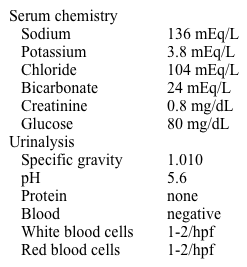 Urine pregnancy test is negative. Eight hours following a water deprivation, her weight remains unchanged and her plasma and urine osmolalties are 284 and 650 mOsm/kg H2O respectively.
Which of the following is the most likely diagnosis?
Urine pregnancy test is negative. Eight hours following a water deprivation, her weight remains unchanged and her plasma and urine osmolalties are 284 and 650 mOsm/kg H2O respectively.
Which of the following is the most likely diagnosis? (Multiple Choice)
5.0/5 (75)
(75) A 37-year-old woman comes to the physician complaining of persistent rhinorrhea. Her symptoms peak on arising from sleep and can be accompanied by 8-12 sneezes in rapid sequence. She has occasional postnasal drip. Her symptoms started about 5 years ago and have become progressively worse. There is no seasonal component to her symptoms, and she does not have itchy eyes. She has tried over-the-counter loratadine, which did not help. She has never had sinusitis, asthma, or eczema. The patient does not regularly use aspirin or over-the-counter nonsteroidal anti-inflammatory agents and has never used nasal sprays. She has no pets in the home. She takes amlodipine for hypertension.
Her blood pressure is 146/92 mm Hg and pulse 72/min. Her oropharynx is normal, and there are no nasal polyps. The turbinates are pale and boggy. Her chest is clear to auscultation.
Which of the following is the most appropriate treatment for her symptoms?
(Multiple Choice)
4.9/5 (73)
(73) A 32-year-old man comes to the clinic with a week of sore throat, fatigue, and malaise. He has had several episodes of diarrhea but no abdominal pain. His past medical history is unremarkable. The patient reports several new sexual partners in the last 6 months. Last year, screening tests for HIV, syphilis, gonorrhea, and chlamydia were all negative.
His temperature is 38.2 C (100.8 F), blood pressure is 120/60 mm Hg, pulse is 88/min, and respirations are 16/min. Physical examination shows pharyngeal erythema and shallow, tender ulcers on the buccal mucosa and the posterior pharynx. There is a fine macular rash on his trunk, hands, and feet.
Serum HIV RNA levels are markedly elevated.
Which of the following is the best next step in management of this patient?
(Multiple Choice)
4.8/5 (84)
(84) A 23-year-old African American man with sickle cell disease (Hb SS disease) comes to the clinic for follow-up. He was admitted to the hospital 2 weeks ago due to headaches, slurred speech, and right-sided arm weakness. Imaging studies of the brain revealed no evidence of hemorrhage. The patient received an exchange transfusion, and his symptoms markedly improved. He was discharged home after 5 days of supportive care. Current medications include folate, acetaminophen, oxycodone, and a multivitamin.
Blood pressure is 123/77 mm Hg and pulse is 82/min. Oxygen saturation is 99% on room air. The lungs are clear to auscultation. A 2/6 systolic murmur is heard at the left upper sternal border. Muscle strength is 4/5 in the right arm and 5/5 in the left arm. The rest of the neurological examination, including speech and coordination, is within normal limits.
Laboratory results are as follows:
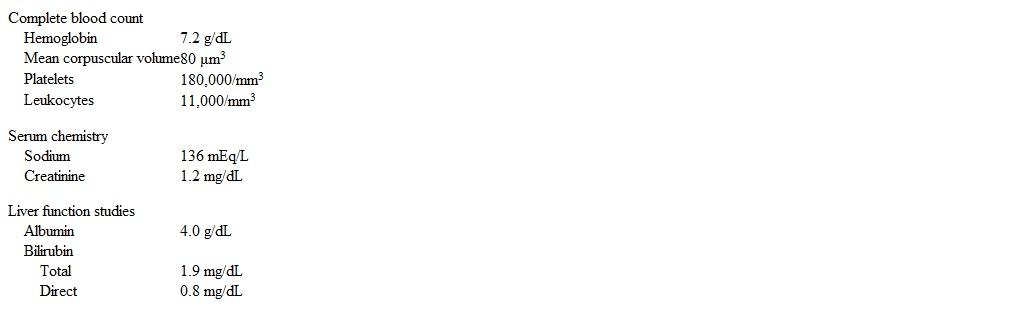 Baseline hemoglobin is approximately 6.9 g/dL. Chest x-ray is clear.
Which of the following is the best strategy to prevent further similar events in this patient?
Baseline hemoglobin is approximately 6.9 g/dL. Chest x-ray is clear.
Which of the following is the best strategy to prevent further similar events in this patient? (Multiple Choice)
4.9/5 (78)
(78) A 65-year-old woman comes to the physician to establish care. She reports a 10-year history of dry eyes and mouth that she has managed with over-the-counter artificial tear and saliva products. The patient has had intermittent painless swelling of her parotid glands for the past 3 years. She also complains of occasional joint pain relieved by ibuprofen. She does not use tobacco, alcohol, or illicit drugs.
Her temperature is 37.2° C (99° F), blood pressure is 142/92 mm Hg, and pulse is 78/min. Physical examination shows several mildly enlarged, nontender, mobile cervical and supraclavicular lymph nodes. Conjunctivae appear dry. Oral mucosa is dry with atrophic glossitis. Severe dental caries are noted as are several missing teeth. The left parotid gland is enlarged and hard to the touch but is nontender. There is no joint swelling or deformity. The remainder of the physical examination is within normal limits.
Laboratory results are as follows:
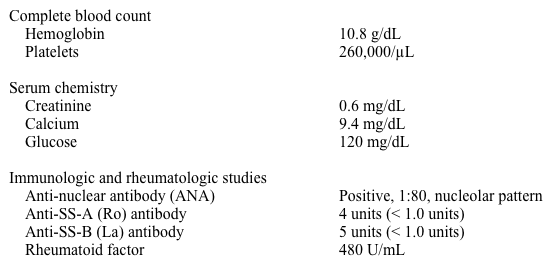 Which of the following is the most likely cause of the enlarged parotid gland?
 (Multiple Choice)
4.7/5 (67)
(67) A 35-year-old woman comes to the office for a routine physical examination. She is in good health and has no significant medical history. The patient does not use tobacco or alcohol. She takes no medications or supplements. Her paternal aunt had an unexpected death at age 32. Physical examination, including cardiac examination, is unremarkable. ECG shows normal sinus rhythm with a corrected QT interval of 505 msec. Serum electrolytes are normal. Echocardiogram shows normal heart structure and function.
The patient is advised about lifestyle modification and medication safety. Which of the following is the best initial management for this patient?
(Multiple Choice)
4.8/5 (69)
(69) A 75-year-old man comes to the physician because of 'a noise in his head.' He describes the noise as a high-pitched ringing which is always present. The sound does not pulsate and does not vary with position. He states that it is interfering with his ability to fall asleep. He denies any changes in balance, falls, or muscle weakness. He denies any problems with hearing or vision.
He has a history of hypertension, hyperlipidemia, benign prostatic hyperplasia, and degenerative joint disease of both knees and his right hip. His medications include ibuprofen, lovastatin, and enalapril. He drinks 1-2 alcoholic beverages on the weekends. He states he feels somewhat depressed a couple of days per week.
His blood pressure is 130/72 mm Hg and pulse is 78/min. There are no abnormalities of his head, ears, eyes, nose, or throat. There are no carotid or head bruits and cervical spine motion is normal. Cardiovascular examination is unremarkable.
Which of the following is the most appropriate next step in managing his tinnitus?
(Multiple Choice)
4.9/5 (74)
(74) A 23-year-old man comes to the physician for evaluation of a murmur. He has no complaints and describes his exercise tolerance as 'excellent.' He has no other medical conditions and takes no medications. He does not use tobacco, alcohol, or illicit drugs. His paternal uncle died from an unknown cause at a young age.
Physical examination reveals a IV/VI holosystolic murmur which is best heard at the fourth intercostal space along the left sternal border. It is accompanied by a palpable thrill. Carotid pulses are 2+ bilaterally without delay. Otherwise, his physical examination is unremarkable.
Which of the following is the most likely diagnosis?
(Multiple Choice)
4.9/5 (82)
(82) A 74-year-old woman with Alzheimer disease is evaluated for a sacral ulcer. She has become increasingly dependent on others for day-to-day activities and has been bed-bound for the past year. The patient developed a sacral pressure ulcer a few months ago, and it has progressively enlarged with excessive drainage. Her other medical problems include hypertension, osteoarthritis, and urinary incontinence. She lives with her sister and gets care from a 24-hour caregiver and a visiting nurse.
Temperature is 36.7 C (98 F), blood pressure is 150/80 mm Hg, and pulse is 68/min. The patient is confused but has no focal neurologic deficits. She has a 3- to 4-cm sacral ulcer with visible subcutaneous tissue, grayish slough, and foul-smelling drainage. There is no surrounding erythema or fluctuation.
Laboratory studies are as follows:
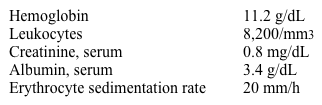 Which of the following is the best next step in managing this patient's pressure ulcer?
 (Multiple Choice)
4.9/5 (76)
(76) A 62-year-old man is being evaluated for a 6-month history of occasional epigastric pain that is relieved by eating. The patient has tried over-the-counter antacids and ranitidine with some relief. He has had no dysphagia, weight loss, black stools, or blood in the stool. The patient has a 15-pack-year smoking history and drinks alcohol socially. He immigrated to the United States from China at age 12 with his family. He had a normal screening colonoscopy 2 years ago.
Blood pressure is 126/80 mm Hg, pulse is 81/min, and BMI is 24 kg/m2. The abdomen is soft and nontender. Rectal examination reveals guaiac-negative stool. The remainder of the examination is normal.
Which of the following is the most appropriate management for this patient?
(Multiple Choice)
4.9/5 (74)
(74) 
Filters
- Essay(0)
- Multiple Choice(0)
- Short Answer(0)
- True False(0)
- Matching(0)