



 Chat with AI
Exam 3: Office/Health Center

Exam 1: Emergency Department218 Questions
Exam 2: In-patient Facilities128 Questions
Exam 3: Office/Health Center900 Questions
Select questions type


A 45-year-old woman comes to the physician because of frequent urination and increasing fatigue over the last 2 weeks. She urinates large volumes and gets up twice each night to urinate. She also thinks that she may have lost some weight during this time. Her general health has been good with the exception of discoid lupus erythematosus, which causes her to experience occasional skin rashes and photosensitivity.
Her blood pressure is 130/78 mm Hg and pulse is 75/min. Her BMI is 21 kg/m2. Her mucous membranes appear moist. Physical examination is unremarkable except for scattered areas of skin depigmentation.
Fasting laboratory studies reveal:
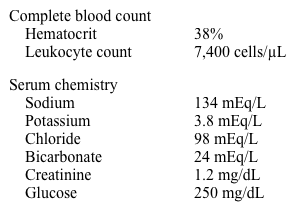 Which of the following is most likely to establish the cause of this patient's current condition?
 (Multiple Choice)
4.7/5  (85)
(85) A 45-year-old woman returns to the office for follow-up of depression. Three months ago, she was diagnosed with major depressive disorder with suicidal ideation and was started on sertraline. At her one-month follow-up, the patient had slight improvement with no suicidal ideation but reported sexual dysfunction with anorgasmia. She has been in a mutually supportive relationship with a single partner for several years and had not experienced sexual dysfunction previously. Her sertraline dose was decreased to help with this effect. At today's visit the patient reports that her mood is "okay" but that she still has "more down days than not" and low energy. She continues to suffer from anorgasmia, which is distressing and negatively affecting her relationship.
Her other medical problems include hypertension and type 2 diabetes mellitus, and she takes lisinopril and metformin. She does not use tobacco or illicit drugs. Vital signs and general examination are within normal limits. A recent chemistry panel was normal, and a recent hemoglobin A1c was 6.8%.
Which of the following is the best next step in management of this patient?
(Multiple Choice)
4.7/5 (82)
(82) A 65-year-old man comes to the office a month after sustaining a nondisplaced left femoral neck fracture in a ground-level fall. He underwent internal fixation of the left hip and was discharged to a skilled nursing facility. The patient is now able to ambulate with a cane. He has no bone pain, previous fractures, diarrhea, or loss of height. Medical history is significant for hypertension treated with hydrochlorothiazide. The patient does not use tobacco or alcohol. There is no family history of osteoporosis or thyroid disorders. Since hospital discharge, the patient has taken adequate amounts of calcium and vitamin D via diet and oral supplementation.
Vital signs are normal. The surgical scar has healed well and physical examination is unremarkable.
Laboratory tests show normal complete blood count, basic metabolic panel, hepatic function tests, TSH, 24-hour urinary calcium, and 25-hydroxyvitamin D. DXA reveals T-scores of −2.0 in the femoral neck and −2.5 in the lumbar spine. Plain radiograph of the spine is normal.
Which of the following is the most appropriate next step in evaluation of this patient?
(Multiple Choice)
4.8/5 (95)
(95) An 18-year-old soccer player is seen in the office for an abnormal electrocardiogram that demonstrates normal sinus rhythm with T-wave inversion in leads V1 and V2. Listen to the auscultation findings at the cardiac apex (Click on media exhibit). Which of the following is the most likely explanation for the auscultation findings in this patient?
(Multiple Choice)
4.8/5 (83)
(83) A 49-year-old woman comes to the office to discuss her risk of heart disease. Her husband recently died of an acute myocardial infarction, and she says, "I need to take care of myself so I can be there for my kids." The patient's medical history is unremarkable and she takes no medications. Her mother died of dementia at age 76, and her father died of chronic obstructive pulmonary disease at age 68. She has a 30-pack-year smoking history but quit after her husband's heart attack, and she drinks a can of beer every day. The patient has a sedentary occupation and does not engage in regular exercise.
Blood pressure is 129/79 mm Hg and pulse is 80/min. BMI is 32 kg/m2. Physical examination shows central obesity but is otherwise unremarkable.
Laboratory results are as follows:
 In addition to providing guidance on increasing physical activity, which of the following is the most appropriate recommendation to reduce the risk of cardiovascular disease in this patient?
 (Multiple Choice)
4.9/5 (92)
(92) A 46-year-old man comes to the physician with recurrent palpitations that wake him up at night. One year ago, he was diagnosed with paroxysmal atrial fibrillation. The patient had been treated with metoprolol, diltiazem, and flecainide in the past with temporary relief, but the symptoms had always recurred. Recently, flecainide was stopped, and he was started on sotalol. His other medical problems are hypertension and hyperlipidemia.
Electrocardiogram shows normal sinus rhythm with a QTC interval of 420 msec. Echocardiogram shows left atrial enlargement, mild mitral regurgitation, and left ventricular ejection fraction of 50%. A 24-hour Holter monitor shows episodes of atrial fibrillation with rapid ventricular rate.
Which of the following is the best next step to maintain sinus rhythm in this patient?
(Multiple Choice)
4.7/5 (70)
(70) A 52-year-old man comes to the office for follow-up of depression. The patient was initially seen 6 months ago for symptoms of low energy, lack of motivation, anxiety, hypersomnia, increased appetite, weight gain, and poor concentration. At that time, he was having difficulty functioning at his job as an accountant and was worried about being fired for poor performance. Physical examination was unremarkable and routine laboratory tests were within normal limits. The patient was diagnosed with major depression and started on sertraline 50 mg. After several weeks, his dosage was gradually increased to 150 mg and he has steadily improved since then. The patient has a history of 2 prior major depressive episodes at ages 35 and 49 but was never treated.
At today's visit, he reports that his mood is "good" and that he is functioning well at home and at work. The patient is tolerating sertraline without difficulty and has no suicidal ideation. He asks how long he should continue the medication.
Which of the following is the most appropriate recommendation for this patient?
(Multiple Choice)
4.7/5 (86)
(86) A 42-year-old man comes to the physician with painful skin lesions. The lesions developed on his neck, chest, and arms 1 week ago. He also complains of fever, headache, malaise, and arthralgias. Three weeks ago, he had an upper respiratory infection that resolved with over-the-counter medications. The patient has no other medical problems and takes no medications. He does not use tobacco or illicit drugs and drinks alcohol on social occasions. He works as a cab driver.
His temperature is 38.2° C (100.8° F), blood pressure is 120/70 mm Hg, pulse is 88/min, and respirations are 14/min. Physical examination is otherwise unremarkable.
Skin findings are shown in the photograph.
 Laboratory studies show a leukocyte count of 14,000 cells/µL with 87% neutrophils. He is started on oral clindamycin and sent home.
The patient returns for follow-up 3 days later with no improvement. Blood cultures obtained on the initial visit show no growth. Biopsy of the lesion shows a dense neutrophilic infiltrate in the dermis without vasculitis. Gram and fungal stains are negative.
Which of the following is the most appropriate next step in management?
Laboratory studies show a leukocyte count of 14,000 cells/µL with 87% neutrophils. He is started on oral clindamycin and sent home.
The patient returns for follow-up 3 days later with no improvement. Blood cultures obtained on the initial visit show no growth. Biopsy of the lesion shows a dense neutrophilic infiltrate in the dermis without vasculitis. Gram and fungal stains are negative.
Which of the following is the most appropriate next step in management? (Multiple Choice)
4.8/5 (80)
(80) A 38-year-old woman comes to the physician with left facial numbness and paresthesias for the last 3 days. She is a known intravenous drug user. One month ago, she had an episode of blurry vision in her right eye and vertigo that resolved spontaneously. One year ago, she was admitted to the hospital with fever to rule out endocarditis. Transesophageal echocardiography at that time showed no vegetations but did demonstrate a small secundum-type atrial septal defect. The patient's past medical history is also significant for hypothyroidism, migraine disorder, and hypertension.
Her temperature is 37.2 C (99 F), blood pressure is 140/88 mm Hg, and pulse is 85/min. Her body mass index is 28 kg/m2. The patient is awake and in mild distress. Examination shows a pale right optic disc, right relative afferent pupillary defect, and reduced sensation on the left side of the face. Motor examination shows a slight pronator drift in the right upper extremity with increased tone and hyperreflexia. She also has mild dysmetria in the left upper extremity.
MRI of the brain with and without gadolinium is performed; the T2/FLAIR sequence is shown in the image below.
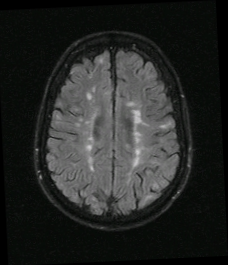 Which of the following would be most helpful in confirming the diagnosis in this patient?
 (Multiple Choice)
4.8/5 (92)
(92) A 42-year-old man comes to the office due to fatigue and shortness of breath. His symptoms began 6 months ago with decreased exercise tolerance during his typical morning jog. Since then, his fatigue has gradually progressed and he has also had occasional palpitations, which he describes as his "heart races fast." The patient reports a weight gain of 5 kg (11 lb) over the last month and has had shortness of breath with mild exertion and leg swelling for the past 2 weeks. The patient does not remember any recent viral illness and has no prior medical conditions. He takes no medications, is a lifelong nonsmoker, and drinks alcohol occasionally. Family history is unremarkable.
Temperature is 37.2 C (99 F), blood pressure is 122/80 mm Hg, pulse is 135/min and irregular, and respirations are 18/min. Jugular venous pressure is 12 cm H2O. Lung examination reveals decreased breath sounds at the bases with occasional bibasilar crackles. Cardiac examination reveals a 2/6 holosystolic murmur best heard at the apex. There is 2+ bilateral lower extremity pitting edema.
Blood cell counts, serum chemistry, and TSH are within normal limits. ECG is shown in the exhibit. 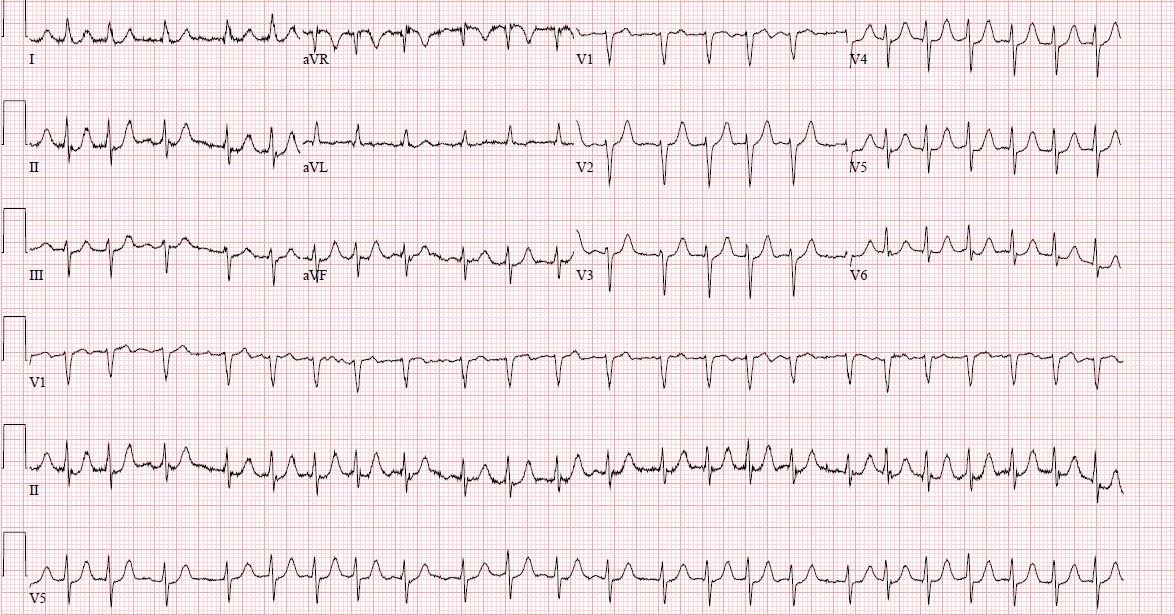 Echocardiography shows a dilated and diffusely hypokinetic left ventricle with an ejection fraction of 25%. The right ventricle is mildly hypokinetic. The left atrium is mildly dilated. There is a central jet of moderate mitral regurgitation.
Which of the following is most likely to provide the greatest long-term improvement in this patient's left ventricular function?
Echocardiography shows a dilated and diffusely hypokinetic left ventricle with an ejection fraction of 25%. The right ventricle is mildly hypokinetic. The left atrium is mildly dilated. There is a central jet of moderate mitral regurgitation.
Which of the following is most likely to provide the greatest long-term improvement in this patient's left ventricular function? (Multiple Choice)
4.8/5 (90)
(90) A 72-year-old man comes to the office due to cough and hemoptysis. The patient has had a nonproductive cough for 3 months and began to cough up scant sputum with flecks of blood 4 days ago. He also notes anorexia and a 7-kg (15-lb) weight loss over this period. He has a history of hypertension and osteoarthritis. The patient is a former smoker with a 54-pack-year history.
Temperature is 37 C (98.6 F), blood pressure is 132/80 mm Hg, pulse is 72/min, and respirations are 16/min. BMI is 22 kg/m2. The patient appears thin. Breath sounds are reduced over the left lower lung field. Abdominal examination is normal. Finger clubbing is noted. There is an enlarged left supraclavicular lymph node but no cervical, axillary, or inguinal lymphadenopathy.
CT scans of the chest, abdomen, and pelvis reveal a 4-cm left perihilar mass, several enlarged mediastinal lymph nodes and right lung nodules, and 2 liver lesions. Bronchoscopic biopsy confirms small cell lung cancer. PET/CT scan and brain imaging reveal no evidence of other metastasic lesions.
Which of the following is the most appropriate next step in management of this patient?
(Multiple Choice)
4.8/5 (80)
(80) A 39-year-old premenopausal woman comes to the physician after a total mastectomy for a 3.5-cm invasive ductal carcinoma. The cancer is negative for estrogen and progestin receptors and for HER2 mutation. The margins were free of cancer and she had negative lymph nodes. The patient had adjuvant chemotherapy and opted to undergo contralateral mastectomy after she was found to have the BRCA1 mutation. She has 2 children and has completed her family. Her mother was diagnosed with ovarian cancer at age 51, and her paternal grandfather had prostate cancer in his 50s.
Her vital signs are within normal limits. Examination shows well-healed bilateral mastectomy scars.
Which of the following is the most appropriate next step in management of this patient?
(Multiple Choice)
4.7/5 (71)
(71) A 52-year-old man comes to the physician very concerned about his high triglyceride levels on a recent lipid profile. He has no complaints except gradual weight gain over the past few years. He eats mainly fast food at lunchtime and drinks a few beers while watching television on weekends. The patient does not smoke or use recreational drugs. His father died of a heart attack at age 50. His mother suffers from diabetes mellitus and experienced a minor stroke.
Blood pressure is 144/90 mm Hg, pulse is 73/min, and body mass index is 31 kg/m2. Physical examination is unremarkable.
Fasting laboratory results are as follows:
 The patient's serum creatinine and liver and thyroid function tests are normal. Repeat fasting triglyceride level is 460 mg/dL.
He is instructed about lifestyle changes. Which of the following will provide the greatest benefit in reducing this patient's cardiovascular risk?
The patient's serum creatinine and liver and thyroid function tests are normal. Repeat fasting triglyceride level is 460 mg/dL.
He is instructed about lifestyle changes. Which of the following will provide the greatest benefit in reducing this patient's cardiovascular risk? (Multiple Choice)
4.8/5 (74)
(74) A 67-year-old woman is evaluated for intermittent claudication prior to angiography. At a recent evaluation, her ankle-brachial index was 0.65 on the right and 0.75 on the left. The patient has a history of long-term cigarette smoking, hypertension, type 2 diabetes mellitus, hyperlipidemia, and severe degenerative arthritis of the knees. Current medications include simvastatin, ibuprofen, glipizide, and amlodipine.
Blood pressure is 130/86 mm Hg and pulse is 72/min. Cardiac examination reveals a grade 2/6 systolic ejection murmur at the base. The lungs are clear and there is no jugular venous distension. Tibial pulses are 1+ and the patient has trace pedal edema of the ankles bilaterally.
Serum creatinine is 2 mg/dL and urinalysis shows 2+ proteinuria.
In addition to using the smallest dose of a third-generation contrast agent and prehydrating with normal saline, which of the following is the most appropriate precaution for this patient's angiography?
(Multiple Choice)
4.9/5 (81)
(81) A 72-year-old man comes to the office for a regular visit. His vision has been deteriorating gradually for the past year. The patient has been having difficulty reading the newspaper and has been using reading glasses more frequently to read small print. Lately, he has also had difficulty driving and now drives only during the daytime. The patient has a history of hypertension and osteoarthritis. He has smoked a pack of cigarettes daily for 38 years.
His blood pressure is 155/77 mm Hg and pulse is 76/min. BMI is 31 kg/m2. Ocular examination shows no visible abnormalities of the cornea or lens, and the pupils are round and reactive. Visual acuity is diminished in both eyes, the left eye more than the right. Funduscopic examination shows mottling of sub-retinal pigments and bright yellow drusen deposits in the macular area of the left retina. Cardiopulmonary and neurologic examination is unremarkable.
Which of the following is the best initial management of this patient's vision problems?
(Multiple Choice)
4.9/5 (72)
(72) A 65-year-old woman comes to the physician with a rash on her hands for the past 2 weeks. Two months ago she developed a rash on her face and forearms while vacationing at a beach resort. Her review of systems is positive for recent onset weakness of the shoulders and hips. She has no dysphagia, shortness of breath, fever, chills, or weight loss. She is a lifetime nonsmoker.
Her temperature is 37.2 C (99 F), blood pressure is 134/82 mm Hg, pulse is 75/min, and respirations are 14/min. Her BMI is 21 kg/m2. Cardiopulmonary examination is within normal limits. There is no hepatosplenomegaly. Range of motion of the spine is normal and without pain, scoliosis, or excessive kyphosis of the back. Upper and lower limb deep-tendon reflexes are 2+. She has difficulty rising from a chair. Muscle strength is 4/5 in both upper and lower extremities.
Laboratory results are as follows:
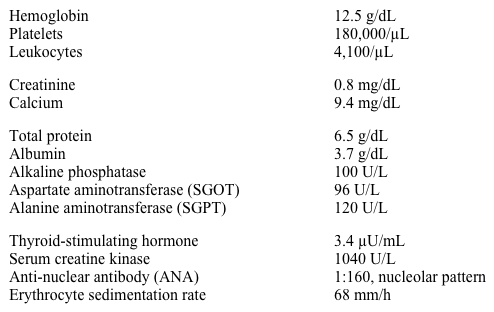 The rash is shown in the photograph.
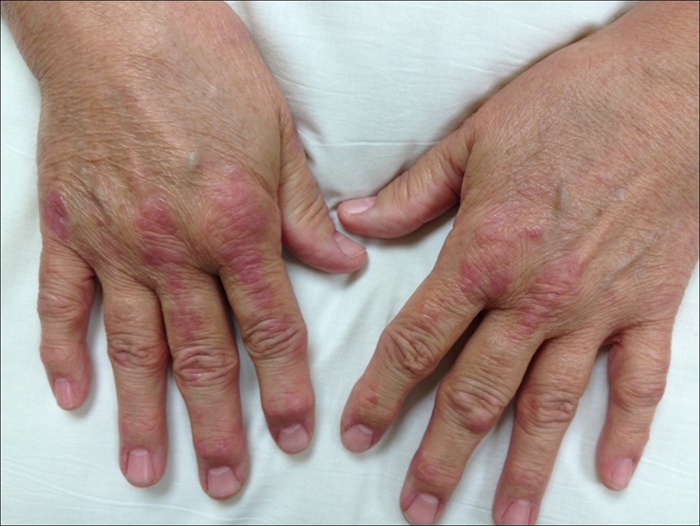 This patient would require which of the following?
The rash is shown in the photograph.
This patient would require which of the following? (Multiple Choice)
4.7/5 (70)
(70) A 75-year-old man residing in a nursing home comes to the office due to episodic lightheadedness over the last 6 months. He feels like he is "graying out" and then has to lie down and close his eyes. The patient has lost consciousness twice over the past 2 months. Tonic-clonic movements have not been observed and there is no associated incontinence. He has not had chest pain, nausea, palpitations, headache, or speech difficulties. The patient's appetite has been good and he eats 3 meals a day. He describes mild lightheadedness occasionally in the morning, but the more severe episodes usually occur between 2:00 and 3:00 PM and around 8:00 PM.
The patient has a history of hypertension, hyperlipidemia, mild cognitive impairment, and type 2 diabetes mellitus. Current medications include hydrochlorothiazide, metformin, rosuvastatin, lisinopril, and low-dose aspirin. There have been no recent changes in his medications.
Blood pressure is 124/82 mm Hg supine and 116/80 mm Hg upright, pulse is 84/min in both positions, and respirations are 14/min. Cardiac, lung, and abdominal examinations are unremarkable. Neurologic examination reveals a decreased sensation to light touch in both distal lower extremities and absent ankle deep tendon reflexes bilaterally.
Fasting laboratory results are as follows:
 Which of the following is most likely to provide symptomatic improvement in this patient?
 (Multiple Choice)
4.9/5 (74)
(74) A 55-year-old man comes to the emergency department with severe right flank pain. CT scan shows a 5-mm stone in the right ureter and several smaller stones in both renal pelvices. Urinalysis results are as follows:
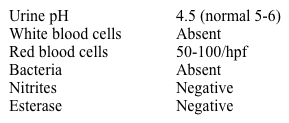 The patient subsequently passes a stone and analysis shows it to be composed of predominantly uric acid.
Besides high fluid intake, which of the following would be most helpful for this patient to prevent recurrent stones?
The patient subsequently passes a stone and analysis shows it to be composed of predominantly uric acid.
Besides high fluid intake, which of the following would be most helpful for this patient to prevent recurrent stones? (Multiple Choice)
4.8/5 (77)
(77) A 35-year-old woman comes to the office for evaluation of a rash on her face. The rash started 3 weeks ago and has slowly worsened. There is no pruritus. The patient has no significant past medical history and no history of tobacco or alcohol use.
Vital signs are within normal limits. Her BMI is 27 kg/m2. Skin examination findings are shown in the image below. There is no warmth or tenderness around the skin lesions. The remainder of her physical examination is normal.
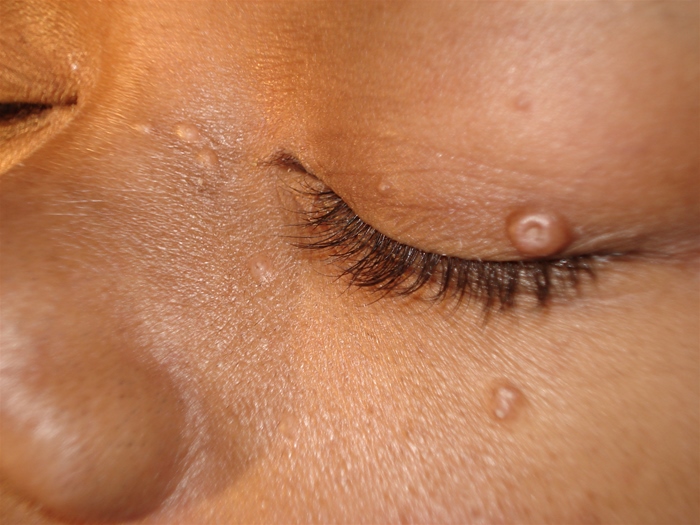 Which of the following is the best next step in management of this patient?
 (Multiple Choice)
4.7/5 (91)
(91) A 60-year-old immigrant from India comes to the physician because of intermittent fevers and weight loss over the last 3 months. For the past 10 days, he has also experienced a dull ache in the right side of his abdomen. He considered himself healthy until 3 months ago. He denies anorexia, vomiting, diarrhea, jaundice, or dysuria. His past medical history is unremarkable.
His temperature is 37.9 C (100.2 F), blood pressure is 128/82 mm Hg, and pulse is 84/min. His BMI is 22 kg/m2. Pulse oximetry shows oxygen saturation of 97% on room air. His mucous membranes are moist. Cardiopulmonary examination is normal. There is no hepatosplenomegaly, but there is some pain to deep palpation in the right flank.
Laboratory results are as follows:
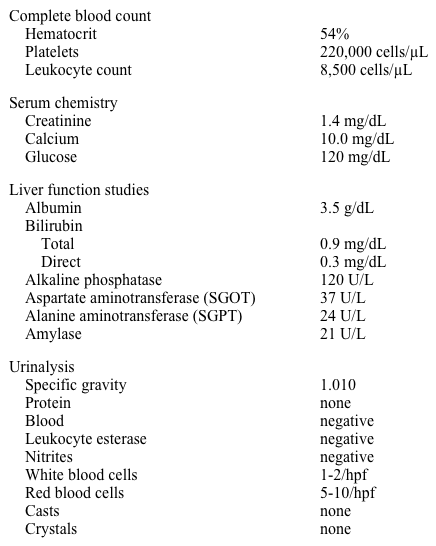 Which of the following is the most likely diagnosis?
 (Multiple Choice)
4.7/5 (82)
(82) 
Filters
- Essay(0)
- Multiple Choice(0)
- Short Answer(0)
- True False(0)
- Matching(0)