



 Chat with AI
Exam 3: Office/Health Center

Exam 1: Emergency Department218 Questions
Exam 2: In-patient Facilities128 Questions
Exam 3: Office/Health Center900 Questions
Select questions type


A 65-year-old overweight woman comes to the physician with 4 weeks of persistent dry, hacking cough that interferes with her sleep. She has minimal sputum production and no associated upper respiratory symptoms, dyspnea, fever, chills, or generalized malaise. She has never had asthma or episodes of wheezing. She does not smoke cigarettes. Her medical problems include newly diagnosed hypertension, hyperlipidemia, and osteoarthritis of the knees. Her blood pressure is currently well controlled with hydrochlorothiazide and lisinopril. In the past, she developed severe lower-extremity swelling and palpitations with amlodipine.
Her blood pressure is 130/80 mm Hg, pulse is 84/min, and respirations are 14/min. Pulse oximetry shows 95% on room air. Cardiopulmonary examination is unremarkable.
Laboratory results are as follows:
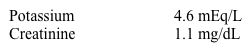 Which of the following is the best next step in managing this patient?
 (Multiple Choice)
4.7/5  (72)
(72) A 32-year-old woman complains of the sensation of a foreign body in her throat for the last 2 months. The feeling is persistent but gets worse with anxiety. She has no loss of appetite, fever, weight loss, nausea, vomiting, or dark stools. The patient was diagnosed with a 2-cm nonmetastatic papillary thyroid cancer 3 years ago and was treated with near-total thyroidectomy followed by radioactive iodine ablation of the remnant thyroid tissue. She had an uncomplicated postoperative course and has been on a stable dose of levothyroxine for the past 3 years. Her total body radioactive iodine scan done 1 year ago showed no abnormal uptake. In addition, ultrasound at that time showed normal thyroid bed and no lymphadenopathy in her neck.
Examination shows a well-healed neck scar with no masses or lymph node enlargement.
Which of the following is the best initial step in managing this patient?
(Multiple Choice)
5.0/5 (77)
(77) A 65-year-old man comes to the office for a follow-up evaluation of hematuria. He underwent evaluation for an insurance policy and was told that he had blood in his urine. He has never observed any blood in his urine; however, he has noticed a progressively weaker urinary stream over the past several years and often gets up to urinate at least twice each night. He has no history of flank or abdominal pain, and has never passed a kidney stone or had urinary tract infection. He has smoked more than one pack of cigarettes daily for 40 years. He recently retired from many years of employment in the dye industry.
He has been diagnosed with moderate chronic obstructive lung disease, benign prostatic hypertrophy, degenerative joint disease, and hypertension. His current medications consist of an inhaler containing a beta adrenergic agonist, several over-the-counter NSAIDs, and lisinopril.
His blood pressure is 140/90 mm Hg, pulse is 84/min, and respirations are 20/min. Physical examination findings are compatible with moderate chronic obstructive lung disease. A urinalysis performed in the office shows a positive dipstick and 3-5/hpf RBCs. Subsequently, 2 additional urinalyses are performed; RBCs are 1-2/hpf on the first and 5-10/hpf on the second urinalysis. Urine cytology is negative for malignant cells on 3 occasions. A CT scan of the kidneys is within normal limits. A urine culture is negative.
The patient's laboratory studies reveal:
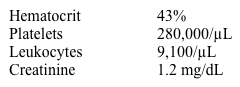 Which of the following is the most appropriate next step in management?
 (Multiple Choice)
4.8/5 (83)
(83) A 67-year-old man comes to the office for an annual examination. He generally feels well, although when asked about urinary problems, the patient says that he urinates 2 or 3 times per night and occasionally has to strain to initiate urination. He takes no medications. The patient does not use tobacco, alcohol, or drugs. His father died of prostate cancer at age 84.
Temperature is 36.5 C (97.7 F), blood pressure is 126/74 mm Hg, pulse is 84/min, and respirations are 12/min. Cardiac, pulmonary, and abdominal examinations are within normal limits. Rectal examination reveals a prostate that is mildly enlarged, symmetric, and nontender. Rectal sphincter tone is normal.
Urinalysis and serum creatinine level are normal.
Which of the following is the most appropriate next step in management of this patient?
(Multiple Choice)
4.8/5 (79)
(79) A 34-year-old African American man comes to the office due to 2 months of fatigue and nonproductive cough. During this time, the patient has also had mild achiness of the joints, a feverish feeling, and night sweats but is most bothered by the constant feeling of tiredness. He has had no change in appetite or weight. The patient served in Iraq and Afghanistan as a United States Marine and was discharged after a combat-zone trauma. He underwent multiple surgeries after the injury and received blood transfusions. While serving, he was also found to have a positive tuberculosis skin test and received treatment for latent tuberculosis. He has no other medical problems and takes no medications. The patient is in a monogamous relationship and does not use tobacco, alcohol, or illicit drugs.
Vital signs are within normal limits. Physical examination reveals a well-built man in no acute distress. There is no scleral icterus, lymphadenopathy, mucosal lesions, or skin rash. The lungs are clear to auscultation and heart sounds are normal. The abdomen is soft and nontender with no masses or hepatosplenomegaly. Neurologic examination shows no abnormalities.
Blood cell counts and serum chemistry studies are within normal limits. Chest imaging reveals right paratracheal and bilateral hilar lymphadenopathy with no parenchymal opacities.
Which of the following is the most appropriate next step in management of this patient?
(Multiple Choice)
4.9/5 (91)
(91) An 18-year-old man comes to the office because a college physical urinalysis indicated that he had proteinuria. The patient does not recall having a previous urinalysis. He denies flank pain, hematuria, dysuria, nocturia, edema, urinary frequency, hypertension, or family history of kidney disease. His review of systems provides no significant information. He is in excellent health, with the exception of one or two upper respiratory infections per year. He takes no medications. He has no known drug allergies. He does not use tobacco or illicit drugs and rarely drinks alcohol. He has no history of a sexually transmitted disease and he is not sexually active.
His blood pressure is 120/76 mm Hg, pulse is 64/min, and respirations are 12/min. On examination, he appears healthy. Cardiovascular, pulmonary, and abdominal examinations show no abnormalities. He has no edema.
The patient's laboratory studies reveal:
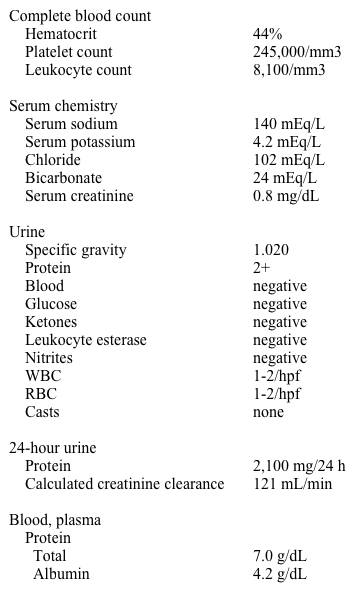 Which of the following is the most appropriate course of action?
 (Multiple Choice)
4.8/5 (70)
(70) A 24-year-old woman comes to the office for emergency contraception. The patient had unprotected intercourse with her boyfriend 2 nights ago after a condom broke. She is not using any form of contraception other than condoms with spermicide. Her last menstrual period was 2 weeks ago. The patient has no medical problems and has had no surgeries. She takes no daily medications and does not use tobacco, alcohol, or illicit drugs.
Vital signs are normal. BMI is 26 kg/m2. On speculum examination, there is a mucopurulent discharge at the cervical os; no vaginal bleeding is noted. The uterus is small and mobile. There are no adnexal masses or tenderness.
Urine pregnancy test is negative.
Which of the following is the best next step in management of this patient?
(Multiple Choice)
5.0/5 (71)
(71) A 26-year-old woman comes to the office for a follow-up visit. The patient was first seen 4 months ago for irregular menstrual periods and hirsutism. Laboratory results at that time showed mildly elevated levels of serum testosterone and LH but normal levels of FSH, prolactin, salivary cortisol, TSH, and 17-hydroxyprogesterone. Serum chemistry profile, including liver enzymes and glucose tolerance test, were normal. Based on symptoms and laboratory results, she was diagnosed with polycystic ovary syndrome and started on oral contraceptives.
After the patient's initial visit, she began eating a low-carbohydrate diet and started exercising for 30 minutes, 5 times a week, which has led to significant weight loss. Her menstrual cycles are now regular, every 28 days. In addition, her hirsutism has markedly improved. The patient is a medical assistant and does not use tobacco, alcohol, or illicit drugs. She is sexually active with her boyfriend and does not desire pregnancy. Family history is remarkable for type 2 diabetes mellitus, hyperlipidemia, and hypertension in both parents.
Blood pressure is 124/70 mm Hg and pulse is 78/min. BMI is 27 kg/m2. The patient has moderate terminal hair growth on the face, chest, lower abdomen, and lower back. The remainder of the physical examination is within normal limits.
Which of the following is the best next step in management of this patient?
(Multiple Choice)
4.8/5 (91)
(91) An 84-year-old woman comes to the office due to leakage of urine with coughing and sneezing. She also reports increased urinary frequency and a feeling of pelvic pressure but has no dysuria or hematuria. Medical history includes congestive heart failure (last known ejection fraction: 35%), persistent atrial fibrillation, and moderate aortic stenosis.
Pelvic examination findings are consistent with pelvic organ prolapse extending to the introitus (stage 2). Urinalysis and urine cultures are normal.
Which of the following is the best next step in management of this patient?
(Multiple Choice)
4.8/5 (79)
(79) A recent study of patients with stage 2 chronic kidney disease (CKD) found that a new drug reduced the progression to end-stage (stage 5) CKD from 37/1,000 placebo-treated cases to 12/1,000 new drug-treated cases over a five-year period.
Which of the following is the number needed to treat in order to obtain a single favorable outcome?
(Multiple Choice)
4.8/5 (90)
(90) A 58-year-old man with type 2 diabetes mellitus comes to the physician for a follow-up appointment. His other medical problems include obesity and chronic kidney disease with a baseline creatinine of 1.5 mg/dL and urine protein excretion of 1100 mg/day. He has failed to lose weight despite diet adjustments and aerobic exercise. The patient takes insulin daily. His blood pressure is 140/89 mm Hg and his pulse is 83/min. Body mass index is 30 kg/m2. He is started on lisinopril 5 mg daily.
The patient returns for a follow-up appointment 2 weeks later and reports feeling well. His blood pressure is 133/85 mm Hg. Repeat testing shows creatinine of 1.8 mg/dL and potassium of 4.8 mEq/L.
Which of the following is the best next step in management of this patient?
(Multiple Choice)
4.8/5 (66)
(66) A 72-year-old man comes to the office due to occasional lightheadedness over the last 3 months. It occurs both during exertion and at rest and lasts about 2 minutes. The patient has no chest pain, dyspnea, or syncope. Other medical issues include hypertension, hyperlipidemia, and a right hemicolectomy 8 years ago for colon cancer. Medications include low-dose aspirin, hydrochlorothiazide, lisinopril, and rosuvastatin. The patient quit smoking 20 years ago and usually drinks 2 or 3 beers on weekends. He does not participate in any regular exercise program.
Physical examination is unremarkable. A treadmill exercise stress test is performed. The patient exercises for 7 minutes and 20 seconds and achieves a workload of 7.0 metabolic equivalents at 90% of his maximal age-predicted heart rate. No symptoms except fatigue are reported during the exercise. ECG shows no ST-segment changes suggestive of myocardial ischemia. During the last minute of exercise and the recovery period, he has a transient episode of third-degree atrioventricular block noted on the rhythm strip. Coronary angiogram shows 70% stenosis in the distal left anterior descending artery.
Which of the following is the most appropriate next step in management of this patient?
(Multiple Choice)
4.9/5 (69)
(69) A 38-year-old woman comes to the physician with progressive exertional shortness of breath over the last 6 months. She thinks it began with a cold followed by a cough that eventually subsided. However, the shortness of breath has persisted. The patient can barely walk 2 blocks on level ground without becoming short of breath. She has a 15-pack-year smoking history.
Her blood pressure is 142/78 mm Hg, pulse is 90/min, and oxygen saturation is 94% on room air. Her BMI is 27 kg/m2. Cardiac examination reveals a 2/6 holosystolic murmur at the lower sternal border that increases with inspiration. Lungs are clear to auscultation. There is trace bilateral lower-extremity edema.
Pulmonary function test results are as follows:
 Which of the following is the most likely diagnosis?
 (Multiple Choice)
4.9/5 (68)
(68) A 28-year-old primigravid woman at 24 weeks gestation comes to the office due to heartburn and nausea. Over the last several weeks she has also had retrosternal and epigastric pain after eating. Although the patient uses 2 pillows to sleep and avoids spicy food, she awakens several nights a week due to heartburn and regurgitation. The symptoms started a month ago and have been minimally responsive to over-the-counter antacids.
The patient has a history of heartburn prior to pregnancy, which she managed with dietary changes and over-the-counter antacids. Her father died from esophageal cancer at age 60. The patient does not use tobacco, alcohol, or illicit drugs. She takes a multivitamin daily.
Which of the following is the most appropriate management for this patient?
(Multiple Choice)
4.8/5 (94)
(94) A 71-year-old man comes to the physician for routine follow-up. He has no current health concerns or complaints. His medical problems include moderate chronic obstructive pulmonary disease, prostate cancer, hypothyroidism, and type 2 diabetes mellitus. He also reports a humeral fracture after falling off a 10-foot ladder about 5 years ago. His medications include tiotropium, leuprolide, levothyroxine, and metformin. His last HbA1c was 7.5% and thyroid-stimulating hormone level was 4.2 µU/mL about 6 months ago.
Which of the following is this patient's strongest risk factor for osteoporosis?
(Multiple Choice)
4.9/5 (82)
(82) A 60-year-old man comes to the physician for follow-up 8 weeks after coronary artery bypass graft surgery. Although his exertional chest pain is improved since surgery, he is short of breath when walking briskly. He also complains of orthopnea that has worsened since the surgery. The patient has no fever, chills, cough, weight loss, or chest pain. His medications include aspirin, atorvastatin, metoprolol, amlodipine, and albuterol/ipratropium as needed. He is an ex-smoker with 20-pack-year history.
His blood pressure is 134/87 mm Hg, pulse is 57/min, and respirations are 14/min. His oxygen saturation on room air is 96% while sitting and 90% while supine. His body mass index is 31 kg/m2. Physical examination shows a middle-aged man in no acute distress. Jugular venous pressure is estimated at 6 cm H2O. Lung examination is notable for decreased breath sounds at the left base with dullness to percussion. Cardiac examination shows a 2/6 mid-systolic murmur at the right sternal base and normal second heart sound. The surgical wound is well apposed and clean.
Chest x-ray reveals a raised left hemidiaphragm and mild scarring of the right lung base.
Spirometry in the upright position shows forced expiratory volume in 1 second of 69% of predicted, forced vital capacity of 70% predicted, and FEV1/FVC ratio of 0.98. Spirometry performed in the supine position shows forced vital capacity of 59% of predicted.
Which of the following is the best test to diagnose the cause of this patient's dyspnea on exertion?
(Multiple Choice)
4.7/5 (81)
(81) A 55-year-old woman comes to the physician with worsening left knee pain. She has had intermittent pain and stiffness in her left knee for the past 5 years. The pain is aggravated by prolonged standing, but her knee also feels stiff if she sits in 1 place for too long. She was diagnosed with ulcerative colitis 3 years ago. The patient initially was treated with systemic steroids, and the disease is currently in remission on oral sulfasalazine. Her other medical problems include hypertension, impaired glucose tolerance, and hypothyroidism.
The patient's vital signs are normal. Her BMI is 31 kg/m2. On physical examination, flexion and extension of the left knee joint elicit pain, but there is no instability. There is a small joint effusion. Knee joint aspiration yields 3 mL of synovial fluid. Synovial fluid analysis shows a total cell count of 2000/µL with 25% polymorphonuclear cells.
An x-ray of the left knee is shown below.
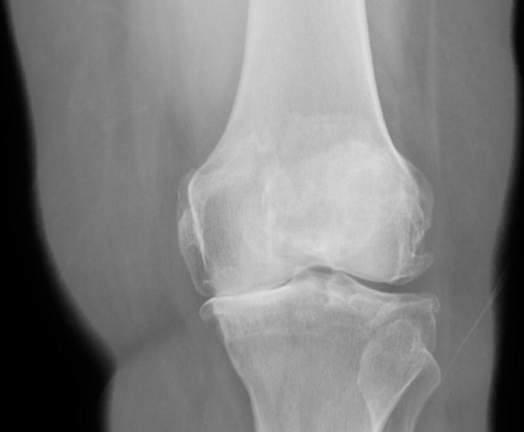 Which of the following is the most likely diagnosis?
 (Multiple Choice)
4.8/5 (82)
(82) A 40-year-old obese man with type 2 diabetes mellitus comes to the clinic complaining of abdominal distension, flatus, and an episode of low-volume fecal incontinence over the past 2 weeks. His last hemoglobin A1C 2 months ago was 7.5%. He has been treated with metformin for years and was recently started on exenatide and orlistat.
His blood pressure is 133/90 mm Hg and pulse is 82/min. Body mass index is 37 kg/m2. His abdomen is distended, tympanic, and nontender.
Which of the following is the best next step in management of this patient?
(Multiple Choice)
5.0/5 (91)
(91) A 45-year-old man comes to the office with low energy, depressed mood, sleep disturbance, and loss of interest and motivation. He is worried that he may lose his job due to repeated absences and low productivity. The patient has no suicidal ideation or psychotic features. There is no psychiatric history. After a thorough evaluation he is diagnosed with major depressive disorder. He is started on bupropion 150 mg, which is subsequently increased to 300 mg at his 2-week follow-up visit.
At his 6 week follow-up, the patient reports feeling much better and is back to his baseline. He is more productive at work and is considering applying for a promotion. The patient is tolerating bupropion without difficulty but mentions, "I hate taking medication everyday. How long do I have to take this stuff?"
Which of the following is the most appropriate recommendation?
(Multiple Choice)
4.9/5 (86)
(86) A 67-year-old woman with stable angina pectoris comes to the office for follow-up. She has occasional retrosternal chest pain on heavy exertion, which improves with sublingual nitroglycerin. The patient has had no shortness of breath, palpitations, headache, or focal neurological symptoms. Medical history is significant for hypertension, type 2 diabetes mellitus, peripheral vascular disease, and a 3.5-cm abdominal aortic aneurysm.
Physical examination shows a carotid bruit. Duplex ultrasonography reveals complete occlusion of the right internal carotid artery and mild stenosis of the left internal carotid artery.
Which of the following is the best management for this patient's carotid disease?
(Multiple Choice)
4.8/5 (75)
(75) 
Filters
- Essay(0)
- Multiple Choice(0)
- Short Answer(0)
- True False(0)
- Matching(0)