



 Chat with AI
Exam 3: Office/Health Center

Exam 1: Emergency Department218 Questions
Exam 2: In-patient Facilities128 Questions
Exam 3: Office/Health Center900 Questions
Select questions type


A 57-year-old postmenopausal woman comes to the office for an annual health maintenance examination. The patient is feeling well and has no medical concerns. She has depression and hypertension, which are well controlled with her current regimen. Her maternal aunt died from metastatic breast cancer at age 72.
Vital signs are normal. BMI is 29 kg/m2. Breast examination reveals a nontender, fixed, 3-cm mass in the upper outer quadrant of the left breast. There are no skin changes, nipple discharge, or associated axillary lymphadenopathy. A diagnostic mammogram and breast ultrasound reveal no masses or calcifications.
Which of the following is the best next step in management of this patient?
(Multiple Choice)
4.8/5  (78)
(78) A 20-year-old woman comes to the office due to atraumatic heel pain over the last week. For the past 6-8 months, the patient has also experienced bilateral hip pain that has progressively worsened and now awakens her during the early-morning hours. When this occurs, she gets up and walks around for a few minutes before going back to sleep. The patient also has difficulty tying her shoelaces in the morning due to back pain and stiffness; however, she does not feel limited when performing other daytime activities. She has tried over-the-counter pain medications and found ibuprofen to be more effective than acetaminophen. A year ago, she had an episode of intense pain, photophobia, and redness involving her left eye, which improved with corticosteroid eye drops. The patient also occasionally has mouth ulcers, usually around the time of her menstrual periods. Family history is significant for breast cancer in her mother and multiple sclerosis in her aunt. The patient does not use tobacco, alcohol, or illicit drugs. She is sexually active and uses oral contraceptives for birth control.
Vital signs are normal. The oral mucosa is moist with mild tonsillar swelling, but there are no ulcers or other lesions. There is tenderness and swelling of the heel, as shown in the exhibit. 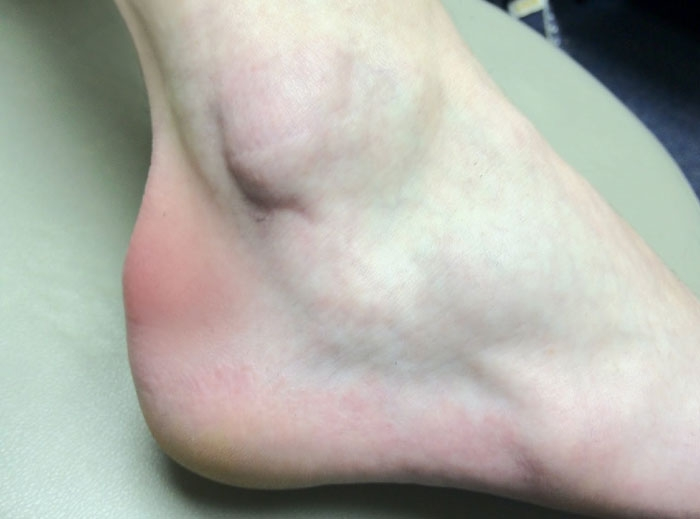 Examination of the ankle and other joints shows no synovitis or effusion. Flexion and external rotation of the hip joints elicits intense pain at the gluteal region.
Laboratory results are as follows:
 Which of the following is the best next step in evaluation of this patient's condition?
Examination of the ankle and other joints shows no synovitis or effusion. Flexion and external rotation of the hip joints elicits intense pain at the gluteal region.
Laboratory results are as follows:
Which of the following is the best next step in evaluation of this patient's condition? (Multiple Choice)
4.9/5 (66)
(66) A 31-year-old primigravida comes to the office seeking advice regarding her pregnancy. She discovered that she was pregnant approximately a week ago. The patient was diagnosed with systemic lupus erythematosus 8 months ago and was started on hydroxychloroquine. Her initial clinical features included fatigue, pain and swelling of the finger joints, and facial rash. Her symptoms have subsided with therapy.
The patient has a positive antinuclear antibody test with a 1:640 titer in a homogeneous pattern. Liver function tests, serum creatinine, complete blood count, and differential are normal. Urinalysis shows trace protein and 1-2 red blood cells/hpf. Anti-double-stranded DNA antibodies are positive at 1:120 titer, and anti-Ro/SSA and anti-La/SSB antibodies are negative. Complement levels are normal.
Which of the following is the best next step in management of this patient?
(Multiple Choice)
4.7/5 (79)
(79) A 35-year-old woman comes to the office as she missed her period 10 days ago and believes that she may be pregnant. She otherwise has regular monthly menstrual cycles. The patient moved to the United States from South Africa 6 months ago, and has a history of rheumatic heart disease. She had a "ministroke" 8 years ago and was found to be in atrial fibrillation at that time; she has since been on warfarin for anticoagulation. The patient took antibiotic prophylaxis for secondary prevention of rheumatic fever with intramuscular penicillin until age 30.
Temperature is 37.2 C (99 F), blood pressure is 122/82 mm Hg, pulse is 96/min, and respirations are 14/min. The lungs are clear to auscultation. Cardiac examination reveals irregular heart sounds, an accentuated S1, and a loud "snapping" sound shortly after S2. There is also a faint mid-diastolic murmur heard over the cardiac apex.
Urine pregnancy test is positive. ECG is shown in the exhibit.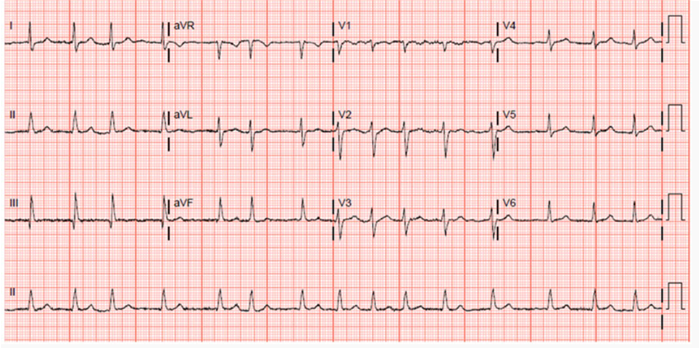 Which of the following is the best next step in management of this patient?
 (Multiple Choice)
4.8/5 (93)
(93) A 65-year-old woman comes to the office for a preoperative evaluation. She is scheduled to undergo a total hip arthroplasty for osteoarthritis in 6 weeks. The patient walks slowly and uses a cane due to hip pain. She has no chest pain or shortness of breath. Her other medical problems include atypical ductal hyperplasia of the breast, gastroesophageal reflux disease, hypertension, and hyperlipidemia. Her mother was diagnosed with breast cancer at age 51, and her father had a myocardial infarction at age 62. She is a lifetime nonsmoker. Medications include amlodipine, naproxen, esomeprazole, rosuvastatin, and tamoxifen. Vital signs are within normal limits. Chest and abdominal examination is unremarkable. The patient asks whether any medication changes are necessary prior to the scheduled surgery. In addition to holding nonsteroidal anti-inflammatory medications 3 days prior to surgery, which of the following is the most appropriate course of action?
(Multiple Choice)
4.8/5 (74)
(74) A 50-year-old woman comes to the office due to nail discoloration for the past several months. The patient is a realtor and says she feels embarrassed to shake hands with clients due to nail disfiguration. She has used several over-the-counter antifungal creams but with no relief. The patient reports no fever, chills, joint pain, or skin rash. She has no prior medical problems and takes only a daily multivitamin supplement. The patient has smoked half a pack of cigarettes daily for 30 years and drinks alcohol occasionally.
Vital signs are within normal limits. Most of her fingernails have the findings shown in the image below.
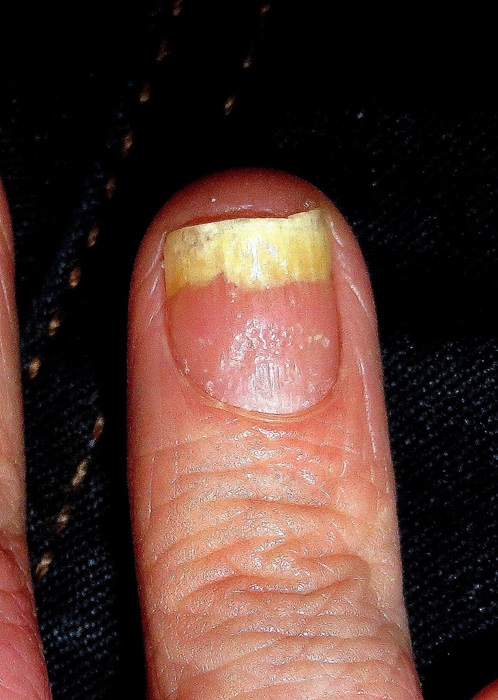 Which of the following is the most appropriate next step in management of this patient's condition?
 (Multiple Choice)
4.9/5 (78)
(78) A 72-year-old woman is evaluated for low platelet count. She is currently being treated for an uncomplicated urinary tract infection with ciprofloxacin. A complete blood count sent as part of the workup showed a platelet count of 12,000/µL. The patient's medical problems include type 2 diabetes mellitus, hypertension, hypercholesterolemia, osteoarthritis, and mild dementia.
Her temperature is 37.2° C (99° F), blood pressure is 130/80 mm Hg, pulse is 84/min, and respirations are 14/min. Physical examination shows no bruises, petechiae, or mucosal bleeding. Cardiopulmonary examination is normal. The abdomen is soft and nontender with no hepatosplenomegaly. The remainder of the examination is within normal limits.
Repeat laboratory results are as follows:
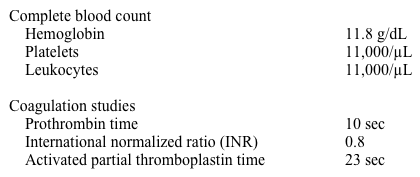 Repeat complete blood count sent in a heparin tube shows a platelet count of 135,000/µL.
Which of the following is the most likely diagnosis?
Repeat complete blood count sent in a heparin tube shows a platelet count of 135,000/µL.
Which of the following is the most likely diagnosis? (Multiple Choice)
4.8/5 (78)
(78) A 62-year-old man comes to the emergency department due to a 3-day history of worsening diarrhea and abdominal pain. The patient has had 3-4 watery stools a day with no blood or mucus. The pain is mild, located in the lower abdominal quadrants, and partially relieved with bowel movements. He has had no fever, nausea, or vomiting.
The patient had similar symptoms 6 weeks ago after antibiotic treatment for pneumonia. He was found to have Clostridium difficile infection and was treated with oral vancomycin. The patient had been feeling well after finishing the 10-day treatment until the symptoms recurred. Other medical issues include hypertension, type 2 diabetes mellitus, hyperlipidemia, and depression.
Temperature is 37.2 C (99 F), blood pressure is 110/80 mm Hg, and pulse is 88/min. The abdomen is soft with mild tenderness in the periumbilical and left lower quadrant. There is no rebound tenderness or rigidity.
Laboratory results are as follows:
 Stool PCR for C difficile is positive. Which of the following is the best therapy for this patient?
 (Multiple Choice)
4.7/5 (83)
(83) A 65-year-old woman with known chronic obstructive pulmonary disease seeks evaluation due to pain in both of her knees and warmth in her fingertips. She has a 50-pack-year smoking history and quit 5 years ago. She has never been hospitalized for respiratory symptoms. The patient uses a tiotropium inhaler daily and albuterol as needed for shortness of breath. She also takes lisinopril for hypertension and bisacodyl for chronic constipation.
Her blood pressure is 144/85 mm Hg and pulse is 90/min. She has decreased breath sounds bilaterally and a mildly prolonged expiratory phase of respiration. There is a grade 1/6 systolic murmur along the left upper sternal border. The finger joints and both knees have some mild warmth and slight tenderness to palpation, with normal range of motion. Mild finger clubbing is present.
What is the best next step in management of this patient?
(Multiple Choice)
4.9/5 (76)
(76) A 33-year-old woman with no past medical history comes to the emergency department complaining of progressive leg weakness and difficulty walking that started 2 days ago. Yesterday she had difficulty with urination. Two weeks ago, she had an upper respiratory tract infection and diarrhea that has since resolved. She is a vegan and takes daily multivitamin supplements. She does not use tobacco, alcohol, or illicit drugs.
Vital signs are within normal limits. Cranial nerve examination is unremarkable. Strength is 5/5 in the upper extremities and 2/5 in the lower extremities. Reflexes are 2+ in the arms but absent in the legs with decreased tone. Rectal tone is diminished. There is no response to plantar cutaneous stimulation in the big toes bilaterally. Superficial abdominal reflexes are absent. There is sensory loss to pain, temperature, vibration, and proprioception of both lower extremities.
Which of the following is the most likely diagnosis?
(Multiple Choice)
4.8/5 (76)
(76) A 36-year-old man comes to the travel clinic prior to a safari in East Africa. He has a history of intermittent asthma, and he takes albuterol as needed. The patient has no allergies. Physical examination is unremarkable. He inquires about malaria prophylaxis.
Which of the following could be recommended for malaria prophylaxis in this patient?
(Multiple Choice)
4.7/5 (82)
(82) A 30-year-old woman comes to the physician complaining of headaches, blurry vision, and fatigue. She can walk only 3-4 blocks before becoming tired and developing cramps in her legs. She does not use alcohol or tobacco.
Her blood pressure is 188/105 mm Hg and pulse is 78/min. Funduscopic examination reveals retinal hemorrhages. A continuous murmur is heard at the left and right sides of the anterior chest. Lungs are clear. No abdominal masses are palpated. Femoral pulses are faint bilaterally.
Laboratory results are as follows:
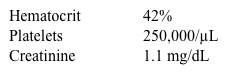 Which of the following is the most likely associated feature in this patient?
 (Multiple Choice)
4.8/5 (87)
(87) A 78-year-old woman is brought to the physician by her daughter due to intermittent dizziness, weakness, and confusion. The patient was seen for fever and dysuria 3 days ago and started on trimethoprim/sulfamethoxazole. Her other medical problems include type 2 diabetes mellitus, hypertension, and chronic kidney disease with a baseline serum creatinine of 1.3 mg/dL. Her chronic medications include hydrochlorothiazide, amlodipine, glyburide, atorvastatin, calcium, vitamin D, and alendronate.
Her temperature is 36.8 C (98.2 F), blood pressure is 140/85 mm Hg supine and 144/89 mm Hg standing, pulse is 84/min, and respirations are 20/min. BMI is 19 kg/m2. There are no focal neurologic findings. Her Mini-Mental State Examination score is 24/30.
Laboratory results are as follows:
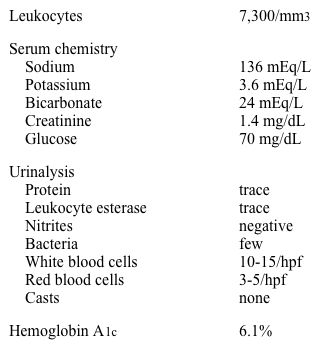 Which of the following is the best next step in management of this patient?
 (Multiple Choice)
4.9/5 (74)
(74) A 28-year-old woman, gravida 1 para 0, at 29 weeks gestation comes to the office in the fall for routine prenatal care. She has had no vaginal bleeding, abdominal pain, or leakage of fluid. Fetal movements have been normal. The patient has no chronic medical conditions. Medications include a daily prenatal vitamin. She does not use alcohol, tobacco, or illicit drugs. She works as a kindergarten teacher.
Vital signs are normal; fetal heart rate is 140/min. Fundal height is 29 cm.
Prenatal laboratory results showed a lack of immunity to rubella. Ultrasounds have been normal.
Which of the following vaccines is recommended for this patient during pregnancy?
(Multiple Choice)
4.9/5 (80)
(80) A 54-year-old man comes to the physician for a follow up appointment. He has no complaints. His medical problems include type 2 diabetes mellitus, hyperlipidemia, and hypertension. His current medications include metformin, glyburide, lovastatin, and lisinopril. He was diagnosed with type 2 diabetes mellitus 6 years ago and at the time had a BMI of 31 kg/m2. He has since employed significant lifestyle changes to decrease his blood glucose levels and has lost 10 lbs (4.5 kg). Both of his parents have type 2 diabetes and hypertension. He works as a supervisor in a grocery store. He walks 3 miles five times per week. He denies tobacco or alcohol use.
His physical examination is unremarkable, except for a BMI of 29 kg/m2.
His hemoglobin A1C trend is shown below.
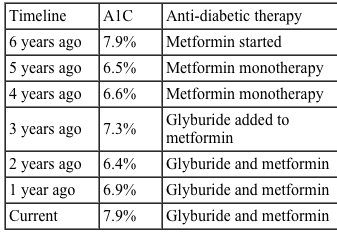 Anti-glutamic acid decarboxylase (anti-GAD) antibody is not detected.
Which of the following is the most likely explanation for this patient's worsening glycemic status?
Anti-glutamic acid decarboxylase (anti-GAD) antibody is not detected.
Which of the following is the most likely explanation for this patient's worsening glycemic status? (Multiple Choice)
4.9/5 (78)
(78) A 47-year-old woman comes to the physician with foot pain for several months. Pain occurs in the ball of her right foot between the 3rd and 4th toes. It is especially intense when she wears high heels or drives. She often has the sensation of stepping on a marble just beneath her toes. She normally walks 2-3 miles about 3 times a week for exercise but the discomfort has prevented her from doing so. She has no history of foot trauma and the pain does not bother her at night. She has no other musculoskeletal symptoms.
Her other medical problems include type 2 diabetes mellitus and hypertension.
Her blood pressure is 134/84 mm Hg and pulse is 76/min. BMI is 30 kg/m2. Foot examination reveals bilateral full and symmetric pulses and small bunions. There is unilateral pain to deep palpation at the base of the web space between the 3rd and 4th toes on the right. No lesions are palpable. Foot sensation to light touch, position, and tuning fork is normal. There are no obvious deformities of her feet and ankles. Range of motion of her ankles and toes is normal.
X-ray of the foot show no abnormalities.
What is the most likely diagnosis?
(Multiple Choice)
4.8/5 (61)
(61) A 38-year-old woman with a history of hypertension comes to the physician with complaints of left-sided facial pressure, nasal congestion, and rhinorrhea for the past 5 days. She describes the rhinorrhea as yellow with occasional white, nonbloody, and thin discharge. She also notes fullness of the left ear. She has no fevers, chills, cough, wheezing, or muscle pain and has no known sick contacts.
Her temperature is 37.0 C (98.6 F), blood pressure is 114/74 mm Hg, pulse is 86/min, and respirations are 14/min. Oxygen saturation is 97% on room air pulse oximetry. Pupils are equal and reactive. There is mild tenderness over the right maxillary sinus. Nasal mucosa is boggy appearing and erythematous bilaterally. Her oropharynx is mildly erythematous without cervical lymphadenopathy. Lungs are clear to auscultation bilaterally.
Which of the following is the most appropriate empiric therapy for this patient?
(Multiple Choice)
4.9/5 (84)
(84) A 63-year-old man comes to the physician for a periodic health evaluation. He reports nocturia once or twice per night, and he has noticed a decrease in the size and force of his urinary stream over the past six months. These symptoms mildly affect his quality of life. There is no additional past medical or surgical history and review of symptoms is otherwise unremarkable. His father suffered from benign prostatic hyperplasia and underwent prostate surgery. His mother passed away from breast cancer at the age of 74.
On examination, he appears healthy. His blood pressure is 128/82 mm Hg and pulse is 72/min. General physical examination is within normal limits. On digital rectal examination, his prostate is mildly enlarged. There is a firm 1 cm nodule in the right lateral lobe of the prostate.
Laboratory results are as follows:
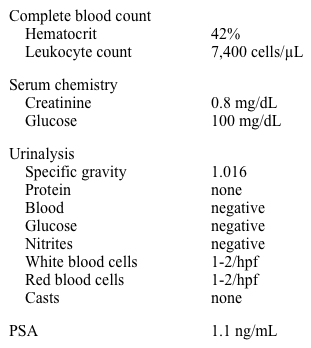 Which of the following is the best next step in this patient's management?
 (Multiple Choice)
4.9/5 (73)
(73) A 29-year-old woman comes to the physician accompanied by her husband for an initial consultation. She has no current symptoms. She is physically active and walks for 45 minutes on a treadmill 3-4 days a week. She has a past history of "heart failure," which was diagnosed 1 week after the birth of her first child 2 years ago.
She was found to have a reduced LV ejection fraction of 25%, but further evaluation did not reveal any specific cause of her cardiomyopathy. She has been taking daily furosemide, potassium supplements, carvedilol, and quinapril since that time. Her last echocardiogram 2 months ago showed an improved LV ejection fraction of 40%, mild left atrial enlargement, and mild mitral regurgitation. The couple is contemplating another pregnancy and was referred by the obstetrician for a second opinion.
Which of the following is the most appropriate recommendation?
(Multiple Choice)
4.9/5 (84)
(84) A 67-year-old woman with moderate chronic obstructive pulmonary disease comes to the physician to discuss plans for upcoming air travel from Boston to California. She leads a sedentary lifestyle and has mild occasional cough but no significant dyspnea with household activities. One year ago, she was hospitalized with exacerbation of chronic obstructive pulmonary disease and was treated with noninvasive ventilation, corticosteroids, and antibiotics. The patient's other medical problems include coronary artery disease with stent placement 2 years ago. Her left ventricular ejection fraction is normal. Current medications include tiotropium, salmeterol, albuterol as needed, aspirin, clopidogrel, atorvastatin, metoprolol, and losartan.
Her blood pressure is 122/70 mm Hg, pulse is 75/min, and respirations are 16/min. Pulse oximetry is 96% on room air at rest. Pulmonary examination shows minimal bilateral end-expiratory wheezes. Cardiac examination is within normal limits. There is no peripheral edema. Forced expiratory volume in 1 second on spirometry 6 months ago was 55% of predicted.
Which of the following is the best next step in management of this patient?
(Multiple Choice)
5.0/5 (81)
(81) 
Filters
- Essay(0)
- Multiple Choice(0)
- Short Answer(0)
- True False(0)
- Matching(0)