



 Chat with AI
Exam 3: Office/Health Center

Exam 1: Emergency Department218 Questions
Exam 2: In-patient Facilities128 Questions
Exam 3: Office/Health Center900 Questions
Select questions type


A nuclear stress test using a new radioisotope tracer has a sensitivity of 60% and specificity of 80% for detecting hemodynamically significant coronary artery disease, defined as coronary artery narrowing > 50% by coronary angiography. In a patient with a pre-test probability for coronary artery disease of 40%, what is the positive likelihood ratio for the test?
(Multiple Choice)
4.9/5  (60)
(60) A 44-year-old man comes to the physician because of muscle cramps and stiffness involving his legs over the last two weeks. He also describes fatigue and needs to rest after walking several blocks. His other medical problems include type 2 diabetes mellitus, hyperlipidemia, and migraine headaches. His medications include metformin, low-dose aspirin, glyburide, and simvastatin. He was recently started on daily verapamil for migraine prevention. He has a strong family history of diabetes and coronary artery disease.
His blood pressure is 123/70 mm Hg and his pulse is 70/min. His BMI is 31 kg/m2. There is no muscle tenderness on physical examination. Muscle strength is 5/5 bilaterally and deep tendon reflexes are 2+ and symmetrical bilaterally.
Laboratory results are as follows:
 Which of the following is the most appropriate next step in managing this patient?
 (Multiple Choice)
4.7/5 (87)
(87) A 63-year-old woman with a long history of type 2 diabetes mellitus is being evaluated for a progressive decline in renal function. She has no new complaints except for occasional tiredness and lower back pain. Her other medical problems include hypertension, obesity, mild diabetic retinopathy, and peripheral neuropathy. One year ago, she was evaluated for atypical chest pain and had a negative exercise stress test. She is a lifetime non-smoker. Her current medications include insulin, amlodipine, and low-dose aspirin. She was treated with lisinopril, which has been stopped recently due to renal dysfunction and hyperkalemia.
Her current eGFR is 15 ml/min, potassium is 5.1 mEq/L, and hemoglobin is 10.2 g/dL.
Which of the following would provide the highest survival benefit in this patient?
(Multiple Choice)
4.8/5 (88)
(88) A 56-year-old woman with major depressive disorder comes to the office for follow-up. Three months ago she was started on fluoxetine 20 mg. Her dosage was subsequently increased to 40 mg after 4 weeks due to nonresponse. At today's visit, the patient says she is "discouraged" and continues to feel sad and unmotivated. Her energy remains low and she sleeps 9-10 hours a day without feeling rested. Although she forces herself to go out with friends, she has difficulty enjoying these occasions. The patient also describes an increased appetite and is discouraged by having gained an additional 2.3 kg (5 lb) since her last visit. She is not interested in psychotherapy at this time. The patient is tolerating fluoxetine without difficulty and takes no other medication. She does not use tobacco or alcohol.
Blood pressure is 128/70 mm Hg and pulse is 68/min. BMI is 25 kg/m2. Physical examination is normal. Mental status examination is remarkable for sad affect and no suicidal ideation.
Which of the following is the most appropriate next step in treatment of this patient?
(Multiple Choice)
4.9/5 (87)
(87) You are about to see an 80-year-old man for an annual follow-up visit. Just prior to entering the exam room, the patient's daughter tells you that she wishes you would dissuade the patient from driving. When you inquire as to why, she relates that she doesn't have any specific reason other than his advancing age, he is becoming a little forgetful, and she worries about him driving.
The patient states that he is doing well and voices no new complaints. He denies falls. He has a history of hypertension, hyperlipidemia, gastroesophageal reflux, diminished hearing, and benign prostatic hyperplasia. His current medications include atenolol, hydrochlorothiazide, omeprazole, and a multivitamin. He does not drink alcohol.
The patient lives independently and performs all of his own activities of daily living, including his own shopping. He drives approximately 3-5 times a week for shopping, restaurants, and entertainment. He's had one minor "fender bender" when he backed into a short stationary garbage can that he did not see one year ago. He has not had any moving traffic violations, he denies having any close calls while driving, and he has never gotten lost while driving. He has cataracts but his recent eye exam showed a corrected vision of 20/40 in both eyes and good peripheral vision. His last driver's license renewal was 12 months ago. He relates that he feels comfortable with driving.
His blood pressure is 136/84 mm Hg and pulse is 72/min. His general examination is unchanged. His head and neck mobility are good and his gait is normal. He performs a 'Get Up and Go test' in 14 seconds. His score on a Mini-Mental State Exam is 26/30; he scored 27/30 18 months ago.
What should you tell this patient and his daughter regarding his driving?
(Multiple Choice)
4.9/5 (75)
(75) A 38-year-old man comes to an urgent care center with sore throat and malaise for 3 days. He also has pain during swallowing. His past medical history is significant for mild intermittent asthma, gastroesophageal reflux disease, and irritable bowel syndrome. His irritable bowel syndrome manifests as abdominal pain and diarrhea several times a year. He has had multiple male sexual partners over the last 10 years. He recently returned from a trip to Europe to visit friends.
Examination shows pharyngeal erythema and shallow, tender ulcers on buccal mucosa. The remainder of the examination is unremarkable. Point-of-care testing for group A streptococcus is negative. Symptomatic therapy with acetaminophen and mouthwash is prescribed. The patient returns 2 days later due to persistent sore throat, fatigue, and new rash. He also reports poor appetite and 2 episodes of diarrhea. Physical examination shows a fine macular rash on his trunk, hands, and feet.
Which of the following is the most likely diagnosis?
(Multiple Choice)
4.9/5 (65)
(65) A 55-year-old woman comes to the physician with a 6-month history of a diffuse rash. The patient has episodes of localized itching on her arms followed by a rash that worsens over a few hours before spontaneously resolving. The rash has also occurred on her arms, legs, and back. The most recent episode occurred 2 days ago, and the patient has brought a photograph of the rash, shown below. She has no trauma, insect bites, travel history, or sick contacts. The patient has a history of hypertension, diabetes, and osteoarthritis of her knees. Her medications include metformin, lisinopril, and occasional ibuprofen. She does not use tobacco, alcohol, or illicit drugs.
The patient's temperature is 36.1 C (97 F), blood pressure is 138/77 mm Hg, and pulse is 78/min. Her physical examination is within normal limits.
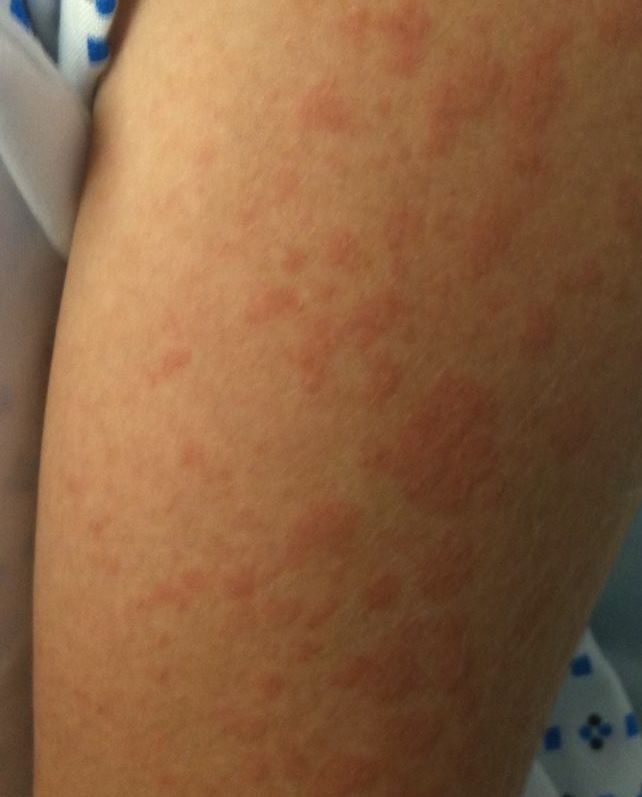 Which of the following is the next best step in management of this patient?
 (Multiple Choice)
4.7/5 (81)
(81) A 74-year-old white, widowed man comes to the office at the request of his daughter due to lack of appetite and a 4.54-kg (10-lb) weight loss over the past 4 months. Prior to breaking his hip last year when he fell from a horse, the patient had worked as a rancher for over 50 years. His daughter says he never quite recovered from the fall and refused to participate in an outpatient physical rehabilitation program. The patient says, "I don't want to be around a bunch of disabled people, and those exercises are a waste of time; I just have to accept that my life is over." He says his mood is "bad" but that depression is for "the weak-minded." When asked about suicidal thoughts and plans, he is initially silent; with further prompting he says, "I believe in keeping my options open." The patient had a depressive episode in his late 40s that responded well to antidepressant treatment. He has never attempted suicide. His daughter lives in a nearby city and checks on him once a month.
The patient has a history of hypertension that has been well controlled for many years with atenolol.
Physical examination is notable for decreased mobility, arthritis, and a healed gunshot wound sustained in a hunting accident last year.
Which of the following is the most appropriate next step in management of this patient?
(Multiple Choice)
5.0/5 (70)
(70) A 46-year-old man comes to the physician for follow-up. He recently went to the emergency department after fracturing 2 ribs in a bicycle accident. During the evaluation, a CT scan of the chest revealed an 8-mm pulmonary nodule. He has experienced no cough, dyspnea, fevers, chills, or weight loss. The patient lives in Indiana and works in the agriculture industry. He is a current smoker with a 25-pack-year history. He underwent a bronchoscopic biopsy of the nodule, which revealed budding yeast. Bacterial and fungal culture from the biopsy yielded no growth.
Which is the most appropriate treatment for this patient's nodule?
(Multiple Choice)
4.8/5 (83)
(83) A 62-year-old man complains of a black lesion and severe pain in his left leg. Initially the lesion was red, but over the past 3 days it has become black. He has end-stage renal disease due to diabetic nephropathy and has been on hemodialysis for the last 10 years. The patient's past medical history is also significant for hypertension, gout, and previous episodes of deep venous thrombosis requiring lifelong anticoagulation with warfarin.
His vitals signs are within normal limits. The leg lesion is shown in the picture below.
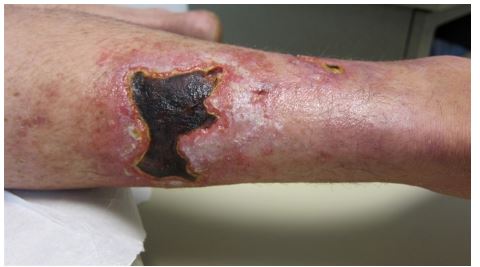 The lesion is exquisitely tender, but the area is not warm to palpation. Femoral and other peripheral pulses are 2+ bilaterally. There is no lymphadenopathy and no other skin lesions are noted. The remainder of the physical examination is within normal limits.
Laboratory results are as follows:
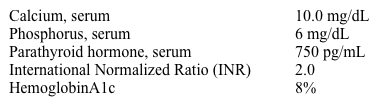 Which of the following is the most likely diagnosis?
The lesion is exquisitely tender, but the area is not warm to palpation. Femoral and other peripheral pulses are 2+ bilaterally. There is no lymphadenopathy and no other skin lesions are noted. The remainder of the physical examination is within normal limits.
Laboratory results are as follows:
Which of the following is the most likely diagnosis? (Multiple Choice)
4.8/5 (71)
(71) A 32-year-old man comes to the office due to a week of nausea and generalized fatigue. He has no chronic medical problems and recently donated blood. He does not use alcohol or illicit drugs but smokes marijuana occasionally. The patient has been sexually active with multiple partners and does not use condoms consistently.
Blood pressure is 122/76 mm Hg and pulse is 78/min. BMI is 35 kg/m2. There is mild scleral icterus with no jaundice. The lymph nodes are not enlarged. Chest examination is unremarkable. The liver and spleen cannot be palpated due to obesity. Neurological examination shows no focal deficits.
Laboratory results are as follows:
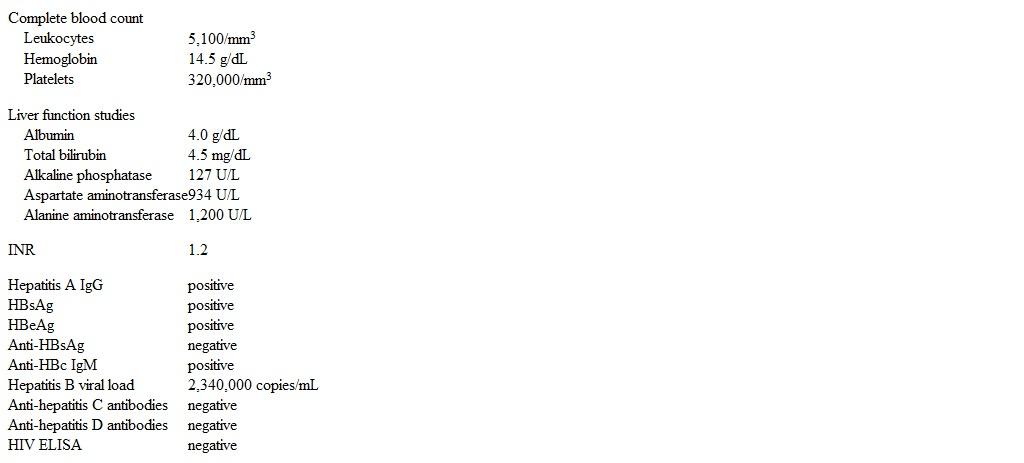 Which of the following is the most appropriate next step in management of this patient?
 (Multiple Choice)
5.0/5 (81)
(81) A 43-year-old man comes to the office to discuss smoking cessation. He is motivated to quit but has been unable to do so on his own and thinks that he needs help. The patient has smoked 1-2 packs of cigarettes a day over the past 20 years and has been able to stop for varying periods. He has tried bupropion, nicotine replacement, and varenicline. He found them all to be helpful to some degree but had the most success with varenicline. Medical history includes coronary artery disease and a myocardial infarction 4 months ago. At that time he underwent an urgent right coronary artery revascularization with placement of a drug-eluting stent. The left anterior descending artery had a 70% mid-segment obstruction, which was not revascularized. Since then he has felt well and has had no further chest pain. The patient has a history of depression in his early 30s. He has occasional anxiety that he might "get another heart attack" as he still has "a blockage in the artery." Medications include simvastatin, metoprolol, aspirin, and prasugrel.
Blood pressure is 132/78 mm Hg and pulse is 62/min. BMI is 29 kg/m2. Physical examination is unremarkable.
Appropriate behavioral support is provided, and the risks and benefits of various treatment options are discussed during the visit.
Which of the following is the most appropriate course of action to address this patient's smoking?
(Multiple Choice)
4.9/5 (91)
(91) A 32-year-old man comes to the office for evaluation after a recent visit to the emergency department due to recurrent nephrolithiasis. The patient passed the stone spontaneously with supportive care alone. Analysis of the stone composition later revealed calcium oxalate crystals. The patient drinks 1 or 2 beers daily but does not use tobacco or illicit drugs. His diet consists of mostly processed foods and meats obtained at local stores, and he avoids fruits, vegetables, and dairy products.
Vital signs are within normal parameters. BMI is 32 kg/m2. Physical examination is normal. Serum chemistry is normal. You provide affirmation of his desire to lose weight and recommend increasing his water intake.
In addition to weight loss and increased fluid intake, which of the following is the best dietary recommendation to reduce the risk of recurrent nephrolithiasis in this patient?
(Multiple Choice)
4.9/5 (82)
(82) A 29-year-old man comes to the office with right eye pain, redness, and blurry vision for the past 2 days. Physical examination findings are shown below. No discharge is present.
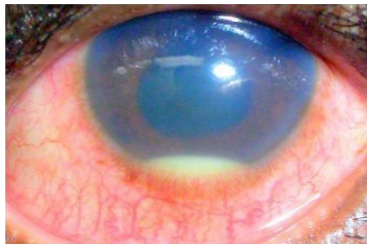 Which of the following is the most likely diagnosis?
 (Multiple Choice)
4.9/5 (88)
(88) A 42-year-old, previously healthy woman comes to the office 3 weeks after an emergency department visit due to a motor vehicle accident. She was a restrained driver in a high-impact accident during which she briefly lost consciousness after hitting her head. Evaluation in the emergency department, including CT scan of the head and cervical spine, was normal. Since the accident, the patient has had intermittent headaches, dizziness, anxiety, and insomnia. She is not able to remain focused on anything and has a sensation of "mental clouding". She has had no nightmares or flashbacks of the accident.
Her temperature is 36.7 C (98 F), blood pressure is 130/80 mm Hg, and pulse is 78/min. Cardiopulmonary examination is normal. Muscle power is symmetric, sensations are intact, and deep tendon reflexes are normal. Her mood and memory are normal.
MRI of the head is normal.
Which of the following is the most appropriate next step in management of this patient?
(Multiple Choice)
4.8/5 (75)
(75) A 35-year-old woman comes to the physician complaining of right thigh numbness. She states that her symptoms started a few weeks prior to delivering her first child. She describes numbness and paresthesias along the anterolateral aspect of her right thigh. She denies any weakness, difficulty walking, back pain, recent trauma, or bowel/bladder difficulty. Her symptoms have improved somewhat after the delivery of her child a few days ago. Her past medical history is significant for asthma, rheumatoid arthritis, and Lyme disease treated with 2 weeks of oral doxycycline therapy. Her current medications include albuterol and sulfasalazine.
Her blood pressure is 110/60 mm Hg, pulse is 72/min, and respirations are 12/min. Her BMI is 34 kg/m2. On neurological examination, she has a reduction in pain and temperature perception along the anterolateral aspect of her right thigh. The remainder of the neurological examination is normal.
Which of the following is the most appropriate next step in management?
(Multiple Choice)
4.8/5 (82)
(82) A 36-year-old man is brought to the emergency department by his wife for treatment of severe restlessness. She says, "I told him he has to come in and get checked out. Last night, he didn't come home and was partying all night with friends. He finally admitted that he has been using drugs again and drinking for the past year without telling me." The patient is not forthcoming regarding the specific details of his drug and alcohol use. He feels depressed and suicidal with thoughts of hanging himself. He says, "I started using drugs again because it is the only thing that helps my depression." The patient's eating and sleeping have been erratic over the past month. In the emergency department, he feels "shaky" and has a headache and nausea but is cognitively intact. He has no other medical issues and does not use tobacco.
Temperature is 36.7 C (98 F), blood pressure is 168/85 mm Hg, and pulse is 110/min. The patient is restless and diaphoretic. Cardiopulmonary examination is normal. The abdomen is soft and nontender. He has visible tremors of both hands and muscle twitches in all 4 extremities. At the end of the examination, he exhibits mild truncal myoclonic jerks.
Complete blood count and serum chemistries are unremarkable. Liver function tests are pending. Blood alcohol level is 70 mg/dL. Urine toxicology screen is positive for marijuana and heroin but negative for cocaine and amphetamines.
Intravenous fluids and a security watch are initiated.
Which of the following is the most appropriate next step in management of this patient?
(Multiple Choice)
5.0/5 (81)
(81) A 43-year-old woman with no significant medical history comes to the physician with episodic rectal pain for the past 8 months. About once a month she has severe rectal pain that lasts for minutes and resolves without intervention. She has no fever, diarrhea, anal trauma, rectal bleeding, or weight loss. She has 1 formed bowel movement every 3 days without any straining and does not associate the pain with bowel movements. She takes no medications.
Her blood pressure is 110/60 mm Hg, pulse is 76/min, and respirations are 14/min. Physical examination reveals a soft, nontender abdomen with normal bowel sounds. There is no hepatomegaly or splenomegaly. Rectal examination shows normal tone, no external hemorrhoids, and guaiac-negative brown stool. Pelvic examination is also unremarkable.
Laboratory results are as follows:
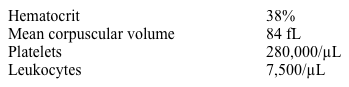 Colonoscopy is notable for small internal hemorrhoids and mild diverticulosis.
Which of the following is the most likely cause of this patient's symptoms?
Colonoscopy is notable for small internal hemorrhoids and mild diverticulosis.
Which of the following is the most likely cause of this patient's symptoms? (Multiple Choice)
4.9/5 (83)
(83) A 76-year-old man comes to the physician due to a several-week history of fatigue and lethargy. He lives in an assisted living facility and takes naps during the day but still feels exhausted in the evening. The patient does not use tobacco or alcohol. His medical problems include hypertension, type 2 diabetes mellitus, coronary artery disease, and ischemic cardiomyopathy. He also underwent coronary artery bypass grafting 5 years ago.
The patient was hospitalized 4 months ago with dizziness, palpitations, and near-syncope and was diagnosed with monomorphic ventricular tachycardia. He underwent electrical cardioversion and was started on amiodarone and high-dose metoprolol. Laboratory workup during that time was unremarkable, and his echocardiogram showed a left ventricular ejection fraction of 25%. An automated implantable cardioverter-defibrillator (AICD) was implanted before discharge. The last device interrogation 4 weeks ago showed multiple episodes of non-sustained ventricular tachycardia but no defibrillator shocks.
His blood pressure is now 140/90 mm Hg and pulse is 62/min and regular. The patient has normal jugular venous pressure. There is no thyromegaly. Lung fields are clear to auscultation. A faint mid-systolic murmur is heard at the left sternal border. There is 1+ peripheral edema bilaterally and his skin is dry. Deep tendon reflexes are diminished bilaterally. Laboratory studies are shown below:
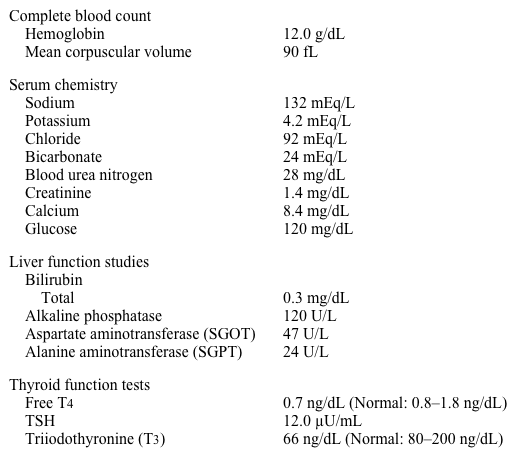 Which of the following is the best next step in managing this patient?
 (Multiple Choice)
4.8/5 (85)
(85) A 61-year-old man comes to the emergency department with abdominal pain for the past 2 days. He has lower abdominal discomfort and generalized malaise but no nausea, vomiting, back pain, or urinary symptoms. His last bowel movement was yesterday. The stool was formed but did not relieve the pain. He has never had a colonoscopy. His father was diagnosed with colon cancer at age 65.
His temperature is 37.8 C (100 F), blood pressure is 122/70 mm Hg, and pulse is 92/min. Mucous membranes are moist. There is moderate tenderness in the left lower quadrant without rebound tenderness.
Laboratory results are as follows:
 Computed tomography of the abdomen with contrast shows sigmoid wall thickening and increased density of the pericolic fat.
Which of the following is the best management for this patient?
Computed tomography of the abdomen with contrast shows sigmoid wall thickening and increased density of the pericolic fat.
Which of the following is the best management for this patient? (Multiple Choice)
4.7/5 (85)
(85) 
Filters
- Essay(0)
- Multiple Choice(0)
- Short Answer(0)
- True False(0)
- Matching(0)