



 Chat with AI
Exam 3: Office/Health Center

Exam 1: Emergency Department218 Questions
Exam 2: In-patient Facilities128 Questions
Exam 3: Office/Health Center900 Questions
Select questions type


A 79-year-old woman is referred for perioperative evaluation prior to cataract surgery. Medical history is significant for hypertension, heart failure, mild intermittent asthma, gout, and nonvalvular atrial fibrillation for which she takes warfarin. Medications also include lisinopril, furosemide, carvedilol, and amlodipine. The patient has no history of stroke. Two weeks ago, the INR was 2.5.
Blood pressure is 130/82 mm Hg and pulse is 84/min and irregular. Jugular venous pressure is normal and the lungs are clear to auscultation. The patient has a grade 2/6 systolic ejection murmur at the right upper sternal border without radiation. Pedal edema is not present.
What is the best way to manage this patient's anticoagulation?
(Multiple Choice)
4.8/5  (75)
(75) A 60-year-old man is brought to the office due to difficulty walking. He reports being "weak" and describes occasional brief episodes of intense back pain. Review of systems is negative for constitutional, pulmonary, cardiac, genitourinary, or other neurologic symptoms, including memory concerns. He has no known medical problems except for a remote history of treated pulmonary tuberculosis. The patient recently emigrated from China to the United States to live with his daughter after his wife died. His daughter says that he is afraid of doctors and has not been evaluated for many years. He does not use tobacco, alcohol, or recreational drugs.
Blood pressure is 138/64 mm Hg and pulse is 74/min. Lung examination is normal. Cardiac auscultation reveals an early diastolic murmur in the aortic area. The abdomen is soft and nontender. Rectal examination shows an unremarkable prostate and normal rectal tone. Motor strength is normal. Bilateral lower extremity reflexes are diminished, and vibration and position sensation is decreased. The patient's gait is unsteady and broad-based.
Laboratory results are as follows:
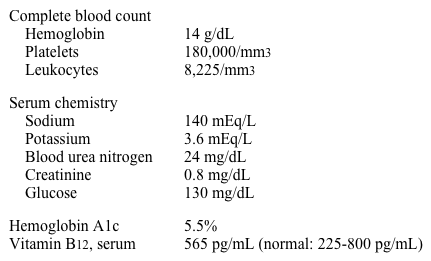 ECG shows normal sinus rhythm. Chest x-ray reveals left upper lobe scarring, widened mediastinum, and calcifications of the ascending aorta and aortic arch.
Which of the following is most helpful in establishing the diagnosis?
ECG shows normal sinus rhythm. Chest x-ray reveals left upper lobe scarring, widened mediastinum, and calcifications of the ascending aorta and aortic arch.
Which of the following is most helpful in establishing the diagnosis? (Multiple Choice)
4.8/5 (78)
(78) A 27-year-old woman, gravida 1 para 0, at 25 weeks gestation comes to the office for a follow-up visit. The patient was diagnosed with gestational diabetes mellitus a week ago and was started on an appropriate diet. She has a history of infertility due to polycystic ovarian syndrome and conceived via ovulation induction. The patient's pregnancy has been complicated by excessive weight gain. She has no other chronic medical problems and has had no surgeries. She takes a prenatal vitamin daily. The patient's mother has type 2 diabetes mellitus and her father has hypertension.
Vital signs are normal. Fetal heart rate is 150/min. Fundal height is 25 cm. On examination, the skin on the axilla and back of the neck is notable for acanthosis nigricans. The remainder of the examination is within normal limits.
Hemoglobin A1c is 7.3%. Home blood glucose levels for the last 5 days are as follows:
 Which of the following is the best next step in management of this patient?
 (Multiple Choice)
4.8/5 (82)
(82) A 53-year-old woman comes to the physician complaining of lower-extremity numbness over the last several months. Her numbness is worse at night and causes her to stumble a lot, but she has not had any major falls. She has become more irritable and may have had some memory loss recently. The patient has no muscle weakness, language difficulties, or vision problems. Her bowel movements are predominantly loose. Her medical problems include a roux-en-Y gastric bypass surgery 3 years ago, hypertension, chronic back pain, and diet-controlled diabetes mellitus after successful weight loss. The patient's medications include lisinopril, amlodipine, chlorthalidone, and a multivitamin. She works as an administrative assistant and has no work-related problems.
Her vital signs are within normal limits. Body mass index is 29 kg/m2. Examination shows decreased sensation to light touch in her feet and lower legs. She also has loss of vibration and proprioception in her feet bilaterally. Strength, tone, and bulk are within normal limits. Gait is narrow based and steady. The remainder of the examination is within normal limits.
Which of the following is the most likely cause of her symptoms?
(Multiple Choice)
4.9/5 (84)
(84) A 24-year-old woman is brought to the office by her mother for evaluation. Since dropping out of college 3 years ago, the patient has been unemployed and living at home. Over the past year, she has become increasingly isolated from her friends. She spends most of the day alone in her room on the computer and has no motivation to look for work. The patient won't go outside because she is convinced that people on the street are talking about her. She eats only food that she has prepared herself because she fears someone may be trying to poison her. The patient has no medical issues and takes no medication. Family history is significant for opioid use disorder in her brother and colon cancer in her father, who died 2 years ago after a long illness. The patient smokes marijuana twice a month and does not use alcohol.
Physical examination reveals a thin, disheveled woman. She refuses to change into an examination gown, makes poor eye contact, and gives very brief responses. Vital signs are normal and physical examination is unremarkable. A urine toxicology screen is positive for cannabinoids. A complete blood count and basic chemistry panel are normal.
Which of the following is the most likely diagnosis?
(Multiple Choice)
4.8/5 (85)
(85) A 34-year-old woman comes to the office with dizzy spells. The patient had uncomplicated Roux-en-Y gastric bypass surgery 6 weeks ago. She has abdominal pain, nausea, diarrhea, and lightheadedness with palpitations 15-20 minutes after meals. Her symptoms are occasionally accompanied by profuse sweating. The patient has lost 3.6 kg (8 lb) since the surgery. She had type 2 diabetes mellitus before the operation. Her current medications include multivitamins and iron supplements.
Temperature is 36.7 C (98 F), blood pressure is 112/70 mm Hg, and pulse is 78/min. Physical examination is notable for an overweight woman in no acute distress. The abdomen shows well-healed surgical scars but is otherwise unremarkable. Laboratory results are as follows:
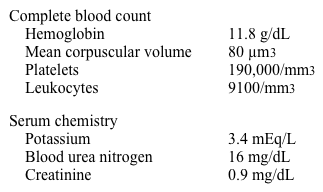 Which of the following is the most likely diagnosis?
 (Multiple Choice)
4.8/5 (86)
(86) A 43-year-old man undergoes abdominal ultrasonography for dyspepsia. Medical problems include gastroesophageal reflux disease. He is not overweight and has no history of hypertension. His father was diagnosed with colon cancer at age 65.
Temperature is 36.7 C (98.1 F), blood pressure is 120/60 mm Hg, pulse is 68/min, and respirations are 18/min. Physical examination is unremarkable.
Ultrasound of the abdomen reveals gallbladder sludge. There is also a 2.4-cm right renal cyst that is round, has smooth walls, is anechoic, and demonstrates strong posterior wall enhancement. Laboratory studies show hemoglobin of 14.5 g/dL and serum creatinine of 0.8 mg/dL. Urinalysis is unremarkable.
Which of the following is the best next step in management of this patient's renal cyst?
(Multiple Choice)
4.9/5 (81)
(81) A 46-year-old woman comes to the office due to fatigue and generalized itching over the last 6 months. She has no energy to accomplish her daily goals and sometimes feels depressed. The patient takes pregabalin for fibromyalgia and diphenhydramine as needed for itching. She does not use tobacco, alcohol, or illicit drugs. Family history is notable for type 2 diabetes in her father and Graves disease in her mother.
Blood pressure is 100/60 mm Hg, pulse is 74/min, and respirations are 14/min. There are no rashes. The abdomen is nontender with the liver edge palpable 4 fingerbreadths below the right costal margin. There is no splenomegaly.
Laboratory results are as follows:
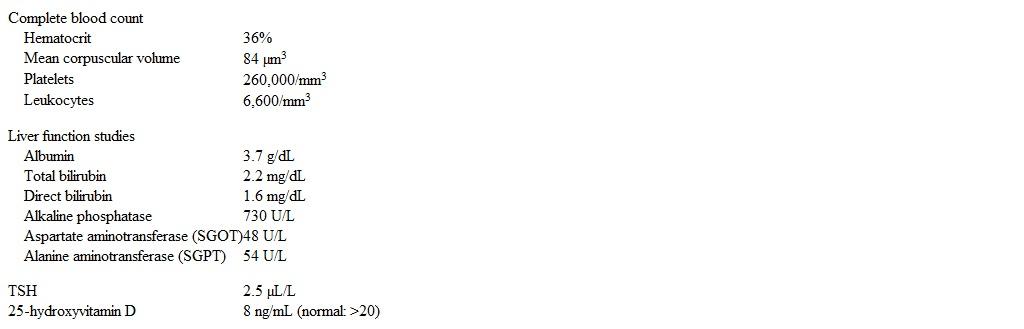 This patient would benefit most from which of the following?
 (Multiple Choice)
4.8/5 (82)
(82) A 38-year-old woman comes to the office due to constipation for the last 3-4 months. She has not had previous problems with bowel movements; however, she now spends 20-25 minutes having a bowel movement once every 3-4 days. The patient reports excessive straining; hard, pebble-like stools; incomplete evacuation; and intermittent digital disimpaction. She also has abdominal discomfort, bloating, and increased flatulence; all are relieved with bowel movements. Her appetite is good and her weight is stable.
The patient's other medical problems include anxiety disorder, vitiligo, migraine headaches, and fibromyalgia. She uses ibuprofen occasionally and takes no other medications. She underwent cognitive-behavioral therapy for anxiety and panic attacks approximately 3 years ago.
The patient does not use tobacco, alcohol, or illicit drugs. Her diet consists mainly of hamburgers, pizza, and fried foods. Family history is negative for colon cancer.
Vital signs are normal. Physical examination shows no abnormalities.
Laboratory results are as follows:
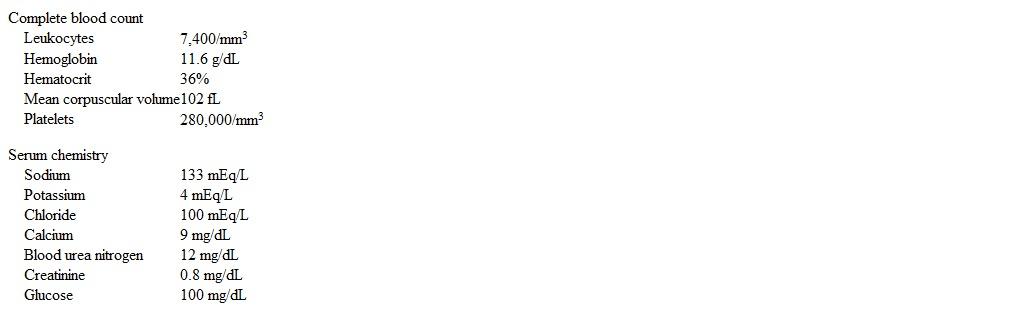 Which of the following is the most appropriate next step in management of this patient?
 (Multiple Choice)
4.9/5 (86)
(86) A 76-year-old man comes to the office due to nonproductive cough and progressive shortness of breath on exertion for the past 6 months. He uses 2 pillows at night to sleep and occasionally wakes up to urinate. The patient has had no chest pain, weight loss, night sweats, or joint pains. Two months ago, another physician started him on furosemide, which has provided little symptomatic relief. Other medical conditions include hypertension and hypercholesterolemia. The patient is an ex-smoker with a 40-pack-year history; he quit 10 years ago. He used to play golf regularly but stopped 3 months ago because he felt too winded.
Blood pressure is 144/78 mm Hg and pulse is 89/min and regular. Oxygen saturation is 93% on room air. BMI is 30 kg/m2. Jugular venous pressure is estimated at 10 cm H2O. Bibasilar crackles are heard on lung auscultation. The apical impulse is not displaced. A faint holosystolic murmur is heard at the lower sternum and increases with inspiration. The abdomen is soft and nontender. Liver span is 11 cm and there is no splenomegaly. Digital clubbing and trace ankle edema are present.
ECG shows normal sinus rhythm and nonspecific T-wave changes. Chest x-ray reveals prominent interstitial markings and decreased lung volumes.
Which of the following is most likely to establish this patient's diagnosis?
(Multiple Choice)
4.8/5 (69)
(69) A 53-year-old man has been prescribed fluphenazine for many years for schizophrenia. He lives in a group home and is accompanied by his caseworker. His psychotic symptoms have been stable, but he has developed a tremor in his hands and his caseworker has noticed that he walks slower. His medical history is significant for obesity, hypercholesterolemia, and hypertension, for which he takes lisinopril and simvastatin. He has been trying to exercise and eat healthy foods and has managed to lose 5 kg (11 lb) since his last visit 3 months ago. He is concerned about his hands shaking and would like to lose more weight. He wonders if he might do better on a different medication.
Vital signs are normal. BMI is 37 kg/m2. Mental status examination is significant for psychomotor retardation, slow speech, and lack of facial expressions. A resting tremor of the hands is noted.
ECG shows normal sinus rhythm without abnormalities.
The physician discusses the risks and benefits of switching to a different antipsychotic medication. Considering the patient's history, which of the following medications would be most appropriate?
(Multiple Choice)
4.7/5 (72)
(72) A 32-year-old woman comes to the office due to fatigue and loss of energy. She sleeps poorly due to multiple awakenings to feed her 3-month-old son, and it takes her a long time to fall back asleep. During the day, the patient is able to nap when the baby is sleeping but still feels tired all the time. Although the baby is healthy, she worries about him constantly. She has trouble concentrating and fears that she will neglect some aspect of his care. The patient says, "I was elated for the first few weeks after giving birth, but for the last couple of months I haven't been able to enjoy him and just feel I am a bad mother." Although still overweight, she has lost most of her baby weight and is less interested in food. The patient has a history of psoriasis and asthma treated with topical corticosteroids and as-needed beta agonists.
Blood pressure is 120/70 mm Hg and pulse is 88/min. Examination shows moist mucous membranes, clear lung fields, normal S1 and S2, no edema, and no neurological deficits. On mental status examination, the patient appears tired and anxious. She has no thoughts of suicide or harming the baby.
Which of the following is the most likely diagnosis?
(Multiple Choice)
4.9/5 (85)
(85) A 24-year-old man comes to the urgent care clinic with fevers and chills that developed when he awoke this morning. He also has diffuse body aches, most pronounced in his shoulders and knees. Two days ago, the patient was seen by his primary care provider due to a skin rash and was diagnosed with secondary syphilis. HIV testing was negative, and urine testing for gonorrhea and chlamydia was negative. He received a dose of intramuscular benzathine penicillin G yesterday afternoon.
Currently, the patient's temperature is 39 C (102.2 F), blood pressure is 114/64 mm Hg, pulse is 72/min, and respirations are 18/min. He is uncomfortable but not acutely ill-appearing. Oropharynx examination does not show any abnormalities. His lungs are clear bilaterally. The patient's abdomen is soft and nontender throughout. He has scattered macular, erythematous regions on his abdomen, back, shoulders, and lower extremities, which he reports have progressed since his initial presentation 2 days ago.
What is the most appropriate initial treatment for this patient?
(Multiple Choice)
4.8/5 (65)
(65) A 24-year-old man comes to the office due to concern that he is unable to adequately complete his work at his construction job. He is constantly distracted by thoughts that he has hurt one of his coworkers and spends hours each day repeatedly checking to make sure he has completed his assignments and that no one is injured. The patient feels the need to hammer nails in a specific geometric pattern and to make sure he uses only an odd number of nails. He counts the number of nails at least 3 times, saying to himself, "If I don't do this, someone could fall or injure themselves." He is extremely distressed by these thoughts and behaviors. On his last performance review, his supervisor reported that the patient is very cautious and has good skills but takes longer to complete jobs than his coworkers. The patient is afraid he will be fired if he doesn't start working more efficiently. He is otherwise healthy but smokes cigarettes and occasionally uses marijuana.
Physical examination is unremarkable apart from hard callouses on his ring fingers and right thumb. Laboratory studies, including complete blood count, comprehensive metabolic panel, and TSH, are within normal limits.
Which of the following is the most appropriate next step in management of this patient?
(Multiple Choice)
4.7/5 (73)
(73) A 24-year-old woman with a history of anxiety and asthma comes to the office due to wheezing. She was diagnosed with asthma 3 years ago and has been intubated twice during that period, both for <24 hours. She has been taking high-dose fluticasone/salmeterol and montelukast but has required frequent oral corticosteroids because "the attacks keep on happening."
In the past 6 months, the patient has been to the emergency department twice but was not admitted. She says that the attacks come on suddenly, often due to stress, but occasionally also due to dust, cigarette smoke, and exercise. The symptoms manifest as throat and chest tightness and cough. There is no seasonal variation.
The patient has no nighttime awakenings due to shortness of breath or cough and nasal congestion. She reports occasional symptoms of reflux, primarily when she eats in the late evening. The patient demonstrates excellent inhaler technique. She does not use tobacco, alcohol, or illicit drugs. She works as a waitress, lives alone, and has no pets.
Blood pressure is 110/80 mm Hg, pulse is 74/min, and respirations are 14/min. Pulse oximetry is 98% on room air. She appears comfortable, and there is no accessory respiratory muscle usage. Lung examination shows diffuse wheezes.
Spirometry shows forced expiratory volume (FEV1) of 97% predicted, forced vital capacity (FVC) of 101% predicted, and FEV1/FVC ratio of 0.94. Lung volumes and diffusion capacity are normal. Chest x-ray reveals no acute disease.
Which of the following is the best next step in management of this patient?
(Multiple Choice)
4.7/5 (90)
(90) A 40-year-old man comes to the emergency department due to acute flank pain and dysuria. He has no associated fever, joint pain, or suprapubic pain. The patient was discharged 5 days ago following hospitalization for central nervous system toxoplasmosis. He has long-standing AIDS (most recent CD4 count: 150/mm3) and had not been compliant with either antiretroviral treatment or trimethoprim-sulfamethoxazole prophylaxis therapy for several months prior to admission. While in the hospital, the patient was started on sulfadiazine and pyrimethamine, and antiretroviral treatment was reinstituted.
Temperature is 37 C (98.6 F), blood pressure is 122/78 mm Hg, and pulse is 98/min. Mucous membranes are dry. The abdomen is soft, and bilateral costovertebral angle tenderness is present. No rash is present.
Laboratory studies are as follows:
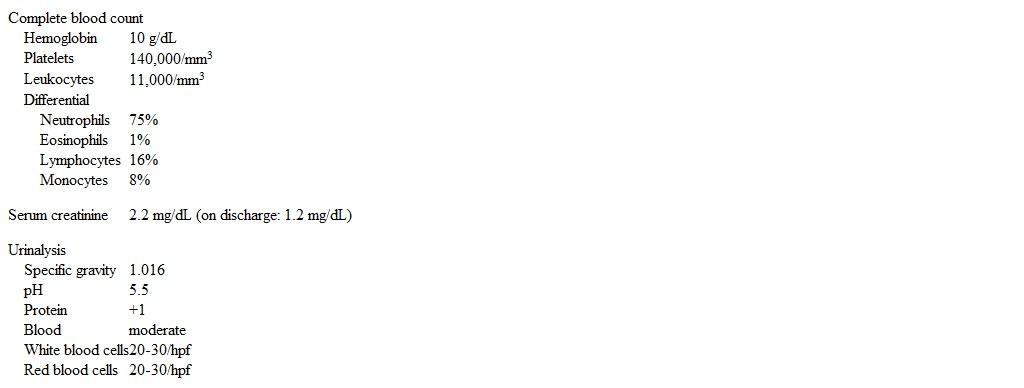 A urinary catheter is placed and produces 10 mL of urine during 6 hours of observation in the emergency department.
Which of the following is most likely to confirm the diagnosis in this patient?
A urinary catheter is placed and produces 10 mL of urine during 6 hours of observation in the emergency department.
Which of the following is most likely to confirm the diagnosis in this patient? (Multiple Choice)
4.7/5 (84)
(84) An 85-year-old man comes to the office due to increasing dyspnea and fatigue, which are affecting his ability to perform activities of daily living. His medical conditions include chronic obstructive pulmonary disease and congestive heart failure. The patient's wife passed away a year ago and he is struggling to come to terms with her death. He misses her and feels hopeless that his medical conditions will ever improve. The patient has stopped going to his community recreation center as "it is such an effort to get there and I don't enjoy it anymore." He admits to occasionally forgetting to take his medications, which include tiotropium, salmeterol, and furosemide.
Physical examination is significant for a prolonged expiratory phase and decreased breath sounds bilaterally, which are unchanged from previous examinations.
Which of the following is the best next step in management of this patient?
(Multiple Choice)
4.8/5 (71)
(71) A 53-year-old seamstress comes to the physician with pain and intermittent swelling in her fingers for the past 3 years. Symptoms involve primarily the distal interphalangeal joints and occur after she sews. A year ago, she was hospitalized with upper gastrointestinal bleeding and was found to have erosive gastritis and a duodenal ulcer. Her other medical problems include hypertension, type 2 diabetes mellitus, and fatty liver. Her current medications are glipizide, sitagliptin, lisinopril, and amlodipine.
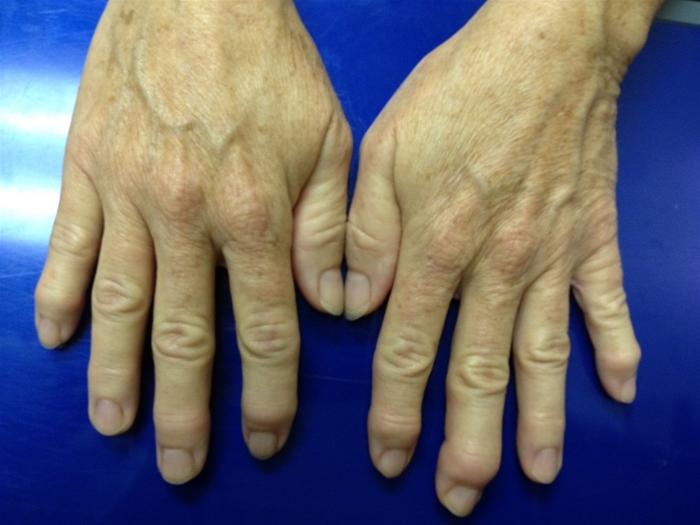
Her blood pressure is 133/70 mm Hg and pulse is 78/min. Her BMI is 26 kg/m2. Her hands appear as shown below. There is bony swelling and tenderness of several distal interphalangeal joints. The remainder of the examination is within normal limits.
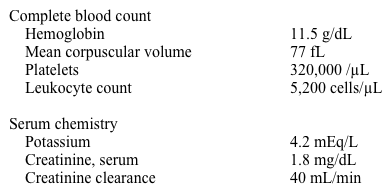
 Laboratory results are as follows:
 Liver function tests are within normal limits.
Which of the following is the most appropriate treatment for this patient?
Laboratory results are as follows:
Liver function tests are within normal limits.
Which of the following is the most appropriate treatment for this patient? (Multiple Choice)
4.9/5 (92)
(92) A 63-year-old woman reports changes in her toenails. The toenails of her right foot have been discolored for 3 years and are becoming thicker and more difficult to cut. She experiences pain in her toenails when wearing some of her high-heeled shoes. The patient feels that her toenails are "embarrassing" when she is barefoot at the beach.
A photograph of her foot is shown below.
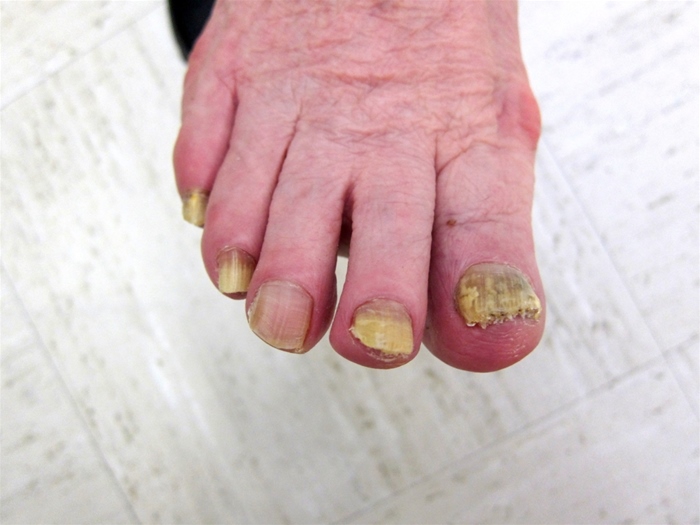 A KOH preparation of material removed from under the nails reveals hyphae.
What is the best therapy for this patient?
A KOH preparation of material removed from under the nails reveals hyphae.
What is the best therapy for this patient? (Multiple Choice)
4.9/5 (82)
(82) A 58-year-old man comes to the office complaining of feeling tired and having poor sleep. He was diagnosed with myocardial infarction (MI) three months ago and underwent percutaneous coronary revascularization. According to the patient, it was a "scary and life-changing experience". He also complains of occasional headaches in the morning, dry mouth, and sore throat. Sometimes he wakes up in the middle of the night with a choking sensation and pounding in his chest. He is afraid that he is going to have "another heart attack". His exercise tolerance is about three blocks and it is limited by weakness and shortness of breath. He denies any exertional chest pain.
His other medical problems include hypertension, hyperlipidemia, gout, and gastro-esophageal reflux disease (GERD). He is a lifetime non-smoker. His mother suffers from diabetes mellitus. His father died of a stroke at age 70. His current medications include metoprolol, rosuvastatin, aspirin, clopidogrel, lisinopril, amlodipine, and esomeprazole.
His blood pressure is 142/86 mmHg and his heart rate is 81/min and regular, and his oxygen saturation is 94% at room air. His BMI is 39 kg/m2. On physical examination, the heart sounds appear distant. Lungs are clear on auscultation. He has 1+ bilateral pitting lower extremity edema to the mid-calf.
Which of the following is the best next step in managing this patient?
(Multiple Choice)
4.9/5 (78)
(78) 
Filters
- Essay(0)
- Multiple Choice(0)
- Short Answer(0)
- True False(0)
- Matching(0)