



 Chat with AI
Exam 3: Office/Health Center

Exam 1: Emergency Department218 Questions
Exam 2: In-patient Facilities128 Questions
Exam 3: Office/Health Center900 Questions
Select questions type


A 35-year-old woman, gravida 1 para 1, who is 8 weeks postpartum comes to the office with multiple painful lumps in her breasts for the past week. She is breastfeeding and is otherwise healthy. Her only medication is a prenatal vitamin. The patient's mother had postmenopausal breast cancer.
Vital signs are normal. Physical examination reveals multiple small and tender masses in bilateral breasts; there is no surrounding erythema. Milky discharge is expressed bilaterally.
Which of the following is the most likely cause of this patient's symptoms?
(Multiple Choice)
4.7/5  (91)
(91) A 20-year-old man comes to the office for a sports physical. The patient has played varsity basketball since high school. He has had no chest pain, shortness of breath, palpitations, or fainting spells. He has no medical history and takes no medications. There is no family history of sudden death.
Blood pressure is 115/75 mm Hg, pulse is 56/min, and BMI is 22 kg/m2. The patient is in no distress. The apical precordial impulse is hyperdynamic. There is a normal S1 and S2, and an S4 is heard. He has a 2/6 systolic murmur at the left sternal border that increases with Valsalva maneuver. The lungs are clear to auscultation. The abdomen is soft and nondistended. Peripheral pulses demonstrate a rapid upstroke followed by a decline and secondary rise.
Transthoracic echocardiogram reveals interventricular septal thickness of 1.8 cm (normal: <1.1 cm) and posterior left ventricular wall thickness of 0.9 cm (normal: <1.1 cm). Left ventricular ejection fraction is 75%. At rest, there is no left ventricular outflow gradient; however, Valsalva maneuver generates a gradient of 30 mm Hg.
Which of the following is the most appropriate recommendation for this patient?
(Multiple Choice)
4.9/5 (66)
(66) A 54-year-old woman comes to the office due to 2 days of dull, aching pain and mild swelling of the left leg. The symptoms began after a 12-hour nonstop flight. The patient has had no shortness of breath, chest pain, or fever. She has been able to ambulate and perform daily activities despite the discomfort. Medical history includes hypertension and hyperlipidemia. She has smoked a pack of cigarettes daily for the last 30 years but does not use alcohol or injection drugs. The patient has no drug allergies. She works in a law firm.
Vital signs are within normal limits. BMI is 31 kg/m2. Heart sounds are normal, with no murmurs. The lungs are clear to auscultation. The left calf is mildly tender to palpation, with increased circumference compared to the right. The remainder of the physical examination is normal.
Laboratory results of blood cell counts, serum chemistry, and coagulation studies are within normal limits. Lower extremity venous Doppler ultrasonography shows an occluding thrombus in the left popliteal vein. Which of the following is the best next step in management of this patient?
(Multiple Choice)
4.7/5 (89)
(89) A 52-year-old man comes to the office due to a skin rash behind his ears, which his wife first noticed 2 months ago. The rash is not painful but is mildly pruritic, and the patient frequently scratches the skin. He has tried using emollient creams and changing his soap and shampoo, but the rash is persistent and gradually enlarging. The patient has no history of skin disorders; current medical conditions include hypertension and hyperlipidemia. He has smoked a pack of cigarettes daily for the last 30 years and drinks 4-6 alcoholic beverages a week. The patient has worked in an automotive assembly plant for the last 10 years and previously worked in a coal mine.
Vital signs are normal. Skin examination findings are shown in the Exhibit. There is a similar scaly, erythematous lesion at the gluteal cleft.
Which of the following is the most likely diagnosis?
(Multiple Choice)
4.8/5 (79)
(79) A 65-year-old man comes to the physician to follow up polymyalgia rheumatica with giant cell arteritis. He was started on 60 mg/day of prednisone 6 weeks ago and has been tapered to 20 mg/day. The patient has been taking 1,200 mg/day of supplemental calcium as well as 800 IU/day of vitamin D. He has no visual symptoms. His morning shoulder stiffness and aches have dissipated, and he feels well overall. Blood pressure is 136/84 mm Hg and pulse is 72/min. His weight is 77 kg (169.4 lb), an increase from 72 kg (158.4 lb) 2 months ago. The patient has no temporal artery tenderness. The remainder of his physical examination is within normal limits. Laboratory results are as follows:
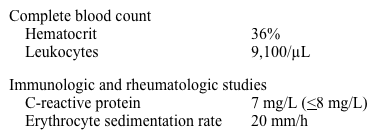 Dual-energy x-ray absorptiometry reveals a T-score of −1.3 at the lumbar spine and −1.2 at the femoral neck. Which of the following is the best next step in preventing fragility fractures in this patient?
 (Multiple Choice)
4.8/5 (97)
(97) A 70-year-old man comes to the physician with muscle pains and weakness over the last several weeks. He now has difficulty getting up from a chair and climbing stairs. He has no fever, weight loss, vision changes, or shortness of breath.
The patient's other medical problems include hyperlipidemia, gout, hypertension, chronic kidney disease, and degenerative joint disease of the hips and knees. His medications include lisinopril, allopurinol, colchicine, atorvastatin, and acetaminophen.
Vital signs are within normal limits. Examination shows some tenderness to palpation of his thighs and weakness of both thighs to extension and flexion. Deep-tendon reflexes are symmetrically diminished at the patellar tendons and absent at the Achilles tendons. Peripheral pulses are normal.
Laboratory results are as follows:
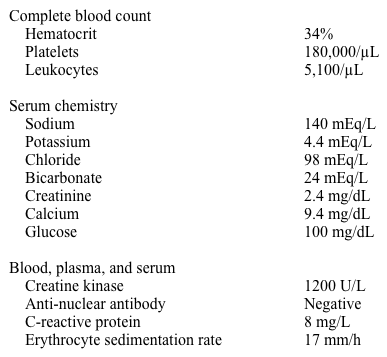 Electromyogram shows slowed sensory and motor nerve conduction velocities and small-amplitude, short-duration polyphasic waves.
A quadriceps muscle biopsy demonstrates widespread cytoplasmic vacuolization but no inflammation.
What is the most likely explanation for this patient's symptoms?
Electromyogram shows slowed sensory and motor nerve conduction velocities and small-amplitude, short-duration polyphasic waves.
A quadriceps muscle biopsy demonstrates widespread cytoplasmic vacuolization but no inflammation.
What is the most likely explanation for this patient's symptoms? (Multiple Choice)
4.9/5 (91)
(91) A 65-year-old woman comes to the physician because of unsteadiness and near-falls over the last 6 months. In the evening, she has to hold on to the wall in the hallway while going to the bathroom. She also complains of bilateral knee pains, occasional low back pain, and difficulty falling asleep. She is concerned that she has become more forgetful than usual. She denies dizziness, headaches, blurry vision, or weight loss. She has hypothyroidism, osteoporosis, and hypertension. Current medications include risedronate, hydrochlorothiazide, vitamin D, and levothyroxine. Her mother suffered from dementia and died at the age of 75. Her mammogram results 1 year ago and colonoscopy results 3 years ago were unremarkable.
Her blood pressure is 133/82 mmHg while supine and 135/85 mmHg while standing, and pulse is 78/min. On neurologic exam, position and vibration sensation is diminished in both feet as well as a slight decrease in light touch sensation. Cranial nerves are intact. Motor strength is normal and symmetric. Deep tendon reflexes are symmetric and decreased in her feet. There are no pathologic reflexes. Her score on a Folstein mini-mental status exam is 26/30.
The patients labs reveal:
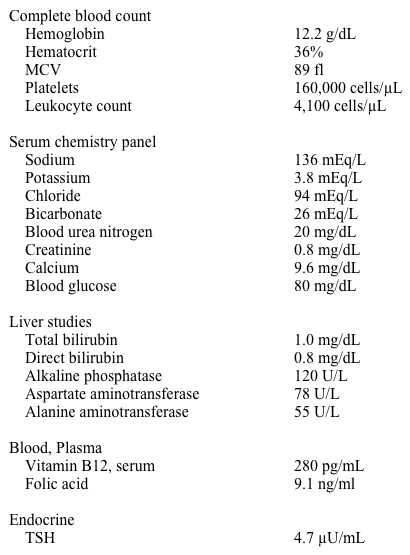 Which of the following is the most appropriate next step in management?
 (Multiple Choice)
4.8/5 (78)
(78) A 34-year-old woman returns to the physician for the results of her liver function tests, which were initially drawn 2 days ago when she presented with malaise, low-grade fever, and scleral icterus. She reports no significant change in her symptoms. Her medical problems include migraine headaches and irritable bowel syndrome. She takes intermittent ibuprofen for headaches. She denies tobacco, alcohol, or any recreational drug use. She works as a flight attendant and recently returned from Thailand. Her household contacts include her 36-year-old husband and 2 healthy children (ages 5 and 8). None of the family members have ever received any hepatitis vaccine.
Her physical examination is unremarkable except for mild abdominal discomfort in the right upper quadrant and mild scleral icterus.
Laboratory results are as follows:
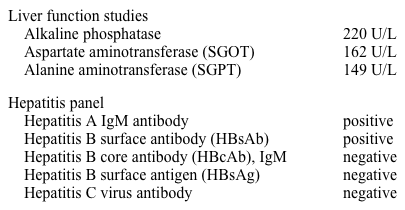 Which of the following is the most appropriate course of action?
 (Multiple Choice)
4.9/5 (75)
(75) A 35-year-old man underwent PPD/TST (tuberculin skin test) testing one week ago. The TST showed 20 mm of erythema and 2 mm induration at the inoculation site. He complains of an occasional dry cough in the mornings but denies fever, chills, weight changes, or night sweats. His medical problems include obesity, type 2 diabetes, and hyperlipidemia. His current medications include aspirin, metformin, and pravastatin. He smokes half a pack of cigarettes daily.
The patient works as an ambulance transport associate at a group home for mentally challenged children, and he occasionally spends time with the same kids supervising various recreational activities. He was born in Haiti and moved to the United States at age 5 with his family. He was tested for HIV with negative results at an employee health screening last year.
His vital signs and physical examination are within normal limits.
The patient's routine blood work during his annual physical last year was within normal limits.
Which of the following is the most appropriate next step in management?
(Multiple Choice)
4.9/5 (78)
(78) A 57-year-old man is evaluated for a 6-month history of persistent diarrhea. The patient describes frequent soft to watery bowel movements that sometimes awaken him from sleep. He has had fecal incontinence on several occasions along with abdominal bloating and excessive flatulence but has had no fever, abdominal or rectal pain, tenesmus, melena, hematochezia, or weight loss. Medical history includes hypertension, peripheral vascular disease, and a 40-year history of diabetes mellitus treated with insulin. The patient has not traveled recently.
Temperature is 36.9 C (98.4 F), blood pressure is 136/84 mm Hg supine and 122/77 mm Hg standing, and pulse is 72/min. The lungs are clear on auscultation and heart sounds are normal. The abdomen is nondistended, soft, and nontender with no palpable mass or hepatosplenomegaly. Bowel sounds are normal. Stool is negative for occult blood. Light touch and vibratory sensation are decreased on both feet, and bilateral ankle reflexes are absent.
Laboratory results are as follows:
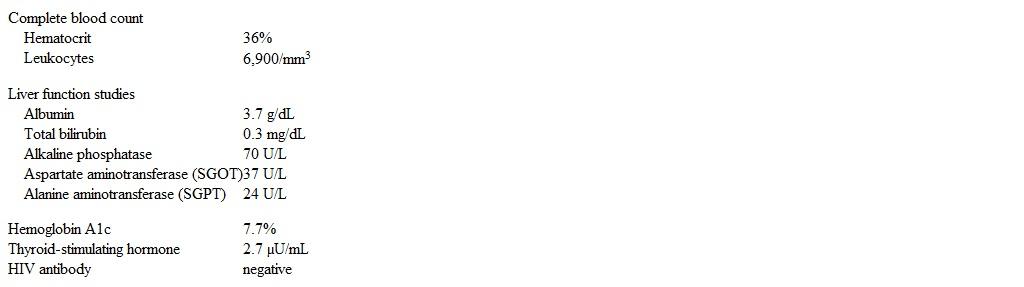 Stool is negative for ova and parasites, and stool culture grows no pathogenic bacteria. Colonoscopy reveals grossly normal mucosa; random biopsies are unrevealing. Small bowel follow-through barium studies and upper gastrointestinal endoscopy with random biopsies are normal.
Which of the following is most likely contributing to this patient's condition?
Stool is negative for ova and parasites, and stool culture grows no pathogenic bacteria. Colonoscopy reveals grossly normal mucosa; random biopsies are unrevealing. Small bowel follow-through barium studies and upper gastrointestinal endoscopy with random biopsies are normal.
Which of the following is most likely contributing to this patient's condition? (Multiple Choice)
4.7/5 (75)
(75) A 40-year-old woman comes to the office due to increasing pelvic pain and urinary urgency for the last few months. The patient initially had increasing urgency and was voiding every 1-2 hours. She now has increasing pelvic pain and pressure that requires her to void every 30-45 minutes. The patient's pelvic pain is typically relieved with voiding but returns prior to her next void. She has had no hematuria, postcoital bleeding, or urinary leakage.
The patient has fibromyalgia and type 2 diabetes mellitus. She had 2 vaginal deliveries in her late 20s. She is sexually active with a male partner and has had a tubal ligation. The patient does not use tobacco, alcohol, or illicit drugs.
Vital signs are normal. BMI is 28 kg/m2. On pelvic examination, the external genitalia and vagina appear normal and well-supported. The cervix is multiparous and nonfriable, and physiologic discharge is noted throughout the vaginal vault. On bimanual examination, there is tenderness to palpation over the urethra but no cervical motion tenderness.
Laboratory results are as follows:
 Urine culture and pregnancy test are negative.
Which of the following is the most likely diagnosis in this patient?
Urine culture and pregnancy test are negative.
Which of the following is the most likely diagnosis in this patient? (Multiple Choice)
4.8/5 (76)
(76) A 21-year-old woman comes to the office due to excessive sweating. She reports heavy axillary sweating even when she is not feeling warm. The patient has had no anxiety, tremors, or weight changes. Her symptoms began several years ago and have become progressively worse. The patient has tried a variety of over-the-counter antiperspirants without relief, and her clothes often become stained, causing significant embarrassment at her job. Medical history is otherwise unremarkable. She drinks alcohol on social occasions and does not use tobacco or illicit drugs. Her only medication is an oral contraceptive.
Vital signs are within normal limits and physical examination shows no abnormalities.
Which of the following is the most appropriate next step in management of this patient?
(Multiple Choice)
5.0/5 (75)
(75) A 55-year-old man comes to the office due to a 2-year history of pain in both hands with intermittent swelling of the finger joints. The pain impairs his functioning as a carpenter. He also has stiffness in the knees after prolonged sitting. Review of systems is negative for any other systemic or physical symptoms.
His other medical problems include chronic bronchitis, impaired glucose tolerance, and a history of nephrolithiasis. His home medications include ibuprofen as needed, glucosamine/chondroitin supplements, and aspirin. His father died of cardiomyopathy at age 75. The patient does not use illicit drugs but smokes a pack of cigarettes daily and drinks 2 mixed alcoholic beverages every night.
His vital signs are within normal limits. Finger nails appears pitted. There is boggy swelling and tenderness to palpation involving all the proximal and distal interphalangeal joints.
Laboratory results are as follows:
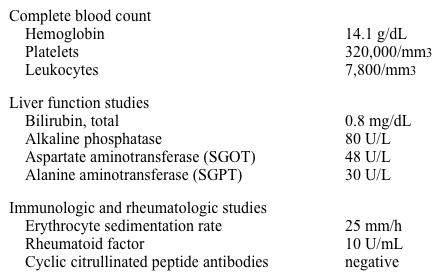 Chest x-ray reveals hyperinflation of the lungs but is otherwise normal. Hand x-ray is shown in the exhibit.
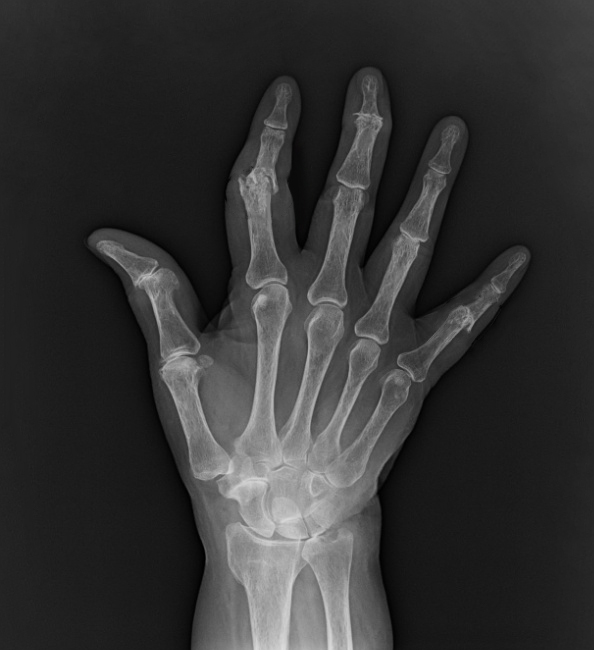 Which of the following is the most likely diagnosis?
Chest x-ray reveals hyperinflation of the lungs but is otherwise normal. Hand x-ray is shown in the exhibit.
Which of the following is the most likely diagnosis? (Multiple Choice)
4.8/5 (78)
(78) A 24-year-old woman comes to the office for an annual examination. Two weeks ago, the patient was evaluated at an urgent care center for lower abdominal pain and vaginal discharge. Pelvic examination at that time showed mucopurulent cervical discharge and cervical friability. Nucleic acid amplification testing (NAAT) was positive for Chlamydia trachomatis. Testing for gonorrheal infection was negative. The patient was treated with doxycycline orally twice daily for 7 days. Her partner also tested positive for Chlamydia infection and received doxycycline therapy. The patient's symptoms resolved after 7 days of treatment.
The patient has had no sexual activity since her last visit and is currently asymptomatic. As part of her annual examination, a Pap test and NAAT for both Chlamydia trachomatis and Neisseria gonorrhoeae are performed. The Pap test is normal and the NAAT is positive for Chlamydia trachomatis.
Which of the following is the most likely explanation for this patient's positive test result?
(Multiple Choice)
4.8/5 (88)
(88) A 42-year-old woman is evaluated for insomnia, anxiety, and irritability. She is accompanied by her husband to the appointment due to her fear of leaving home unaccompanied. The patient was raped in her neighborhood 3 months ago. Since then, she has become increasingly socially isolated and no longer goes out shopping or to the gym to exercise. The patient has difficulty falling and staying sleep and has frequent nightmares. She has difficulty concentrating when reading or staying focused during long conversations. During the day she feels anxious and exhausted, and she has had several unusual episodes of feeling a sense of unreality and as if she is detached from her physical body. Her husband comments, "She seems to be someplace else when I am talking to her." Her appetite is unchanged and she has continued her hobbies of painting and sewing at home. She has no suicidal thoughts.
Vital signs and physical examination are normal.
Which of the following is the most likely explanation for this patient's symptoms?
(Multiple Choice)
4.8/5 (84)
(84) A 65-year-old man comes to the physician because of a 3 day history of pain and swelling in his left knee. He also reports nausea and feeling weak earlier today. He has a long-standing history of rheumatoid arthritis (RA) and has had several previous episodes of "fluid in the knee." He currently takes methotrexate and sulfasalazine for his RA. Tumor necrosis factor inhibitor therapy was prescribed two years ago but was discontinued after six months due to frequent sinus infections and exacerbation of his congestive heart failure. His other medical problems include hypertension, hypercholesterolemia, colonic polyps, essential tremor, congestive heart failure, and a remote history of asbestos exposure. His other medications include furosemide, propranolol, lisinopril, aspirin, and simvastatin.
His temperature is 37.2 C (99 F), blood pressure is 110/70 mm Hg, pulse is 88/min, and respirations are 16/min. He has no jugular venous distention. His heart sounds are normal and his lungs are clear. Musculoskeletal examination is notable for extensive deformities in the hands due to long-standing arthritis. His right knee is normal. The left knee is tender and swollen and he is unable to extend it due to pain.
Joint aspiration yields 20 cc of synovial fluid. Laboratory results are as follows:
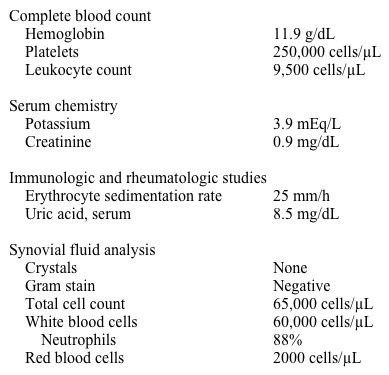 Which of the following is the most appropriate next step in management?
 (Multiple Choice)
4.9/5 (77)
(77) A 35-year-old woman comes to the office to discuss her risk of ovarian cancer. The patient recently read that women who have sex with women might be at increased risk of ovarian cancer. She has had only female sexual partners. The patient has no appetite changes, abdominal distension, pelvic pain, or abnormal vaginal bleeding. She is nulliparous and has never been on contraception.
The patient has no chronic medical conditions and has had no prior surgeries. She takes a daily multivitamin and occasional ibuprofen at the beginning of her menstrual periods. Family history is significant for a maternal aunt with postmenopausal breast cancer. The patient drinks 1 or 2 glasses of wine a night but does not use tobacco or illicit drugs.
Vital signs are normal. The lungs are clear to auscultation bilaterally. Cardiac examination reveals a regular rate and rhythm. The abdomen is soft, nontender, and nondistended.
Which of the following is the most appropriate ovarian cancer screening guideline for this patient?
(Multiple Choice)
4.9/5 (91)
(91) A 28-year-old African American woman returns to the physician for follow-up of persistent symptoms. She has had a low-grade fever, joint pains, a cough, and shortness of breath for one month. Two weeks ago, she was given a 5-day course of azithromycin without improvement of her symptoms. A chest x-ray showed bilateral upper lobe opacities. She was then prescribed a 10-day course of levofloxacin. She has not noticed any improvement and has now developed painful red bumps on her legs.
She has no other medical problems and takes no other medications. She lives in New York and denies recent travel or any sick contacts. She has been in a relationship with a new male partner for the last 2 months. She does not use tobacco, alcohol, or illicit drugs.
Her temperature is 37.2 C (99 F), blood pressure is 120/70 mm Hg, pulse is 84/min, and respirations are 16/min. The patient's pulse oximetry is 94% on room air. Examination reveals crackles in the upper lungs bilaterally. Tender, erythematous, non-fluctuant nodules are present on the anterior surfaces of both legs. The remainder of the examination is unremarkable.
Repeat chest x-ray shows bilateral upper lobe opacities that are unchanged.
Which of the following is the most likely diagnosis?
(Multiple Choice)
4.9/5 (73)
(73) A 57-year-old man comes to the physician with mild dyspnea on exertion and wheezing for the past 6 months. He experiences dyspnea when walking 4-5 blocks or when climbing stairs. The patient sleeps poorly and often has wheezing at night when lying down, especially when lying on his back. He has an occasional cough but attributes this to allergic rhinitis. The patient has a history of childhood asthma for which he used albuterol as needed until he was 25 years old, but says that he "grew out of it." He does not use tobacco, alcohol, or illicit drugs.
Vital signs and physical examination are within normal limits. His BMI is 30 kg/m2.
Electrocardiogram (ECG) is unremarkable.
What is the best next step in management of this patient?
(Multiple Choice)
4.9/5 (91)
(91) A 23-year-old African American man returns to the physician because of jaundice, dark urine, and fatigue. He was seen in the clinic 4 days ago for sinusitis and was prescribed trimethoprim-sulfamethoxazole. He reports that his sinus symptoms have improved. He has no other medical problems and takes no other medications. He does not use tobacco, alcohol, or illicit drugs.
Vitals signs are normal. Physical examination shows scleral icterus. Abdominal examination is unremarkable with no evidence of hepatosplenomegaly.
Laboratory results are as follows:
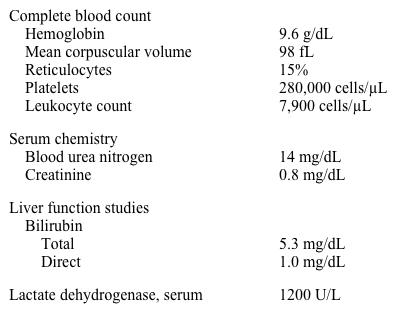 Peripheral blood smear shows many bite cells. Direct and indirect Coombs' test is negative. Red blood cell glucose-6-phosphate dehydrogenase level is normal.
Which of the following is the most likely cause of his anemia?
Peripheral blood smear shows many bite cells. Direct and indirect Coombs' test is negative. Red blood cell glucose-6-phosphate dehydrogenase level is normal.
Which of the following is the most likely cause of his anemia? (Multiple Choice)
4.9/5 (76)
(76) 
Filters
- Essay(0)
- Multiple Choice(0)
- Short Answer(0)
- True False(0)
- Matching(0)