



 Chat with AI
Exam 3: Office/Health Center

Exam 1: Emergency Department218 Questions
Exam 2: In-patient Facilities128 Questions
Exam 3: Office/Health Center900 Questions
Select questions type


A 22-year-old woman comes to the physician after several months of headaches. She describes them as moderate intensity and occurring frequently, now daily. She occasionally hears a noise similar to wind blowing during the headaches. The patient has taken escalating doses of over-the-counter painkillers with some relief. She smokes marijuana occasionally.
Her blood pressure is 132/80 mm Hg and heart rate is 87/min. On neurologic examination, there is no muscle weakness or sensory loss. Deep-tendon reflexes are normal. The neck is supple. Funduscopic findings (as shown) are the same in both eyes.
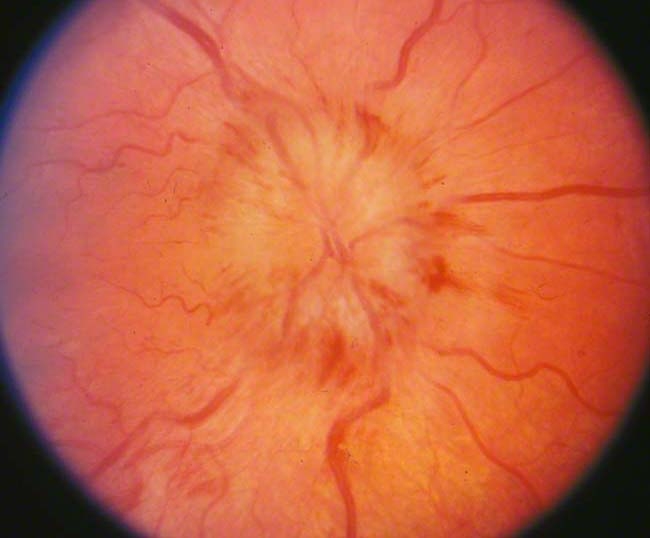 Which of the following is the most likely diagnosis?
 (Multiple Choice)
4.8/5  (81)
(81) A 43-year-old woman is being evaluated for exertional dyspnea. She has a history of right leg deep vein thrombosis that was diagnosed 18 years ago during the postpartum period of her first pregnancy. Her other medical problems include hypertension, hyperlipidemia, type 2 diabetes, and asymptomatic gall stones. She works in a local textile factory and has 20 pack-year smoking history.
Her blood pressure is 150/90 mm Hg and pulse is 76/min. Her BMI is 36 kg/m2. Examination shows a plethoric appearance, mild facial hirsutism, and abdominal skin stretch marks. Lungs are clear to auscultation. There is no leg swelling. Arterial blood gas findings demonstrate a pH of 7.35, pCO2 of 45 mm Hg, and pO2 of 65 mm Hg.
Pulmonary function tests are shown below.
 Which of the following is the most likely cause of her dyspnea?
 (Multiple Choice)
4.8/5 (68)
(68) A 36-year-old woman comes to the office due to recurrent dysuria. She also has had dull pain in her right flank and cloudy urine that contains blood. The patient has a history of recurrent urinary tract infections since becoming sexually active in high school. Over the last year, she has had 3 infections accompanied by fever. Her last urine culture grew Klebsiella pneumoniae. The patient is in a monogamous relationship. For contraception, she uses a diaphragm or her partner uses a condom, both with spermicidal coatings.
Temperature is 38.1 C (100.6 F), blood pressure is 114/70 mm Hg, and pulse is 95/min. The abdomen is soft and nontender. Mild right costovertebral angle tenderness is present on percussion.
Laboratory results are as follows:
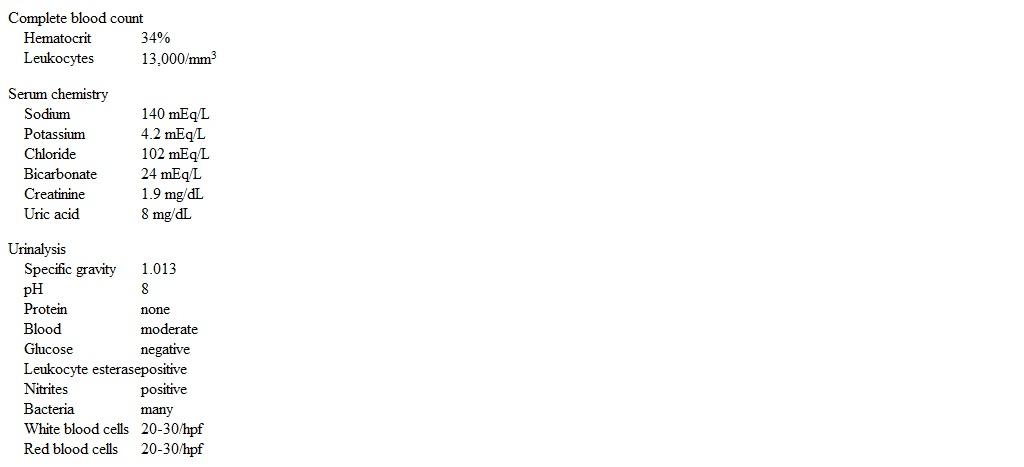 Which of the following would most likely treat the underlying cause of this patient's recurrent condition?
 (Multiple Choice)
4.8/5 (100)
(100) A 24-year-old woman comes to the physician with lumps in her neck. She has no fever, night sweats, or weight loss. The patient has no other medical problems and takes no medications. Menarche was at age 12 and she has never been pregnant. Family history is unremarkable. She has smoked a pack of cigarettes daily for 2 years but does not use alcohol or illicit drugs.
Vital signs are within normal limits. Physical examination shows bilateral enlarged cervical and axillary lymph nodes. There is no hepatosplenomegaly. The remainder of the physical examination is within normal limits.
Laboratory results are as follows:
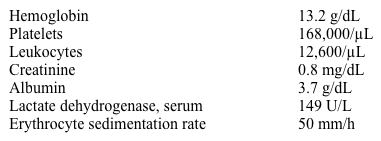 Computed tomography scan of the neck, chest, abdomen, and pelvis reveals enlarged lymph nodes above the diaphragm. A lymph node biopsy shows large multinucleated giant cells that are negative for CD20 and CD45 and positive for CD15 and CD30. Bone marrow biopsy is negative. Transthoracic echocardiogram shows normal cardiac structures and function.
Which of the following is the most appropriate next step in management of this patient?
Computed tomography scan of the neck, chest, abdomen, and pelvis reveals enlarged lymph nodes above the diaphragm. A lymph node biopsy shows large multinucleated giant cells that are negative for CD20 and CD45 and positive for CD15 and CD30. Bone marrow biopsy is negative. Transthoracic echocardiogram shows normal cardiac structures and function.
Which of the following is the most appropriate next step in management of this patient? (Multiple Choice)
4.8/5 (84)
(84) A 76-year-old woman is brought to the office by her daughter due to generalized weakness, muscle aches, and loss of appetite for the past 2-3 weeks. The patient has a history of hypertension and hypercholesterolemia. Current medications include amlodipine and rosuvastatin which was started 6 weeks ago. The patient is an ex-smoker with a 40-pack-year history.
Temperature is 35.6 C (96 F), blood pressure is 140/100 mm Hg, and pulse is 62/min. Examination shows normal first and second heart sounds. The lungs are clear to auscultation. There is no jugular venous distension. The abdomen is soft and nontender. Muscle strength is 4/5 in both upper and lower extremities, with diffuse muscle tenderness but no joint swelling.
Laboratory results are as follows:
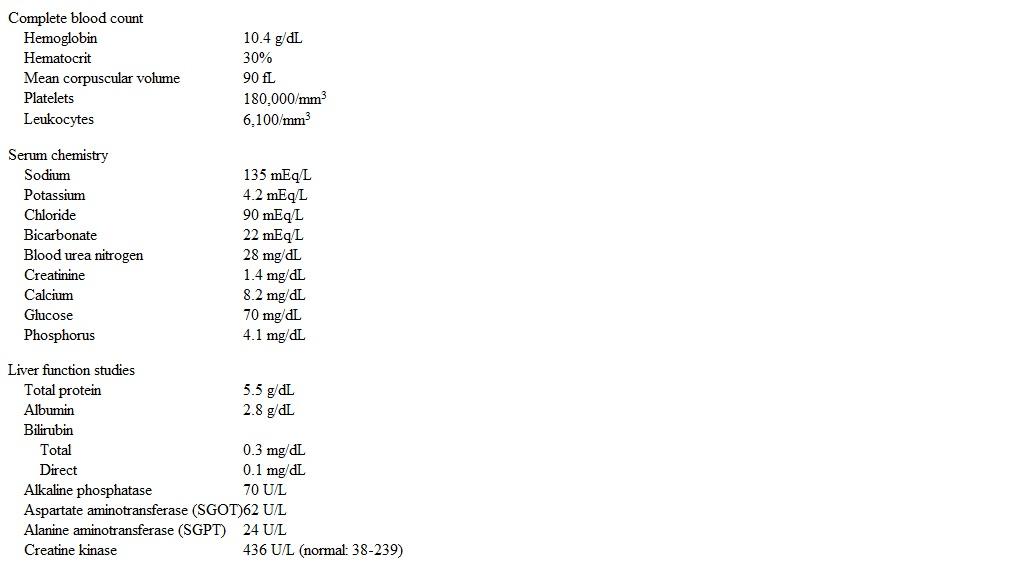 Rosuvastatin is held.
Which of the following is the most appropriate next step in management?
Rosuvastatin is held.
Which of the following is the most appropriate next step in management? (Multiple Choice)
4.8/5 (84)
(84) A 62-year-old man comes to the office for follow-up of diabetes mellitus type 2. He admits missing his appointments and medications and not following a strict diet. The patient does not smoke but has chewed tobacco for many years. He drinks 6-10 beers each weekend. His body mass index is 27.5 kg/m2. On oral examination, a white patch is seen on the buccal mucosa. The lesion appears to have a granular texture, is not indurated, and is not removed by scraping with a tongue depressor. There is no regional lymphadenopathy. His hemoglobin A1c is 8.5%.
Which of the following is the most likely diagnosis?
(Multiple Choice)
4.8/5 (87)
(87) A 55-year-old man comes to the physician with a 3-month history of right groin pain. It initially occurred only during weight-bearing maneuvers but now has become constant. He has no fever, dysuria, or paresthesia.
The patient underwent renal transplantation 10 years ago due to polycystic kidney disease. His other medical problems include hypertension and spinal stenosis status post lumbar laminectomy. His medications include prednisone, mycophenolate, and sirolimus. He does not use tobacco or alcohol.
His temperature is 37 C (98 F), blood pressure is 114/67 mm Hg, pulse is 72/min, and respirations are 14/min. The abdomen is soft and nontender. Range of motion and curvature of the spine are normal with no pain to palpation noted. Internal rotation of the right hip joint is restricted due to pain. There is no warmth, swelling, or erythema to the joint. Neurologic examination is within normal limits. Pinprick and light touch sensations are intact.
Laboratory results are as follows:
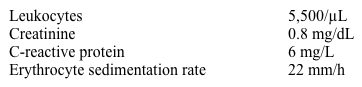 X-ray of the right hip shows mild joint space narrowing between the femur and acetabulum.
Which of the following is the most appropriate next step in management of this patient?
X-ray of the right hip shows mild joint space narrowing between the femur and acetabulum.
Which of the following is the most appropriate next step in management of this patient? (Multiple Choice)
5.0/5 (80)
(80) A 65-year-old woman with a known history of Crohn's disease comes to the physician to receive the influenza and pneumonia vaccines. She has never received these vaccines in the past. She has no current complaints. She denies abdominal pain, diarrhea, vomiting, and weight loss. Her other medical problems include hypertension and osteoarthritis.
Her surgical history includes hysterectomy for fibroids, partial small bowel resection, and cholecystectomy. Her last colonoscopy was 9 months ago, which showed mild inflammation. She quit smoking 2 years ago and has 30 pack-year smoking history. Her medications include hydrochlorothiazide, omeprazole, naproxen, sulfasalazine, azathioprine, and infliximab.
Which of the following is the most appropriate course of action?
(Multiple Choice)
4.9/5 (92)
(92) A 32-year-old man comes to the clinic after experiencing heart palpitations. He is concerned as his uncle died suddenly at age 35.
During physical examination, the physician asks the patient to sit up, lean forward, and hold his breath in full expiration while placing the diaphragm of the stethoscope at the left sternal border and applying firm pressure.
Which of the following findings is best auscultated with this maneuver?
(Multiple Choice)
4.9/5 (83)
(83) A 45-year-old woman comes to the physician complaining of pain in her hands and wrists for the last 3 months. She says that her hands are "frozen" and tender every morning. She has no weight loss, fevers, chest pain, or back pain.
Examination of her joints shows mild swelling and tenderness of several proximal interphalangeal joints, metacarpophalangeal joints, and both wrists. There are no skin rashes or mucosal lesions. No lymph nodes are palpable.
Laboratory results are as follows:
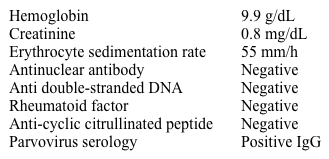 Which of the following is the most likely diagnosis?
 (Multiple Choice)
4.8/5 (70)
(70) A 65-year-old man comes to the office for follow-up on hypertension. He was diagnosed with hypertension 2 years ago and has since followed a low-salt diet and tried to lose weight. At the patient's last clinic visit 8 weeks ago, his blood pressure was 176/95 mm Hg. Medical history is notable for gout; he had 2 episodes of gouty arthritis last year that affected his right big toe and right knee. Allopurinol was prescribed following the first episode but was discontinued after the patient developed oral ulcers. The patient does not use tobacco and drinks alcohol socially.
Blood pressure is 174/101 mm Hg and pulse is 79/min. BMI is 30 kg/m2. Examination shows normal S1 and S2. There are no carotid bruits. The lungs are clear bilaterally. Peripheral pulses are full and symmetric.
Laboratory results are as follows:
 Liver function tests and urinalysis are unremarkable.
Which of the following is the best initial treatment for this patient?
Liver function tests and urinalysis are unremarkable.
Which of the following is the best initial treatment for this patient? (Multiple Choice)
4.9/5 (97)
(97) A 32-year-old man comes to the office due to burning pain in his chest and severe midsternal pain on swallowing over the past week. The symptoms have become so severe that he cannot swallow any food or fluids. The patient has also felt warm for the past 2 days but has had no dyspnea, cough, abdominal pain, diarrhea, or urinary symptoms. He has a history of intravenous drug abuse and a recent episode of community-acquired pneumonia. The patient also has chronic HIV infection (last CD4 count was 90 cells/mm3) but has had poor medical follow-up. He has smoked a pack of cigarettes daily for 15 years and drinks 1 or 2 cans of beer daily.
Temperature is 38 C (100.4 F), blood pressure is 112/67 mm Hg, pulse is 98/min, and respirations are 16/min. Oxygen saturation is 97% on room air. BMI is 19 kg/m2. The patient is in distress due to pain. Examination shows no oral lesions. The chest is clear to auscultation. No murmurs are noted. The remainder of the physical examination is unremarkable.
Which of the following is the most appropriate next step in management of this patient?
(Multiple Choice)
4.8/5 (87)
(87) A 53-year-old postmenopausal woman comes to the office for a follow-up visit. The patient recently had surgery for early-stage, estrogen receptor-positive breast cancer diagnosed on screening mammography. She was started on an aromatase inhibitor postoperatively but discontinued the therapy due to intolerable side effects. Today she is starting tamoxifen as an adjuvant endocrine treatment. The patient has no other chronic medical problems. Her mother has type 2 diabetes mellitus and had a minor stroke. Her father died from metastatic colon cancer.
Vital signs are within normal limits. BMI is 29 kg/m2.
This patient is at highest risk for which of the following complications from tamoxifen therapy?
(Multiple Choice)
4.9/5 (89)
(89) A 52-year-old woman with known rheumatoid factor-positive rheumatoid arthritis comes to the physician for routine follow-up. She currently takes 7.5 mg methotrexate weekly with good response. She has minimal morning stiffness and good exercise tolerance. The patient's last flare 2 years ago was treated with a short course of prednisone. Her other medications include folic acid daily and naproxen occasionally for joint pain. She has a 30-pack-year smoking history. There is no family history of cancer or heart disease.
Her blood pressure is 133/82 mm Hg and pulse is 75/min. Her BMI is 18 kg/m2. There are mild deformities affecting small joints of both hands with no active synovitis. Lungs are clear to auscultation. Abdominal examination shows no organomegaly. There are no skin rashes.
Laboratory results are as follows:
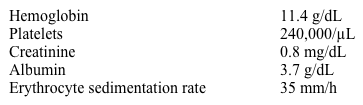 Liver function tests are within normal limits.
Which of the following is the best next step in management of this patient?
Liver function tests are within normal limits.
Which of the following is the best next step in management of this patient? (Multiple Choice)
4.8/5 (65)
(65) A 50-year-old man comes to the physician with the complaint of weakness. He was well until about 3 weeks ago when he had several episodes of diarrhea that lasted 4 days. Seven days ago, he felt shooting pains in his feet and legs followed by bilateral leg weakness. He reports difficulty with ambulation and getting out of a chair. He has no fever, chills, vision changes, dysphagia, bladder or bowel problems, back pain, muscle tenderness, or dark urine. His past medical history includes hypertension and hyperlipidemia. His current medications include hydrochlorothiazide and lovastatin.
His blood pressure is 144/86 mm Hg, and pulse is 90/min and regular. Physical examination reveals marked symmetrical weakness of both legs without sensory deficits. Lower-extremity deep-tendon reflexes are absent. There is slight symmetric weakness of his hands, but strength and deep-tendon reflexes of his proximal upper extremities are intact. Cranial nerves are intact. The remainder of the examination is within normal limits.
Laboratory results are as follows:
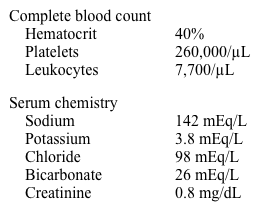 Which of the following is the most likely finding on cerebrospinal fluid analysis?
 (Multiple Choice)
4.9/5 (89)
(89) A 42-year-old woman with known HIV infection comes to the physician with left-sided facial swelling and pain. She describes similar episodes over the last 6 months that last several days and then slowly subside. During these episodes, she has difficulty eating and sleeping on her left side. She also complains of occasional dry mouth, heartburn, and nocturnal wheezing. Her CD4 count was 450/µL 2 months ago.
Her temperature is 36.7 C (98 F), blood pressure is 108/78 mm Hg, pulse is 70/min, and respirations are 16/min. There is a tender, nonerythematous, spongy swelling in the preauricular area extending to the angle of the mandible. Cranial nerve examination is unremarkable.
Which of the following is the most likely diagnosis?
(Multiple Choice)
4.8/5 (77)
(77) A 77-year-old woman is transferred to a skilled nursing facility after a 2-week hospital stay for hip fracture repair. Her hospital course was complicated by a lower gastrointestinal hemorrhage and subsequent bacteremia from an intravenous line.
Vital signs are within normal limits. The patient is alert and oriented to person and date; she appears thin. She has a 4x5-cm pressure ulcer over her presacral area that extends through the skin, but no muscle or bone is exposed. The ulcer has little exudate and minimal surrounding erythema.
In addition to nutritional support, which of the following is indicated for this patient's pressure ulcer?
(Multiple Choice)
4.9/5 (78)
(78) A 48-year-old man comes to the office due to recurrent "painful lumps" in both axillae that often rupture spontaneously. He has had these lesions for the past several years, but lately they are recurring more frequently. The discharge from the lesions has an unpleasant smell, and the patient has to use deodorant several times daily. He also takes an over-the-counter nonsteroidal anti-inflammatory drug for pain. The patient has had no fever, chills, cough, anorexia, or weight loss. He has no other medical problems. The patient has not traveled out of his home state of Ohio for the past several years and works as a landscaper in a park. He smokes a pack of cigarettes daily but does not use alcohol or illicit drugs.
Vital signs are within normal limits. BMI is 47 kg/m2. The axillary areas have findings as shown below, and the remainder of the physical examination shows no abnormalities.
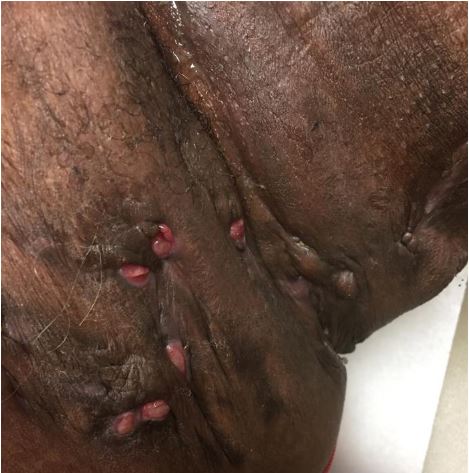 Which of the following is the most likely diagnosis in this patient?
 (Multiple Choice)
4.9/5 (90)
(90) A 20-year-old woman comes to the physician with pain and itching in her left ear. She has been swimming frequently and first noticed some itching a few days ago. She tried using cotton swabs in the canal and subsequently developed pain with malodorous discharge from that ear. Her hearing is also diminished on that side. The patient has no fever or chills. Her balance and coordination are normal. She does not wear earrings and has no known skin disorders.
Vital signs are within normal limits. Examination shows ear pain elicited with movement of her left tragus. There is no warmth or redness around the ear and no pain to percussion of the mastoid area. There is a moderate amount of debris blocking 50% of the auditory canal. Removal of the debris shows an erythematous and edematous external canal. The tympanic membrane appears slightly red but is intact and mobile with a pneumatic otoscope.
Which of the following is the most appropriate management for this patient?
(Multiple Choice)
4.7/5 (93)
(93) A 57-year-old woman comes to the office for perioperative evaluation prior to decompressive lumbar laminectomy surgery scheduled in 3 weeks. For the past 2 years she has experienced gnawing pain in the left buttock and thigh. The patient was once able to walk in the grocery store and get some relief by leaning forward on the cart, but now walking even short distances is intolerable. She has had occasional mild stress incontinence since the birth of her third child 20 years ago but no recent change in bladder or bowel function. She has tried physical therapy and nonsteroidal anti-inflammatory drugs with minimal relief. A month ago, the patient came to the emergency department with asymmetric leg swelling and was found to have a thrombosis in the left popliteal vein. Her reduced mobility due to pain was thought to be a contributing factor. She has no history of heart disease or diabetes. The patient had an uncomplicated cholecystectomy 10 years ago. Medications include apixaban and amitriptyline. She is not aware of any family history of blood clots.
Blood pressure is 136/86 mm Hg and pulse is 94/min. Pulse oximetry is 98% on room air. BMI is 17 kg/m2. Examination shows normal jugular venous pressure, clear lungs, and normal S1 and S2. Straight-leg raise to 90 degrees is negative. There is flexion in response to stimulation of the plantar surface of the left foot. Trace pretibial edema is present bilaterally.
Serum chemistry demonstrates normal renal function.
Which of the following is the most appropriate recommendation for perioperative management of this patient's anticoagulation?
(Multiple Choice)
4.9/5 (80)
(80) 
Filters
- Essay(0)
- Multiple Choice(0)
- Short Answer(0)
- True False(0)
- Matching(0)