



 Chat with AI
Exam 3: Office/Health Center

Exam 1: Emergency Department218 Questions
Exam 2: In-patient Facilities128 Questions
Exam 3: Office/Health Center900 Questions
Select questions type


A 63-year-old man comes to the physician for routine follow-up after an episode of acute diverticulitis. Four weeks ago, he was admitted to the hospital with severe abdominal pain and vomiting. Computed tomography scan of the abdomen at that time showed sigmoid wall thickening and increased density of the pericolic fat. He was treated with intravenous fluids and antibiotics before completing oral antibiotics as an outpatient.
The patient has no abdominal pain and a good appetite. He suffers from chronic constipation and takes fiber supplements. A colonoscopy 6 years ago was normal. His father was diagnosed with colon cancer at age 65.
His temperature is 36.7 C (98 F), blood pressure is 120/70 mm Hg, and pulse is 70/min. There is minimal tenderness in the left lower quadrant on deep palpation.
Which of the following is the best next step in managing this patient?
(Multiple Choice)
4.9/5  (72)
(72) A 55-year-old man comes to the physician for excessive daytime sleepiness. Over the last year he has experienced nighttime sleep disturbances, including dream-enacting behaviors such as talking, yelling, punching, kicking, and jumping from the bed. His mood has changed and he is now frequently depressed and anxious. The patient has noticed increasing difficulty with his sense of smell and no longer enjoys a morning cup of coffee. His bowel movements have also become less regular and he is frequently constipated. He has no headaches, changes in vision, trouble swallowing, slurred speech, numbness, weakness, tremors, or difficulty walking. The patient also has no delusions or visual or auditory hallucinations. He works as an attorney and does not use tobacco, alcohol, or illicit drugs.
His temperature is 36.7 C (98 F), blood pressure is 140/90 mm Hg, pulse is 92/min, and respirations are 12/min. Pulse oximetry shows 96% on room air. The patient's BMI is 35 kg/m2. His Mini-Mental State Examination is normal. He has a diminished sense of smell on "scratch and sniff" testing.
Which of the following is the most likely explanation for this patient's symptoms?
(Multiple Choice)
4.9/5 (91)
(91) A 49-year-old woman comes to the physician with complaints of food getting stuck in her chest. It happens most often when she eats in a hurry and does not fully chew her food. She has no chest pain, abdominal pain, vomiting, heartburn, or weight loss. Her past medical history is not significant.
Barium esophagogram reveals a lower esophageal ring. She undergoes an endoscopic dilation procedure with complete relief of the symptoms. The remainder of the esophageal mucosa has no abnormalities.
Which of the following complications is the patient most likely to develop over the next 5 years?
(Multiple Choice)
4.9/5 (98)
(98) A 76-year-old man comes to the office due to right ear pain. He first experienced mild pain several weeks ago and has also noticed that his pillow is wet in the morning with discharge from the ear. The patient saw another provider 2 weeks ago and was given oral ciprofloxacin but has not had any relief since. He has type 2 diabetes mellitus treated with metformin, sitagliptin, and glyburide. He admits to occasionally skipping his medications and does not regularly check his blood glucose at home. The patient has a 50-pack-year smoking history.
His temperature is 36.7 C (98 F), blood pressure is 134/78 mm Hg, and pulse is 90/min. On physical examination, ulceration with exudation is present in the right ear canal, and manipulation of the right pinna evokes mild pain.
Laboratory results are as follows:
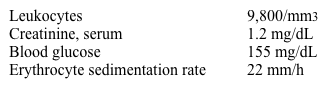 CT scan of the base of the skull reveals areas of bony erosion involving the right auditory canal. Cultures of the ear exudate are obtained.
Which of the following is the best next step in management of this patient?
CT scan of the base of the skull reveals areas of bony erosion involving the right auditory canal. Cultures of the ear exudate are obtained.
Which of the following is the best next step in management of this patient? (Multiple Choice)
4.8/5 (81)
(81) A 58-year-old woman comes to the office due to progressive fatigue over the last 2 years. She has also experienced generalized pruritus, for which she has used different lotions over the past year, but she has had no chest pain, abdominal pain, diarrhea, or weight loss. The patient takes lansoprazole for acid reflux, atorvastatin for hypercholesterolemia, and fosinopril for hypertension. She received a blood transfusion following a motor vehicle collision several years ago. The patient has no history of illicit drug use. She was adopted and her biological history is unknown.
Temperature is 36.7 C (98 F), blood pressure is 144/89 mm Hg, and pulse is 78/min. BMI is 27 kg/m2. The patient appears healthy and well tanned although she denies sun exposure. There is no scleral icterus. Cardiac and pulmonary examinations are within normal limits. There is mild hepatomegaly.
Laboratory results are as follows:
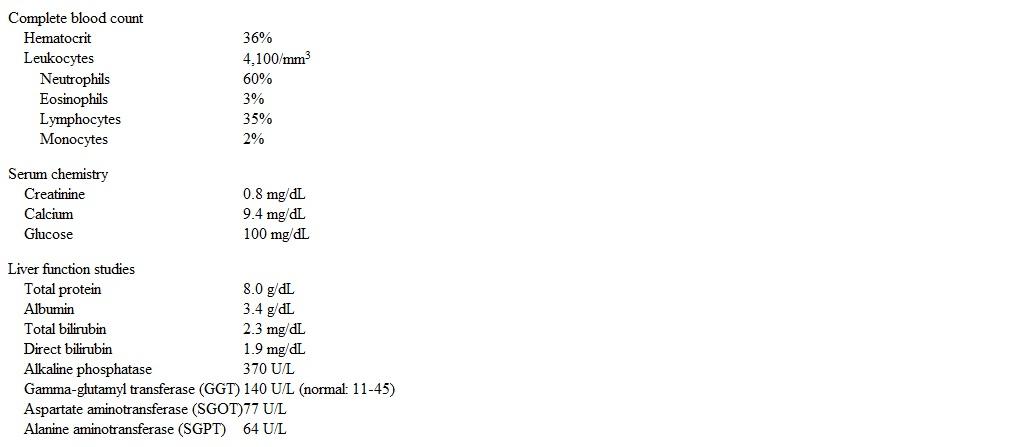 Which of the following is most likely in this patient?
 (Multiple Choice)
5.0/5 (87)
(87) A 24-year-old man comes to the physician complaining of poor asthma control. He previously had not required therapy, but 3 months ago he developed an upper respiratory infection and has had difficulty controlling his symptoms since then. He was treated in the emergency department and discharged with tapering prednisone, fluticasone/salmeterol 100/50 µg, and albuterol metered-dose inhaler. The patient improved initially but his breathing did not return to normal. He has also been to an urgent care center twice in the last 2 months for breathing difficulty and has required nebulizer therapy. He tried to use his albuterol inhaler on each of these occasions but did not find relief. The patient is compliant with his medications and does not use tobacco, alcohol, or illicit drugs.
His temperature is 36.7 C (98 F), blood pressure is 118/78 mm Hg, pulse is 64/min, and respirations are 12/min. His pulse oximetry is 97% on room air. Physical examination shows a healthy young man in no acute distress. Lung examination shows mild end-expiratory wheezes but no crackles. He coughs during deep inspiration. Cardiac examination is normal.
Which of the following is the most appropriate next step in management of this patient?
(Multiple Choice)
4.9/5 (82)
(82) An 81-year-old man comes to the physician with an episode of right arm weakness and difficulty finding words. The episode occurred the night before and lasted 90 minutes, followed by slow resolution of symptoms. He had no loss of consciousness. He has never had similar symptoms and otherwise feels fine. The patient's medical history includes hypertension and type 2 diabetes mellitus. His medications include lisinopril, metformin, and glipizide. His last hemoglobin A1c was 7.6%. He quit smoking 5 years ago.
The patient's blood pressure is 130/80 mm Hg and pulse is 88/min. His body mass index is 30 kg/m2. Cardiac examination shows no murmurs. No carotid bruits are heard and lungs are clear to auscultation. Peripheral pulses are full and symmetric. Neurologic examination, including visual field testing, is within normal limits. Fingerstick glucose level is 176 mg/dL. Electrocardiogram shows normal sinus rhythm.
Which of the following is the most appropriate next step in management of this patient?
(Multiple Choice)
4.9/5 (95)
(95) A 27-year-old man comes to the physician because of a 10-day history of crampy lower abdominal pain and diarrhea that awakens him at night. He says he might have some blood in his stool, but he is not sure. He also complains of fatigue. His past medical history is unremarkable. He takes a daily multivitamin and exercises regularly. He has a stable male partner and uses condoms regularly. His mother died of lymphoma and his older brother suffers from ulcerative colitis.
He is afebrile. His blood pressure is 130/88 mm Hg, pulse is 90/min, and respirations are 12/min. His bowel sounds are normoactive. There is mild abdominal tenderness in both lower quadrants without rebound tenderness. His examination is otherwise unremarkable.
The patient's labs reveal:
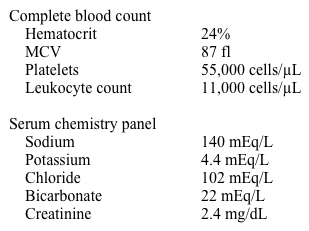 Which of the following is the best next step in managing this patient?
 (Multiple Choice)
4.9/5 (97)
(97) A 76-year-old man is brought to the physician by his son for unsteadiness and several near-falls over the last 2 weeks. The patient has been less interactive lately and prefers to stay in his room. His symptoms have been slowly worsening over the last 2 weeks. He has had no recent illness, fever, chills, or headaches. His medical problems include mild dementia, ischemic stroke without significant residual deficit, and seizure disorder. His medications include aspirin, phenytoin, levetiracetam, and vitamin D. He was recently started on omeprazole for reflux symptoms.
The patient's vital signs are within normal limits. Physical examination shows a narrow-based, unsteady gait with poor balance. His speech is slightly slurred. The patient has horizontal nystagmus and poor coordination with rapid alternating movements and finger-to-nose maneuvers bilaterally. His strength and sensation are intact.
Which of the following is the most likely diagnosis?
(Multiple Choice)
4.7/5 (80)
(80) A 35-year-old woman comes to the physician for follow-up of hypertension. When the patient was seen in the office 2 weeks ago, her blood pressure was 145/95 mm Hg initially and 140/92 mm Hg after recheck. Since then, she had her blood pressure taken 3 times at a nearby pharmacy, with readings averaging 120/80 mm Hg. The patient has no symptoms and feels "pretty healthy." She takes no medications.
The patient's father has hypertension and coronary artery disease, which required coronary artery bypass grafting. Her mother has hypertension and type 2 diabetes mellitus. The patient regularly salts her food before tasting it. She drinks alcohol socially and does not use tobacco or illicit drugs. The patient works as an information technology consultant and exercises moderately 3 times a week.
Blood pressure during this visit is 149/94 mm Hg initially and 138/94 mm Hg after 20 minutes. BMI is 28 kg/m2. The ocular fundi appear normal. Physical examination is unremarkable.
A complete blood count, urinalysis, and comprehensive metabolic panel are normal. Serum creatinine is 0.9 mg/dL. ECG shows normal sinus rhythm and T-wave inversion in leads V1 and V2.
Which of the following is the best next step in management of this patient's blood pressure?
(Multiple Choice)
4.8/5 (79)
(79) A 46-year-old man comes to an urgent care center with fever and productive cough for the past 2 days. He had a "bad pneumonia" 2 years ago that required hospitalization and intravenous antibiotics. Since then he has had almost daily cough with "thick, yellow" sputum and 5-6 episodes of a "respiratory infection" with fevers, sputum production, and occasional hemoptysis. The episodes have responded well to oral antibiotic therapy. The patient reports no chills, night sweats, weight loss, diarrhea, or swollen glands. He has no other medical problems and does not use tobacco.
His temperature is 38.0 C (100.4 F). On auscultation, crackles are heard at the right lung base.
Which of the following is the most likely diagnosis?
(Multiple Choice)
4.8/5 (69)
(69) A 34-year-old man comes to the office for a routine preventive visit. He has had low back pain intermittently for the past 2 months and believes he injured his back while exercising at the gym. The patient has taken naproxen as needed and says that the pain is slowly improving. He has no fevers, focal weakness, or bowel or bladder difficulties. The patient has a 20-pack-year smoking history. His father was diagnosed with prostate cancer at age 66, and his mother had a myocardial infarction at age 59.
Vital signs, weight, and physical examination are unremarkable. The patient is interested in improving his health and asks if he should be screened for any other diseases.
Which of the following is the most appropriate screening test for this patient?
(Multiple Choice)
4.9/5 (78)
(78) A 24-year-old man comes to the physician with a 6-month history of intermittent palpitations. He reports a sudden onset of fluttering in his chest that lasts 30-40 minutes and stops spontaneously or after deep breathing maneuvers. The episodes occur about once a month and are not related to physical activity. He has no chest pain, dizziness, dyspnea, or syncope.
Jugular venous pressure is estimated at 4 cm H2O. There are no cardiac murmurs or additional heart sounds. Peripheral pulses are 2+ and symmetrical bilaterally.
ECG is shown in this exhibit. 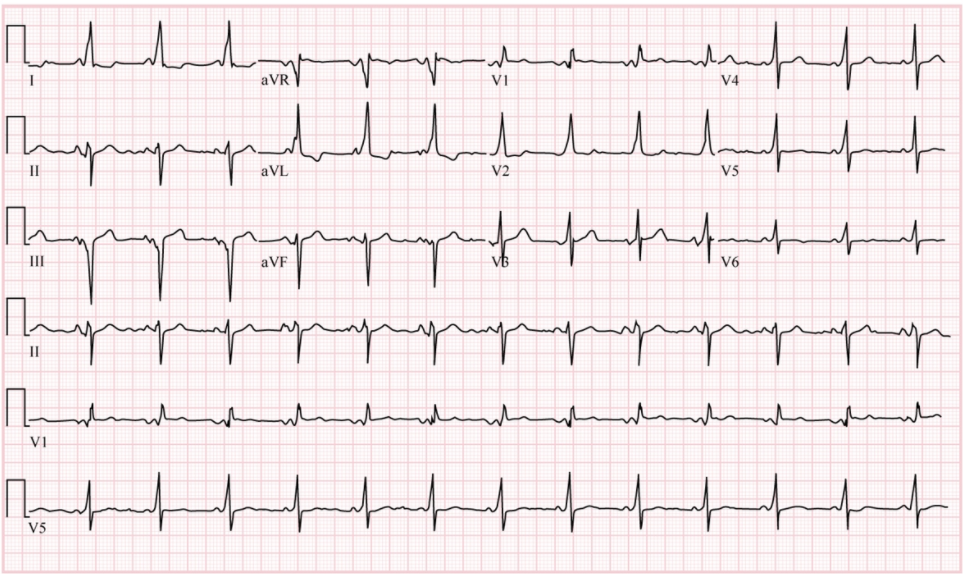 The PR interval duration is 100 msec and the QRS complex duration is 140 msec.
Which of the following findings would most likely be seen during episodes of palpitations in this patient?
The PR interval duration is 100 msec and the QRS complex duration is 140 msec.
Which of the following findings would most likely be seen during episodes of palpitations in this patient? (Multiple Choice)
4.8/5 (65)
(65) A 58-year-old man comes to the office with reports of visual disturbances over the past several weeks. He describes multiple episodes of bluish tinting of his vision and a sensation of "lights becoming too bright," which last a few hours and improve spontaneously. He has had no headache, eye pain, loss of vision, tunnel vision, focal weakness, or numbness. The patient has a history of type 2 diabetes mellitus, hypertension, stage 3 chronic kidney disease, and erectile dysfunction. His medications include lisinopril, amlodipine, furosemide, insulin detemir, and as-needed sildenafil. He does not use tobacco, alcohol, or recreational drugs.
Blood pressure is 120/70 mm Hg and pulse is 76/min. The patient's pupils are equal and reactive, and visual acuity and field of vision are normal. Funduscopy shows few microaneurysms and dot-blot hemorrhages but is otherwise unremarkable. Neurological examination demonstrates decreased pain sensation over both feet and bilateral absence of ankle reflexes but is otherwise unremarkable.
Which of the following is the most likely cause of this patient's current visual symptoms?
(Multiple Choice)
4.8/5 (77)
(77) A 27-year-old woman comes to the outpatient clinic for evaluation. She says her father, who came from India 3 months ago and is living with her, was recently diagnosed with pulmonary tuberculosis and began a 4-drug treatment regimen. The patient has had no cough, weight loss, night sweats, chills, or fevers. She has a history of type 1 diabetes mellitus but no history of lung disease. She does not use tobacco, alcohol, or illicit drugs.
Vital signs are within normal limits. Cardiac and pulmonary examinations are normal. A tuberculin skin test is read 48 hours later as 7-mm induration and 12-mm erythema. Chest x-ray shows no abnormalities.
What is the best next step in management of this patient?
(Multiple Choice)
4.9/5 (96)
(96) A 60-year-old man comes to the office due to 6 months of exertional dyspnea and occasional headaches. He has had no chest pain, lightheadedness, or syncope. The patient injured his knee 8 months ago and required arthroscopic ligament repair. Due to restricted physical activity after surgery, he has gained 4.5-6.8 kg (10-15 lb). He also has a history of gastroesophageal reflux disease and seasonal allergies. The patient was a heavy smoker but quit a year ago after being hospitalized with community-acquired pneumonia. He drinks 6 beers daily and occasionally more on weekends.
Blood pressure is 145/100 mm Hg, pulse is 95/min, and oxygen saturation is 93% on room air. BMI is 34 kg/m2. Cardiopulmonary auscultation reveals no abnormalities. A smooth liver edge is palpated 2 cm below the right costal margin. The tip of the spleen is palpable with deep inspiration. There is no peripheral edema.
Laboratory results are as follows:
 Repeat hemoglobin level is 18.5 g/dL.
Which of the following is most likely to establish the cause of polycythemia in this patient?
Repeat hemoglobin level is 18.5 g/dL.
Which of the following is most likely to establish the cause of polycythemia in this patient? (Multiple Choice)
4.8/5 (83)
(83) In a study comparing treatment to placebo, the relative risk is given as 2.28 in favor of the treatment group with a 95% confidence interval of 1.32-3.96.
Which of the following represents the best interpretation of the 95% confidence interval?
(Multiple Choice)
4.9/5 (76)
(76) A 68-year-old man with chronic obstructive pulmonary disease comes to the physician due to fever and malaise. He developed abrupt-onset fever, headache, nonproductive cough, severe body aches, and generalized weakness about 24 hours ago. He has a 43-year history of smoking but quit 2 years ago. His medications include tiotropium daily and albuterol as needed. The patient has no other medical problems. He visited his grandchildren a week ago during Christmas and reports that his 6-year-old grandson was sick with similar symptoms.
His temperature is 38.9 C (102 F), blood pressure is 124/84 mm Hg, pulse is 96/min, and respirations are 18/min. Pulmonary auscultation shows decreased breath sounds bilaterally but no focal crackles.
Chest x-ray shows flat hemidiaphragms bilaterally but no focal infiltrate. A rapid influenza antigen test is negative. Laboratory results are as follows:
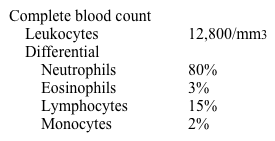 Which of the following is the most appropriate treatment at this time?
 (Multiple Choice)
4.8/5 (79)
(79) A 43-year-old man comes to the physician with persistent fatigue, morning headaches, and daytime sleepiness. The patient's wife confirms that he snores loudly at night and occasionally stops breathing. He has no known medical problems and does not use tobacco, alcohol, or illicit drugs.
His blood pressure is 138/88 mm Hg and pulse is 78/min. BMI is 33 kg/m2. Physical examination is unremarkable.
Which of the following conditions is the patient at highest risk for developing?
(Multiple Choice)
4.7/5 (86)
(86) A 60-year-old man with a past medical history of hypertension comes to the physician complaining of urinary symptoms. Over the last 6 months, he has had a decreased urinary stream and an occasional uncomfortable sensation while urinating. He awakens once a night to urinate but sometimes feels that he needs to go again. The symptoms do not bother him much at this point, but he is afraid that they may worsen. He has no family history of prostate problems. He has no fever, malaise, back pain, cloudy urine, or blood in the urine.
Digital rectal examination shows a moderately enlarged and rubbery prostate. The remainder of the physical examination is unremarkable.
Laboratory results are as follows:
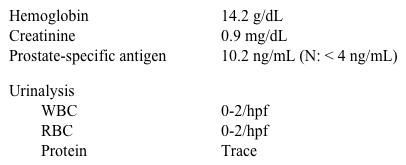 Which of the following is the best next step in managing this patient?
 (Multiple Choice)
4.7/5 (82)
(82) 
Filters
- Essay(0)
- Multiple Choice(0)
- Short Answer(0)
- True False(0)
- Matching(0)