



 Chat with AI
Exam 3: Office/Health Center

Exam 1: Emergency Department218 Questions
Exam 2: In-patient Facilities128 Questions
Exam 3: Office/Health Center900 Questions
Select questions type


An 18-year-old woman comes to the office for evaluation of vaginal discharge that is thin, gray, and malodorous. The patient has had no vulvovaginal pruritus or pelvic pain. She is sexually active with multiple partners and uses oral contraceptives but does not consistently use condoms. Her general health is good. She recently completed a course of antibiotics for uncomplicated cystitis. Review of systems is negative.
Vital signs are normal. Speculum examination reveals a gray, adherent, malodorous discharge on the walls of the vaginal vault. The cervix appears normal and there is no cervical motion tenderness.
Vaginal pH is 5. Microscopic examination is shown below:
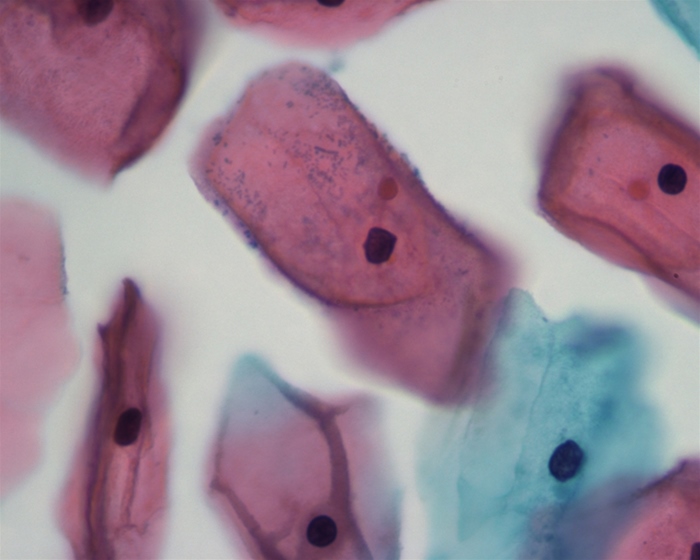 Which of the following is the best therapy for this patient?
 (Multiple Choice)
4.7/5  (68)
(68) A 51-year-old man comes to the physician because of persistent swelling over the left mandible for the last 3 months. The swelling initially responded to antibiotics prescribed to him 2 months ago; however, it subsequently returned. His other medical problems include a history of poorly controlled type 2 diabetes mellitus and hypertension. His medications include metformin, glyburide, and lisinopril. He denies tobacco, alcohol, or illicit drug use.
His temperature is 37 C (98.6 F), blood pressure is 130/80 mm Hg, and respirations are 12/min. Eye examination reveals intact ocular movements. There is no nasal discharge or sinus tenderness. Palpation over the jaw reveals a 4 cm mass extending from the mandible that is raised, non-tender, and firm. There is a sinus tract extending to the skin with purulent and blood-tinged drainage. No erythema or fluctuance is noted. Examination of the oral cavity shows poor dentition with gingivitis, but no open lesions. There is neither anterior nor posterior cervical lymphadenopathy. The remainder of the physical examination is within normal limits.
Laboratory results are as follows:
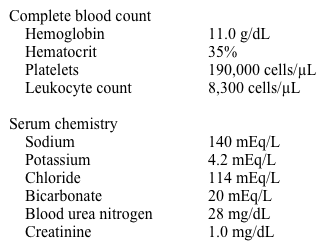 Which of the following is the most effective treatment for this patient's condition?
 (Multiple Choice)
4.7/5 (72)
(72) A 22-year-old woman comes to the office for evaluation of amenorrhea. Her last menstrual period was 5 months ago. Menarche was at age 11. The patient had regular menstrual periods up until 5 years ago when they began occurring every 2-3 months and consisted of 3 days of light bleeding. She feels fatigued and anxious, and has lost 6.8 kg (15 lb) in the past year. She has had no headaches, abnormal hair growth, loss of scalp hair, changes in peripheral vision, or hot flashes.
The patient has no chronic medical conditions and takes no medications. She does not use tobacco, alcohol, or illicit drugs. Her mother has hypothyroidism. The patient has been training for a marathon for the last 6 months and runs approximately 40 miles each week. Her diet consists mainly of high-protein bars. She is single and not sexually active.
Blood pressure is 106/78 mm Hg and pulse is 73/min. BMI is 19 kg/m2. Physical examination is unremarkable.
Laboratory results are as follows:
 Medroxyprogesterone acetate challenge does not produce uterine withdrawal bleeding.
Which of the following is the best next step in management of this patient?
Medroxyprogesterone acetate challenge does not produce uterine withdrawal bleeding.
Which of the following is the best next step in management of this patient? (Multiple Choice)
4.9/5 (71)
(71) An 80-year-old man admitted to the hospital with abdominal pain is diagnosed with acute cholecystitis. His abdominal ultrasound reveals a distended, thick-walled gallbladder with pericholecystic fluid and multiple gallstones. The common bile duct diameter is normal. The patient has a history of idiopathic pulmonary fibrosis and uses continuous oxygen at 4-5 L/min via nasal cannula. His other medical problems include hypertension, type 2 diabetes mellitus, and prior ischemic stroke with residual right-sided hemiparesis. He is started on intravenous fluids, analgesics, and piperacillin-tazobactam, but the next day he has increasing pain and confusion.
His temperature is 38.9 C (102 F), blood pressure is 90/45 mm Hg, and pulse is 116/min and regular. Pulse oximetry is 94% on 4 L oxygen. Abdominal examination is notable for right upper quadrant tenderness without rebound.
Laboratory results are as follows:
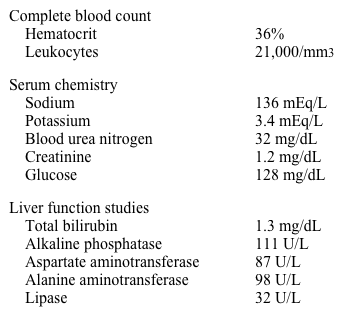 Which of the following is the most appropriate additional intervention in management of this patient?
 (Multiple Choice)
4.9/5 (81)
(81) A 50-year-old woman comes to the office due to involuntary leakage of urine. The leakage started a year ago and currently occurs several times a day when the patient coughs, sneezes, laughs, or stands up. She also sometimes has loss of urine during sexual intercourse. The patient awakens to urinate once each night; she has had no dysuria, hematuria, urinary urgency, or fecal incontinence. She has had 2 vaginal deliveries. Her incontinence makes her self-conscious during social interactions and she has stopped participating in exercise classes. Her general health is otherwise good.
Physical examination is within normal limits, except for a BMI of 32 kg/m2. Pelvic examination reveals mild uterine prolapse. A cough with a full bladder elicits an immediate release of a small amount of urine.
Urinalysis is normal. Post-voiding urinary residual volume is 20 mL. The patient is currently collecting information in a voiding diary regarding fluid intake, voiding frequency, and amount of urine.
Which of the following is the best next step in management of this patient?
(Multiple Choice)
4.8/5 (83)
(83) A 37-year-old school teacher comes to the physician for a preventive care appointment. She denies any current symptoms, and she has not seen a doctor for many years. She takes over-the-counter vitamin and calcium supplements. She does not smoke and she drinks alcohol only on social occasions.
Her temperature is 37.2 C (99 F), blood pressure is 122/80 mm Hg, pulse is 84/min, and respirations are 14/min. Jugular venous pressure is normal. Cardiac auscultation reveals wide and fixed splitting of the second heart sound. There is a 2/6 mid-systolic ejection murmur heard best over the left second intercostal space. The remainder of her physical examination is unremarkable.
Which of the following would most likely be present on her electrocardiogram?
(Multiple Choice)
4.8/5 (83)
(83) A 52-year-old woman comes to the office due to abdominal discomfort and bloating accompanied by watery diarrhea for the past 6 months. The patient has lost 9 kg (20 lb) during this period. Review of systems reveals gastroesophageal reflux symptoms and color changes in her fingers consistent with Raynaud's phenomenon, which has been present for 2 years. The patient has no other past medical history, and her only medication is over-the-counter omeprazole as needed. She drinks 2 or 3 glasses of wine on weekends and does not smoke.
Vital signs are within normal limits. BMI is 20 kg/m2. There are patchy areas of skin thickening on the patient's chest, upper back, forearms, and legs. Skin over the fingers appears tight with a tapering appearance of the fingertips. Heart and lung sounds are normal. Abdominal examination shows diffuse, mild tenderness with no guarding or rebound tenderness. There is no hepatosplenomegaly, and bowel sounds are normal. Joint examination shows no abnormalities. Laboratory studies are as follows:
 Stool studies are negative for pathogenic bacteria, ova, and parasites. Colonoscopy reveals scattered diverticulosis, and random biopsies reveal no abnormalities.
Which of the following would be most helpful to relieve this patient's gastrointestinal symptoms?
Stool studies are negative for pathogenic bacteria, ova, and parasites. Colonoscopy reveals scattered diverticulosis, and random biopsies reveal no abnormalities.
Which of the following would be most helpful to relieve this patient's gastrointestinal symptoms? (Multiple Choice)
4.7/5 (81)
(81) A 29-year-old previously healthy man comes to the physician with malaise, rash, and joint pain with swelling for the last week. He has no energy and can hardly get out of bed. He has no abdominal pain, vomiting, or genital lesions. The patient reports several new sexual partners over the last year and says that he had a negative HIV test 2 months ago. He smokes marijuana but does not use tobacco, alcohol, or other illicit drugs.
His temperature is 38.2° C (100.7° F), blood pressure is 122/68 mm Hg, and pulse is 89/min. Several small, mobile lymph nodes are palpated in the submandibular region. There is no pharyngeal erythema. There is diffuse swelling, warmth, and pain with active motion in the elbow, knee, and ankle joints. The abdomen is soft and mildly tender in the epigastrium. There is no hepatosplenomegaly. Multiple urticarial skin lesions with excoriation are seen on the upper and lower extremities. There are no oral or genital lesions.
Laboratory results are as follows:
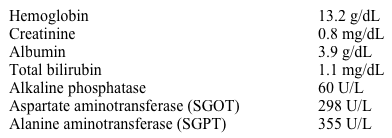 Which of the following would be most helpful in establishing a diagnosis in this patient?
 (Multiple Choice)
4.7/5 (74)
(74) A 40-year-old woman comes to the office for follow-up after a recent upper gastrointestinal endoscopy. She initially had a 3-month history of diarrhea and weight loss. The patient's tissue transglutaminase antibody (IgA) assay was positive, and small-bowel biopsy performed during the endoscopy confirmed the diagnosis of celiac disease. Since the endoscopy, she has been following a strict gluten-free diet and has experienced significant improvement in symptoms. The patient's medical history is unremarkable and she has had normal menstrual periods. Her only medication is a daily multivitamin, and she does not use tobacco, alcohol, or illicit drugs.
Vital signs and physical examination are normal.
Laboratory results show a hemoglobin level of 11.4 mg/dL (increased from 10.2 mg/dL 4 weeks ago).
Which of the following additional tests is indicated at this time?
(Multiple Choice)
4.8/5 (71)
(71) A 23-year-old woman comes to the office due to excess facial hair that she finds embarrassing. She has had this problem for years and has tried different methods of hair removal, with unsatisfactory results. The patient has no chronic medical conditions and has regular menstrual periods. She is not sexually active and takes no medications.
BMI is 29 kg/m2. On physical examination, there is coarse, dark hair on her upper lip, chin, midsternum, and buttocks. The rest of the examination is unremarkable.
Which of the following is the best next step in management of this patient?
(Multiple Choice)
4.7/5 (70)
(70) A 37-year-old man comes to the physician for acute onset of a sore throat that has gotten progressively worse during the day. He is also experiencing some mild myalgias. For the past 2 days, he has had subjective fevers and a nonproductive cough. He does not have chills or fatigue. The patient has not been exposed to a similar illness and has no HIV risk factors. He has no significant past medical history, takes no medications, and has no known allergies.
His temperature is 37.2 C (99 F), blood pressure is 130/80 mm Hg, pulse is 72/min, and respirations are 16/min. Oropharyngeal examination shows slightly enlarged tonsils with grayish-white exudates. There are a few palpable, bilateral, small, and slightly tender anterior cervical nodes. Auscultation of the heart and lungs is normal. The abdomen is soft, and there is no hepatosplenomegaly.
What is the best next step in management of this patient?
(Multiple Choice)
4.8/5 (81)
(81) A 36-year-old woman has increasing nausea and headaches 12 hours after a right-sided percutaneous nephrolithotomy for staghorn calculi. The procedure involved ultrasonic lithotripsy followed by fragment removal using a flexible nephroscope. The patient spent a prolonged period in recovery and has been drowsy since returning to the ward. She is receiving intermittent morphine for pain control. She also received intravenous ceftriaxone after an episode of postoperative low-grade fever.
Other medical conditions include frequent urinary tract infections, gastroesophageal reflux disease, and angioedema. A month ago, the patient was treated for contact dermatitis from poison ivy with a 10-day course of prednisone.
Temperature is 37.2 C (99 F), blood pressure is 130/90 mm Hg, pulse is 64/min, respirations are 14/min, and oxygen saturation is 96% on room air. The patient is drowsy but arousable with a short attention span. Pupils are small but reactive to light and accommodation. Mucous membranes are moist. The neck is supple, and cardiovascular and lung examinations are unremarkable. Abdominal examination reveals diminished bowel sounds. The patient is able to move all extremities on command, and deep tendon reflexes are symmetric. The remainder of the examination is normal.
Laboratory results are as follows:
 The patient's preoperative laboratory studies were normal. Which of the following is the most appropriate next step in management of this patient?
 (Multiple Choice)
4.9/5 (69)
(69) A 45-year-old woman comes to the physician for a periodic health examination. She has a pigmented lesion on her right leg that she first noticed a few years ago and would like to have checked. The patient does not think that the mole has changed in appearance. She has had some sunburn in the past.
The patient is fair skinned and has reddish-blond hair and hazel eyes. Skin examination shows multiple cherry angiomata over her trunk and some on her upper extremities. There is dense freckling over her shoulders and barely perceptible dense freckling over her cheeks. There is a homogenous, well-demarcated, circular, light brown, and nonelevated lesion 5 mm in diameter over her right distal tibial area. No border irregularity is seen under dermoscopy.
Which of the following is the best next step in management of this patient?
(Multiple Choice)
4.9/5 (83)
(83) A 48-year-old man comes to the office for evaluation of palpitations. The patient wakes up frequently at night with a pounding sensation in his chest. He has also experienced "skipped beats" and palpitations during the day on several occasions. He has had no chest pain, dyspnea, lightheadedness, or syncope. The patient lives alone after a recent divorce and says he is afraid that he may die in his sleep. He also states that he feels "stressed out" and has had frequent headaches and feels tired throughout the day. He has smoked a pack of cigarettes daily for the past 20 years and drinks alcohol on the weekends, sometimes excessively.
Blood pressure is 152/89 mm Hg and pulse is 78/min. BMI is 33 kg/m2. Heart sounds are normal and the lungs are clear on auscultation. The remainder of the physical examination is within normal limits.
Blood cell counts, serum chemistry studies, and thyroid function tests obtained on a previous visit are within normal limits. ECG shows sinus rhythm with nonspecific T-wave changes, and echocardiography reveals mild left atrial enlargement but is otherwise normal.
Continuous ambulatory ECG (Holter) monitoring is performed for 24 hours and shows frequent premature ventricular contractions, several episodes of bradycardia with heart rates around 30/min between 2 AM and 5 AM, and a 5-second sinus pause followed by a short run of atrial fibrillation at a rate of 130/min at 4:30 AM.
Which of the following is the most appropriate next step in management of this patient?
(Multiple Choice)
4.8/5 (80)
(80) A 29-year-old woman who immigrated to the United States from India comes to the office to establish care. She has a mild sore throat that she believes may have come from her toddler, who recently had a fever. The patient has no other concerns. She has a history of gestational diabetes during her 2 pregnancies. In childhood, the patient had a febrile illness associated with loss of motor control. She takes no medications and does not use tobacco or alcohol.
Temperature is 36.7 C (98.1 F), blood pressure is 130/80 mm Hg, pulse is 70/min, and respirations are 14/min. Examination shows mild erythema of the nasal mucosa and posterior pharynx. Jugular venous pulsation is normal and there is no cervical lymphadenopathy. The lungs are clear. There is a low-pitched diastolic murmur with presystolic accentuation at the apex. Neurologic examination is normal.
She is referred for transthoracic echocardiography that shows normal left ventricular function with moderate left atrial enlargement and doming of the mitral valve leaflets in diastole. The estimated mitral valve area is 1.7 cm2. There is mild mitral regurgitation.
Which of the following is the most appropriate recommendation regarding antibiotic therapy in this patient?
(Multiple Choice)
4.9/5 (78)
(78) A 55-year-old war veteran comes to the office due to new onset of bizarre behavior that has occurred during sleep at night over the past 3 months. His wife reports that he screams as if being attacked and swings his arms wildly while still asleep. The patient has knocked over lamps on the bedside table and has hit his wife several times, once leading to a black eye. He also hurt himself once by falling out of bed. He is able to describe his dreams vividly and says they normally involve fighting with animals; he is completely lucid on awakening. The patient snores loudly, but his wife has never seen him stop breathing during his sleep and he has not awakened gasping for breath. When he was in the military 20 years ago, he was involved in a firefight during which a close army friend was shot and killed next to him.
Other medical issues include recently diagnosed depression, hypertension, and hyperlipidemia. Current medications include hydrochlorothiazide, metoprolol, simvastatin, and venlafaxine.
 Vital signs are normal. BMI is 32 kg/m2. Physical examination is essentially normal except for a mild resting tremor.
Which of the following is the most likely diagnosis?
Vital signs are normal. BMI is 32 kg/m2. Physical examination is essentially normal except for a mild resting tremor.
Which of the following is the most likely diagnosis? (Multiple Choice)
4.8/5 (87)
(87) A 55-year-old woman comes to the office due to hair loss. She has had gradual thinning of hair at the vertex and center of the scalp since experiencing menopause 4 years ago. There is no associated pain or itching. Medical history is notable for hypothyroidism. Current medications include levothyroxine and a daily multivitamin supplement. The patient does not use tobacco, alcohol, or illicit drugs.
Vital signs are normal. Examination shows thinning of hair as shown in the exhibit.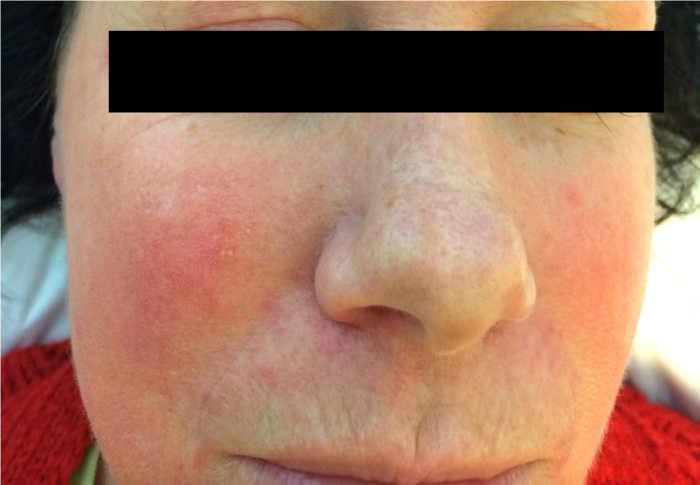 Which of the following is the most likely cause of this patient's hair loss?
 (Multiple Choice)
4.9/5 (69)
(69) A 36-year-old woman comes to the physician complaining of recurrent vesicular lesions on her lips. The lesions always occur at the lip borders. Her pharynx and oral mucosa are not involved. The appearance of the lesions is preceded by tingling, burning, and discomfort in the area as well as mild malaise. She has approximately 1 to 2 episodes a year. The patient relates that these lesions are uncomfortable and result in an unprofessional appearance at work. She has no genital lesions and is in otherwise good health. There is no history of tobacco, alcohol, or illicit drug use. She is monogamous with her husband.
Physical examination is unremarkable.
Which of the following is the best next step in management of this patient?
(Multiple Choice)
5.0/5 (86)
(86) A 54-year-old man comes to the physician with fatigue and decreased exercise tolerance over the last 6 months. He denies cough, chest pain, syncope, or weight loss. He had aortic valve replacement with a mechanical valve due to bicuspid aortic valve stenosis 7 years ago. Coronary angiography prior to surgery showed no evidence of coronary artery disease. His medications include warfarin and antacids for occasional heartburn.
His blood pressure is 122/70 mm Hg and pulse is 89/min and regular. Jugular venous pressure is estimated at 9 cm H2O. A faint early diastolic murmur is heard at the left sternal border. Lungs are clear on auscultation. The liver span is 9 cm, and the tip of the spleen is not palpable. There is no edema of the lower extremities.
Laboratory results are as follows:
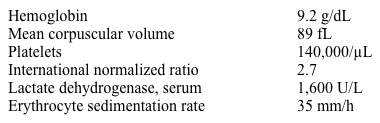 Which of the following is the most likely diagnosis?
 (Multiple Choice)
4.8/5 (87)
(87) A 63-year-old woman comes to the physician because of hot flashes and heat intolerance for the last 2-3 months. The patient was taking conjugated estrogen therapy after having a total abdominal hysterectomy with bilateral salpingo-oophorectomy at age 50 for large fibroids and excessive uterine bleeding. However, she stopped taking estrogen 4 months ago after reading an article about the side effects of hormone replacement therapy. She has been treated for hypothyroidism for the past 15 years. Her thyroid function studies have been in the normal range, and her levothyroxine dose has not been changed in 8 years. She has no other medical issues and takes no other medications.
On examination, she appears to be slightly anxious. Her blood pressure is 140/66 mm Hg and pulse is 98/min. The thyroid gland is not palpable. She has mild lid lag but no proptosis. Fine hand tremors are present. There is no pretibial myxedema. The remainder of the physical examination is within normal limits.
Laboratory results are as follows:
 Which of the following is the most likely cause of her thyrotoxicosis?
 (Multiple Choice)
4.8/5 (78)
(78) 
Filters
- Essay(0)
- Multiple Choice(0)
- Short Answer(0)
- True False(0)
- Matching(0)