



 Chat with AI
Exam 3: Office/Health Center

Exam 1: Emergency Department218 Questions
Exam 2: In-patient Facilities128 Questions
Exam 3: Office/Health Center900 Questions
Select questions type


A 60-year-old woman is being evaluated for headache and hypertension. For the past week, she has felt tired and has had a progressive, generalized headache. She denies fever, chills, photophobia, or neck stiffness. Her general health has been good with the exception of 6 months of persistent pains and swelling in both hands. During this time, her fingers felt puffy and she recently noted some tiny pits appearing on her finger tips. She is also troubled by heartburn and mild dyspnea with exertion. She does not smoke or drink alcohol. She takes calcium, vitamin D, and a multivitamin. Over the past few days, she has also been taking acetaminophen and ibuprofen.
Her blood pressure is 210/111 mm Hg, pulse is 90/min, and respirations are 16/min. She looks her stated age and appears uncomfortable. Her ocular fundi reveal no papilledema. Her neck is supple. Cardiac and abdominal exams are within normal limits. She has bibasilar fine end-inspiratory crackles on pulmonary exam. There are a few small digital fingertip pits.
Her laboratory studies are shown below.
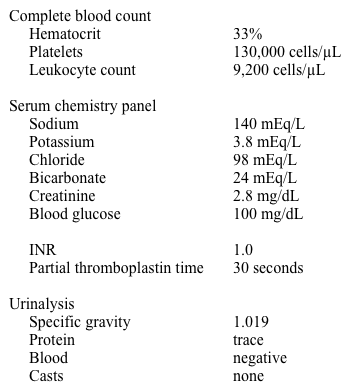 Her chest-x ray shows bibasilar reticular fibrosis. Her peripheral blood smear reveals schistocytes.
Which of the following is the best initial treatment for this patient?
Her chest-x ray shows bibasilar reticular fibrosis. Her peripheral blood smear reveals schistocytes.
Which of the following is the best initial treatment for this patient? (Multiple Choice)
4.7/5  (86)
(86) A 42-year-old man comes to the office after his blood pressure was found to be 146/92 mm Hg at a health fair. The patient has had no unusual headaches, blurry vision, polyuria, chest pain, or shortness of breath. He has no significant prior medical conditions and takes no medications. HIV testing 3 years ago was negative. The patient's father was diagnosed with colon cancer at age 65, and his brother underwent a thyroidectomy for differentiated papillary thyroid cancer at age 34. The patient has a current 15-pack-year smoking history and does not drink alcohol or use illicit drugs.
Blood pressure is 140/90 mm Hg, and pulse is 68/min and regular. BMI is 27 kg/m2. Repeat blood pressure measurement after 5 minutes is 140/92 mm Hg. Physical examination is unremarkable.
Nonfasting laboratory results are as follows:
 Urine microalbumin/creatinine ratio, TSH, and ECG are normal. A fasting lipid profile has been ordered.
Which of the following additional tests is recommended at this time?
Urine microalbumin/creatinine ratio, TSH, and ECG are normal. A fasting lipid profile has been ordered.
Which of the following additional tests is recommended at this time? (Multiple Choice)
4.9/5 (65)
(65) A 29-year-old man comes to the office due to 2 weeks of malaise and body aches. Initially he attributed these symptoms to a viral infection, but yesterday he noticed a skin rash. He has had no cough, chest pain, shortness of breath, nausea, vomiting, or diarrhea. The patient has no significant past medical history. He drinks alcohol socially, smokes marijuana occasionally, and does not use intravenous drugs. He has been sexually active with 2 women over the past year. The patient recently returned from a ski trip to Vermont.
Temperature is 37.8 C (100 F), blood pressure is 112/68 mm Hg, and pulse is 92/min. A diffuse maculopapular rash is seen on the trunk and extremities, with patchy areas of hair loss on the scalp. Sclerae are anicteric. No oral lesions are present. Rubbery palpable lymph nodes are present in the anterior and posterior cervical areas. No murmurs are heard and the lungs are clear on auscultation. The abdomen is soft and nontender and the spleen is not palpable. The penis is uncircumcised with no lesions, ulcerations, or discharge.
Laboratory results are as follows:
 Which of the following is the most likely diagnosis?
 (Multiple Choice)
4.8/5 (81)
(81) A 37-year-old man comes to the physician with nodules on his hand and forearm. The nodules first appeared about 2 weeks ago on the dorsal aspect of his right index finger. Initially, a small papule formed and drained some clear, odorless material. There was minimal associated pain. The nodule persisted and several days later two other similar nodules formed over the dorsal aspect of his right wrist and distal arm. He has no fever, chills, or constitutional symptoms. The patient works as a landscaper and has installed a lot of moss in terraced yards over the past month. He also hunts and within the past month has dressed rabbits that he has shot. He is in good health, takes no medications, and has no HIV risk factors.
Vital signs are normal. Cardiopulmonary, abdominal, and neurologic examinations are normal. There are 3 tender papules on top of the dorsal aspects of the right index finger, wrist, and the distal right upper extremity. One open nodule has a small crust on the top. There are no other cutaneous lesions and no adenopathy.
A sample is obtained for biopsy and culture. The biopsy shows mixed pyogenic and granulomatous inflammation. Gram stain, acid-fast/partial acid-fast, silver methenamine, and periodic acid-Schiff stains (PAD) are negative. Cultures are pending.
What is the most likely diagnosis in this patient?
(Multiple Choice)
4.8/5 (84)
(84) An 82-year-old woman comes to the office due to fatigue. For the last 6 months since her husband died, she has had low energy associated with decreased appetite. The patient has had no weight change, fevers, chills, or night sweats. She sleeps 5-6 hours a night. Medical history is notable for hypertension, depression, and osteoporosis, for which she takes hydrochlorothiazide, sertraline, and alendronate, respectively. She does not smoke, and she drinks alcohol only once or twice a year on social occasions.
Temperature is 36.8 C (98.2 F), blood pressure is 128/82 mm Hg, and pulse is 68/min. BMI is 24 kg/m2. On examination, the patient is awake, alert, and cooperative. Neck examination is normal with no goiter. Cardiopulmonary examination is normal. Neurologic examination shows normal cranial nerves and motor strength. Ankle reflexes are absent.
Laboratory studies show normal glucose, electrolytes, and blood counts. TSH is 7.2 µU/mL, and free T4 is 1.1 ng/dL (normal: 0.9-1.7 ng/dL).
Which of the following is the most appropriate next step in management of this patient's symptoms?
(Multiple Choice)
4.9/5 (71)
(71) A 65-year-old woman comes to the office to discuss bone density test results. She has had chronic low back pain since a motor vehicle collision 25 years ago but otherwise feels well and has had no recent injuries. Medical history is unremarkable. The patient does not use tobacco or alcohol.
Vital signs are normal. BMI is 20 kg/m2. Examination shows decreased range of motion in the lumbar spine with no focal tenderness. Lower extremity neurologic examination is normal, and straight-leg raising test is negative bilaterally.
Serum chemistry panel, complete blood count, and 25-hydroxyvitamin D level are normal. DXA reveals a T-score of +0.2 in the lumbar spine and −2.7 at the right hip.
Which of the following is the most likely reason for the discordant DXA results in this patient?
(Multiple Choice)
4.7/5 (98)
(98) A 64-year-old man comes to the office for a routine follow-up. He has no current concerns. Last year, he underwent a transthoracic echocardiogram for a cardiac murmur and was diagnosed with mild calcific aortic stenosis. The mean gradient across the valve was 18 mm Hg (normal <5 mm Hg), and the estimated valve area was 1.6 cm2 (normal 3-4 cm2). The patient does not use tobacco, alcohol, or illicit drugs. He jogs and bikes 3 times a week.
Blood pressure is 136/78 mm Hg, and pulse is 77/min and regular. BMI is 29 kg/m2. A 3/6 systolic ejection-type murmur is heard at the upper sternal border radiating to the carotids. S4 is heard at the apex at end-expiration. Lungs are clear to auscultation. The remainder of the examination is unremarkable.
ECG shows normal sinus rhythm with voltage criteria for left ventricular hypertrophy and nonspecific ST segment changes.
Laboratory results are as follows:
 What is the best next step in management of this patient?
 (Multiple Choice)
4.9/5 (82)
(82) A 66-year-old woman with a 10-year-history of type 2 diabetes mellitus comes to the office because of unsteadiness. She stumbles occasionally and has had several near-fall episodes over the last 6 months. Her other medical problems include hypertension and hyperlipidemia. Her medications include aspirin, lisinopril, metformin, sitagliptin, and a statin. She was diagnosed with diabetic neuropathy one year ago. She was also told that she spills protein in her urine.
Her blood pressure is 133/70 mm Hg supine and 135/76 mm Hg while standing, and her pulse is 82/min. Her body mass index is 32 kg/m2. Pinprick and vibration sensations are decreased in both feet. Ankle reflexes are absent bilaterally.
Laboratory results are as follows:
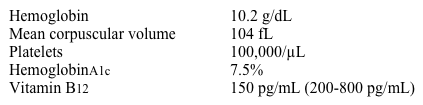 Which of the following most likely contributed to this patient's current condition?
 (Multiple Choice)
5.0/5 (76)
(76) A 29-year-old woman comes to the physician because of worsening fatigue for the past few months. She has also noticed dizziness, nausea, constipation, and hair loss. Her past medical history is unremarkable except for eclampsia with complicated vaginal delivery 1 year ago. She takes estrogen and progesterone-containing birth control pills. She has regular menstrual periods.
Her temperature is 36.1 C (97 F), blood pressure is 90/60 mm Hg, and pulse is 58/min. She weighs 50 kg (110.2 lb) and is 165 cm (5'5") tall. Her thyroid gland is normal in size on palpation. Her skin is dry and she has sparse axillary and pubic hair. Visual fields are normal on confrontation. The remainder of the examination is unremarkable.
Laboratory results are as follows:
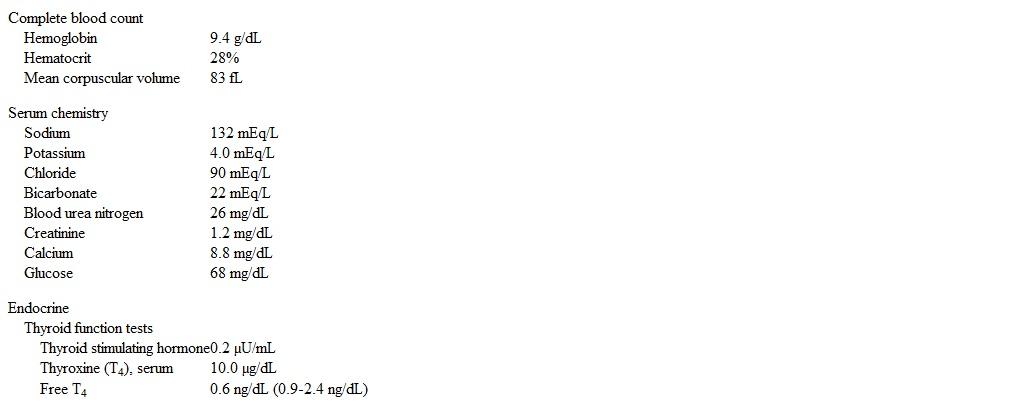 Which of the following is the most appropriate next step in management of this patient?
 (Multiple Choice)
4.7/5 (74)
(74) A 22-year-old man comes to the physician for a follow-up after the passage of a kidney stone. He was evaluated in the emergency department 10 days ago for right-sided colicky flank pain. An abdominal CT scan at that time revealed a 7-mm stone at the right ureteropelvic junction and two stones near the tips of calyces in the left kidney. The patient spontaneously passed the stone, but was not able to retrieve it for analysis. He has not previously had symptoms of kidney stones. His review of systems is normal. He is in good health, takes no medication or vitamins, is not chronically dehydrated, and has no family history of kidney stones.
Physical examination shows no abnormalities. Urinalysis shows occasional hexagonal crystals with benzene ring morphology.
Which of the following analyses performed on a 24-hour urine collection is most likely to lead to the diagnosis?
(Multiple Choice)
4.8/5 (86)
(86) A 70-year-old woman comes to the office for evaluation before an elective left knee replacement. Except for chronic left knee pain due to long-standing osteoarthritis, she has no other symptoms. The patient underwent an uncomplicated right knee replacement 4 years ago. Her only other medical problem is hypertension, for which she takes hydrochlorothiazide and amlodipine. She does not use tobacco or alcohol.
Vital signs are within normal limits. Her BMI is 24 kg/m2. Physical examination shows spotty submandibular lymph nodes and crepitus in her left knee. Cardiovascular and abdominal examinations are unremarkable.
Laboratory results are as follows:
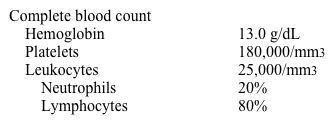 Peripheral blood smear shows small mature lymphocytes and a few smudge cells. Flow cytometry shows a population of cells that are CD5+, CD19+, CD23+, and CD38+.
Which of the following is the most appropriate next step in management of this patient?
Peripheral blood smear shows small mature lymphocytes and a few smudge cells. Flow cytometry shows a population of cells that are CD5+, CD19+, CD23+, and CD38+.
Which of the following is the most appropriate next step in management of this patient? (Multiple Choice)
4.8/5 (80)
(80) A 49-year-old woman comes to the office due to vulvar lesions. The patient first noticed 2 small flat lesions several months ago that have since increased in size and number. Currently, there are 10-15 lesions around her vulva. She has no chronic medical conditions. The patient is sexually active and uses a copper-containing intrauterine device. She has been in her current relationship for 6 months and has had 10 lifetime partners.
Vital signs are normal. BMI is 23 kg/m2. Genital lesions are similar to the ones seen in the exhibit. The lesions are nonfriable and there is no associated inguinal lymphadenopathy.
Which of the following is the most likely diagnosis in this patient?
(Multiple Choice)
4.8/5 (85)
(85) A community-dwelling 80-year-old patient comes to the physician for preoperative assessment prior to elective hip replacement. Which of the following would be the best metric for determining the likelihood of 30-day post-operative complications and discharge to a nursing facility?
(Multiple Choice)
4.9/5 (69)
(69) A 44-year-old man comes to the physician for hypertension follow-up. Systolic blood pressure readings during his prior visits ranged from 150-160 mm Hg and diastolic readings were 90-100 mm Hg. Medical history is significant for right knee osteoarthritis. He has a strong family history of type 2 diabetes mellitus and stroke.
Blood pressure is 158/95 mm Hg and pulse is 78/min. BMI is 31.5 kg/m2. Physical examination shows central obesity but is otherwise unremarkable.
Complete blood count, basic metabolic panel, and urinalysis show no significant abnormalities except for serum glucose of 110 mg/dL. Fasting lipid panel shows low-density lipoprotein of 110 mg/dL and triglycerides of 185 mg/dL.
Use of which of the following medications is associated with the highest risk of developing diabetes mellitus in this patient?
(Multiple Choice)
4.9/5 (77)
(77) A 63-year-old man comes to the office due to fatigue, lethargy, constipation, dry skin, loss of libido, and cold intolerance for the past 4 months. He has been previously healthy except for a stage I nasopharyngeal tumor treated with radiation 10 years ago. He currently takes no medications. The patient has a 20-pack-year smoking history but quit after being diagnosed with cancer. There is no history of alcohol or illicit drug use.
Blood pressure is 100/70 mm Hg and pulse is 60/min. Examination shows dry skin with normal pigmentation. Visual fields are normal on confrontation. The oropharynx is normal. Testes are normal in size but soft. Deep-tendon reflex relaxation time is prolonged.
Laboratory results received at 8:00 AM are as follows:
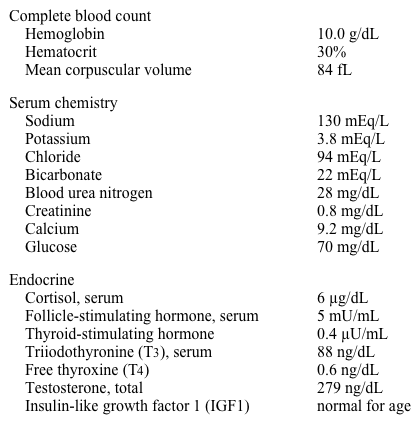 An MRI of the pituitary reveals no mass lesions.
Which of the following is the most appropriate next step in management of this patient?
An MRI of the pituitary reveals no mass lesions.
Which of the following is the most appropriate next step in management of this patient? (Multiple Choice)
4.8/5 (79)
(79) A 44-year-old man comes to the office for an annual physical examination. He has no significant medical history and takes no medications. The patient has a history of depression in his early 20s that responded well to sertraline. He currently has no depressive symptoms. He is married, has 2 school-age children, and works as a landscaping contractor. The patient drinks socially and does not use recreational drugs. He has a 25 pack-year smoking history. He says that his mother and brother are recovering alcoholics. Physical examination is unremarkable. Routine laboratory blood tests are obtained.
Which of the following is the best next step in assessing this patient for unhealthy alcohol use?
(Multiple Choice)
4.9/5 (69)
(69) A 58-year-old man comes to the office due to increased dyspnea on exertion and wheezing over the last 2 months. He has never had these symptoms before and says they "make it harder to sleep." There is no family history of asthma.
On physical examination, the lungs have good air movement with scattered wheezes and no crackles. No edema is present at the ankles.
The results of pulmonary function testing are as follows:
 Which of the following additional findings would most strongly support the diagnosis of asthma as opposed to chronic obstructive lung disease in this patient?
 (Multiple Choice)
4.9/5 (82)
(82) A 65-year-old man comes to the physician with complaints of poor balance and near-falls over the last 6 months. He recently began using a cane for ambulation. He also reports memory loss during this period and has difficulty handling finances and keeping appointments. The patient has no headache, trauma, visual difficulty, slurred speech, muscle weakness, back pain, or incontinence. His past medical history includes chronic lymphocytic leukemia. He takes no medications.
Vital signs are within normal limits. The patient has some postural instability on pull-back testing. Gait is slow with short strides. He turns slowly, with several steps. There is no evidence of tremor or rigidity, although he does have increased tone in the lower extremities with brisk reflexes. He scores 24/30 on the Mini-Mental State Examination. The remainder of the physical examination is within normal limits.
Magnetic resonance imaging of the brain with and without gadolinium shows enlarged ventricles.
Which of the following is the most likely diagnosis?
(Multiple Choice)
4.7/5 (78)
(78) A 78-year-old man comes to the office for routine follow-up. He had an ischemic stroke 8 months ago and has some residual weakness in his left leg. The patient had a fall 4 months ago without significant injuries, but his gait is somewhat unsteady. Medical history is significant for diet-controlled type 2 diabetes mellitus, hypertension, chronic kidney disease, and persistent atrial fibrillation. Current medications are lisinopril, metoprolol, atorvastatin, and low-dose aspirin. The patient has been treated with warfarin due to atrial fibrillation, but he found it difficult to follow frequent blood checks and stopped the therapy. He is a lifelong nonsmoker and does not drink alcohol. Despite leg weakness, he enjoys short walks in his yard every morning.
Blood pressure is 133/76 mm Hg, and pulse is 88/min and irregular. No murmurs are heard on cardiac auscultation, and there is no peripheral edema.
Laboratory results are as follows:
 Estimated glomerular filtration rate (eGFR) is 39 mL/min. ECG shows atrial fibrillation and voltage criteria for left ventricular hypertrophy.
Which of the following is the best therapy to offer this patient?
Estimated glomerular filtration rate (eGFR) is 39 mL/min. ECG shows atrial fibrillation and voltage criteria for left ventricular hypertrophy.
Which of the following is the best therapy to offer this patient? (Multiple Choice)
4.8/5 (85)
(85) A 57-year-old man comes to the physician for evaluation of pain and swelling in his right leg. He experienced pain in his right calf the night before that he thought was related to playing softball the previous day. He recalled no injury while playing. The pain progressed and he now has slight swelling in the right foot. The patient has not had a similar problem previously. He has no fever, chills, chest pain, or dyspnea. His other medical problems include hypertension, hyperlipidemia, and degenerative joint disease of both knees.
Vital signs are normal. There is 1+ pedal edema on the right leg and no edema on the left. Peripheral pulses are full and symmetric. There is no obvious difference in temperature between the legs. There is no erythema or palpable cords. Homan's sign is strongly positive on the right. There may be a small effusion of the right knee. The patient has nonpulsatile fullness in the right popliteal fossa when standing with his legs fully extended.
Which of the following is the most likely diagnosis?
(Multiple Choice)
4.9/5 (69)
(69) 
Filters
- Essay(0)
- Multiple Choice(0)
- Short Answer(0)
- True False(0)
- Matching(0)