



 Chat with AI
Exam 3: Office/Health Center

Exam 1: Emergency Department218 Questions
Exam 2: In-patient Facilities128 Questions
Exam 3: Office/Health Center900 Questions
Select questions type


A 42-year-old woman comes to the office due to a rash. She has experienced recurring "red spots" on her legs for 2-3 years. These appear sporadically, last a few weeks to a few months, and disappear spontaneously. The rash is not pruritic. When it occurs, the patient also experiences generalized fatigue and arthralgias involving her hips and knees. She rarely has right lower quadrant pain with the rash. Review of systems is otherwise normal.
Medical history is unremarkable. The patient has no known drug allergies. Her only medication is an oral contraceptive, which she has taken for several years. She does not use tobacco, alcohol, or illicit drugs. She is single and works in an office.
On examination, the patient appears healthy. Blood pressure is 136/86 mm Hg, pulse is 72/min, and respirations are 14/min. BMI is 24 kg/m2. Physical examination is normal except for the skin. A total of 10-12 palpable red lesions, measuring 1×0.5 cm, are scattered over both lower extremities distal to the mid-calf. The lesions are nontender and do not blanch with pressure.
Laboratory results are as follows:
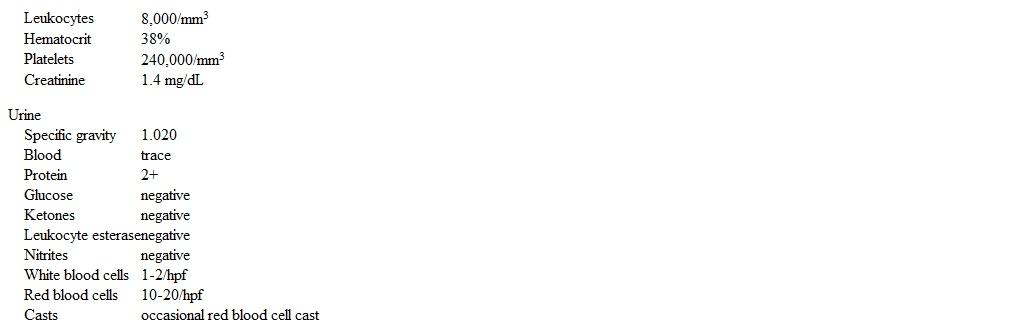 Which of the following would most likely be found in this patient?
 (Multiple Choice)
4.7/5  (85)
(85) A 35-year-old man comes to the physician with complaints of dizziness and fatigue. These episodes occur immediately after he exercises on the treadmill for 30 minutes, and are accompanied by shaking and sweating. He has a history of type 1 diabetes mellitus and takes insulin glargine once daily at breakfast and pre-meal injections of insulin aspart. The patient checks his blood glucose every day prior to breakfast; the usual range is 110-140 mg/dL. His last hemoglobin A1C was 7.2%. He has no other medical problems.
Which of the following is the best next step in management of this patient?
(Multiple Choice)
4.9/5 (66)
(66) A 45-year-old man complains of decreased hearing on the right side for the last 2 months. He also has occasional ringing in the right ear. He has a remote history of early-stage melanoma treated with surgical excision. The patient's medications include metformin for type 2 diabetes mellitus, lansoprazole for gastroesophageal reflux disease, meclizine for intermittent vertigo, and naproxen for occasional low back pain. He is a lifetime nonsmoker.
His blood pressure is 135/85 mm Hg and pulse is 80/min and regular. His body mass index is 30 kg/m2. Weber test shows the sound from the tuning fork placed on the patient's forehead localizing to the left side. Rinne test shows air conduction better than bone conduction on both sides.
Which of the following is the most likely diagnosis in this patient?
(Multiple Choice)
4.7/5 (86)
(86) A 40-year-old woman is evaluated for mildly elevated blood pressure. She complains of occasional low back pain, but she is otherwise in good health. Her other medical problems include type 2 diabetes mellitus, hyperlipidemia, and gastroesophageal reflux disease. She lives a sedentary lifestyle and spends the majority of her time indoors. Her mother suffered from a hip fracture at the age of 55. She has no family history of cancer.
Her blood pressure is 144/90 mm Hg and pulse is 78/min. Her BMI is 32 kg/m2. Physical examination is unremarkable.
Laboratory results are as follows:
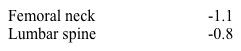
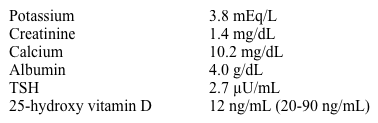 Dual energy x-ray absorptiometry (DEXA) T scores:
 She is treated with 50,000 IU of vitamin D2 (ergocalciferol) weekly for 4 weeks. Repeat laboratory data shows a serum calcium of 11.4 mg/dL and parathyroid hormone (PTH) levels of 75 pg/mL (normal 10-65 pg/mL).
Which of the following is the most likely diagnosis?
Dual energy x-ray absorptiometry (DEXA) T scores:
She is treated with 50,000 IU of vitamin D2 (ergocalciferol) weekly for 4 weeks. Repeat laboratory data shows a serum calcium of 11.4 mg/dL and parathyroid hormone (PTH) levels of 75 pg/mL (normal 10-65 pg/mL).
Which of the following is the most likely diagnosis? (Multiple Choice)
4.8/5 (81)
(81) A 25-year-old man with no past medical history comes to his primary care physician for follow-up after a seizure episode 1 week ago. According to his coworkers, he suddenly lost awareness and began having semi-purposeful movements of his right hand. A few seconds later, he fell and had generalized tonic-clonic movements of his arms and legs. The event lasted about 2 minutes and was followed by at least 20 minutes of confusion and lethargy. The patient woke up in the ambulance and had no memory of the event. He admits that 30 seconds before the seizure he had a feeling of uneasiness in his stomach. He has no history of similar events, head trauma, central nervous system infections, or family history of seizures. He takes no medications at home. He works as an accountant and does not use alcohol, tobacco, or illicit drugs.
His vital signs are within normal limits. Physical examination is unremarkable. In the emergency department, the patient had a normal laboratory workup, urine drug screen, and noncontrast head computed tomography.
Which of the following is the best next step in management of this patient?
(Multiple Choice)
4.9/5 (81)
(81) A 45-year-old obese woman with diet-controlled diabetes mellitus comes to the physician with mild pruritus in both axillary areas. Physical examination findings are shown in the image below.
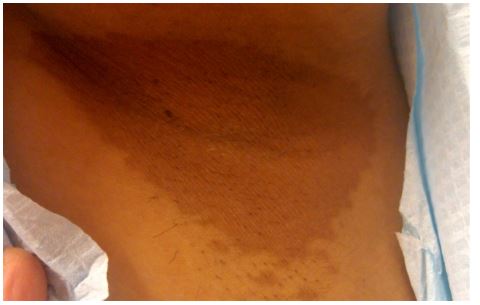 Examination with Wood's lamp shows red fluorescence in the affected areas. Which of the following is the most likely diagnosis?
 (Multiple Choice)
5.0/5 (77)
(77) A 40-year-old man comes to the physician for evaluation of a rash involving his knees and shins. The rash has been present for 9 months with mild itching that worsens in winter. No other areas of the patient's body are involved, and he has no musculoskeletal symptoms. His general health is good and he takes no medications.
A general physical examination is within normal limits. Nail examination is normal. His knees are shown in the photograph below.
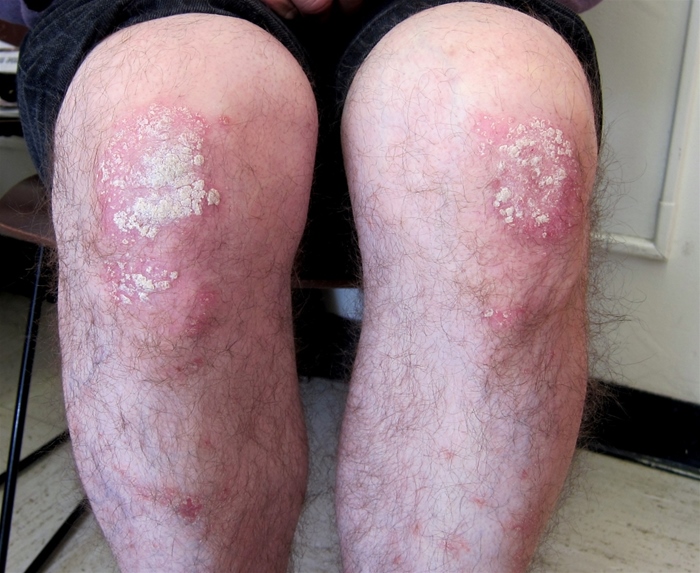 What would be the most appropriate initial therapy for this patient?
 (Multiple Choice)
4.8/5 (79)
(79) A 24-year-old woman has a low platelet count on routine blood work. She denies bleeding, fever, chills, weight loss, bone pain, or abdominal pain. Her past medical history is unremarkable and she does not take any medications. She does not use tobacco, alcohol, or illicit drugs. She is sexually active.
Complete physical examination is within normal limits.
Laboratory results are as follows:
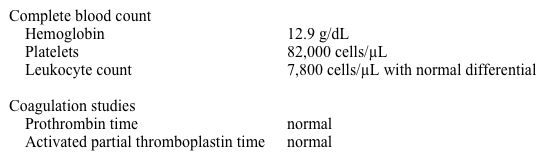 Blood smear shows a paucity of platelets but is otherwise unremarkable. Pregnancy test is negative.
Which of the following is the best next step in managing this patient?
Blood smear shows a paucity of platelets but is otherwise unremarkable. Pregnancy test is negative.
Which of the following is the best next step in managing this patient? (Multiple Choice)
4.7/5 (82)
(82) A 24-year-old man comes to the physician with cold extremities and loss of feeling in his hands. He is a mountaineer who was on an expedition to climb Mt. Rainier. His group became lost in a storm and was stranded at high altitude due to reduced visibility and high winds. The patient had several hours of exposure to very low ambient temperatures before being rescued. He had on 2 pairs of gloves, including a woolen inner pair and an outer shell. However, the outer shell was damaged during the climb.
Vital signs are within normal limits. Examination shows that the first through third digits are white, cold, numb, and firm distal to the first interphalangeal joint.
The fingers are immersed rapidly in water heated to 38 C (100.4 F). After 30 minutes, the fingers are purplish-red between the proximal interphalangeal and distal interphalangeal joints.
Which of the following is the best next step in managing this patient?
(Multiple Choice)
4.8/5 (66)
(66) A 60-year-old woman comes to the office due to frequent urination. She gets up 3 times a night to urinate and drink water. She has also noticed some mild hoarseness, fatigue, and difficulty concentrating. Her eyes have been dry and "burning," for which she uses over-the-counter eye drops. The patient has no history of chronic medical conditions but has smoked a pack of cigarettes daily for 40 years.
Blood pressure is 144/78 mm Hg and pulse is 82/min and regular. Physical examination is unremarkable.
Laboratory results are as follows:
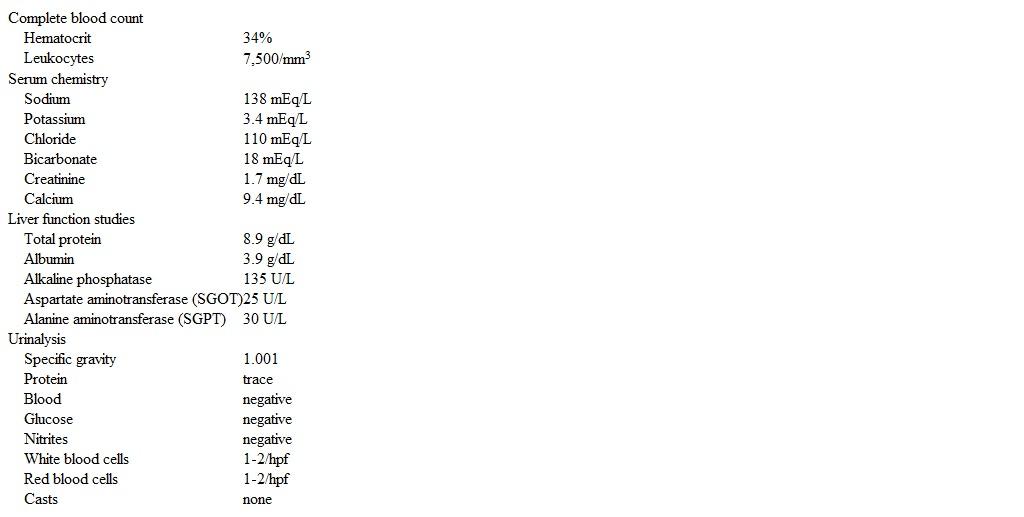 Which of the following is most likely to establish the diagnosis in this patient?
 (Multiple Choice)
4.9/5 (68)
(68) A 54-year-old man comes to the clinic 6 weeks after being discharged from the hospital for treatment of aortic valve endocarditis. He has no concerns and says that he feels "fine." The patient's endocarditis was caused by Enterococcus and occurred following cystoscopic evaluation of hematuria. Transesophageal echocardiography during hospitalization showed moderate aortic regurgitation and a 5-mm vegetation on the non-coronary cusp of the aortic valve.
The patient had an uncomplicated hospital stay and completed a full course of intravenous antibiotics as an outpatient. His other medical problems include peptic ulcer disease, kidney stones, and gout. He does not use tobacco. His father had a stroke at age 72.
Temperature is 36.7 C (98 F), blood pressure is 124/78 mm Hg, and pulse is 78/min. The lungs are clear to auscultation. No murmurs are present.
ECG shows normal sinus rhythm and nonspecific T-wave changes. Transthoracic echocardiogram shows normal left ventricular size, a left ventricular ejection fraction of 65%, and moderate eccentric aortic regurgitation.
Which of the following is the next best step in management of this patient?
(Multiple Choice)
4.8/5 (89)
(89) A 32-year-old man with known hypertrophic cardiomyopathy is brought to the emergency department after an episode of syncope. He was carrying groceries to his car when he suddenly passed out. He had no chest pain, lightheadedness, nausea, or palpitations prior to the event. The patient now says he feels fine and wants to go home. He was diagnosed with hypertrophic cardiomyopathy 2 years ago. He had a mild provokable left ventricular outflow tract gradient with exercise due to systolic anterior motion of the mitral valve. The gradient was eliminated with metoprolol. The patient claims compliance with the therapy and has no exertional shortness of breath or chest pain. His paternal uncle died suddenly at age 40.
Blood pressure is 132/80 mm Hg and pulse is 62/min. Fourth heart sound is heard at the apex with the patient in the left lateral decubitus position.
Electrocardiogram shows normal sinus rhythm and T-wave inversion in leads I, V5, and V6; it is unchanged from a previous reading.
Which of the following is the best next step in management of this patient?
(Multiple Choice)
4.8/5 (79)
(79) A 63-year-old man with a history of hypertension, type 2 diabetes, and severe osteoarthritis underwent a right total knee arthroplasty 3 months earlier. He comes to his primary care physician with persistent pain and swelling of the right knee. The patient has pain with activity and at rest, with the most significant pain associated with weight bearing. He has no fevers, chills, nausea, vomiting, or diarrhea. He goes to rehabilitation but his participation has been limited over the past week due to persistent pain.
His temperature is 37.1 C (98.7 F), blood pressure is 114/74 mm Hg, pulse is 86/min, and respirations are 18/min. Examination shows a moderately swollen right knee with decreased range of motion. The surgical scar is intact without surrounding erythema. Examination of the left knee is within normal limits.
An x-ray of the knee reveals an intact prosthesis. Laboratory tests, including complete blood count, electrolyte panel, C-reactive protein, and erythrocyte sedimentation rate, have been ordered.
Which of the following is the best next step in management of this patient's condition?
(Multiple Choice)
4.8/5 (73)
(73) A 37-year-old woman comes to the physician with pain in her hand joints lasting several months. She feels she is clumsy in the morning because her hands are stiff and tender. Four weeks ago the patient was treated for knee pain and swelling with naproxen. Her past medical history is otherwise unremarkable.
Joint examination shows warmth, swelling, and tenderness in the proximal interphalangeal and metacarpophalangeal joints and both wrists. X-rays show periarticular osteopenia and erosions of the proximal interphalangeal and metacarpophalangeal joints.
Laboratory results are as follows:
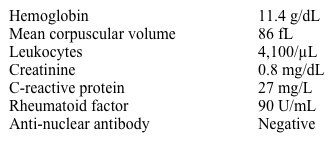 The patient is treated with nonsteroidal anti-inflammatory therapy with significant symptomatic relief.
Which of the following is the most appropriate next step in management of this patient?
The patient is treated with nonsteroidal anti-inflammatory therapy with significant symptomatic relief.
Which of the following is the most appropriate next step in management of this patient? (Multiple Choice)
4.8/5 (70)
(70) A 45-year-old woman comes to the office due to an intensely pruritic rash. Over the last 2 months, she has had a persistent rash characterized by pruritic papules and blisters on her elbows, knees, and buttocks. The patient has no significant medical history and takes no medications. She has a 15-pack-year smoking history and does not use alcohol or illicit drugs.
Skin findings are shown in the image.
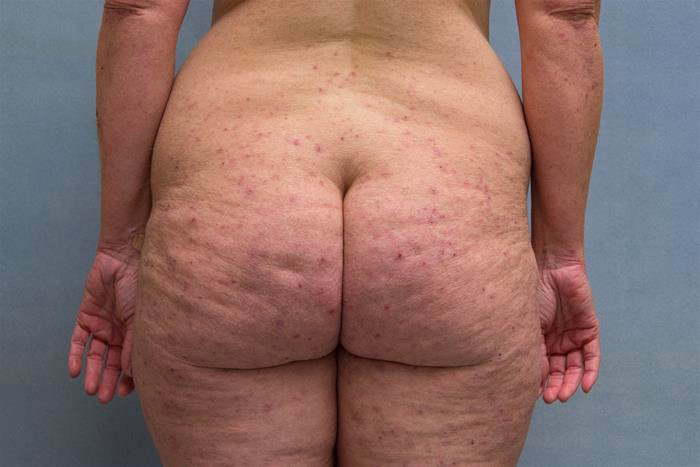 This patient's condition is most likely associated with which of the following?
 (Multiple Choice)
4.8/5 (75)
(75) A 57-year-old woman undergoes mitral valve replacement with a mechanical valve for mitral stenosis. Preoperative angiogram shows no evidence of coronary artery disease. The postoperative course is uncomplicated. Transthoracic echocardiogram shows a moderately enlarged left atrium, left ventricular ejection fraction of 60%, and a normally functioning mechanical mitral valve. Which of the following is the best long-term treatment option for this patient?
(Multiple Choice)
4.8/5 (89)
(89) A 52-year-old woman comes to the office to follow up elevated blood pressure, which was 140/100 mm Hg during a routine preventive visit 4 weeks ago. The patient feels well and has experienced no recent weight changes, headaches, chest pain, palpitations, or polyuria. Medical history is notable only for gastroesophageal reflux disease managed with dietary modification, and she takes no medications. Screening colonoscopy at age 50 was normal. She drinks 1 or 2 glasses of wine most days and does not use tobacco or illicit drugs. The patient is an only child, and her parents have no unusual health history.
Blood pressure is 138/100 mm Hg and pulse is 72/min. BMI is 27 kg/m2. The patient appears mildly overweight but comfortable. Physical examination is otherwise unremarkable.
Laboratory results are as follows:
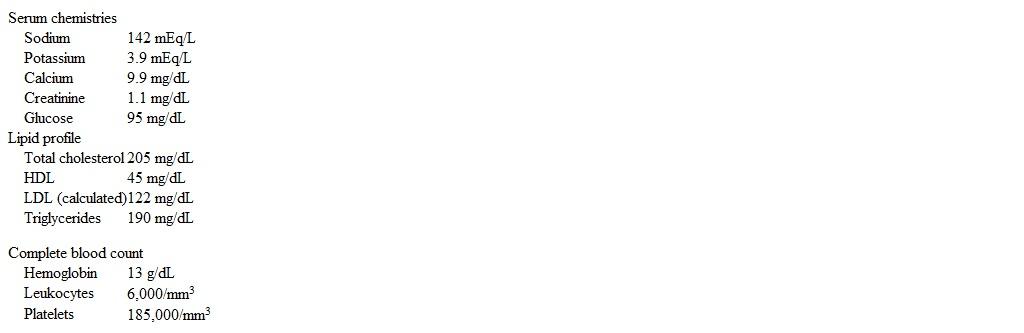 Urinalysis is normal. ECG shows normal sinus rhythm with no significant abnormalities.
Which of the following additional studies is most appropriate for this patient?
Urinalysis is normal. ECG shows normal sinus rhythm with no significant abnormalities.
Which of the following additional studies is most appropriate for this patient? (Multiple Choice)
4.9/5 (83)
(83) A 52-year-old woman comes to the physician for routine follow-up. She has no complaints and thinks of herself as "pretty healthy." She takes lisinopril and hydrochlorothiazide for hypertension and lansoprazole for gastroesophageal reflux disease. She was treated with isoniazid for latent tuberculosis 7 years ago. Her mother died of uterine cancer at age 62. The patient does not smoke. She jogs 3 miles a day and eats a balanced diet. She takes 2000 units of vitamin D3 a day orally as a dietary supplement.
Her blood pressure is 139/82 mm Hg and pulse is 74/min. Her BMI is 28 kg/m2. There are no neck masses or lymph node enlargement. Breast examination is unremarkable. Lungs are clear to auscultation. The spleen is not palpable. There are no skin rashes.
Laboratory results are as follows:
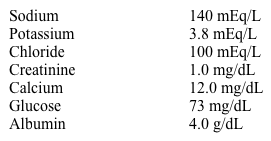 Repeat calcium level is 12.1 mg/dL. Hydrochlorothiazide is discontinued.
Which of the following is the most likely diagnosis?
Repeat calcium level is 12.1 mg/dL. Hydrochlorothiazide is discontinued.
Which of the following is the most likely diagnosis? (Multiple Choice)
4.9/5 (80)
(80) A 67-year-old man with polycythemia vera comes to the physician for a follow-up visit. He complains of mild fatigue and early satiety. He was diagnosed with polycythemia vera 7 years ago and has had no complications or chemotherapy. The patient underwent therapeutic phlebotomy for 6 years but not during the last year. His other medical problems include hypertension and acid reflux disease. His medications include amlodipine, esomeprazole, and low-dose aspirin.
His blood pressure is 150/75 mm Hg, and pulse is 78/min. Physical examination reveals pale conjunctivae. The abdomen is soft and nontender, and the liver span is 12 cm. The spleen is palpable 7 cm below the costal margin. The remainder of the examination is within normal limits.
Laboratory results are as follows:
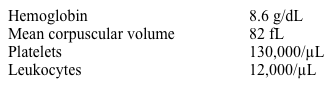 Which of the following conditions is the most likely diagnosis?
 (Multiple Choice)
4.9/5 (75)
(75) A 32-year-old physician approaches a colleague and asks if he would write him a prescription for an antidepressant. He has known this colleague since medical school and they work closely in the same hospital department. The physician says he has been under a great deal of stress lately. His mother was recently diagnosed with cancer and his spouse has complained about his long work hours and disinterest in the relationship. The physician says, "I'm trying so hard to be everything to everybody, but some days it's just too much. I would really appreciate if you could help me out. I don't want this in my medical record. I don't think I'm clinically depressed; I just think I could feel better."
Which of the following is the most appropriate response?
(Multiple Choice)
4.9/5 (85)
(85) 
Filters
- Essay(0)
- Multiple Choice(0)
- Short Answer(0)
- True False(0)
- Matching(0)