Multiple Choice
A 38-year-old man comes to the physician with intermittent abdominal pain for several months. The pain is in the epigastric area and is often worse with food intake. He has tried over-the-counter antacids and H2 blockers with minimal relief. He reports occasional nausea but denies vomiting, hematemesis, or melena.
His past medical history is significant for asthma diagnosed 2 years ago, for which he uses an albuterol inhaler. Two months ago, he was hospitalized for pneumonia and asthma exacerbation and was treated with steroids and antibiotics. The patient immigrated to the United States 5 years ago from Laos. He does not use tobacco, alcohol, or illicit drugs. He denies HIV risk factors and known exposure to tuberculosis.
His temperature is 36.7 C (98 F) , blood pressure is 122/70 mm Hg, and pulse is 77/min. Physical examination is unremarkable.
Laboratory results are as follows: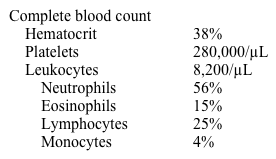
Serum chemistry and liver function tests are normal. Chest CT is unremarkable. Two stool samples for ova and parasites are negative.
What is the best next step in management of this patient?
A) Bone marrow biopsy
B) Celiac disease antibodies
C) Serology for Helicobacter pylori
D) Serology for parasitic infection
E) Skin testing for Aspergillus
Correct Answer:

Verified
Correct Answer:
Verified
Q426: An analysis of results from 18,317 patients
Q427: A 34-year-old woman comes to the office
Q428: A 23-year-old-man comes to the clinic seeking
Q429: A 34-year-old man comes to the office
Q430: A 22-year-old man comes to the physician
Q432: A 74-year-old man is admitted to the
Q433: A 76-year-old woman comes to the office
Q434: A 73-year-old woman comes to the office
Q435: An 82-year-old woman comes to the physician
Q436: A 36-year-old man comes to the physician