Multiple Choice
A 72-year-old man presents with 4 weeks of central low back pain. His pain was initially mild and relieved by recumbency. Over the past two weeks, the pain has increased in severity and occurs at night without relief by lying down. The pain does not radiate and he has neither sensory loss nor weakness in his legs.
The patient has benign prostatic hyperplasia with significant outlet obstruction. He is scheduled for a transurethral prostatectomy soon. He was treated for a urinary tract infection both 3 years ago and two months ago. He has a history of stable coronary artery disease, hypertension, and degenerative joint disease. He has no history of cancer.
His temperature is 37.8 C (100.1 F) , blood pressure is 140/72 mm Hg, and pulse is 84/min. Cardiac, pulmonary, and abdominal exams are unremarkable. There is decreased range of motion in all aspects of his back. Point tenderness is present over the third and fourth lumbar processes. There are no sensory or motor deficits in his lower extremities. Deep tendon reflexes are symmetric. Perineal sensation and rectal tone are normal. An enlarged, non-tender rubbery prostate is palpated on digital rectal examination.
The patient's labs reveal: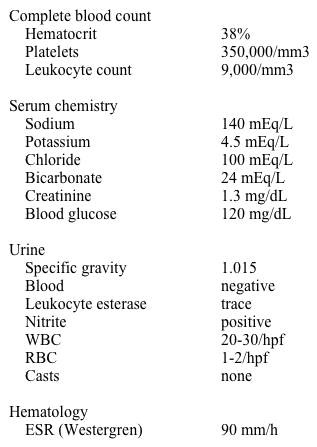
Which of the following is the most appropriate next step in management?
A) Ibuprofen and activity as tolerated
B) MRI of the lower spine
C) Oxycodone with acetaminophen for 2 weeks
D) Prostate biopsy
E) Serum protein electrophoresis
Correct Answer:

Verified
Correct Answer:
Verified
Q569: A 65-year-old Asian woman comes to the
Q570: A 45-year-old man is evaluated for recurrent
Q571: A 78-year-old woman comes to the urgent
Q572: A 67-year-old man seeks medical attention because
Q573: A 64-year-old man comes to the office
Q575: A 47-year-old man comes to the physician
Q576: A 45-year-old man comes to the physician
Q577: A 22-year-old African American man is evaluated
Q578: A 34-year-old man comes to the emergency
Q579: A 35-year-old man is evaluated for pain