



 Chat with AI
Exam 17: Genomes

Exam 1: Studying Life246 Questions
Exam 2: Small Molecules and the Chemistry of Life246 Questions
Exam 3: Proteins, Carbohydrates, and Lipids246 Questions
Exam 4: Nucleic Acids and the Origin of Life246 Questions
Exam 5: Cells: the Working Units of Life248 Questions
Exam 6: Cell Membranes246 Questions
Exam 7: Cell Communication and Multicellularity246 Questions
Exam 8: Energy, Enzymes, and Metabolism246 Questions
Exam 9: Pathways That Harvest Chemical Energy246 Questions
Exam 10: Photosynthesis: Energy From Sunlight242 Questions
Exam 11: The Cell Cycle and Cell Division260 Questions
Exam 12: Inheritance, Genes, and Chromosomes250 Questions
Exam 13: Dna and Its Role in Heredity257 Questions
Exam 14: From Dna to Protein: Gene Expression252 Questions
Exam 15: Gene Mutation and Molecular Medicine251 Questions
Exam 16: Regulation of Gene Expression245 Questions
Exam 17: Genomes249 Questions
Exam 18: Recombinant Dna and Biotechnology243 Questions
Exam 20: Mechanisms of Evolution243 Questions
Exam 21: Reconstructing and Using Phylogenies246 Questions
Exam 22: Speciation247 Questions
Exam 23: Evolution of Genes and Genomes252 Questions
Exam 24: The History of Life on Earth246 Questions
Exam 25: Bacteria, Archaea, and Viruses262 Questions
Exam 26: The Origin and Diversification of Eukaryotes252 Questions
Exam 27: Plants Without Seeds: From Water to Land251 Questions
Exam 28: The Evolution of Seed Plants259 Questions
Exam 29: The Evolution and Diversity of Fungi261 Questions
Exam 30: Animal Origins and the Evolution of Body Plans248 Questions
Exam 31: Protostome Animals244 Questions
Exam 32: Deuterostome Animals246 Questions
Exam 33: The Plant Body243 Questions
Exam 34: Transport in Plants248 Questions
Exam 35: Plant Nutrition247 Questions
Exam 36: Regulation of Plant Growth246 Questions
Exam 37: Reproduction in Flowering Plants247 Questions
Exam 38: Plant Responses to Environmental Challenges246 Questions
Exam 39: Physiology, Homeostasis, and Temperature Regulation258 Questions
Exam 40: Animal Hormones249 Questions
Exam 41: Immunology: Animal Defense Systems265 Questions
Exam 42: Animal Reproduction261 Questions
Exam 43: Animal Development261 Questions
Exam 44: Neurons, Glia, and Nervous Systems250 Questions
Exam 45: Sensory Systems249 Questions
Exam 46: The Mammalian Nervous System: Structure and Higher Functions254 Questions
Exam 47: Musculoskeletal Systems259 Questions
Exam 48: Gas Exchange247 Questions
Exam 49: Circulatory Systems252 Questions
Exam 50: Nutrition, Digestion, and Absorption259 Questions
Exam 51: Salt and Water Balance and Nitrogen Excretion251 Questions
Exam 52: Animal Behavior249 Questions
Exam 53: The Physical Environment and Biogeography of Life248 Questions
Exam 54: Populations259 Questions
Exam 55: Species Interactions254 Questions
Exam 56: Communities247 Questions
Exam 57: Ecosystems238 Questions
Exam 58: A Changing Biosphere222 Questions
Select questions type


Genomics has revealed that the bacterium that causes tuberculosis has more than 250 genes that metabolize lipids, many more than most bacteria have.What does this finding suggest about the bacterium and about medicinal approaches to this disease?
(Essay)
4.8/5  (96)
(96) A drug that reduces blood pressure is broken down by an enzyme and becomes inactive.Individuals who have a more active enzyme will tend to have _______ blood pressure than those with the less active version of the enzyme and will thus need to take the drug _______ often.
(Multiple Choice)
4.8/5 (70)
(70) The Denisovans are an extinct species of human that lived in Siberia several tens of thousands of years ago.We now have sequence information from these Denisovans.What evidence would best support Denisovans having had the capacity for speech?
(Multiple Choice)
4.7/5 (78)
(78) Suppose, in contrast to the actual situation, that Neanderthals had a variant of the FOXP2 gene that resembled the chimpanzee variant more than the human variant.What would be the most reasonable inference based on this counterfactual finding?
(Multiple Choice)
4.7/5 (76)
(76) Three overlapping reads are generated from sequencing.(Note: All reads are in a 5′-to-3′ direction.) Read 1: AAGCGAAGTCACTACGTAGC
Read 2: CGTAGCAGGCGATCGGCA
Read 3: AGTCGCGGCTAGCTTAAGCGA
What is the correct order of the sequence?
(Multiple Choice)
4.9/5 (80)
(80) Refer to the figure showing high-throughput sequencing. 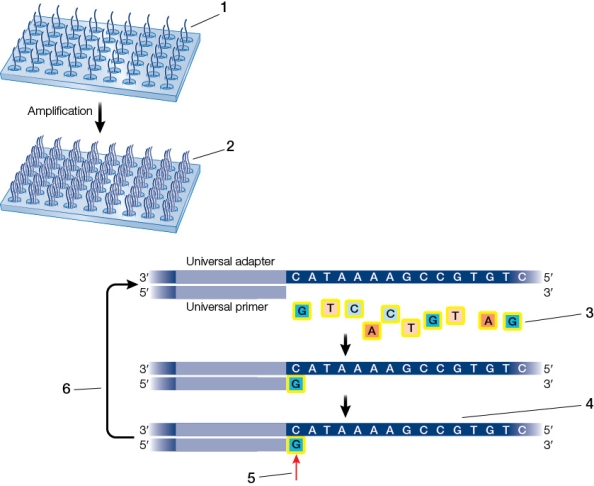 When are the DNA segments first separated by length?
 (Short Answer)
4.8/5 (87)
(87) Pathogenic strains of E.coli often exchange genes with other pathogenic bacteria such as Salmonella and Shigella.Refer to the table showing which bacteria contain various genes.(Note: "x" denotes presence of the gene.) 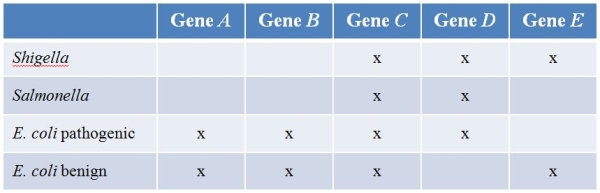 Which gene most likely got into pathogenic E.coli from the other pathogenic bacteria?
 (Multiple Choice)
4.8/5 (79)
(79) What evidence suggests that Neanderthals may have had red hair?
(Multiple Choice)
4.9/5 (81)
(81) Refer to the table comparing the genomes of E.coli and S.cerevisiae. 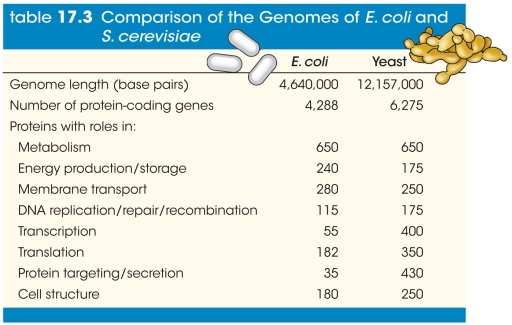 The most striking difference between yeasts and bacteria in their numbers of genes is in the category of _______ genes.
 (Multiple Choice)
5.0/5 (76)
(76) Biologists have published a report showing the numbers of different genes in five different bacteria, correlating these findings to the environments in which the bacteria live and their evolutionary relationships.This report is best described as a study in
(Multiple Choice)
4.8/5 (90)
(90) _______ add(s) dNTPs to DNA strands during high-throughput sequencing.
(Multiple Choice)
4.9/5 (81)
(81) Refer to the figure showing microbial DNA being sequenced and analyzed. 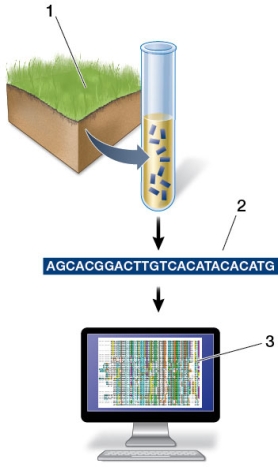 At what step(s) is/are DNA sequenced?
 (Multiple Choice)
4.7/5 (80)
(80) Arabidopsis has a genome size much smaller than that of many other plants.What is the most likely explanation for this phenomenon?
(Multiple Choice)
4.8/5 (93)
(93) A well-funded team of biologists wishes to sequence the full genomes of several individual mice.The team would most likely use _______ sequencing to carry out this research program.
(Short Answer)
4.7/5 (87)
(87) An enzyme in the liver activates a drug.Individuals with the GG genotype at an SNP have a variant of this enzyme that activates the drug more slowly than the variant that AA or AG individuals have.Most likely, GG individuals would require a _______ dose of the drug than other individuals.
(Short Answer)
4.8/5 (75)
(75) A DNA sequence has been cut into the following four overlapping sequence fragments:
(1) AGGGGCCTATAGCATACGTACA
(2) CGTACATCTGAGGGTACGATCATGGC
(3) CATGGCTAGCAAACGCGATCCCAAG
(4) AGGCTAGTTACGATATAGGGGCC
What is the correct order of these fragments?
(Multiple Choice)
4.9/5 (89)
(89) Refer to the table showing the genotypes of a SNP and the average systolic blood pressure and LDL and HDL cholesterol levels associated with those genotypes. 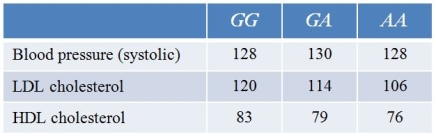 High LDL cholesterol levels and low HDL levels are generally associated with increased cardiovascular disease risk.Which statement is most likely to be true?
 (Multiple Choice)
4.9/5 (67)
(67) Suppose a scientist engineered the mass movement of transposable elements in the genomes of a group of fruit flies, and then these flies had offspring.A control group of flies that were from the same genetic strain but had not had a mass movement of transposable elements also had offspring.The most likely result would be that the average survival rate of the experimental offspring would be _______ than that of the control offspring, and that the genetic variance in the experimental offspring would be _______ in the control offspring.
(Multiple Choice)
4.9/5 (85)
(85) Biologists are examining sequences from several species of bacteria in order to address whether bacteria that live in warmer conditions lose genes more rapidly than those from cooler conditions.Such a study is an example of _______.
(Short Answer)
4.9/5 (81)
(81) The proteomes of eukaryotes are more complex than their genomes, but this is not true of prokaryotes.Which is not a major reason for this difference?
(Multiple Choice)
4.7/5 (85)
(85) 
Filters
- Essay(0)
- Multiple Choice(0)
- Short Answer(0)
- True False(0)
- Matching(0)