



 Chat with AI
Exam 25: Bacteria, Archaea, and Viruses

Exam 1: Studying Life246 Questions
Exam 2: Small Molecules and the Chemistry of Life246 Questions
Exam 3: Proteins, Carbohydrates, and Lipids246 Questions
Exam 4: Nucleic Acids and the Origin of Life246 Questions
Exam 5: Cells: the Working Units of Life248 Questions
Exam 6: Cell Membranes246 Questions
Exam 7: Cell Communication and Multicellularity246 Questions
Exam 8: Energy, Enzymes, and Metabolism246 Questions
Exam 9: Pathways That Harvest Chemical Energy246 Questions
Exam 10: Photosynthesis: Energy From Sunlight242 Questions
Exam 11: The Cell Cycle and Cell Division260 Questions
Exam 12: Inheritance, Genes, and Chromosomes250 Questions
Exam 13: Dna and Its Role in Heredity257 Questions
Exam 14: From Dna to Protein: Gene Expression252 Questions
Exam 15: Gene Mutation and Molecular Medicine251 Questions
Exam 16: Regulation of Gene Expression245 Questions
Exam 17: Genomes249 Questions
Exam 18: Recombinant Dna and Biotechnology243 Questions
Exam 20: Mechanisms of Evolution243 Questions
Exam 21: Reconstructing and Using Phylogenies246 Questions
Exam 22: Speciation247 Questions
Exam 23: Evolution of Genes and Genomes252 Questions
Exam 24: The History of Life on Earth246 Questions
Exam 25: Bacteria, Archaea, and Viruses262 Questions
Exam 26: The Origin and Diversification of Eukaryotes252 Questions
Exam 27: Plants Without Seeds: From Water to Land251 Questions
Exam 28: The Evolution of Seed Plants259 Questions
Exam 29: The Evolution and Diversity of Fungi261 Questions
Exam 30: Animal Origins and the Evolution of Body Plans248 Questions
Exam 31: Protostome Animals244 Questions
Exam 32: Deuterostome Animals246 Questions
Exam 33: The Plant Body243 Questions
Exam 34: Transport in Plants248 Questions
Exam 35: Plant Nutrition247 Questions
Exam 36: Regulation of Plant Growth246 Questions
Exam 37: Reproduction in Flowering Plants247 Questions
Exam 38: Plant Responses to Environmental Challenges246 Questions
Exam 39: Physiology, Homeostasis, and Temperature Regulation258 Questions
Exam 40: Animal Hormones249 Questions
Exam 41: Immunology: Animal Defense Systems265 Questions
Exam 42: Animal Reproduction261 Questions
Exam 43: Animal Development261 Questions
Exam 44: Neurons, Glia, and Nervous Systems250 Questions
Exam 45: Sensory Systems249 Questions
Exam 46: The Mammalian Nervous System: Structure and Higher Functions254 Questions
Exam 47: Musculoskeletal Systems259 Questions
Exam 48: Gas Exchange247 Questions
Exam 49: Circulatory Systems252 Questions
Exam 50: Nutrition, Digestion, and Absorption259 Questions
Exam 51: Salt and Water Balance and Nitrogen Excretion251 Questions
Exam 52: Animal Behavior249 Questions
Exam 53: The Physical Environment and Biogeography of Life248 Questions
Exam 54: Populations259 Questions
Exam 55: Species Interactions254 Questions
Exam 56: Communities247 Questions
Exam 57: Ecosystems238 Questions
Exam 58: A Changing Biosphere222 Questions
Select questions type


Refer to the figure, which shows a prokaryote. 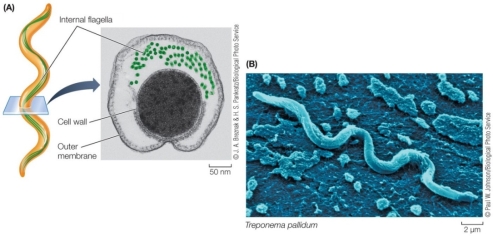 Which statement about the organism shown is true?
Free
(Multiple Choice)
4.9/5  (78)
(78) Correct Answer: Verified
D
Organisms found in samples isolated from the hypersaline Don Juan Pond in Antarctica would be classified as _______.
Free
(Short Answer)
4.9/5 (76)
(76) Correct Answer:Verified
Verifiedhalophiles
Which statement about the mutation rates of most viruses is true?
Free
(Multiple Choice)
4.9/5 (75)
(75) Correct Answer:Verified
VerifiedA
Which of the following is not evidence for the theory that all known life has a single origin?
(Multiple Choice)
4.9/5 (87)
(87) Kashefi and Lovley were able to grow an unnamed archaeal species at temperatures above 120°C only because they used Fe3+ as an electron acceptor-no other electron acceptor they tried allowed the species to grow (see Figure 25.14A).How might you explore the same or other high-temperature environments for other hyperthermophilic organisms not detected by Kashefi and Lovley using Fe3+?
(Essay)
4.9/5 (83)
(83) Ecosystems based on chemoautotrophic prokaryotes occur around deep-sea hydrothermal vents at 2,500 m below the ocean surface.These bacteria
(Multiple Choice)
4.9/5 (72)
(72) Ribosomal RNA (rRNA) nucleotide sequences are suitable for phylogenetic analysis of prokaryotes, because rRNA
(Multiple Choice)
4.9/5 (74)
(74) The Sumatran elephant is a critically endangered species.You are part of a research group that is going to sequence its genome in the hope that you can learn more about the species before it disappears.After analyzing its genome, you find a sizable percentage of the DNA is noncoding and not eukaryotic in origin.What is the most likely explanation?
(Multiple Choice)
4.9/5 (83)
(83) It is difficult to reconstruct phylogenetic relationships in viruses, because of their
(Multiple Choice)
4.9/5 (76)
(76) Chlamydias are known as "energy parasites." Your research group has identified a mutant strain that is no longer able to acquire ATP from its host.The phenotype of this strain is likely due to a mutation in its _______ gene.
(Short Answer)
5.0/5 (77)
(77) The _______ of cyanobacteria carry out _______, whereas the _______ carry out _______.
(Multiple Choice)
4.8/5 (78)
(78) Which statement about methanogenic species of Euryarchaeota is false?
(Multiple Choice)
5.0/5 (75)
(75) Which of the following about antibiotics and the medical use of bacteriophages is false?
(Multiple Choice)
4.9/5 (72)
(72) Match the name of the bacteria from the list below with the description that follows.
(Multiple Choice)
5.0/5 (99)
(99) Which of the following is a property of eukaryotes but not of prokaryotes?
(Multiple Choice)
4.8/5 (78)
(78) Upon sequencing the koala genome, you find a sizable percentage of the DNA is noncoding and not eukaryotic in origin.What is the most likely explanation?
(Multiple Choice)
4.8/5 (80)
(80) 
Filters
- Essay(0)
- Multiple Choice(0)
- Short Answer(0)
- True False(0)
- Matching(0)