



 Chat with AI
Exam 9: Pathways That Harvest Chemical Energy

Exam 1: Studying Life246 Questions
Exam 2: Small Molecules and the Chemistry of Life246 Questions
Exam 3: Proteins, Carbohydrates, and Lipids246 Questions
Exam 4: Nucleic Acids and the Origin of Life246 Questions
Exam 5: Cells: the Working Units of Life248 Questions
Exam 6: Cell Membranes246 Questions
Exam 7: Cell Communication and Multicellularity246 Questions
Exam 8: Energy, Enzymes, and Metabolism246 Questions
Exam 9: Pathways That Harvest Chemical Energy246 Questions
Exam 10: Photosynthesis: Energy From Sunlight242 Questions
Exam 11: The Cell Cycle and Cell Division260 Questions
Exam 12: Inheritance, Genes, and Chromosomes250 Questions
Exam 13: Dna and Its Role in Heredity257 Questions
Exam 14: From Dna to Protein: Gene Expression252 Questions
Exam 15: Gene Mutation and Molecular Medicine251 Questions
Exam 16: Regulation of Gene Expression245 Questions
Exam 17: Genomes249 Questions
Exam 18: Recombinant Dna and Biotechnology243 Questions
Exam 20: Mechanisms of Evolution243 Questions
Exam 21: Reconstructing and Using Phylogenies246 Questions
Exam 22: Speciation247 Questions
Exam 23: Evolution of Genes and Genomes252 Questions
Exam 24: The History of Life on Earth246 Questions
Exam 25: Bacteria, Archaea, and Viruses262 Questions
Exam 26: The Origin and Diversification of Eukaryotes252 Questions
Exam 27: Plants Without Seeds: From Water to Land251 Questions
Exam 28: The Evolution of Seed Plants259 Questions
Exam 29: The Evolution and Diversity of Fungi261 Questions
Exam 30: Animal Origins and the Evolution of Body Plans248 Questions
Exam 31: Protostome Animals244 Questions
Exam 32: Deuterostome Animals246 Questions
Exam 33: The Plant Body243 Questions
Exam 34: Transport in Plants248 Questions
Exam 35: Plant Nutrition247 Questions
Exam 36: Regulation of Plant Growth246 Questions
Exam 37: Reproduction in Flowering Plants247 Questions
Exam 38: Plant Responses to Environmental Challenges246 Questions
Exam 39: Physiology, Homeostasis, and Temperature Regulation258 Questions
Exam 40: Animal Hormones249 Questions
Exam 41: Immunology: Animal Defense Systems265 Questions
Exam 42: Animal Reproduction261 Questions
Exam 43: Animal Development261 Questions
Exam 44: Neurons, Glia, and Nervous Systems250 Questions
Exam 45: Sensory Systems249 Questions
Exam 46: The Mammalian Nervous System: Structure and Higher Functions254 Questions
Exam 47: Musculoskeletal Systems259 Questions
Exam 48: Gas Exchange247 Questions
Exam 49: Circulatory Systems252 Questions
Exam 50: Nutrition, Digestion, and Absorption259 Questions
Exam 51: Salt and Water Balance and Nitrogen Excretion251 Questions
Exam 52: Animal Behavior249 Questions
Exam 53: The Physical Environment and Biogeography of Life248 Questions
Exam 54: Populations259 Questions
Exam 55: Species Interactions254 Questions
Exam 56: Communities247 Questions
Exam 57: Ecosystems238 Questions
Exam 58: A Changing Biosphere222 Questions
Select questions type


Fermentation is a process that occurs

Free
(Multiple Choice)
4.9/5  (73)
(73) Correct Answer: Verified
A
Refer to the diagram below, showing energy-releasing metabolic pathways. 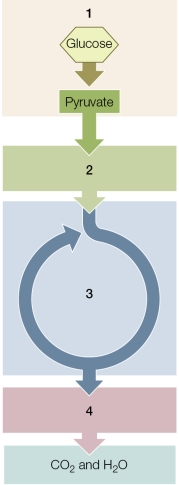 Explain what happens to this sequence of pathways in the absence of O2.
Free
(Essay)
4.9/5 (78)
(78) Correct Answer:Verified
VerifiedPyruvate undergoes fermentation to form lactic acid or alcohol rather than continuing to step 2.
The oxidizing agent at the end of the electron transport chain is
(Multiple Choice)
4.8/5 (72)
(72) Approximately how many ATP molecules per glucose molecule are produced via glycolysis and cellular respiration?
(Multiple Choice)
4.9/5 (81)
(81) The main control point of glycolysis is the glycolytic enzyme
(Multiple Choice)
4.9/5 (82)
(82) Methanogens are bacteria that carry out a form of cellular respiration under anaerobic conditions inside the ruminant organs of cows and sheep.They take in carbon dioxide and release methane.In these organisms, carbon dioxide acts in place of oxygen as an alternative _______.
(Short Answer)
4.9/5 (86)
(86) More free energy is harvested during the citric acid cycle than during glycolysis, but only 1 mole of ATP is produced for each mole of acetyl CoA that enters the cycle.Most of the remaining free energy released during the citric acid cycle is
(Multiple Choice)
4.8/5 (78)
(78) According to the chemiosmotic theory, the energy for the synthesis of ATP during the flow of electrons down the respiratory chain is provided directly by the
(Multiple Choice)
4.8/5 (82)
(82) Aerobic organisms exchange air containing O2 with air containing less O2 and more CO2.The CO2 comes from
(Multiple Choice)
4.9/5 (80)
(80) The carbon-containing molecule that enters glycolysis differs from the one that enters the citric acid cycle.How do the numbers of carbon atoms per molecule compare in these two cases?
(Multiple Choice)
4.7/5 (88)
(88) Refer to the table below, showing data collected from experiments using purified soybean mitochondria incubated in buffer containing compound X, compound Y, or no additions.Three different assays were performed on each group of mitochondria to determine the rate of oxygen uptake, ATP synthesis, and formation of a hydrogen ion gradient.The results are expressed as a percentage relative to the control group. 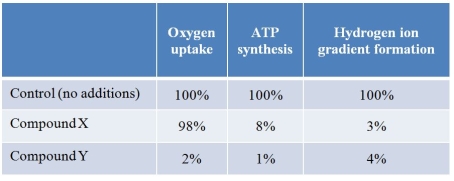 Which conclusion is consistent with these results?
 (Multiple Choice)
4.9/5 (78)
(78) In the complete oxidation of glucose, six CO2 molecules are formed per glucose molecule.The number of CO2 molecules released by glycolysis is _______, by pyruvate oxidation is _______, and by the citric acid cycle is _______.
(Multiple Choice)
4.7/5 (81)
(81) Refer to the figure below. 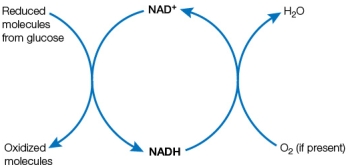 Five statements about energy metabolism in cells are given.Which statement can be used to explain the importance of the process shown in the figure?
 (Multiple Choice)
4.9/5 (89)
(89) Refer to the equation below, summarizing a step in lactic acid fermentation. Pyruvate + NADH + H+ lactate + NAD+
In this reaction, which compound is oxidized and which is reduced?
(Multiple Choice)
4.9/5 (75)
(75) The compound 2,4-dinitrophenol (DNP) is a lipid soluble compound that has been used as a weight loss agent.It functions this way by causing the inner mitochondrial membrane to become leaky with respect to protons.Which result might be expected if cells treated with DNP were examined in detail?
(Multiple Choice)
4.7/5 (79)
(79) Refer to the graph below, containing data from three assays carried out simultaneously on a population of bacterial cells growing in culture.At various points in time, small samples of cells were taken from the population to measure cell number, total protein mass, and mass of enzymes involved in arginine biosynthesis.Halfway through the experiment, arginine was added to the medium in which the population was growing.A vertical arrow is shown on the graph to indicate this time. 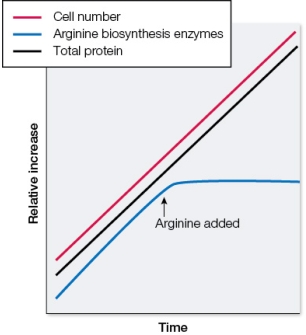 What do these data indicate about a mechanism of regulation of arginine biosynthesis in bacterial cells in response to high levels of available arginine?
 (Multiple Choice)
4.8/5 (82)
(82) The first and third reactions of the glycolytic pathway result in consumption of ATP.These are examples of
(Multiple Choice)
4.8/5 (74)
(74) 
Filters
- Essay(0)
- Multiple Choice(0)
- Short Answer(0)
- True False(0)
- Matching(0)