



 Chat with AI
Exam 52: Animal Behavior

Exam 1: Studying Life246 Questions
Exam 2: Small Molecules and the Chemistry of Life246 Questions
Exam 3: Proteins, Carbohydrates, and Lipids246 Questions
Exam 4: Nucleic Acids and the Origin of Life246 Questions
Exam 5: Cells: the Working Units of Life248 Questions
Exam 6: Cell Membranes246 Questions
Exam 7: Cell Communication and Multicellularity246 Questions
Exam 8: Energy, Enzymes, and Metabolism246 Questions
Exam 9: Pathways That Harvest Chemical Energy246 Questions
Exam 10: Photosynthesis: Energy From Sunlight242 Questions
Exam 11: The Cell Cycle and Cell Division260 Questions
Exam 12: Inheritance, Genes, and Chromosomes250 Questions
Exam 13: Dna and Its Role in Heredity257 Questions
Exam 14: From Dna to Protein: Gene Expression252 Questions
Exam 15: Gene Mutation and Molecular Medicine251 Questions
Exam 16: Regulation of Gene Expression245 Questions
Exam 17: Genomes249 Questions
Exam 18: Recombinant Dna and Biotechnology243 Questions
Exam 20: Mechanisms of Evolution243 Questions
Exam 21: Reconstructing and Using Phylogenies246 Questions
Exam 22: Speciation247 Questions
Exam 23: Evolution of Genes and Genomes252 Questions
Exam 24: The History of Life on Earth246 Questions
Exam 25: Bacteria, Archaea, and Viruses262 Questions
Exam 26: The Origin and Diversification of Eukaryotes252 Questions
Exam 27: Plants Without Seeds: From Water to Land251 Questions
Exam 28: The Evolution of Seed Plants259 Questions
Exam 29: The Evolution and Diversity of Fungi261 Questions
Exam 30: Animal Origins and the Evolution of Body Plans248 Questions
Exam 31: Protostome Animals244 Questions
Exam 32: Deuterostome Animals246 Questions
Exam 33: The Plant Body243 Questions
Exam 34: Transport in Plants248 Questions
Exam 35: Plant Nutrition247 Questions
Exam 36: Regulation of Plant Growth246 Questions
Exam 37: Reproduction in Flowering Plants247 Questions
Exam 38: Plant Responses to Environmental Challenges246 Questions
Exam 39: Physiology, Homeostasis, and Temperature Regulation258 Questions
Exam 40: Animal Hormones249 Questions
Exam 41: Immunology: Animal Defense Systems265 Questions
Exam 42: Animal Reproduction261 Questions
Exam 43: Animal Development261 Questions
Exam 44: Neurons, Glia, and Nervous Systems250 Questions
Exam 45: Sensory Systems249 Questions
Exam 46: The Mammalian Nervous System: Structure and Higher Functions254 Questions
Exam 47: Musculoskeletal Systems259 Questions
Exam 48: Gas Exchange247 Questions
Exam 49: Circulatory Systems252 Questions
Exam 50: Nutrition, Digestion, and Absorption259 Questions
Exam 51: Salt and Water Balance and Nitrogen Excretion251 Questions
Exam 52: Animal Behavior249 Questions
Exam 53: The Physical Environment and Biogeography of Life248 Questions
Exam 54: Populations259 Questions
Exam 55: Species Interactions254 Questions
Exam 56: Communities247 Questions
Exam 57: Ecosystems238 Questions
Exam 58: A Changing Biosphere222 Questions
Select questions type


Briefly discuss the role of testosterone in sexual behavior of male rats.

Free
(Essay)
4.9/5  (83)
(83) Correct Answer: Verified
Under normal circumstances, testosterone early in life organizes the male rat's nervous system so he has the potential to display male sexual behavior (mounting) in adulthood. Testosterone in adulthood is needed for the male to display sexual behavior.
Which statement about visual signals is false?
Free
(Multiple Choice)
4.8/5 (90)
(90) Correct Answer:Verified
VerifiedC
Which of the following does not characterize a fixed action pattern?
Free
(Multiple Choice)
4.8/5 (87)
(87) Correct Answer:Verified
VerifiedD
Two mice, Alison and Benny, were placed in a lab with continuous light.The graph describes their activity patterns. 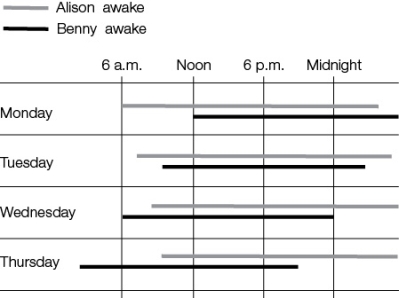 To the nearest hour, what is the period of Alison's circadian rhythm? What is the period of Benny's circadian rhythm?
 (Short Answer)
4.9/5 (76)
(76) When an animal maintained under constant conditions has a circadian clock running according to its natural period, it is said to be _______.
(Short Answer)
5.0/5 (83)
(83) Upon returning to the hive, honey bee foragers perform the _______ dance to signal the distance and direction of a food source.
(Short Answer)
4.9/5 (95)
(95) You are investigating the function of a pheromone receptor found in the vomeronasal organ (VNO) of mice.You hypothesize that when pheromones produced by a female mouse bind to the VNO receptors of a male mouse, the binding stimulates mating behavior.You test your hypothesis by doing a knockout experiment, silencing a gene needed for the VNO receptor to work.When you expose the knockout male mouse to a female mouse, the knockout mouse mates with the female.When you expose the same knockout male mouse to a male mouse, the knockout mouse tries to mate with the male.When you test a normal male mouse under the same situations, the male mates with the female, but reacts aggressively toward the male.What conclusion can you draw from these results?
(Multiple Choice)
4.9/5 (81)
(81) Which of the following was not characteristic of the field of study called "behaviorism"?
(Multiple Choice)
5.0/5 (77)
(77) Which male white-crowned sparrow will sing the species-typical song in adulthood?
(Multiple Choice)
4.9/5 (82)
(82) Which of the following does not characterize a free-running circadian rhythm?
(Multiple Choice)
4.8/5 (74)
(74) Adult hamsters whose suprachiasmatic nuclei (SCN) were destroyed received SCN transplants from hamster fetuses with long-day rhythmicity.As a result the recipients
(Multiple Choice)
4.9/5 (73)
(73) Which of the following represents an ultimate cause of behavior?
(Multiple Choice)
4.7/5 (90)
(90) Most prairie vole young remain at their natal burrow even after they have reached adulthood and help their parents rear subsequent litters of younger siblings.Breeding pairs with helpers have higher reproductive success than those without helpers.Young that leave the natal burrow have low survival and reproductive success.Prairie vole helpers have no _______ fitness, but do have _______ fitness.
(Multiple Choice)
4.8/5 (74)
(74) Which of the following is not necessary for celestial navigation?
(Multiple Choice)
4.8/5 (66)
(66) A mosquito feeding on mammalian blood benefits nutritionally but also places itself in danger.The insect's chance of being killed by that mammal is an example of a(n) _______ cost.
(Multiple Choice)
4.7/5 (90)
(90) 
Filters
- Essay(0)
- Multiple Choice(0)
- Short Answer(0)
- True False(0)
- Matching(0)