



 Chat with AI
Exam 52: Animal Behavior

Exam 1: Studying Life246 Questions
Exam 2: Small Molecules and the Chemistry of Life246 Questions
Exam 3: Proteins, Carbohydrates, and Lipids246 Questions
Exam 4: Nucleic Acids and the Origin of Life246 Questions
Exam 5: Cells: the Working Units of Life248 Questions
Exam 6: Cell Membranes246 Questions
Exam 7: Cell Communication and Multicellularity246 Questions
Exam 8: Energy, Enzymes, and Metabolism246 Questions
Exam 9: Pathways That Harvest Chemical Energy246 Questions
Exam 10: Photosynthesis: Energy From Sunlight242 Questions
Exam 11: The Cell Cycle and Cell Division260 Questions
Exam 12: Inheritance, Genes, and Chromosomes250 Questions
Exam 13: Dna and Its Role in Heredity257 Questions
Exam 14: From Dna to Protein: Gene Expression252 Questions
Exam 15: Gene Mutation and Molecular Medicine251 Questions
Exam 16: Regulation of Gene Expression245 Questions
Exam 17: Genomes249 Questions
Exam 18: Recombinant Dna and Biotechnology243 Questions
Exam 20: Mechanisms of Evolution243 Questions
Exam 21: Reconstructing and Using Phylogenies246 Questions
Exam 22: Speciation247 Questions
Exam 23: Evolution of Genes and Genomes252 Questions
Exam 24: The History of Life on Earth246 Questions
Exam 25: Bacteria, Archaea, and Viruses262 Questions
Exam 26: The Origin and Diversification of Eukaryotes252 Questions
Exam 27: Plants Without Seeds: From Water to Land251 Questions
Exam 28: The Evolution of Seed Plants259 Questions
Exam 29: The Evolution and Diversity of Fungi261 Questions
Exam 30: Animal Origins and the Evolution of Body Plans248 Questions
Exam 31: Protostome Animals244 Questions
Exam 32: Deuterostome Animals246 Questions
Exam 33: The Plant Body243 Questions
Exam 34: Transport in Plants248 Questions
Exam 35: Plant Nutrition247 Questions
Exam 36: Regulation of Plant Growth246 Questions
Exam 37: Reproduction in Flowering Plants247 Questions
Exam 38: Plant Responses to Environmental Challenges246 Questions
Exam 39: Physiology, Homeostasis, and Temperature Regulation258 Questions
Exam 40: Animal Hormones249 Questions
Exam 41: Immunology: Animal Defense Systems265 Questions
Exam 42: Animal Reproduction261 Questions
Exam 43: Animal Development261 Questions
Exam 44: Neurons, Glia, and Nervous Systems250 Questions
Exam 45: Sensory Systems249 Questions
Exam 46: The Mammalian Nervous System: Structure and Higher Functions254 Questions
Exam 47: Musculoskeletal Systems259 Questions
Exam 48: Gas Exchange247 Questions
Exam 49: Circulatory Systems252 Questions
Exam 50: Nutrition, Digestion, and Absorption259 Questions
Exam 51: Salt and Water Balance and Nitrogen Excretion251 Questions
Exam 52: Animal Behavior249 Questions
Exam 53: The Physical Environment and Biogeography of Life248 Questions
Exam 54: Populations259 Questions
Exam 55: Species Interactions254 Questions
Exam 56: Communities247 Questions
Exam 57: Ecosystems238 Questions
Exam 58: A Changing Biosphere222 Questions
Select questions type


Which research question does not refer to proximate causes of behavior?
(Multiple Choice)
4.7/5  (94)
(94) Which of the following does not characterize chemical signals?
(Multiple Choice)
4.7/5 (78)
(78) Which behavior would be predicted by the energy maximization hypothesis?
(Multiple Choice)
4.8/5 (90)
(90) Which species would likely display aggressive territorial behavior?
(Multiple Choice)
4.8/5 (77)
(77) Refer to the figure showing sex hormone manipulations of female rats. 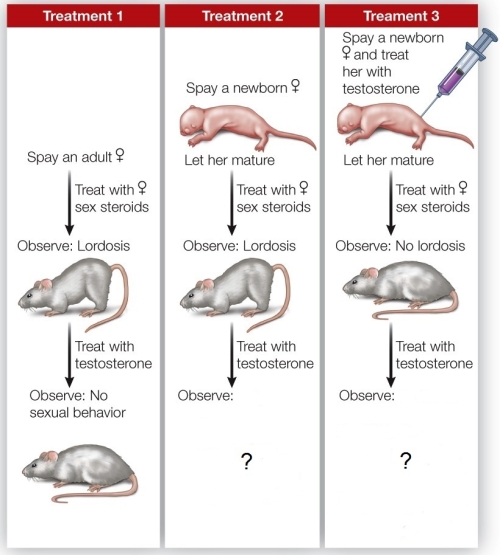 What is the correct final observation for female rats in treatments 2 and 3?
 (Multiple Choice)
4.8/5 (85)
(85) Which statement about the cost-benefit approach to animal behavior is false?
(Multiple Choice)
4.7/5 (77)
(77) Which statement does not characterize individual variation in the singing behavior of a bird species?
(Multiple Choice)
4.9/5 (72)
(72) Knockout experiments concerning pheromone receptors in the vomeronasal organ (VNO) of mice have revealed that
(Multiple Choice)
4.9/5 (74)
(74) Studying how urinary posture of the domestic dog changes from the juvenile period to adulthood would be classified as a question concerning _______ by Tinbergen (i.e., which of Tinbergen's four questions is being addressed?).
(Short Answer)
4.8/5 (84)
(84) A male frog calling to attract females is eaten by a bat.This is an example of a(n) _______ cost.
(Short Answer)
4.7/5 (76)
(76) Which of the following best explains why naked mole-rats are eusocial?
(Multiple Choice)
4.7/5 (81)
(81) Of Tinbergen's four questions, those that concern function and _______ address the ultimate causes of a behavior.
(Short Answer)
4.9/5 (77)
(77) Which male white-crowned sparrow will sing his species-specific song?
(Multiple Choice)
4.7/5 (89)
(89) A(n) _______ is a location where males gather to display and attract females, who typically choose males at the center of this area.
(Short Answer)
4.9/5 (78)
(78) The difference between the number of calories an animal expends while performing a behavior and the number it would have expended at rest is known as the _______ cost of that behavior.
(Short Answer)
4.8/5 (74)
(74) A bee is performing a waggle dance on the vertical surface of the honeycomb.The dance has a long waggle segment that goes straight upward.What is she communicating to her hivemates?
(Multiple Choice)
4.9/5 (78)
(78) A hungry rat placed in a Skinner box explores its new surroundings and at some point presses a bar.This action immediately results in delivery of a food pellet, which the rat eats.The food reward increases the likelihood that the rat will press the bar again.This is an example of
(Multiple Choice)
4.8/5 (78)
(78) On which measure would acoustic signals be rated better than visual signals?
(Multiple Choice)
4.8/5 (69)
(69) 
Filters
- Essay(0)
- Multiple Choice(0)
- Short Answer(0)
- True False(0)
- Matching(0)