



 Chat with AI
Exam 7: Cell Communication and Multicellularity

Exam 1: Studying Life246 Questions
Exam 2: Small Molecules and the Chemistry of Life246 Questions
Exam 3: Proteins, Carbohydrates, and Lipids246 Questions
Exam 4: Nucleic Acids and the Origin of Life246 Questions
Exam 5: Cells: the Working Units of Life248 Questions
Exam 6: Cell Membranes246 Questions
Exam 7: Cell Communication and Multicellularity246 Questions
Exam 8: Energy, Enzymes, and Metabolism246 Questions
Exam 9: Pathways That Harvest Chemical Energy246 Questions
Exam 10: Photosynthesis: Energy From Sunlight242 Questions
Exam 11: The Cell Cycle and Cell Division260 Questions
Exam 12: Inheritance, Genes, and Chromosomes250 Questions
Exam 13: Dna and Its Role in Heredity257 Questions
Exam 14: From Dna to Protein: Gene Expression252 Questions
Exam 15: Gene Mutation and Molecular Medicine251 Questions
Exam 16: Regulation of Gene Expression245 Questions
Exam 17: Genomes249 Questions
Exam 18: Recombinant Dna and Biotechnology243 Questions
Exam 20: Mechanisms of Evolution243 Questions
Exam 21: Reconstructing and Using Phylogenies246 Questions
Exam 22: Speciation247 Questions
Exam 23: Evolution of Genes and Genomes252 Questions
Exam 24: The History of Life on Earth246 Questions
Exam 25: Bacteria, Archaea, and Viruses262 Questions
Exam 26: The Origin and Diversification of Eukaryotes252 Questions
Exam 27: Plants Without Seeds: From Water to Land251 Questions
Exam 28: The Evolution of Seed Plants259 Questions
Exam 29: The Evolution and Diversity of Fungi261 Questions
Exam 30: Animal Origins and the Evolution of Body Plans248 Questions
Exam 31: Protostome Animals244 Questions
Exam 32: Deuterostome Animals246 Questions
Exam 33: The Plant Body243 Questions
Exam 34: Transport in Plants248 Questions
Exam 35: Plant Nutrition247 Questions
Exam 36: Regulation of Plant Growth246 Questions
Exam 37: Reproduction in Flowering Plants247 Questions
Exam 38: Plant Responses to Environmental Challenges246 Questions
Exam 39: Physiology, Homeostasis, and Temperature Regulation258 Questions
Exam 40: Animal Hormones249 Questions
Exam 41: Immunology: Animal Defense Systems265 Questions
Exam 42: Animal Reproduction261 Questions
Exam 43: Animal Development261 Questions
Exam 44: Neurons, Glia, and Nervous Systems250 Questions
Exam 45: Sensory Systems249 Questions
Exam 46: The Mammalian Nervous System: Structure and Higher Functions254 Questions
Exam 47: Musculoskeletal Systems259 Questions
Exam 48: Gas Exchange247 Questions
Exam 49: Circulatory Systems252 Questions
Exam 50: Nutrition, Digestion, and Absorption259 Questions
Exam 51: Salt and Water Balance and Nitrogen Excretion251 Questions
Exam 52: Animal Behavior249 Questions
Exam 53: The Physical Environment and Biogeography of Life248 Questions
Exam 54: Populations259 Questions
Exam 55: Species Interactions254 Questions
Exam 56: Communities247 Questions
Exam 57: Ecosystems238 Questions
Exam 58: A Changing Biosphere222 Questions
Select questions type


A transcription factor located in the cytoplasm of a eukaryotic cell

Free
(Multiple Choice)
4.8/5  (80)
(80) Correct Answer: Verified
C
Adrenocorticotropic hormone (ACTH) is a peptide consisting of 39 amino acids.When the arginine residue at position 8 in the peptide chain is replaced with cysteine, the peptide no longer activates signal transduction in cells containing ACTH receptors.Explain why a single change in amino acid identity in ACTH has this result.
Free
(Essay)
4.9/5 (71)
(71) Correct Answer:Verified
VerifiedThe ACTH molecule must assume a particular three-dimensional shape to bind to the ACTH receptor and activate the receptor to change conformation to begin signal transduction along the signal pathway. The change in one amino acid at a critical place in the ACTH structure could result in an ACTH molecule that takes on a three-dimensional shape that no longer binds to and activates the receptor.
Refer to the figure below. 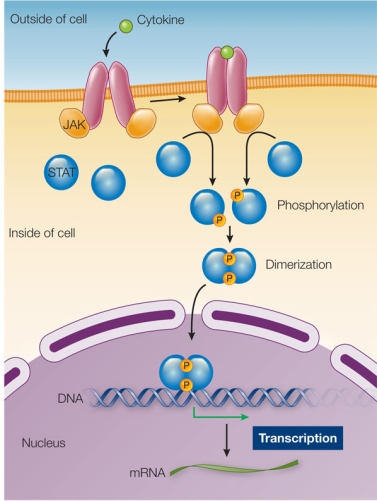 The figure shows a signal transduction pathway involving two proteins found in the cytoplasm-JAK and STAT.Based on this figure, what are the roles of JAK and STAT in this pathway?
 (Multiple Choice)
4.9/5 (66)
(66) Refer to the table below. 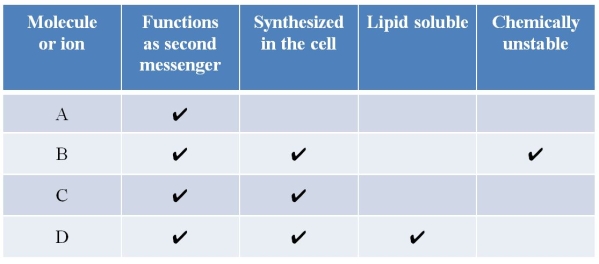 Which molecules and ions are matched appropriately to the letters in the table?
 (Multiple Choice)
4.9/5 (85)
(85) The hydrolysis of phosphatidyl inositol-bisphosphate (PIP2) results in
(Multiple Choice)
4.9/5 (82)
(82) Refer to the table below. 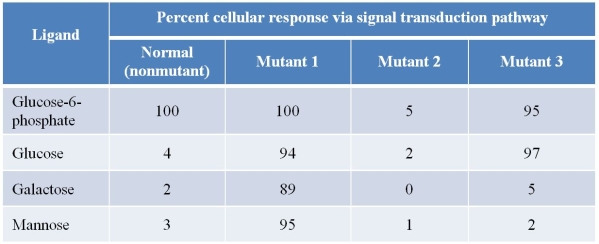 The table summarizes results of experiments using a group of normal cells and three other groups of the same type of cells, each carrying a different mutation in a membrane receptor protein.The receptor is part of a signal transduction pathway that is stimulated by glucose-6-phosphate.Cells were tested for their ability to respond, via the signal transduction pathway, to a variety of ligand molecule, as shown in the table.Based on these data, which statement about these three mutations is plausible?
 (Multiple Choice)
4.9/5 (90)
(90) In which aspect are gap junctions and plasmodesmata least similar to each other?
(Multiple Choice)
4.8/5 (75)
(75) Neighboring animal cells can communicate directly through specialized cell connections called
(Multiple Choice)
4.8/5 (90)
(90) Signals that travel to distant cells through the circulatory system are
(Multiple Choice)
4.8/5 (73)
(73) Refer to the figure below, which represents structures connecting adjacent cells in multicellular organisms. 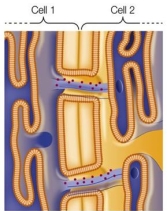 The structures shown are found in (plants/animals) _______.
 (Short Answer)
4.8/5 (74)
(74) Which was probably not a step in the evolution from single-celled to multicellular organisms?
(Multiple Choice)
4.9/5 (81)
(81) Refer to the table below. 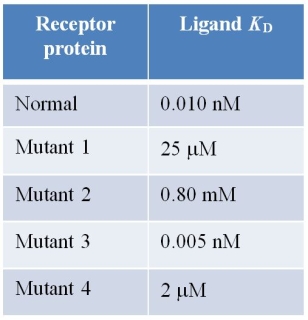 Listed in the first row of the table is the dissociation constant for a ligand and its receptor.Listed below this are the dissociation constants for the same ligand and four different mutants of the same receptor.Which sequence displays the range of affinities of the receptor for the ligand in order, from lowest to highest affinity?
 (Multiple Choice)
4.9/5 (66)
(66) PIP2 is a phospholipid in cell membranes that produces two lipid-derived _______ when hydrolyzed by phospholipase C.
(Multiple Choice)
4.8/5 (74)
(74) Which sequence lists the various mechanisms cells use to respond to signals in order, from shortest to longest response time?
(Multiple Choice)
4.9/5 (94)
(94) A signal transduction pathway includes the steps listed below.
1.An inactive signal transduction molecule is activated.
2.A transcription factor enters the nucleus.
3.A gene is expressed.
4.A ligand binds to a protein.
5.A protein undergoes a conformational change.
6.An active signal transduction molecule binds a transcription factor.
Which represents the correct order of these steps?"
(Multiple Choice)
4.9/5 (78)
(78) The G protein-mediated cascade stimulated by epinephrine within a liver cell results in the phosphorylation of two key enzymes.The eventual results of this phosphorylation are the _______ of glycogen synthase and the _______ of glycogen phosphorylase, leading to the release of glucose.
(Multiple Choice)
4.8/5 (92)
(92) Explain how observations about various algal species support the current scientific thinking about how multicellularity arose.
(Essay)
4.8/5 (67)
(67) 
Filters
- Essay(0)
- Multiple Choice(0)
- Short Answer(0)
- True False(0)
- Matching(0)