



 Chat with AI
Exam 7: Cell Communication and Multicellularity

Exam 1: Studying Life246 Questions
Exam 2: Small Molecules and the Chemistry of Life246 Questions
Exam 3: Proteins, Carbohydrates, and Lipids246 Questions
Exam 4: Nucleic Acids and the Origin of Life246 Questions
Exam 5: Cells: the Working Units of Life248 Questions
Exam 6: Cell Membranes246 Questions
Exam 7: Cell Communication and Multicellularity246 Questions
Exam 8: Energy, Enzymes, and Metabolism246 Questions
Exam 9: Pathways That Harvest Chemical Energy246 Questions
Exam 10: Photosynthesis: Energy From Sunlight242 Questions
Exam 11: The Cell Cycle and Cell Division260 Questions
Exam 12: Inheritance, Genes, and Chromosomes250 Questions
Exam 13: Dna and Its Role in Heredity257 Questions
Exam 14: From Dna to Protein: Gene Expression252 Questions
Exam 15: Gene Mutation and Molecular Medicine251 Questions
Exam 16: Regulation of Gene Expression245 Questions
Exam 17: Genomes249 Questions
Exam 18: Recombinant Dna and Biotechnology243 Questions
Exam 20: Mechanisms of Evolution243 Questions
Exam 21: Reconstructing and Using Phylogenies246 Questions
Exam 22: Speciation247 Questions
Exam 23: Evolution of Genes and Genomes252 Questions
Exam 24: The History of Life on Earth246 Questions
Exam 25: Bacteria, Archaea, and Viruses262 Questions
Exam 26: The Origin and Diversification of Eukaryotes252 Questions
Exam 27: Plants Without Seeds: From Water to Land251 Questions
Exam 28: The Evolution of Seed Plants259 Questions
Exam 29: The Evolution and Diversity of Fungi261 Questions
Exam 30: Animal Origins and the Evolution of Body Plans248 Questions
Exam 31: Protostome Animals244 Questions
Exam 32: Deuterostome Animals246 Questions
Exam 33: The Plant Body243 Questions
Exam 34: Transport in Plants248 Questions
Exam 35: Plant Nutrition247 Questions
Exam 36: Regulation of Plant Growth246 Questions
Exam 37: Reproduction in Flowering Plants247 Questions
Exam 38: Plant Responses to Environmental Challenges246 Questions
Exam 39: Physiology, Homeostasis, and Temperature Regulation258 Questions
Exam 40: Animal Hormones249 Questions
Exam 41: Immunology: Animal Defense Systems265 Questions
Exam 42: Animal Reproduction261 Questions
Exam 43: Animal Development261 Questions
Exam 44: Neurons, Glia, and Nervous Systems250 Questions
Exam 45: Sensory Systems249 Questions
Exam 46: The Mammalian Nervous System: Structure and Higher Functions254 Questions
Exam 47: Musculoskeletal Systems259 Questions
Exam 48: Gas Exchange247 Questions
Exam 49: Circulatory Systems252 Questions
Exam 50: Nutrition, Digestion, and Absorption259 Questions
Exam 51: Salt and Water Balance and Nitrogen Excretion251 Questions
Exam 52: Animal Behavior249 Questions
Exam 53: The Physical Environment and Biogeography of Life248 Questions
Exam 54: Populations259 Questions
Exam 55: Species Interactions254 Questions
Exam 56: Communities247 Questions
Exam 57: Ecosystems238 Questions
Exam 58: A Changing Biosphere222 Questions
Select questions type


Refer to the figure below. 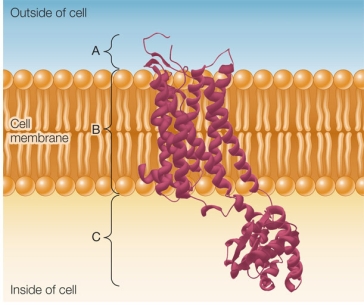 The figure shows a receptor protein that functions in a signal transduction pathway.The portion of this receptor protein that transmits a signal to another molecule in response to ligand binding is labeled _______.
 (Short Answer)
4.9/5  (81)
(81) Which example illustrates how a paracrine signal functions in the human body?
(Multiple Choice)
4.9/5 (91)
(91) If a person is being treated for shock and receives an injection of epinephrine to aid recovery, you would expect to see all of the following except
(Multiple Choice)
4.8/5 (74)
(74) Refer to the table below. 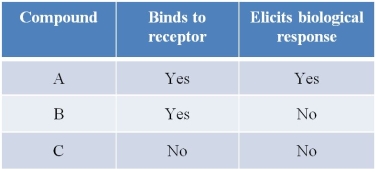 Compound X is the natural ligand that binds to a receptor and stimulates a signal transduction pathway associated with the receptor.Based on the information given in the table, what are the roles of compounds A, B, and C?
 (Multiple Choice)
4.7/5 (71)
(71) Located inside the cell, _______ receptors bind to physical or chemical signals that diffuse across the cell membrane.
(Short Answer)
5.0/5 (81)
(81) Which of the following would be best to use in an investigation about the role of plasmodesmata in a plant?
(Multiple Choice)
4.9/5 (83)
(83) Which statement explains how gap junctions provide a biological advantage to animals?
(Multiple Choice)
4.8/5 (79)
(79) The small molecule acetylcholine acts to signal different cellular responses in many different cell types, including skeletal muscle cells, heart muscle cells, cells lining blood vessels, liver cells, and pancreatic cells.In each case, there is a membrane receptor that specifically binds acetylcholine.Upon binding, acetylcholine triggers a _______ to elicit a specific cellular response.
(Short Answer)
4.8/5 (97)
(97) Refer to the graph below. 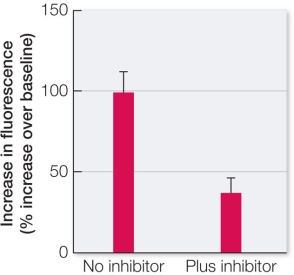 The graph shows results from an investigation using living cartilage cells extracted from slaughtered cows.The cells were treated so that they took up a fluorescent dye in their cytosols without losing viability.(This dye undergoes a change in fluorescence intensity upon binding calcium ions.) The treated cells were then exposed to forces that mimic the forces on cartilage during weight-bearing exercise.This experiment was then repeated with cells that were pretreated with a calcium ion channel inhibitor before exposure to forces of weight-bearing exercise.This inhibitor is specific for intracellular calcium ion channels.Which statement is consistent with the results shown in the graph?
 (Multiple Choice)
4.8/5 (82)
(82) Refer to the graphs below. 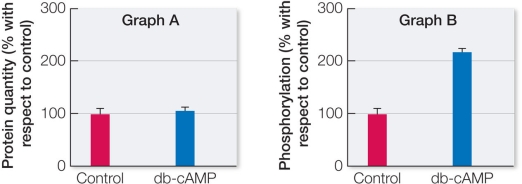 Human cells taken from the large intestine were cultured in dishes and divided into control and experimental groups.Control cells were incubated for 1 hour in a buffered solution, while experimental cells were incubated for 1 hour in a buffered solution that also contained 10 M dibutyryl cyclic AMP (db-cAMP).Dibutyryl cyclic AMP has biological activity similar to that of cyclic AMP (cAMP) but readily diffuses through the cell membrane.Following the incubations, researchers isolated a protein known to act as a transcription factor from the cells.They measured both the protein quantity (graph A) and the amount of phosphorylation of the protein (graph B).Which statement is consistent with these results?
 (Multiple Choice)
4.8/5 (79)
(79) The figure below shows the oxytocin signal transduction pathway in uterine smooth muscle cells.The abbreviation "CaM" refers to calmodulin, and "MLCK" refers to myosin light chain kinase, an enzyme that phosphorylates the light chains of myosin, stimulating smooth muscle contractions. 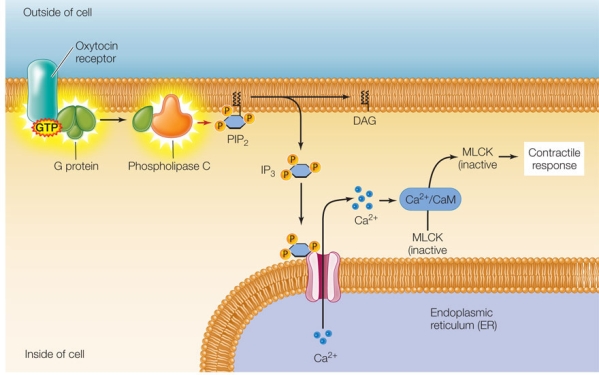 Which two components of this pathway share a similar mechanism in transmitting a biological signal by causing a conformation change in a target protein?
 (Multiple Choice)
4.9/5 (72)
(72) A deer smells a predator as it passes by and quickly bounds to safety.Which sequence represents the correct order of steps in the signal transduction pathway that is involved?
(Multiple Choice)
4.9/5 (75)
(75) A species of algae consists of aggregates of cells that have different functions.Researchers suspect that the outer, motile cells of this species produce a chemical signal that travels to the inner reproductive cells, causing them to lose their flagella and divide.Which experimental approach would best provide evidence in support of a chemical signaling agent acting to cause the observed change in cells?
(Multiple Choice)
4.9/5 (74)
(74) In a signal transduction pathway, the signal molecule that binds to a receptor site of a receptor protein to initiate a cellular response is known as a(n) _______.
(Short Answer)
4.8/5 (79)
(79) Biologists have found numerous genes in a single cell that encode cAMP-binding proteins.Based on what you know about cAMP as a second messenger in signal transduction pathways, which statement makes a reasonable claim?
(Multiple Choice)
4.7/5 (77)
(77) Inositol trisphosphate (IP3) is released into the cytoplasm when phosphatidyl inositol-bisphosphate (PIP2) is hydrolyzed.IP3 is one type of molecule that can directly
(Multiple Choice)
4.9/5 (72)
(72) Epinephrine stimulates a G protein-mediated cascade within liver cells, resulting in phosphorylation of two enzymes: glycogen synthase, which is _______, and glycogen phosphorylase, which is _______.This results in _______ glucose being released to the blood and _______ glycogen being stored.
(Multiple Choice)
4.9/5 (91)
(91) Refer to the table below. 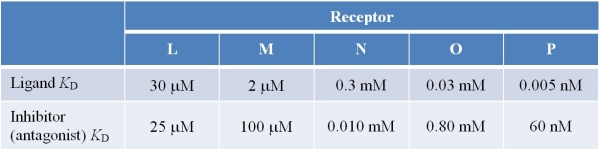 Listed are dissociation constants for ligands and inhibitors of five different membrane receptors.In which case is the receptor's affinity for an inhibitor much greater than the receptor's affinity for its ligand?
 (Multiple Choice)
4.7/5 (76)
(76) Aldosterone is a steroid compound synthesized in the adrenal glands that binds to receptors in kidney cells.How would aldosterone be classified?
(Multiple Choice)
4.8/5 (87)
(87) 
Filters
- Essay(0)
- Multiple Choice(0)
- Short Answer(0)
- True False(0)
- Matching(0)