



 Chat with AI
Exam 7: Cell Communication and Multicellularity

Exam 1: Studying Life246 Questions
Exam 2: Small Molecules and the Chemistry of Life246 Questions
Exam 3: Proteins, Carbohydrates, and Lipids246 Questions
Exam 4: Nucleic Acids and the Origin of Life246 Questions
Exam 5: Cells: the Working Units of Life248 Questions
Exam 6: Cell Membranes246 Questions
Exam 7: Cell Communication and Multicellularity246 Questions
Exam 8: Energy, Enzymes, and Metabolism246 Questions
Exam 9: Pathways That Harvest Chemical Energy246 Questions
Exam 10: Photosynthesis: Energy From Sunlight242 Questions
Exam 11: The Cell Cycle and Cell Division260 Questions
Exam 12: Inheritance, Genes, and Chromosomes250 Questions
Exam 13: Dna and Its Role in Heredity257 Questions
Exam 14: From Dna to Protein: Gene Expression252 Questions
Exam 15: Gene Mutation and Molecular Medicine251 Questions
Exam 16: Regulation of Gene Expression245 Questions
Exam 17: Genomes249 Questions
Exam 18: Recombinant Dna and Biotechnology243 Questions
Exam 20: Mechanisms of Evolution243 Questions
Exam 21: Reconstructing and Using Phylogenies246 Questions
Exam 22: Speciation247 Questions
Exam 23: Evolution of Genes and Genomes252 Questions
Exam 24: The History of Life on Earth246 Questions
Exam 25: Bacteria, Archaea, and Viruses262 Questions
Exam 26: The Origin and Diversification of Eukaryotes252 Questions
Exam 27: Plants Without Seeds: From Water to Land251 Questions
Exam 28: The Evolution of Seed Plants259 Questions
Exam 29: The Evolution and Diversity of Fungi261 Questions
Exam 30: Animal Origins and the Evolution of Body Plans248 Questions
Exam 31: Protostome Animals244 Questions
Exam 32: Deuterostome Animals246 Questions
Exam 33: The Plant Body243 Questions
Exam 34: Transport in Plants248 Questions
Exam 35: Plant Nutrition247 Questions
Exam 36: Regulation of Plant Growth246 Questions
Exam 37: Reproduction in Flowering Plants247 Questions
Exam 38: Plant Responses to Environmental Challenges246 Questions
Exam 39: Physiology, Homeostasis, and Temperature Regulation258 Questions
Exam 40: Animal Hormones249 Questions
Exam 41: Immunology: Animal Defense Systems265 Questions
Exam 42: Animal Reproduction261 Questions
Exam 43: Animal Development261 Questions
Exam 44: Neurons, Glia, and Nervous Systems250 Questions
Exam 45: Sensory Systems249 Questions
Exam 46: The Mammalian Nervous System: Structure and Higher Functions254 Questions
Exam 47: Musculoskeletal Systems259 Questions
Exam 48: Gas Exchange247 Questions
Exam 49: Circulatory Systems252 Questions
Exam 50: Nutrition, Digestion, and Absorption259 Questions
Exam 51: Salt and Water Balance and Nitrogen Excretion251 Questions
Exam 52: Animal Behavior249 Questions
Exam 53: The Physical Environment and Biogeography of Life248 Questions
Exam 54: Populations259 Questions
Exam 55: Species Interactions254 Questions
Exam 56: Communities247 Questions
Exam 57: Ecosystems238 Questions
Exam 58: A Changing Biosphere222 Questions
Select questions type


Which statement about intracellular receptors that respond to physical or chemical signals is false?
(Multiple Choice)
4.7/5  (78)
(78) The membrane-lined tunnels that traverse the cell walls between plant cells are known as
(Multiple Choice)
4.8/5 (81)
(81) Refer to the table below. 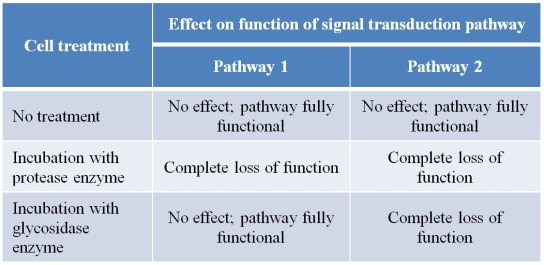 The table summarizes results of experiments using whole cells.Cells were either incubated without an enzyme (control) or incubated with an enzyme.Proteases degrade proteins, and glycosidases degrade oligosaccharides.Which hypothesis is supported by these results?
 (Multiple Choice)
4.9/5 (77)
(77) Some of the stem cells in bone become osteoclasts during differentiation.Researchers have shown that chemical signals called cytokines are released into the extracellular fluid by bone stem cells in response to environmental stimuli.The researchers also have shown that the cytokines induce these same bone stem cells to differentiate into osteoclasts.This example illustrates how a(n) _______ signal functions in the human body.
(Multiple Choice)
4.9/5 (53)
(53) Refer to the figure below. 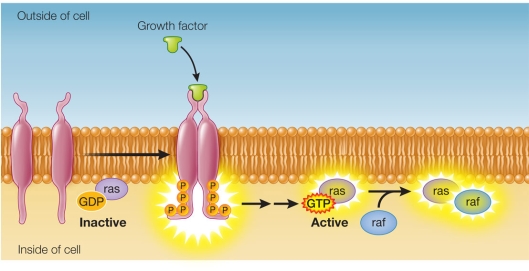 A portion of a signal transduction pathway is shown in the figure.The molecule raf is a protein kinase.This molecule becomes activated when a GTP-ras complex binds to it.Which equation describes how activated raf transmits the signal in this pathway?
 (Multiple Choice)
4.9/5 (87)
(87) Refer to the table below. 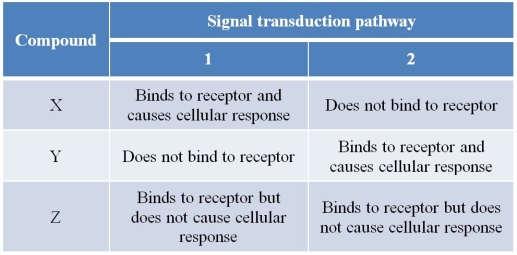 The table summarizes characteristics of three compounds that relate to their function in two different signal transduction pathways.What can you infer about these three compounds from this information?
 (Multiple Choice)
4.8/5 (92)
(92) Which is a similarity between gap junctions and plasmodesmata?
(Multiple Choice)
4.8/5 (73)
(73) A previously unknown chemical signal is discovered in mice.Five observations about this signal are listed.Which observation would serve as evidence in distinguishing whether this chemical signal should be classified as a juxtacrine or a paracrine signal?
(Multiple Choice)
4.8/5 (79)
(79) Which are specialized cell junctions that allow neighboring cells to communicate directly with one another?
(Multiple Choice)
4.9/5 (83)
(83) Refer to the figure below. 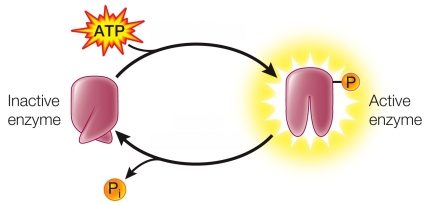 This figure is missing labels to show the types of enzymes catalyzing the forward and reverse reactions.The enzyme catalyzing the reaction producing the active form of the enzyme is a _______.
 (Short Answer)
4.8/5 (83)
(83) In order to respond to a signal, a cell must have a specific _______ that can detect the signal.
(Short Answer)
4.9/5 (74)
(74) Refer to the table below. 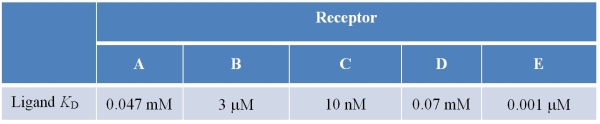 Listed are dissociation constants for five different ligands and their membrane receptors.The ligand with the highest affinity for its receptor is _______.
 (Short Answer)
4.9/5 (86)
(86) Some tissues have only a few cells with the specific receptors needed for a signal response.How can the tissue respond most efficiently to that signal?
(Multiple Choice)
5.0/5 (79)
(79) Refer to the figures below. 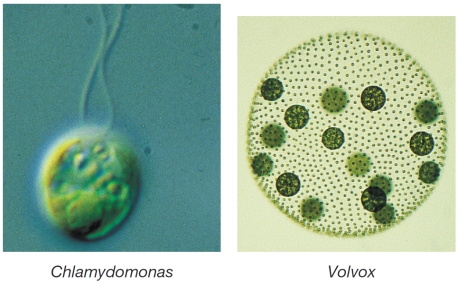 Chlamydomonas and Volvox are two algal genera in the phylum Chlorophyta.Which feature present in Volvox and absent in Chlamydomonas do scientists use as evidence to support their thinking about how multicellularity evolved?
 (Multiple Choice)
4.7/5 (83)
(83) The major difference between a cell that responds to a signal and one that does not is the presence of a
(Multiple Choice)
5.0/5 (81)
(81) The membrane-lined tunnels called plamodesmata that connect adjacent plant cells
(Multiple Choice)
4.8/5 (87)
(87) Plasmodesmata and gap junctions allow small molecules and ions to _______ rapidly between cells.
(Short Answer)
4.8/5 (67)
(67) A researcher working with mammalian kidney cells grown in culture observed that cells treated with a proteolytic enzyme (an enzyme that breaks down proteins) lost the ability to respond to the hormone vasopressin but not to the hormone aldosterone.Which is a reasonable explanation for this observation?
(Multiple Choice)
4.8/5 (70)
(70) 
Filters
- Essay(0)
- Multiple Choice(0)
- Short Answer(0)
- True False(0)
- Matching(0)