



 Chat with AI
Exam 7: Cell Communication and Multicellularity

Exam 1: Studying Life246 Questions
Exam 2: Small Molecules and the Chemistry of Life246 Questions
Exam 3: Proteins, Carbohydrates, and Lipids246 Questions
Exam 4: Nucleic Acids and the Origin of Life246 Questions
Exam 5: Cells: the Working Units of Life248 Questions
Exam 6: Cell Membranes246 Questions
Exam 7: Cell Communication and Multicellularity246 Questions
Exam 8: Energy, Enzymes, and Metabolism246 Questions
Exam 9: Pathways That Harvest Chemical Energy246 Questions
Exam 10: Photosynthesis: Energy From Sunlight242 Questions
Exam 11: The Cell Cycle and Cell Division260 Questions
Exam 12: Inheritance, Genes, and Chromosomes250 Questions
Exam 13: Dna and Its Role in Heredity257 Questions
Exam 14: From Dna to Protein: Gene Expression252 Questions
Exam 15: Gene Mutation and Molecular Medicine251 Questions
Exam 16: Regulation of Gene Expression245 Questions
Exam 17: Genomes249 Questions
Exam 18: Recombinant Dna and Biotechnology243 Questions
Exam 20: Mechanisms of Evolution243 Questions
Exam 21: Reconstructing and Using Phylogenies246 Questions
Exam 22: Speciation247 Questions
Exam 23: Evolution of Genes and Genomes252 Questions
Exam 24: The History of Life on Earth246 Questions
Exam 25: Bacteria, Archaea, and Viruses262 Questions
Exam 26: The Origin and Diversification of Eukaryotes252 Questions
Exam 27: Plants Without Seeds: From Water to Land251 Questions
Exam 28: The Evolution of Seed Plants259 Questions
Exam 29: The Evolution and Diversity of Fungi261 Questions
Exam 30: Animal Origins and the Evolution of Body Plans248 Questions
Exam 31: Protostome Animals244 Questions
Exam 32: Deuterostome Animals246 Questions
Exam 33: The Plant Body243 Questions
Exam 34: Transport in Plants248 Questions
Exam 35: Plant Nutrition247 Questions
Exam 36: Regulation of Plant Growth246 Questions
Exam 37: Reproduction in Flowering Plants247 Questions
Exam 38: Plant Responses to Environmental Challenges246 Questions
Exam 39: Physiology, Homeostasis, and Temperature Regulation258 Questions
Exam 40: Animal Hormones249 Questions
Exam 41: Immunology: Animal Defense Systems265 Questions
Exam 42: Animal Reproduction261 Questions
Exam 43: Animal Development261 Questions
Exam 44: Neurons, Glia, and Nervous Systems250 Questions
Exam 45: Sensory Systems249 Questions
Exam 46: The Mammalian Nervous System: Structure and Higher Functions254 Questions
Exam 47: Musculoskeletal Systems259 Questions
Exam 48: Gas Exchange247 Questions
Exam 49: Circulatory Systems252 Questions
Exam 50: Nutrition, Digestion, and Absorption259 Questions
Exam 51: Salt and Water Balance and Nitrogen Excretion251 Questions
Exam 52: Animal Behavior249 Questions
Exam 53: The Physical Environment and Biogeography of Life248 Questions
Exam 54: Populations259 Questions
Exam 55: Species Interactions254 Questions
Exam 56: Communities247 Questions
Exam 57: Ecosystems238 Questions
Exam 58: A Changing Biosphere222 Questions
Select questions type


Refer to the table below. 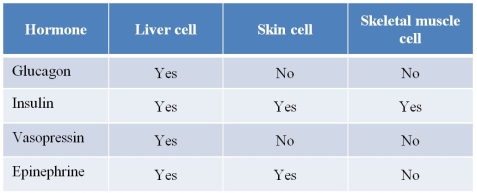 The table lists four hormones and the human cell types that respond to them (yes) or do not respond to them (no).What must be true about the cells listed in the table?
 (Multiple Choice)
4.9/5  (82)
(82) You are studying a cell's response to a signal.After the cellular receptor binds the signal (ligand), you measure several responses.A transcription factor in one signal transduction pathway is inhibited, and an enzyme in a different signal transduction pathway is activated.This is an example of
(Multiple Choice)
4.7/5 (82)
(82) Which molecule acts as a second messenger in the cascade by which epinephrine stimulates the activation of the enzyme glycogen phosphorylase in liver cells?
(Multiple Choice)
4.7/5 (88)
(88) Refer to the figure below. 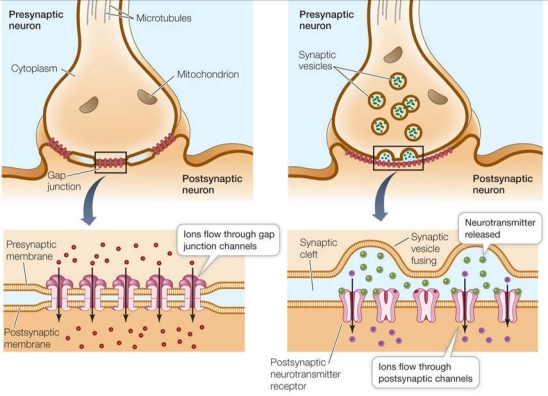 It has been hypothesized that during development of the mammalian brain, neurons are first coupled through gap junctions to one another during the first few days after birth.These gap junctions provide a conduit for propagation of electrical activity as a flow of ions between neurons, as depicted in the figure on the left.However, it is thought that these gap junctions are replaced after this initial period with a chemical signaling system, as depicted in the figure on the right.This system involves one neuron secreting neurotransmitter compounds that carry the signal across the extracellular space to an adjacent neuron, where the electrical signal is continued.Design an experiment to test the hypothesis that gap junctions are replaced during the early days after birth.You may use rats and the compound halothane in your design.Halothane is a compound known to specifically bind to and block gap junctions.
 (Essay)
4.9/5 (84)
(84) Refer to the figure below. 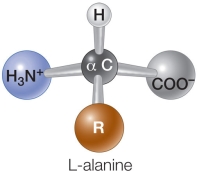 A biologist identifies a new signal transduction pathway in mouse cells that are stimulated by the compound L-alanine, represented above.Which statement makes a reasonable prediction about how D-alanine will interact with this pathway, and why?
 (Multiple Choice)
4.8/5 (79)
(79) If a signal transduction pathway involves amplification of the signal by a factor of 10 at each step, which set of numbers represents the sequence of molecules activated during a single signaling event?
(Multiple Choice)
4.8/5 (70)
(70) Refer to the figure below. 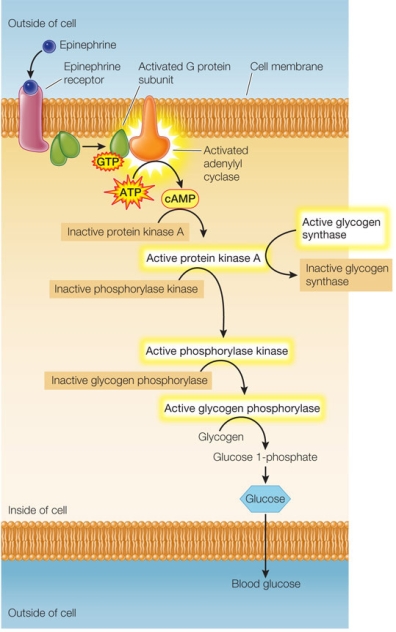 The figure shows a signal transduction pathway in a cell.How does the number of molecules change as the signal is carried in this pathway?
 (Multiple Choice)
4.9/5 (80)
(80) A single epinephrine molecule can cause the release of thousands of glucose molecules from glycogen in a liver cell.Why is this a useful feature of this signal transduction pathway?
(Multiple Choice)
4.8/5 (74)
(74) Which statement regarding chemical signaling systems is false?
(Multiple Choice)
4.9/5 (86)
(86) Nitric oxide (NO) participates in a signal transduction pathway that promotes relaxation of smooth muscle cells lining blood vessels and so increases blood flow.Nitric oxide accomplishes this by
(Multiple Choice)
4.9/5 (84)
(84) Sketch a cell membrane receptor.Identify the parts of the receptor, and explain how each one functions.
(Essay)
4.8/5 (84)
(84) A protein kinase can phosphorylate an enzyme and activate it by
(Multiple Choice)
4.8/5 (83)
(83) Which statement about membrane receptors in a signal transduction pathway is true?
(Multiple Choice)
5.0/5 (74)
(74) _______ are signaling molecules sent to distant cells and are usually transported via the circulatory system.
(Short Answer)
4.7/5 (75)
(75) Refer to the figure below. 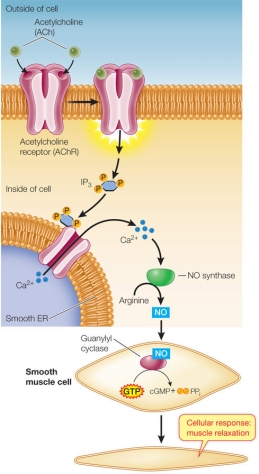 Which action could the cell use to turn off the signal transduction pathway shown, as part of a regulatory mechanism?
 (Multiple Choice)
4.9/5 (92)
(92) The entry of a sperm into an egg causes a massive opening of _______ ion channels.
(Short Answer)
4.8/5 (85)
(85) Refer to the table below showing the observed characteristics of four species of algae. 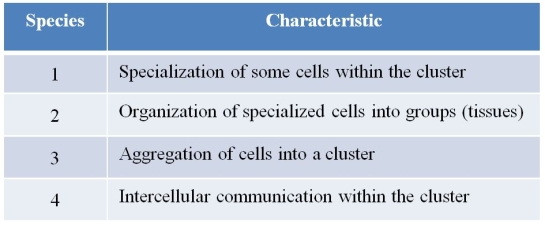 Which sequence of characteristics is consistent with the current thinking about the evolution of multicellularity?
 (Multiple Choice)
4.8/5 (78)
(78) 
Filters
- Essay(0)
- Multiple Choice(0)
- Short Answer(0)
- True False(0)
- Matching(0)