



 Chat with AI
Exam 7: Cell Communication and Multicellularity

Exam 1: Studying Life246 Questions
Exam 2: Small Molecules and the Chemistry of Life246 Questions
Exam 3: Proteins, Carbohydrates, and Lipids246 Questions
Exam 4: Nucleic Acids and the Origin of Life246 Questions
Exam 5: Cells: the Working Units of Life248 Questions
Exam 6: Cell Membranes246 Questions
Exam 7: Cell Communication and Multicellularity246 Questions
Exam 8: Energy, Enzymes, and Metabolism246 Questions
Exam 9: Pathways That Harvest Chemical Energy246 Questions
Exam 10: Photosynthesis: Energy From Sunlight242 Questions
Exam 11: The Cell Cycle and Cell Division260 Questions
Exam 12: Inheritance, Genes, and Chromosomes250 Questions
Exam 13: Dna and Its Role in Heredity257 Questions
Exam 14: From Dna to Protein: Gene Expression252 Questions
Exam 15: Gene Mutation and Molecular Medicine251 Questions
Exam 16: Regulation of Gene Expression245 Questions
Exam 17: Genomes249 Questions
Exam 18: Recombinant Dna and Biotechnology243 Questions
Exam 20: Mechanisms of Evolution243 Questions
Exam 21: Reconstructing and Using Phylogenies246 Questions
Exam 22: Speciation247 Questions
Exam 23: Evolution of Genes and Genomes252 Questions
Exam 24: The History of Life on Earth246 Questions
Exam 25: Bacteria, Archaea, and Viruses262 Questions
Exam 26: The Origin and Diversification of Eukaryotes252 Questions
Exam 27: Plants Without Seeds: From Water to Land251 Questions
Exam 28: The Evolution of Seed Plants259 Questions
Exam 29: The Evolution and Diversity of Fungi261 Questions
Exam 30: Animal Origins and the Evolution of Body Plans248 Questions
Exam 31: Protostome Animals244 Questions
Exam 32: Deuterostome Animals246 Questions
Exam 33: The Plant Body243 Questions
Exam 34: Transport in Plants248 Questions
Exam 35: Plant Nutrition247 Questions
Exam 36: Regulation of Plant Growth246 Questions
Exam 37: Reproduction in Flowering Plants247 Questions
Exam 38: Plant Responses to Environmental Challenges246 Questions
Exam 39: Physiology, Homeostasis, and Temperature Regulation258 Questions
Exam 40: Animal Hormones249 Questions
Exam 41: Immunology: Animal Defense Systems265 Questions
Exam 42: Animal Reproduction261 Questions
Exam 43: Animal Development261 Questions
Exam 44: Neurons, Glia, and Nervous Systems250 Questions
Exam 45: Sensory Systems249 Questions
Exam 46: The Mammalian Nervous System: Structure and Higher Functions254 Questions
Exam 47: Musculoskeletal Systems259 Questions
Exam 48: Gas Exchange247 Questions
Exam 49: Circulatory Systems252 Questions
Exam 50: Nutrition, Digestion, and Absorption259 Questions
Exam 51: Salt and Water Balance and Nitrogen Excretion251 Questions
Exam 52: Animal Behavior249 Questions
Exam 53: The Physical Environment and Biogeography of Life248 Questions
Exam 54: Populations259 Questions
Exam 55: Species Interactions254 Questions
Exam 56: Communities247 Questions
Exam 57: Ecosystems238 Questions
Exam 58: A Changing Biosphere222 Questions
Select questions type


Receptors can be divided into two general classes according to their cellular location: _______ receptors and _______ receptors.
(Multiple Choice)
4.8/5  (79)
(79) How does a protein kinase cascade amplify an intracellular signal?
(Multiple Choice)
5.0/5 (75)
(75) Refer to the figure below. 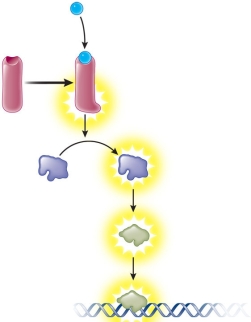 The figure illustrates how an external chemical signal can alter _______ in a cell.
 (Short Answer)
4.9/5 (80)
(80) The concentration of cAMP in a cell is usually increased by activity of
(Multiple Choice)
4.9/5 (74)
(74) Refer to the figure showing an insulin receptor. 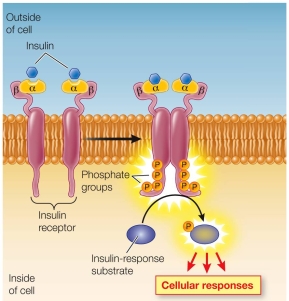 The insulin receptor in the figure shown is considered to be which receptor type?
 (Multiple Choice)
4.9/5 (82)
(82) After a signal arrives at a target cell, the next step in a signal transduction pathway involves
(Multiple Choice)
4.9/5 (73)
(73) The entire cell signaling process is known as a signal _______ pathway.
(Short Answer)
5.0/5 (77)
(77) Oxytocin stimulates a G protein-coupled signal transduction pathway.During signal transduction in this pathway, a G protein becomes activated.Which three molecules does G protein interact with in this pathway?
(Multiple Choice)
4.9/5 (83)
(83) Refer to the table below. 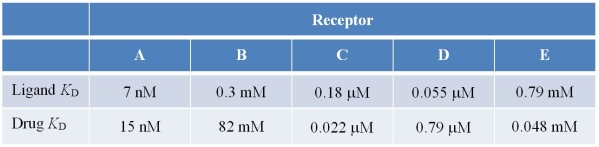 A pharmaceutical company is developing five new drugs to act as antagonists with respect to five different receptor proteins.Listed in the table are dissociation constants for ligand and drug in each case.In which case will the dosage of drug necessary to achieve a biological effect be the smallest?
 (Multiple Choice)
4.9/5 (75)
(75) Refer to the table below. 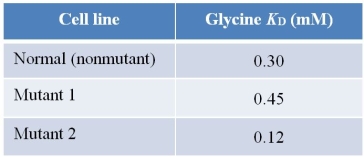 The table shows dissociation constants for the binding of glycine to its membrane receptor in three cell lines.The cell lines differ only in the gene for the receptor protein.Normal cells contain no mutation in this gene, while mutants 1 and 2 contain mutations at different sites in this gene.The cell lines placed in increasing order of affinity for glycine are mutant 1 first, then normal, and _______ last.
 (Short Answer)
4.9/5 (66)
(66) During an investigation, researchers worked with mouse cells cultured in artificial media in dishes.The researchers found that mutant cells could not survive in a particular type of growth medium because they lacked the ability to synthesize a molecule critical for survival.Which investigation could be done to test whether intercellular transport could provide this molecule to cells?
(Multiple Choice)
5.0/5 (72)
(72) Refer to the figure below. 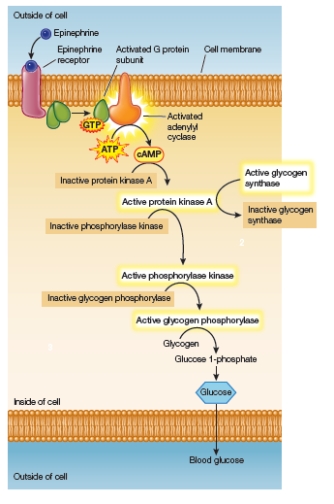 The figure shows a signal transduction pathway in a cell.How does adenylyl cyclase become activated so that it can relay the signal during a signal transduction event in this particular pathway?
 (Multiple Choice)
4.7/5 (78)
(78) In the signal cascade triggered by epinephrine within liver cells, glycogen synthase is
(Multiple Choice)
4.8/5 (86)
(86) A mutation in the thyroid-stimulating hormone receptor (TSH receptor) results in a change in the behavior of the receptor toward its ligand, thyroid-stimulating hormone (TSH).Explain what measuring the TSH dissociation constant, KD, will reveal about this behavior, and explain how a change in this value will affect cells that have this receptor embedded in their cell membranes.
(Essay)
4.7/5 (82)
(82) Refer to the table below. 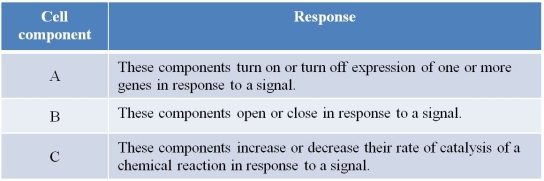 The table lists three ways that a cell might respond to an external chemical signal.What are the cell components labeled A, B, and C?
 (Multiple Choice)
4.9/5 (73)
(73) A(n) _______ binds to a receptor in place of a ligand and prevents stimulation of the signal transduction pathway.
(Short Answer)
4.7/5 (78)
(78) 
Filters
- Essay(0)
- Multiple Choice(0)
- Short Answer(0)
- True False(0)
- Matching(0)