



 Chat with AI
Exam 38: Plant Responses to Environmental Challenges

Exam 1: Studying Life246 Questions
Exam 2: Small Molecules and the Chemistry of Life246 Questions
Exam 3: Proteins, Carbohydrates, and Lipids246 Questions
Exam 4: Nucleic Acids and the Origin of Life246 Questions
Exam 5: Cells: the Working Units of Life248 Questions
Exam 6: Cell Membranes246 Questions
Exam 7: Cell Communication and Multicellularity246 Questions
Exam 8: Energy, Enzymes, and Metabolism246 Questions
Exam 9: Pathways That Harvest Chemical Energy246 Questions
Exam 10: Photosynthesis: Energy From Sunlight242 Questions
Exam 11: The Cell Cycle and Cell Division260 Questions
Exam 12: Inheritance, Genes, and Chromosomes250 Questions
Exam 13: Dna and Its Role in Heredity257 Questions
Exam 14: From Dna to Protein: Gene Expression252 Questions
Exam 15: Gene Mutation and Molecular Medicine251 Questions
Exam 16: Regulation of Gene Expression245 Questions
Exam 17: Genomes249 Questions
Exam 18: Recombinant Dna and Biotechnology243 Questions
Exam 20: Mechanisms of Evolution243 Questions
Exam 21: Reconstructing and Using Phylogenies246 Questions
Exam 22: Speciation247 Questions
Exam 23: Evolution of Genes and Genomes252 Questions
Exam 24: The History of Life on Earth246 Questions
Exam 25: Bacteria, Archaea, and Viruses262 Questions
Exam 26: The Origin and Diversification of Eukaryotes252 Questions
Exam 27: Plants Without Seeds: From Water to Land251 Questions
Exam 28: The Evolution of Seed Plants259 Questions
Exam 29: The Evolution and Diversity of Fungi261 Questions
Exam 30: Animal Origins and the Evolution of Body Plans248 Questions
Exam 31: Protostome Animals244 Questions
Exam 32: Deuterostome Animals246 Questions
Exam 33: The Plant Body243 Questions
Exam 34: Transport in Plants248 Questions
Exam 35: Plant Nutrition247 Questions
Exam 36: Regulation of Plant Growth246 Questions
Exam 37: Reproduction in Flowering Plants247 Questions
Exam 38: Plant Responses to Environmental Challenges246 Questions
Exam 39: Physiology, Homeostasis, and Temperature Regulation258 Questions
Exam 40: Animal Hormones249 Questions
Exam 41: Immunology: Animal Defense Systems265 Questions
Exam 42: Animal Reproduction261 Questions
Exam 43: Animal Development261 Questions
Exam 44: Neurons, Glia, and Nervous Systems250 Questions
Exam 45: Sensory Systems249 Questions
Exam 46: The Mammalian Nervous System: Structure and Higher Functions254 Questions
Exam 47: Musculoskeletal Systems259 Questions
Exam 48: Gas Exchange247 Questions
Exam 49: Circulatory Systems252 Questions
Exam 50: Nutrition, Digestion, and Absorption259 Questions
Exam 51: Salt and Water Balance and Nitrogen Excretion251 Questions
Exam 52: Animal Behavior249 Questions
Exam 53: The Physical Environment and Biogeography of Life248 Questions
Exam 54: Populations259 Questions
Exam 55: Species Interactions254 Questions
Exam 56: Communities247 Questions
Exam 57: Ecosystems238 Questions
Exam 58: A Changing Biosphere222 Questions
Select questions type


Which statement about the role played by salicylic acid in plants is false?

Free
(Multiple Choice)
4.8/5  (71)
(71) Correct Answer: Verified
C
Programmed cell death in plants acts against pathogens primarily by
Free
(Multiple Choice)
5.0/5 (79)
(79) Correct Answer:Verified
VerifiedE
Many plants produce toxins that damage eukaryotic predators.Considering that the cell structure of both the predator and the plant is similar, why is the plant not affected by its own toxins?
Free
(Essay)
4.9/5 (74)
(74) Correct Answer:Verified
VerifiedPlants have a number of strategies to protect themselves from their own toxins. They may isolate the toxins in vacuoles within their cells or glandular trichomes on the leaf surface so that the toxins do not come into contact with the active machinery of the cells. They may restrict toxin production to already-damaged tissue. They may develop enzymes that differentiate toxins and render them harmless. They can also separate toxin precursors and the enzymes that convert them to active form, so that these mix only when there is damage to the cell.
The amino acid canavanine is an insecticide that is made naturally by some plants and can be applied topically to plants that do not produce it.The effect of canavanine is to
(Multiple Choice)
4.9/5 (78)
(78) An adaptation that allows a plant to survive cold stress is most fundamentally a result of
(Multiple Choice)
4.8/5 (88)
(88) Refer to the figure, showing induced resistance mechanisms. 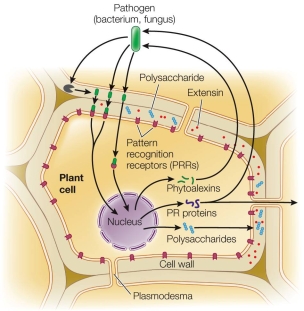 If the number of polysaccharides shown in the figure increased tenfold, they would
 (Multiple Choice)
4.8/5 (77)
(77) Plants launch a successful defense against infection from RNA viruses by
(Multiple Choice)
4.8/5 (82)
(82) Refer to the figure. 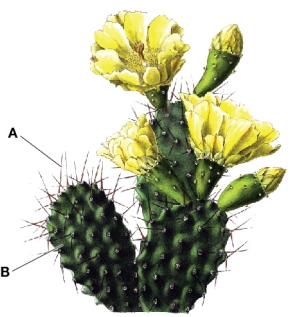 Explain the functions of structures A and B on this cactus and how they serve as adaptations to a dry environment.
 (Essay)
4.7/5 (90)
(90) Foraging by herbivores can induce the formation of which general kind of metabolites in plants?
(Multiple Choice)
4.8/5 (79)
(79) Refer to the figure. 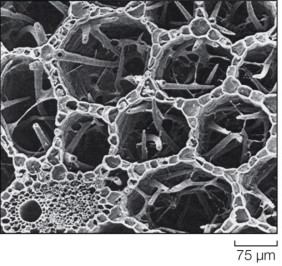 What advantage does the type of tissue shown in the image provide to the plant?
 (Multiple Choice)
4.7/5 (66)
(66) A newly discovered plant that contains very high levels of lead is most likely a(n)
(Multiple Choice)
4.8/5 (88)
(88) Which environment is typical for an annual plant with a brief growing period and seeds capable of long dormant periods?
(Multiple Choice)
4.8/5 (82)
(82) Refer to the figure. 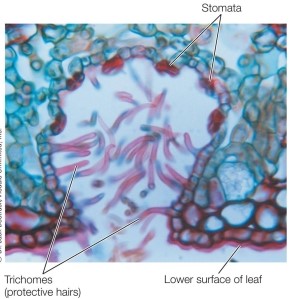 A plant with the leaf structure shown here would most likely thrive in a(n) _______ habitat.
 (Multiple Choice)
4.8/5 (82)
(82) Which method is not used by plants to protect themselves from toxins they produce?
(Multiple Choice)
4.8/5 (84)
(84) Refer to the figure. 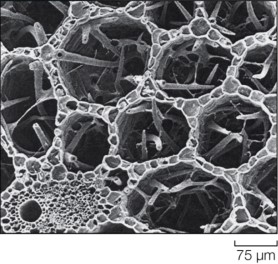 A plant with the type of stem structure shown in the image would most likely thrive in a(n) _______ habitat.
 (Multiple Choice)
4.9/5 (94)
(94) An insect's chewing on a leaf results in the production of a protease inhibitor intended to harm the insect.This response does not involve _______ at the molecular level.
(Multiple Choice)
4.8/5 (82)
(82) 
Filters
- Essay(0)
- Multiple Choice(0)
- Short Answer(0)
- True False(0)
- Matching(0)