



 Chat with AI
Exam 58: A Changing Biosphere

Exam 1: Studying Life246 Questions
Exam 2: Small Molecules and the Chemistry of Life246 Questions
Exam 3: Proteins, Carbohydrates, and Lipids246 Questions
Exam 4: Nucleic Acids and the Origin of Life246 Questions
Exam 5: Cells: the Working Units of Life248 Questions
Exam 6: Cell Membranes246 Questions
Exam 7: Cell Communication and Multicellularity246 Questions
Exam 8: Energy, Enzymes, and Metabolism246 Questions
Exam 9: Pathways That Harvest Chemical Energy246 Questions
Exam 10: Photosynthesis: Energy From Sunlight242 Questions
Exam 11: The Cell Cycle and Cell Division260 Questions
Exam 12: Inheritance, Genes, and Chromosomes250 Questions
Exam 13: Dna and Its Role in Heredity257 Questions
Exam 14: From Dna to Protein: Gene Expression252 Questions
Exam 15: Gene Mutation and Molecular Medicine251 Questions
Exam 16: Regulation of Gene Expression245 Questions
Exam 17: Genomes249 Questions
Exam 18: Recombinant Dna and Biotechnology243 Questions
Exam 20: Mechanisms of Evolution243 Questions
Exam 21: Reconstructing and Using Phylogenies246 Questions
Exam 22: Speciation247 Questions
Exam 23: Evolution of Genes and Genomes252 Questions
Exam 24: The History of Life on Earth246 Questions
Exam 25: Bacteria, Archaea, and Viruses262 Questions
Exam 26: The Origin and Diversification of Eukaryotes252 Questions
Exam 27: Plants Without Seeds: From Water to Land251 Questions
Exam 28: The Evolution of Seed Plants259 Questions
Exam 29: The Evolution and Diversity of Fungi261 Questions
Exam 30: Animal Origins and the Evolution of Body Plans248 Questions
Exam 31: Protostome Animals244 Questions
Exam 32: Deuterostome Animals246 Questions
Exam 33: The Plant Body243 Questions
Exam 34: Transport in Plants248 Questions
Exam 35: Plant Nutrition247 Questions
Exam 36: Regulation of Plant Growth246 Questions
Exam 37: Reproduction in Flowering Plants247 Questions
Exam 38: Plant Responses to Environmental Challenges246 Questions
Exam 39: Physiology, Homeostasis, and Temperature Regulation258 Questions
Exam 40: Animal Hormones249 Questions
Exam 41: Immunology: Animal Defense Systems265 Questions
Exam 42: Animal Reproduction261 Questions
Exam 43: Animal Development261 Questions
Exam 44: Neurons, Glia, and Nervous Systems250 Questions
Exam 45: Sensory Systems249 Questions
Exam 46: The Mammalian Nervous System: Structure and Higher Functions254 Questions
Exam 47: Musculoskeletal Systems259 Questions
Exam 48: Gas Exchange247 Questions
Exam 49: Circulatory Systems252 Questions
Exam 50: Nutrition, Digestion, and Absorption259 Questions
Exam 51: Salt and Water Balance and Nitrogen Excretion251 Questions
Exam 52: Animal Behavior249 Questions
Exam 53: The Physical Environment and Biogeography of Life248 Questions
Exam 54: Populations259 Questions
Exam 55: Species Interactions254 Questions
Exam 56: Communities247 Questions
Exam 57: Ecosystems238 Questions
Exam 58: A Changing Biosphere222 Questions
Select questions type


Of 85 invasive species entering the Great Lakes through the St.Lawrence Seaway, 54 have been linked to transport in and discharge from ships' ballast water.Included are the zebra mussel and the quagga mussel.This information suggests that the spread of invasive species in ballast water

Free
(Multiple Choice)
4.8/5  (72)
(72) Correct Answer: Verified
B
Because giraffes are large and relatively friendly, they are still often seen on safaris, but conservationists say they are undergoing a "silent extinction." A recent study shows that giraffe populations have declined by at least 30 percent over the last 30 years (three giraffe generations).Due to their declining effective population size, giraffes in the coming years could show which change in population dynamics?
Free
(Multiple Choice)
4.8/5 (85)
(85) Correct Answer:Verified
VerifiedC
North America's largest flying bird, the California condor, survives today because of a preservation program called _______.
Free
(Short Answer)
4.9/5 (81)
(81) Correct Answer:Verified
Verifiedcaptive breeding
A person living in a small town has a large backyard in which she cultivates a vegetable garden and several flower gardens.She plants flowering shrubs, hangs birdhouses, and sets up a birdbath.She provides habitat for butterflies and other pollinators, and for toads and other insect predators.The resulting backyard can best be described as a
(Multiple Choice)
4.9/5 (84)
(84) One strategy considered for preventing introduction of invasive species is deoxygenating ballast water.This strategy is
(Multiple Choice)
4.8/5 (78)
(78) Coral reefs destroyed by dynamite fishing or other destructive practices are sometimes restored by building metal lattices, or "spiders," and attaching them to the seafloor.Pieces of living coral are attached to the lattices and eventually reproduce and grow, gradually increasing the size of the coral skeleton and restoring the coral reef habitat.In this situation, the ecological restoration process is aided by the use of a(n)
(Multiple Choice)
4.9/5 (88)
(88) Refer to the graph. 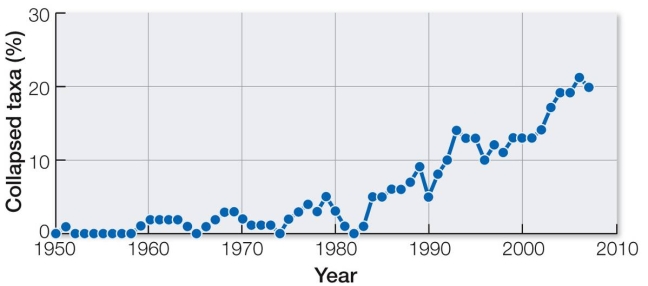 "Collapsed" fish taxa are species or groups of species that have declined to less than 10 percent of the biomass they had before they were fished.These low numbers represent commercial extinction, or levels too low to produce a profit when those taxa are fished.Changes in the numbers of collapsed taxa since 1950 are shown in the graph.The trend shown indicates that
 (Multiple Choice)
4.8/5 (83)
(83) A researcher is very concerned about organism extinctions and wants to address this problem by developing new methods for tracking and predicting extinctions.She develops a list of potential programs that might be implemented.Which new potential program would probably be most practical and most helpful in predicting extinctions?
(Multiple Choice)
4.8/5 (67)
(67) Elevated atmospheric CO2 concentration results in higher rates of plant photosynthesis.It also increases the plants' carbon-to-nitrogen ratio, causing a "nitrogen dilution" effect that decreases leaf protein levels and nutritional content.Herbivorous insects in elevated CO2 conditions show a 22 percent decline in abundance, 17 percent increase in consumption rates, 4 percent increase in development time, 9 percent decrease in relative growth rate, and 5 percent decrease in pupa weight.These are average changes that vary by species and are most pronounced for chewing insects.These changes suggest that climate-induced increases in CO2 levels will likely have
(Multiple Choice)
4.7/5 (87)
(87) Costa Rica protects the country's high level of biodiversity by offering environmentally sensitive hiking and bird-watching trips to protected national parks.This maintenance of a noneconomic value (biodiversity) by the use of an economic-based industry is known as _______.
(Short Answer)
4.9/5 (80)
(80) Emergence of a new endemic pathogen in an ecosystem (as opposed to a newly introduced pathogen) is most likely to occur by which method?
(Multiple Choice)
4.9/5 (73)
(73) Ecologically, if an area cannot support viable populations of a species or it lacks its original ecosystem services and functions, it does not meet the qualifications to be considered a _______.
(Short Answer)
4.9/5 (94)
(94) Ballast water from ships has been responsible for the intercontinental spread of a number of invasive species.One promising strategy proposed by conservationists to reduce this danger is to
(Multiple Choice)
4.8/5 (71)
(71) Refer to the table. 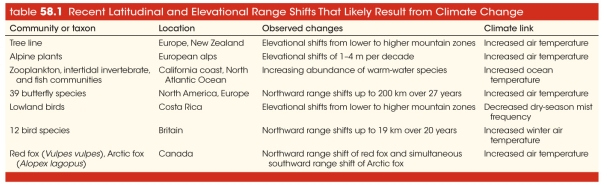 According to the table, do ocean organisms show the same general trends in response to climate change as are shown by terrestrial organisms?
 (Multiple Choice)
5.0/5 (85)
(85) Refer to the table. 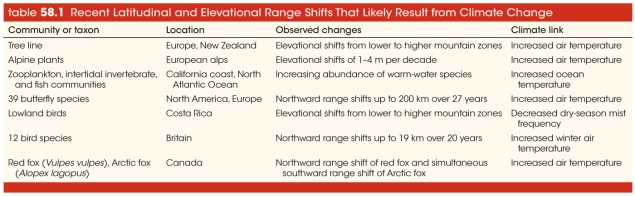 According to the table, the trend for land-based organisms as air temperatures increase is for
 (Multiple Choice)
4.9/5 (84)
(84) In Gabon, West Africa, the Wotango tree is harvested for its medicinal bark.The bark's chemical cannot be synthesized in the lab; it must be obtained from the bark itself.Before 1985, a French pharmaceutical company owned the rights to the chemical and harvested the tree sustainably.In 1985, the company began granting harvesting licenses to local businesses.Now, harvesting is described as "out of control," because villagers need the income.What does this information suggest about the current and future status of the Wotango tree?
(Multiple Choice)
4.9/5 (86)
(86) What are nonmarket, or noneconomic, values of biodiversity? Give examples of these, and justify the importance of preserving biodiversity for these noneconomic values.
(Essay)
4.9/5 (87)
(87) Aquatic species, such as ocean fish, are particularly vulnerable to overharvesting due to a concept called "tragedy of the commons." When everyone harvests a shared (common) resource, each person tends to harvest as much as possible, because no one owns the resource and there is no motivation to be restrained.This is a particular problem now, with the growing human population and constantly improving technology that makes harvesting fast and efficient.In this situation, which type of fish species would likely be most vulnerable to extinction?
(Multiple Choice)
4.9/5 (90)
(90) Refer to the graph. 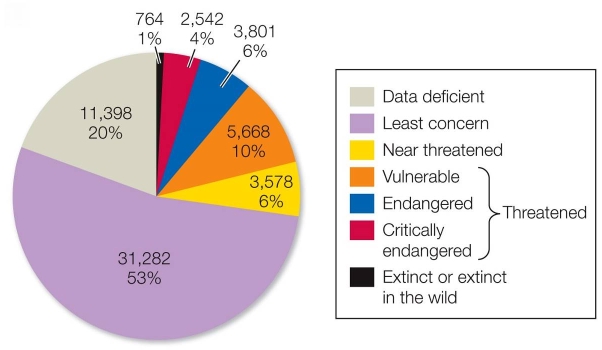 The graph shows the breakdown by extinction risk category of the species assessed by the International Union for Conservation of Nature (IUCN).Based on the graph, what percentage of species in the world are considered threatened?
 (Multiple Choice)
4.9/5 (76)
(76) According to the categories set by the International Union for Conservation of Nature (IUCN), the species most highly threatened by extinction are classified as _______.
(Short Answer)
4.9/5 (90)
(90) 
Filters
- Essay(0)
- Multiple Choice(0)
- Short Answer(0)
- True False(0)
- Matching(0)