



 Chat with AI
Exam 42: Animal Reproduction

Exam 1: Studying Life246 Questions
Exam 2: Small Molecules and the Chemistry of Life246 Questions
Exam 3: Proteins, Carbohydrates, and Lipids246 Questions
Exam 4: Nucleic Acids and the Origin of Life246 Questions
Exam 5: Cells: the Working Units of Life248 Questions
Exam 6: Cell Membranes246 Questions
Exam 7: Cell Communication and Multicellularity246 Questions
Exam 8: Energy, Enzymes, and Metabolism246 Questions
Exam 9: Pathways That Harvest Chemical Energy246 Questions
Exam 10: Photosynthesis: Energy From Sunlight242 Questions
Exam 11: The Cell Cycle and Cell Division260 Questions
Exam 12: Inheritance, Genes, and Chromosomes250 Questions
Exam 13: Dna and Its Role in Heredity257 Questions
Exam 14: From Dna to Protein: Gene Expression252 Questions
Exam 15: Gene Mutation and Molecular Medicine251 Questions
Exam 16: Regulation of Gene Expression245 Questions
Exam 17: Genomes249 Questions
Exam 18: Recombinant Dna and Biotechnology243 Questions
Exam 20: Mechanisms of Evolution243 Questions
Exam 21: Reconstructing and Using Phylogenies246 Questions
Exam 22: Speciation247 Questions
Exam 23: Evolution of Genes and Genomes252 Questions
Exam 24: The History of Life on Earth246 Questions
Exam 25: Bacteria, Archaea, and Viruses262 Questions
Exam 26: The Origin and Diversification of Eukaryotes252 Questions
Exam 27: Plants Without Seeds: From Water to Land251 Questions
Exam 28: The Evolution of Seed Plants259 Questions
Exam 29: The Evolution and Diversity of Fungi261 Questions
Exam 30: Animal Origins and the Evolution of Body Plans248 Questions
Exam 31: Protostome Animals244 Questions
Exam 32: Deuterostome Animals246 Questions
Exam 33: The Plant Body243 Questions
Exam 34: Transport in Plants248 Questions
Exam 35: Plant Nutrition247 Questions
Exam 36: Regulation of Plant Growth246 Questions
Exam 37: Reproduction in Flowering Plants247 Questions
Exam 38: Plant Responses to Environmental Challenges246 Questions
Exam 39: Physiology, Homeostasis, and Temperature Regulation258 Questions
Exam 40: Animal Hormones249 Questions
Exam 41: Immunology: Animal Defense Systems265 Questions
Exam 42: Animal Reproduction261 Questions
Exam 43: Animal Development261 Questions
Exam 44: Neurons, Glia, and Nervous Systems250 Questions
Exam 45: Sensory Systems249 Questions
Exam 46: The Mammalian Nervous System: Structure and Higher Functions254 Questions
Exam 47: Musculoskeletal Systems259 Questions
Exam 48: Gas Exchange247 Questions
Exam 49: Circulatory Systems252 Questions
Exam 50: Nutrition, Digestion, and Absorption259 Questions
Exam 51: Salt and Water Balance and Nitrogen Excretion251 Questions
Exam 52: Animal Behavior249 Questions
Exam 53: The Physical Environment and Biogeography of Life248 Questions
Exam 54: Populations259 Questions
Exam 55: Species Interactions254 Questions
Exam 56: Communities247 Questions
Exam 57: Ecosystems238 Questions
Exam 58: A Changing Biosphere222 Questions
Select questions type


When examining histological sections derived from the testes of male mammals, you come across cells that are near the lumen of the seminiferous tubules and connected by cytoplasmic bridges.Which cells have you found?

Free
(Multiple Choice)
4.9/5  (85)
(85) Correct Answer: Verified
C
Refer to the figure depicting the average blood concentrations of four circulating hormones in 100 healthy adult women.Each hormone plays a role in regulating some aspect of the ovarian and/or uterine cycle. 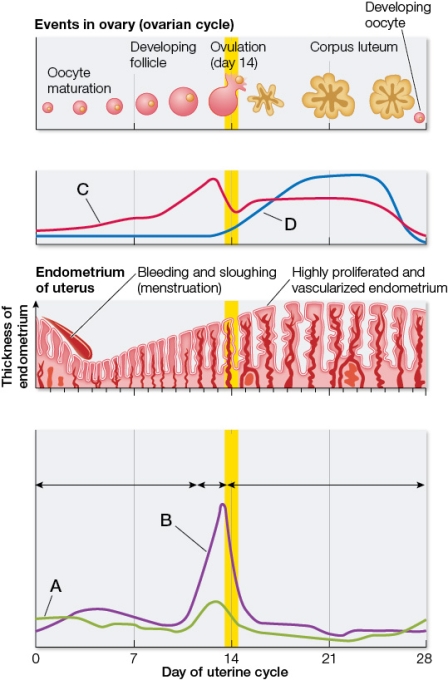 Based on the figure, which statement is true?
Free
(Multiple Choice)
4.9/5 (84)
(84) Correct Answer:Verified
VerifiedA
Mammalian spermatocytes remain in cytoplasmic contact throughout their development
(Multiple Choice)
4.9/5 (78)
(78) Which cells would be found closest to the basement membrane of a seminiferous tubule?
(Multiple Choice)
4.8/5 (67)
(67) While examining histological sections derived from the ovaries of human females at various life stages, you come across a slide labeled "Section of an ovary from a mature female." You would expect to find all of these cells on the slide except for a(n)
(Multiple Choice)
4.8/5 (98)
(98) In humans, a primary oocyte is _______ and arrested in _______ of meiosis.
(Multiple Choice)
4.9/5 (84)
(84) A spontaneous abortion, commonly called a(n) _______, may result from a chromosomal abnormality in the embryo or from a problem in the process of implantation.
(Short Answer)
5.0/5 (68)
(68) Mifepristone (formerly called RU-486) terminates a pregnancy by blocking the action of progesterone.The termination occurs because progesterone is needed to
(Multiple Choice)
4.8/5 (75)
(75) If a man carries a genetic mutation that prevents the maintenance of cytoplasmic bridges between his secondary spermatocytes and his spermatids, would you expect that he would father only sons or only daughters? Explain your answer.
(Essay)
4.8/5 (86)
(86) A vasectomy is a relatively minor operation in which the _______ is/are cut and the loose ends are tied off.
(Multiple Choice)
4.8/5 (85)
(85) The uterus opens into the vagina at a muscular necklike region called the _______.
(Short Answer)
5.0/5 (84)
(84) During the evening hours you observe two salamanders in a pool, one is leading the other as if in a dance.It appears to be a mating ritual.At the conclusion of the ritual, you do not see any eggs in the water.Several days later you return and find a clutch of salamander eggs developing in the pool.What is a likely explanation for these observations?
(Multiple Choice)
4.8/5 (77)
(77) Several days after her due date, a pregnant woman comes to the hospital in labor, but after a period of time, her labor contractions cease.Her physician administers Pitocin, a manufactured form of _______, which causes labor to resume.
(Short Answer)
5.0/5 (81)
(81) Which would be an expected outcome of removal of the prostate gland?
(Multiple Choice)
4.9/5 (78)
(78) Refer to the figure showing aphid reproductive cycles. 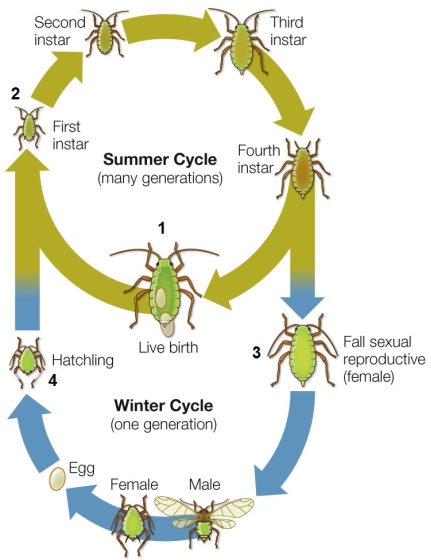 The organism labeled 1 is a female and is genetically identical to the organism(s) labeled _______.
 (Short Answer)
4.9/5 (73)
(73) 
Filters
- Essay(0)
- Multiple Choice(0)
- Short Answer(0)
- True False(0)
- Matching(0)