



 Chat with AI
Exam 42: Animal Reproduction

Exam 1: Studying Life246 Questions
Exam 2: Small Molecules and the Chemistry of Life246 Questions
Exam 3: Proteins, Carbohydrates, and Lipids246 Questions
Exam 4: Nucleic Acids and the Origin of Life246 Questions
Exam 5: Cells: the Working Units of Life248 Questions
Exam 6: Cell Membranes246 Questions
Exam 7: Cell Communication and Multicellularity246 Questions
Exam 8: Energy, Enzymes, and Metabolism246 Questions
Exam 9: Pathways That Harvest Chemical Energy246 Questions
Exam 10: Photosynthesis: Energy From Sunlight242 Questions
Exam 11: The Cell Cycle and Cell Division260 Questions
Exam 12: Inheritance, Genes, and Chromosomes250 Questions
Exam 13: Dna and Its Role in Heredity257 Questions
Exam 14: From Dna to Protein: Gene Expression252 Questions
Exam 15: Gene Mutation and Molecular Medicine251 Questions
Exam 16: Regulation of Gene Expression245 Questions
Exam 17: Genomes249 Questions
Exam 18: Recombinant Dna and Biotechnology243 Questions
Exam 20: Mechanisms of Evolution243 Questions
Exam 21: Reconstructing and Using Phylogenies246 Questions
Exam 22: Speciation247 Questions
Exam 23: Evolution of Genes and Genomes252 Questions
Exam 24: The History of Life on Earth246 Questions
Exam 25: Bacteria, Archaea, and Viruses262 Questions
Exam 26: The Origin and Diversification of Eukaryotes252 Questions
Exam 27: Plants Without Seeds: From Water to Land251 Questions
Exam 28: The Evolution of Seed Plants259 Questions
Exam 29: The Evolution and Diversity of Fungi261 Questions
Exam 30: Animal Origins and the Evolution of Body Plans248 Questions
Exam 31: Protostome Animals244 Questions
Exam 32: Deuterostome Animals246 Questions
Exam 33: The Plant Body243 Questions
Exam 34: Transport in Plants248 Questions
Exam 35: Plant Nutrition247 Questions
Exam 36: Regulation of Plant Growth246 Questions
Exam 37: Reproduction in Flowering Plants247 Questions
Exam 38: Plant Responses to Environmental Challenges246 Questions
Exam 39: Physiology, Homeostasis, and Temperature Regulation258 Questions
Exam 40: Animal Hormones249 Questions
Exam 41: Immunology: Animal Defense Systems265 Questions
Exam 42: Animal Reproduction261 Questions
Exam 43: Animal Development261 Questions
Exam 44: Neurons, Glia, and Nervous Systems250 Questions
Exam 45: Sensory Systems249 Questions
Exam 46: The Mammalian Nervous System: Structure and Higher Functions254 Questions
Exam 47: Musculoskeletal Systems259 Questions
Exam 48: Gas Exchange247 Questions
Exam 49: Circulatory Systems252 Questions
Exam 50: Nutrition, Digestion, and Absorption259 Questions
Exam 51: Salt and Water Balance and Nitrogen Excretion251 Questions
Exam 52: Animal Behavior249 Questions
Exam 53: The Physical Environment and Biogeography of Life248 Questions
Exam 54: Populations259 Questions
Exam 55: Species Interactions254 Questions
Exam 56: Communities247 Questions
Exam 57: Ecosystems238 Questions
Exam 58: A Changing Biosphere222 Questions
Select questions type


Refer to the figure showing male reproductive hormones. 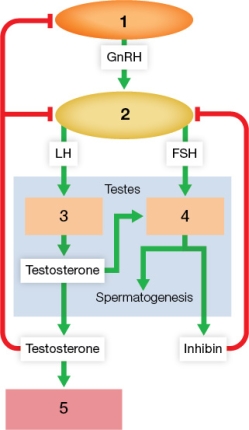 Based on the figure, which statement is true?
 (Multiple Choice)
4.8/5  (77)
(77) An earthworm moves relatively slowly through the soil; thus, it is relatively uncommon to encounter potential mates.But when two sexually mature earthworms do happen to encounter each other, they are able to mate without first determining the sex of the other individual.This is because these organisms are _______, which means each individual has both male and female sexual organs.
(Short Answer)
4.9/5 (74)
(74) If a man produces an insufficient amount of gonadotropin-releasing hormone (GnRH), what fertility issues will he likely face, and why?
(Essay)
4.8/5 (59)
(59) Which feature is usually associated with asexual reproduction?
(Multiple Choice)
5.0/5 (79)
(79) During _______, the germ cell divisions are dramatically unequal, assuring that the developing embryo will start out with as much cytoplasm, informational molecules, and nutrients as possible.
(Short Answer)
4.8/5 (80)
(80) In which procedure does fertilization occur within the female reproductive tract?
(Multiple Choice)
4.8/5 (72)
(72) Which event occurs midway through the human ovarian cycle, around day 14?
(Multiple Choice)
4.9/5 (87)
(87) Which statement characterizes the combination birth control pill?
(Multiple Choice)
4.8/5 (91)
(91) A woman wishing to prevent pregnancy and to avoid sexually transmitted diseases should choose which method of birth control?
(Multiple Choice)
4.8/5 (84)
(84) In the mammalian ovary, thecal cells of the follicle are stimulated by luteinizing hormone (LH) to produce testosterone.Thecal cells are therefore similar to
(Multiple Choice)
4.9/5 (77)
(77) The cytoplasmic bridges between _______ of mammals are necessary to allow sharing of gene products from _______ chromosomes.
(Multiple Choice)
4.9/5 (90)
(90) Refer to the figure depicting the average blood concentrations of four circulating hormones in 100 healthy adult women.Each hormone plays a role in regulating some aspect of the ovarian and/or uterine cycle. 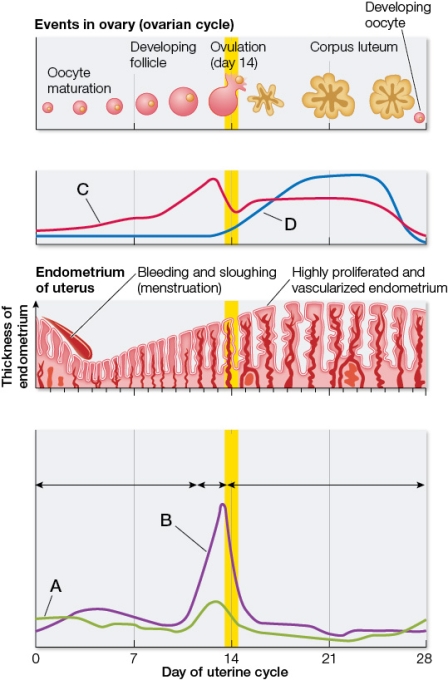 Based on the figure, which statement is true?
 (Multiple Choice)
4.9/5 (86)
(86) Which feature characterizes both spermatogenesis and oogenesis in humans?
(Multiple Choice)
5.0/5 (83)
(83) Which statement about the female reproductive system is true?
(Multiple Choice)
4.9/5 (81)
(81) Refer to the figure showing four different species. 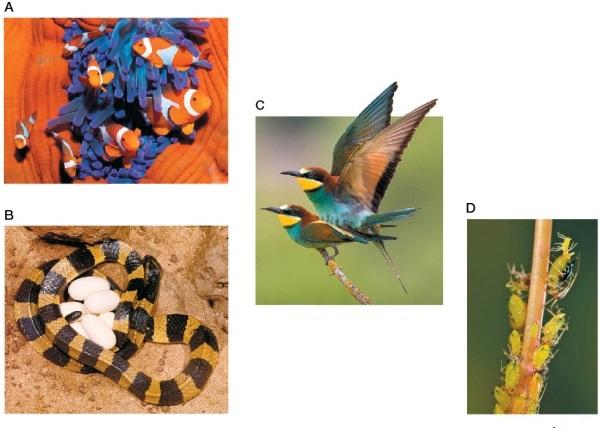 Which organisms in the figure lay amniote eggs?
 (Multiple Choice)
4.8/5 (81)
(81) The synthetic hormones in birth control pills suspend the ovarian cycle, which operates by means of feedback to the hypothalamus and the _______.
(Short Answer)
4.9/5 (83)
(83) Which feature is characteristic of animals with amniote eggs?
(Multiple Choice)
4.8/5 (65)
(65) A drug called RU-486 blocks the actions of progesterone.It is called a contragestational drug because it can terminate a pregnancy after fertilization has occurred.How does RU-486 do this?
(Essay)
4.8/5 (72)
(72) 
Filters
- Essay(0)
- Multiple Choice(0)
- Short Answer(0)
- True False(0)
- Matching(0)