



 Chat with AI
Exam 45: Sensory Systems

Exam 1: Studying Life246 Questions
Exam 2: Small Molecules and the Chemistry of Life246 Questions
Exam 3: Proteins, Carbohydrates, and Lipids246 Questions
Exam 4: Nucleic Acids and the Origin of Life246 Questions
Exam 5: Cells: the Working Units of Life248 Questions
Exam 6: Cell Membranes246 Questions
Exam 7: Cell Communication and Multicellularity246 Questions
Exam 8: Energy, Enzymes, and Metabolism246 Questions
Exam 9: Pathways That Harvest Chemical Energy246 Questions
Exam 10: Photosynthesis: Energy From Sunlight242 Questions
Exam 11: The Cell Cycle and Cell Division260 Questions
Exam 12: Inheritance, Genes, and Chromosomes250 Questions
Exam 13: Dna and Its Role in Heredity257 Questions
Exam 14: From Dna to Protein: Gene Expression252 Questions
Exam 15: Gene Mutation and Molecular Medicine251 Questions
Exam 16: Regulation of Gene Expression245 Questions
Exam 17: Genomes249 Questions
Exam 18: Recombinant Dna and Biotechnology243 Questions
Exam 20: Mechanisms of Evolution243 Questions
Exam 21: Reconstructing and Using Phylogenies246 Questions
Exam 22: Speciation247 Questions
Exam 23: Evolution of Genes and Genomes252 Questions
Exam 24: The History of Life on Earth246 Questions
Exam 25: Bacteria, Archaea, and Viruses262 Questions
Exam 26: The Origin and Diversification of Eukaryotes252 Questions
Exam 27: Plants Without Seeds: From Water to Land251 Questions
Exam 28: The Evolution of Seed Plants259 Questions
Exam 29: The Evolution and Diversity of Fungi261 Questions
Exam 30: Animal Origins and the Evolution of Body Plans248 Questions
Exam 31: Protostome Animals244 Questions
Exam 32: Deuterostome Animals246 Questions
Exam 33: The Plant Body243 Questions
Exam 34: Transport in Plants248 Questions
Exam 35: Plant Nutrition247 Questions
Exam 36: Regulation of Plant Growth246 Questions
Exam 37: Reproduction in Flowering Plants247 Questions
Exam 38: Plant Responses to Environmental Challenges246 Questions
Exam 39: Physiology, Homeostasis, and Temperature Regulation258 Questions
Exam 40: Animal Hormones249 Questions
Exam 41: Immunology: Animal Defense Systems265 Questions
Exam 42: Animal Reproduction261 Questions
Exam 43: Animal Development261 Questions
Exam 44: Neurons, Glia, and Nervous Systems250 Questions
Exam 45: Sensory Systems249 Questions
Exam 46: The Mammalian Nervous System: Structure and Higher Functions254 Questions
Exam 47: Musculoskeletal Systems259 Questions
Exam 48: Gas Exchange247 Questions
Exam 49: Circulatory Systems252 Questions
Exam 50: Nutrition, Digestion, and Absorption259 Questions
Exam 51: Salt and Water Balance and Nitrogen Excretion251 Questions
Exam 52: Animal Behavior249 Questions
Exam 53: The Physical Environment and Biogeography of Life248 Questions
Exam 54: Populations259 Questions
Exam 55: Species Interactions254 Questions
Exam 56: Communities247 Questions
Exam 57: Ecosystems238 Questions
Exam 58: A Changing Biosphere222 Questions
Select questions type


To test the response of a resident mouse to the introduction of an unfamiliar conspecific to its cage, scientists temporarily block neurons from firing in the vomeronasal organ of the resident mouse.What is the most likely outcome?

Free
(Multiple Choice)
4.8/5  (70)
(70) Correct Answer: Verified
E
A change in the resting membrane potential of a sensory cell in response to a stimulus is called a(n) _______ potential.
Free
(Short Answer)
4.8/5 (78)
(78) Correct Answer:Verified
Verifiedreceptor
Which statement about rhodopsin is false?
Free
(Multiple Choice)
4.8/5 (89)
(89) Correct Answer:Verified
VerifiedE
Refer to the figure, which shows receptors in human skin. 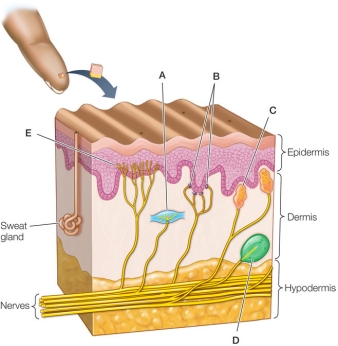 If the tactile receptor labeled C were nonfunctional, what would happen to a person's ability to detect either touch or pressure?
 (Short Answer)
4.9/5 (81)
(81) What is the physiological basis for the auditory system's ability to distinguish different sound frequencies?
(Multiple Choice)
4.9/5 (72)
(72) Refer to the table. 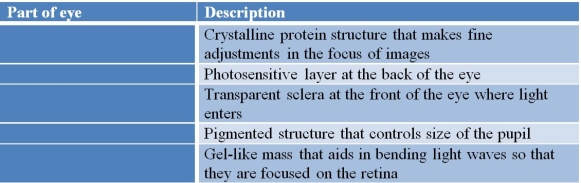 In the first column, what is the correct order of the parts of the ear that match the descriptions listed in the second column?
 (Multiple Choice)
4.8/5 (77)
(77) Refer to the figure. 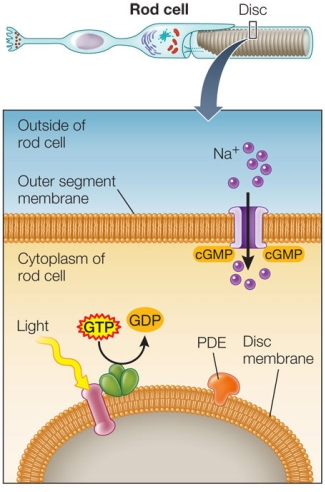 The figure shows the molecular events occurring in a rod photoreceptor in the absence of light.Which of the following best describes the "dark current" that is active in these cells?
 (Multiple Choice)
4.8/5 (74)
(74) _______ are rapidly adapting tactile receptors found primarily in non-hairy skin, where they respond to sensitive touch.
(Short Answer)
4.8/5 (82)
(82) Cutting the auditory nerve or damaging the area of the brain where auditory information is processed would cause _______ deafness.
(Short Answer)
4.9/5 (96)
(96) Refer to the figure, which shows the organ of Corti in the human inner ear. 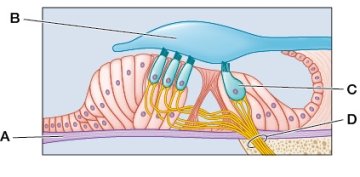 The figure shows the organ of Corti in the human inner ear.Your roommate listens to very loud music wearing headphones.What type of deafness can result, and which of the labeled structures would be affected? Provide the letter and the correct name of the structure.
 (Short Answer)
4.9/5 (95)
(95) Which taste receptor would be activated by the direct effect of hydrogen ions on sodium channels?
(Multiple Choice)
5.0/5 (89)
(89) Increased pressure within the eye can cause glaucoma.Loss of vision results because the increased pressure damages the optic nerve.Which cells of the retina are damaged by glaucoma.On what did you base your answer?
(Short Answer)
5.0/5 (74)
(74) Which of the following does not characterize both muscle spindles and Golgi tendon organs?
(Multiple Choice)
4.8/5 (76)
(76) In a stretch receptor of a crayfish, the rate at which action potentials are fired depends on the magnitude of the _______.
(Short Answer)
4.9/5 (85)
(85) Whereas _______ deafness results from damage to either the tympanic membrane or ossicles, nerve deafness is caused by damage to either the hair cells of the inner ear or the nerves associated with the inner ear.
(Short Answer)
4.7/5 (96)
(96) In casinos, gamblers often roll the dice around in their hands before throwing them.Which type of mechanoreceptor is giving them information about the shape of the dice?
(Multiple Choice)
4.7/5 (80)
(80) 
Filters
- Essay(0)
- Multiple Choice(0)
- Short Answer(0)
- True False(0)
- Matching(0)