



 Chat with AI
Exam 45: Sensory Systems

Exam 1: Studying Life246 Questions
Exam 2: Small Molecules and the Chemistry of Life246 Questions
Exam 3: Proteins, Carbohydrates, and Lipids246 Questions
Exam 4: Nucleic Acids and the Origin of Life246 Questions
Exam 5: Cells: the Working Units of Life248 Questions
Exam 6: Cell Membranes246 Questions
Exam 7: Cell Communication and Multicellularity246 Questions
Exam 8: Energy, Enzymes, and Metabolism246 Questions
Exam 9: Pathways That Harvest Chemical Energy246 Questions
Exam 10: Photosynthesis: Energy From Sunlight242 Questions
Exam 11: The Cell Cycle and Cell Division260 Questions
Exam 12: Inheritance, Genes, and Chromosomes250 Questions
Exam 13: Dna and Its Role in Heredity257 Questions
Exam 14: From Dna to Protein: Gene Expression252 Questions
Exam 15: Gene Mutation and Molecular Medicine251 Questions
Exam 16: Regulation of Gene Expression245 Questions
Exam 17: Genomes249 Questions
Exam 18: Recombinant Dna and Biotechnology243 Questions
Exam 20: Mechanisms of Evolution243 Questions
Exam 21: Reconstructing and Using Phylogenies246 Questions
Exam 22: Speciation247 Questions
Exam 23: Evolution of Genes and Genomes252 Questions
Exam 24: The History of Life on Earth246 Questions
Exam 25: Bacteria, Archaea, and Viruses262 Questions
Exam 26: The Origin and Diversification of Eukaryotes252 Questions
Exam 27: Plants Without Seeds: From Water to Land251 Questions
Exam 28: The Evolution of Seed Plants259 Questions
Exam 29: The Evolution and Diversity of Fungi261 Questions
Exam 30: Animal Origins and the Evolution of Body Plans248 Questions
Exam 31: Protostome Animals244 Questions
Exam 32: Deuterostome Animals246 Questions
Exam 33: The Plant Body243 Questions
Exam 34: Transport in Plants248 Questions
Exam 35: Plant Nutrition247 Questions
Exam 36: Regulation of Plant Growth246 Questions
Exam 37: Reproduction in Flowering Plants247 Questions
Exam 38: Plant Responses to Environmental Challenges246 Questions
Exam 39: Physiology, Homeostasis, and Temperature Regulation258 Questions
Exam 40: Animal Hormones249 Questions
Exam 41: Immunology: Animal Defense Systems265 Questions
Exam 42: Animal Reproduction261 Questions
Exam 43: Animal Development261 Questions
Exam 44: Neurons, Glia, and Nervous Systems250 Questions
Exam 45: Sensory Systems249 Questions
Exam 46: The Mammalian Nervous System: Structure and Higher Functions254 Questions
Exam 47: Musculoskeletal Systems259 Questions
Exam 48: Gas Exchange247 Questions
Exam 49: Circulatory Systems252 Questions
Exam 50: Nutrition, Digestion, and Absorption259 Questions
Exam 51: Salt and Water Balance and Nitrogen Excretion251 Questions
Exam 52: Animal Behavior249 Questions
Exam 53: The Physical Environment and Biogeography of Life248 Questions
Exam 54: Populations259 Questions
Exam 55: Species Interactions254 Questions
Exam 56: Communities247 Questions
Exam 57: Ecosystems238 Questions
Exam 58: A Changing Biosphere222 Questions
Select questions type


The absorption of light by a rhodopsin molecule in a rod cell initiates a signal cascade beginning with the
(Multiple Choice)
4.7/5  (101)
(101) If the normal activity of cone cells in the retina were blocked, what would be the result in the flow of visual information?
(Multiple Choice)
4.7/5 (83)
(83) Which structure of the mammalian auditory system transduces (converts) pressure changes into action potentials that are carried by the auditory nerve to the brain?
(Multiple Choice)
5.0/5 (80)
(80) What do you predict would occur in the rod cells in your retina if you were in a dark room and turned on the lights?
(Multiple Choice)
4.9/5 (87)
(87) If the G proteins in photoreceptors are pharmacologically blocked, exposure of these photoreceptors to light will
(Multiple Choice)
4.8/5 (87)
(87) When a male cat smells the urine of a female cat, he may exhibit the flehmen response, a behavior in which he curls back his upper lip and breathes in deeply.Olfactory molecules from the urine travel in nasal fluid over chemoreceptors of the _______, which is a structure located on the septum dividing the two nostrils.
(Multiple Choice)
5.0/5 (86)
(86) Refer to the table. 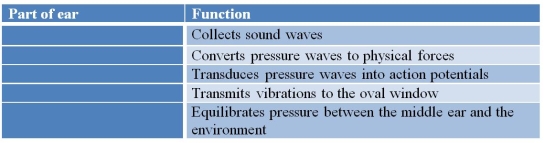 In the first column, what is the correct order of the parts of the ear that match the functions listed in the second column?
 (Multiple Choice)
4.8/5 (83)
(83) A(n) _______ is a change in the membrane potential of a sensory receptor cell in response to a stimulus.
(Multiple Choice)
4.9/5 (82)
(82) Damage to horizontal cells and _______ cells would disrupt lateral processing of information across the retina.
(Short Answer)
4.7/5 (71)
(71) Many mammals have _______, which help collect sounds and direct them into the auditory canals.
(Short Answer)
4.9/5 (84)
(84) Refer to the figure. 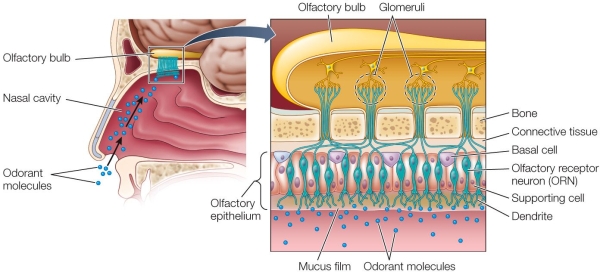 In the human olfactory system, a single glomerulus receives input from
 (Multiple Choice)
4.8/5 (88)
(88) The ability of the olfactory system to distinguish a wide variety of smells is due to
(Multiple Choice)
4.9/5 (77)
(77) Upon diving into a pool, you initially feel cold, but soon you feel comfortable because of the phenomenon known as _______.
(Short Answer)
4.9/5 (66)
(66) On a camping trip, you pitch your tent on a rock that you can feel through your sleeping bag all night.Which mechanoreceptors are most likely to be giving you information about this uncomfortable rock?
(Multiple Choice)
4.9/5 (73)
(73) In the mammalian auditory system, pressure changes are transduced into action potentials by which structure?
(Multiple Choice)
4.9/5 (69)
(69) What would be the effect of destroying the olfactory bulbs in a mouse?
(Short Answer)
4.8/5 (70)
(70) The photoreceptive cells least sensitive to light are the _______.
(Short Answer)
4.8/5 (72)
(72) 
Filters
- Essay(0)
- Multiple Choice(0)
- Short Answer(0)
- True False(0)
- Matching(0)