



 Chat with AI
Exam 28: The Evolution of Seed Plants

Exam 1: Studying Life246 Questions
Exam 2: Small Molecules and the Chemistry of Life246 Questions
Exam 3: Proteins, Carbohydrates, and Lipids246 Questions
Exam 4: Nucleic Acids and the Origin of Life246 Questions
Exam 5: Cells: the Working Units of Life248 Questions
Exam 6: Cell Membranes246 Questions
Exam 7: Cell Communication and Multicellularity246 Questions
Exam 8: Energy, Enzymes, and Metabolism246 Questions
Exam 9: Pathways That Harvest Chemical Energy246 Questions
Exam 10: Photosynthesis: Energy From Sunlight242 Questions
Exam 11: The Cell Cycle and Cell Division260 Questions
Exam 12: Inheritance, Genes, and Chromosomes250 Questions
Exam 13: Dna and Its Role in Heredity257 Questions
Exam 14: From Dna to Protein: Gene Expression252 Questions
Exam 15: Gene Mutation and Molecular Medicine251 Questions
Exam 16: Regulation of Gene Expression245 Questions
Exam 17: Genomes249 Questions
Exam 18: Recombinant Dna and Biotechnology243 Questions
Exam 20: Mechanisms of Evolution243 Questions
Exam 21: Reconstructing and Using Phylogenies246 Questions
Exam 22: Speciation247 Questions
Exam 23: Evolution of Genes and Genomes252 Questions
Exam 24: The History of Life on Earth246 Questions
Exam 25: Bacteria, Archaea, and Viruses262 Questions
Exam 26: The Origin and Diversification of Eukaryotes252 Questions
Exam 27: Plants Without Seeds: From Water to Land251 Questions
Exam 28: The Evolution of Seed Plants259 Questions
Exam 29: The Evolution and Diversity of Fungi261 Questions
Exam 30: Animal Origins and the Evolution of Body Plans248 Questions
Exam 31: Protostome Animals244 Questions
Exam 32: Deuterostome Animals246 Questions
Exam 33: The Plant Body243 Questions
Exam 34: Transport in Plants248 Questions
Exam 35: Plant Nutrition247 Questions
Exam 36: Regulation of Plant Growth246 Questions
Exam 37: Reproduction in Flowering Plants247 Questions
Exam 38: Plant Responses to Environmental Challenges246 Questions
Exam 39: Physiology, Homeostasis, and Temperature Regulation258 Questions
Exam 40: Animal Hormones249 Questions
Exam 41: Immunology: Animal Defense Systems265 Questions
Exam 42: Animal Reproduction261 Questions
Exam 43: Animal Development261 Questions
Exam 44: Neurons, Glia, and Nervous Systems250 Questions
Exam 45: Sensory Systems249 Questions
Exam 46: The Mammalian Nervous System: Structure and Higher Functions254 Questions
Exam 47: Musculoskeletal Systems259 Questions
Exam 48: Gas Exchange247 Questions
Exam 49: Circulatory Systems252 Questions
Exam 50: Nutrition, Digestion, and Absorption259 Questions
Exam 51: Salt and Water Balance and Nitrogen Excretion251 Questions
Exam 52: Animal Behavior249 Questions
Exam 53: The Physical Environment and Biogeography of Life248 Questions
Exam 54: Populations259 Questions
Exam 55: Species Interactions254 Questions
Exam 56: Communities247 Questions
Exam 57: Ecosystems238 Questions
Exam 58: A Changing Biosphere222 Questions
Select questions type


The corolla and the calyx often play roles in

Free
(Multiple Choice)
4.7/5  (72)
(72) Correct Answer: Verified
A
Which statement regarding our dependence on a small number of domesticated plant species for food is true?
Free
(Multiple Choice)
4.8/5 (75)
(75) Correct Answer:Verified
VerifiedE
Refer to the figure. 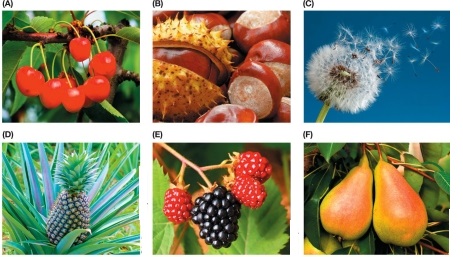 The fruits in images _______ are categorized as simple fruits.
Free
(Multiple Choice)
4.8/5 (70)
(70) Correct Answer:Verified
VerifiedA
Which of the following about plant-pollinator interactions is false?
(Multiple Choice)
4.9/5 (75)
(75) Which group of plants has members that produce "wood" (extensively proliferated xylem)?
(Multiple Choice)
4.9/5 (64)
(64) In most terrestrial regions of Earth today, the flora consists predominantly of
(Multiple Choice)
4.8/5 (78)
(78) You have discovered a new kind of tree that bears edible fruits.Each fruit consists of carpels of many flowers fused tightly together as one fruit.Based on this arrangement, this fruit would most likely resemble a(n)
(Multiple Choice)
4.9/5 (83)
(83) Refer to the figure, which shows the evolutionary relationships among the angiosperms. 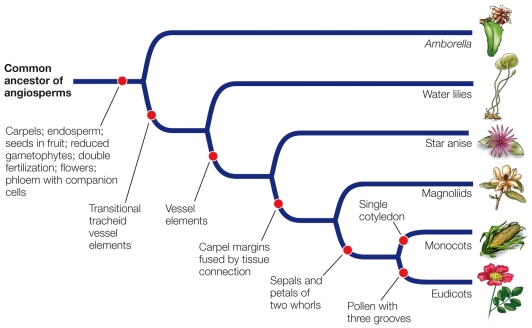 If you discovered a new plant with a two-whorl perianth but more than one cotyledon, the plant would belong to which group?
 (Multiple Choice)
4.9/5 (72)
(72) In angiosperms, double fertilization results in the development of
(Multiple Choice)
4.7/5 (72)
(72) Which of the following are found in gymnosperms as well as angiosperms?
(Multiple Choice)
4.8/5 (81)
(81) In wild populations, self-pollination is often seen as detrimental because it results in a lack of genetic mixing.This issue is most relevant to plants with _______ flowers, rather than those with separate male and female flowers.
(Short Answer)
4.9/5 (82)
(82) Flowers with both megasporangia and microsporangia are said to be _______.
(Short Answer)
4.8/5 (80)
(80) Which of the following does not correctly match a plant with a drug derived from that plant?
(Multiple Choice)
4.8/5 (87)
(87) While digging through boxes in the basement of an old house, you discover an envelope full of seeds labeled "black cherry." Your first attempt to germinate some of the seeds fails, but you correctly assume these seeds are still viable based on how carefully they were stored.Based on your knowledge of seeds and the treatments that might be required to break their dormancy, design an experiment to induce their germination.Keep in mind that fruits are often an enticement for animals that eat and disperse the seeds encased within the fruit.
(Essay)
4.9/5 (87)
(87) The fruit that encases the seeds produced by a maple tree is composed of long, thin membranes that protrude asymmetrically from the surface.These seeds are most likely dispersed by _______.
(Short Answer)
4.8/5 (78)
(78) A grouping of flowers on the stem of a single plant is a(n)
(Multiple Choice)
4.8/5 (80)
(80) Refer to the table. 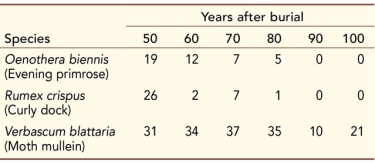 In 1879, W.J.Beal began an experiment that he could not hope to finish in his lifetime.He prepared 20 lots of seeds for long-term storage.Each lot consisted of 50 seeds from each of 23 species.He mixed each lot of seeds with sand and placed the mixture in an uncapped bottle, then buried all the bottles in a sandy knoll.At 5- or 10-year intervals over the next century, biologists excavated a bottle and checked the viability of its contents.The table shows the number of germinating seeds (of the original 50) from three of the species in years 50-100 of this ongoing experiment.What factors do you think might influence the differences among the species in long-term seed viability?
 (Essay)
4.8/5 (80)
(80) 
Filters
- Essay(0)
- Multiple Choice(0)
- Short Answer(0)
- True False(0)
- Matching(0)