



 Chat with AI
Exam 28: The Evolution of Seed Plants

Exam 1: Studying Life246 Questions
Exam 2: Small Molecules and the Chemistry of Life246 Questions
Exam 3: Proteins, Carbohydrates, and Lipids246 Questions
Exam 4: Nucleic Acids and the Origin of Life246 Questions
Exam 5: Cells: the Working Units of Life248 Questions
Exam 6: Cell Membranes246 Questions
Exam 7: Cell Communication and Multicellularity246 Questions
Exam 8: Energy, Enzymes, and Metabolism246 Questions
Exam 9: Pathways That Harvest Chemical Energy246 Questions
Exam 10: Photosynthesis: Energy From Sunlight242 Questions
Exam 11: The Cell Cycle and Cell Division260 Questions
Exam 12: Inheritance, Genes, and Chromosomes250 Questions
Exam 13: Dna and Its Role in Heredity257 Questions
Exam 14: From Dna to Protein: Gene Expression252 Questions
Exam 15: Gene Mutation and Molecular Medicine251 Questions
Exam 16: Regulation of Gene Expression245 Questions
Exam 17: Genomes249 Questions
Exam 18: Recombinant Dna and Biotechnology243 Questions
Exam 20: Mechanisms of Evolution243 Questions
Exam 21: Reconstructing and Using Phylogenies246 Questions
Exam 22: Speciation247 Questions
Exam 23: Evolution of Genes and Genomes252 Questions
Exam 24: The History of Life on Earth246 Questions
Exam 25: Bacteria, Archaea, and Viruses262 Questions
Exam 26: The Origin and Diversification of Eukaryotes252 Questions
Exam 27: Plants Without Seeds: From Water to Land251 Questions
Exam 28: The Evolution of Seed Plants259 Questions
Exam 29: The Evolution and Diversity of Fungi261 Questions
Exam 30: Animal Origins and the Evolution of Body Plans248 Questions
Exam 31: Protostome Animals244 Questions
Exam 32: Deuterostome Animals246 Questions
Exam 33: The Plant Body243 Questions
Exam 34: Transport in Plants248 Questions
Exam 35: Plant Nutrition247 Questions
Exam 36: Regulation of Plant Growth246 Questions
Exam 37: Reproduction in Flowering Plants247 Questions
Exam 38: Plant Responses to Environmental Challenges246 Questions
Exam 39: Physiology, Homeostasis, and Temperature Regulation258 Questions
Exam 40: Animal Hormones249 Questions
Exam 41: Immunology: Animal Defense Systems265 Questions
Exam 42: Animal Reproduction261 Questions
Exam 43: Animal Development261 Questions
Exam 44: Neurons, Glia, and Nervous Systems250 Questions
Exam 45: Sensory Systems249 Questions
Exam 46: The Mammalian Nervous System: Structure and Higher Functions254 Questions
Exam 47: Musculoskeletal Systems259 Questions
Exam 48: Gas Exchange247 Questions
Exam 49: Circulatory Systems252 Questions
Exam 50: Nutrition, Digestion, and Absorption259 Questions
Exam 51: Salt and Water Balance and Nitrogen Excretion251 Questions
Exam 52: Animal Behavior249 Questions
Exam 53: The Physical Environment and Biogeography of Life248 Questions
Exam 54: Populations259 Questions
Exam 55: Species Interactions254 Questions
Exam 56: Communities247 Questions
Exam 57: Ecosystems238 Questions
Exam 58: A Changing Biosphere222 Questions
Select questions type


From the perspective of flowering plants, the role of fruit is to
(Multiple Choice)
4.7/5  (75)
(75) Of the four groups of gymnosperms, conifers are the most abundant.This group uses _______ for pollination and has dispensed with the need for water for fertilization, allowing its members to flourish in arid environments.
(Short Answer)
4.8/5 (71)
(71) The flowers of a new kind of tropical vine are bright scarlet in color but are not highly scented.These plants are most likely pollinated by
(Multiple Choice)
4.9/5 (88)
(88) Refer to the figure, which shows the evolutionary relationships among the angiosperms. 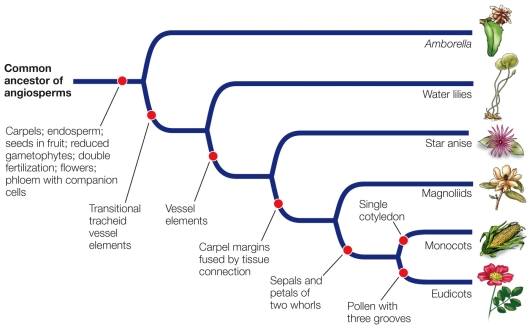 Which group is most closely related to the monocots?
 (Multiple Choice)
4.8/5 (71)
(71) In the flowering plants, male gametophytes are called _______.
(Short Answer)
4.9/5 (74)
(74) Which group is characterized by fruits, flowers, endosperm, and much-reduced gametophytes?
(Multiple Choice)
4.8/5 (94)
(94) Refer to the figure. 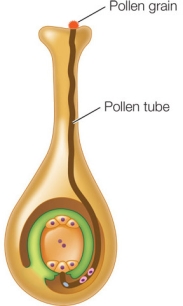 Which statement about the figure is false?
 (Multiple Choice)
4.9/5 (79)
(79) Refer to the figure, which shows the life cycle of an angiosperm. 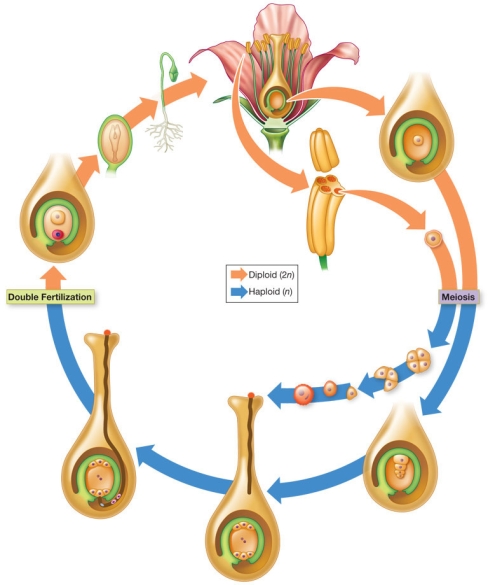 If double fertilization were delayed in this plant, the appearance of which two critical structures shown in the diagram would be also delayed?
 (Multiple Choice)
4.8/5 (80)
(80) In flowers, the inner specialized leaves are called petals, and the outer specialized leaves are called _______.
(Short Answer)
4.8/5 (84)
(84) Which statement most accurately describes the relationship between animals and pollination?
(Multiple Choice)
4.8/5 (91)
(91) Refer to the figure. 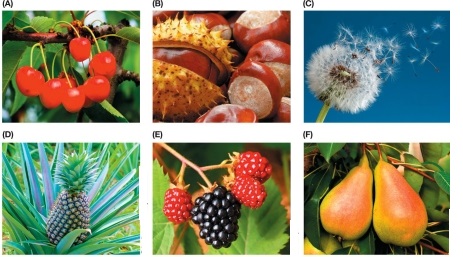 The flesh of the fruit in part _______ is composed several carpels of a single flower.
 (Multiple Choice)
4.8/5 (81)
(81) Most gymnosperms are pollinated by wind, whereas most angiosperms are pollinated by _______.
(Short Answer)
5.0/5 (84)
(84) Refer to the figure. 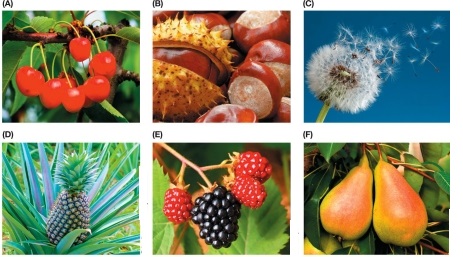 The fruit in part _______ is an aggregate of several separate carpels.
 (Multiple Choice)
4.9/5 (77)
(77) All plant life cycles have generations that alternate between the gametophyte generation and the _______ generation.
(Multiple Choice)
4.8/5 (83)
(83) Refer to the figure. 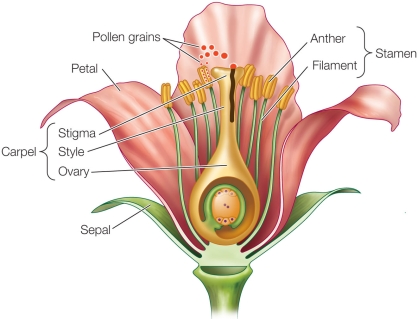 Some flowers are missing one or more of the following floral organs: sepals, petals, stamens, and carpels.Which floral organ or organs do you think might be found in the flowers that have the fewest floral organ types? Discuss the possibilities, both for a single flower and for a species.
 (Essay)
4.9/5 (75)
(75) The _______ is triploid tissue that nourishes the embryonic angiosperm sporophyte during its early development.
(Short Answer)
4.9/5 (87)
(87) Despite the absence of true fruits in gymnosperms, many conifers encase their seeds in a fleshy reward to entice _______ to aid in their seed dispersal.
(Short Answer)
4.7/5 (71)
(71) In some of the most basal clades of angiosperms, all of the following are characteristic of flowers except
(Multiple Choice)
5.0/5 (78)
(78) You are given two flowers of the same species from two separate plants.One flower has only a pistil, and the other has only stamens.It is most likely that the flowers are _______ and the species is _______.
(Multiple Choice)
4.8/5 (99)
(99) 
Filters
- Essay(0)
- Multiple Choice(0)
- Short Answer(0)
- True False(0)
- Matching(0)