



 Chat with AI
Exam 28: The Evolution of Seed Plants

Exam 1: Studying Life246 Questions
Exam 2: Small Molecules and the Chemistry of Life246 Questions
Exam 3: Proteins, Carbohydrates, and Lipids246 Questions
Exam 4: Nucleic Acids and the Origin of Life246 Questions
Exam 5: Cells: the Working Units of Life248 Questions
Exam 6: Cell Membranes246 Questions
Exam 7: Cell Communication and Multicellularity246 Questions
Exam 8: Energy, Enzymes, and Metabolism246 Questions
Exam 9: Pathways That Harvest Chemical Energy246 Questions
Exam 10: Photosynthesis: Energy From Sunlight242 Questions
Exam 11: The Cell Cycle and Cell Division260 Questions
Exam 12: Inheritance, Genes, and Chromosomes250 Questions
Exam 13: Dna and Its Role in Heredity257 Questions
Exam 14: From Dna to Protein: Gene Expression252 Questions
Exam 15: Gene Mutation and Molecular Medicine251 Questions
Exam 16: Regulation of Gene Expression245 Questions
Exam 17: Genomes249 Questions
Exam 18: Recombinant Dna and Biotechnology243 Questions
Exam 20: Mechanisms of Evolution243 Questions
Exam 21: Reconstructing and Using Phylogenies246 Questions
Exam 22: Speciation247 Questions
Exam 23: Evolution of Genes and Genomes252 Questions
Exam 24: The History of Life on Earth246 Questions
Exam 25: Bacteria, Archaea, and Viruses262 Questions
Exam 26: The Origin and Diversification of Eukaryotes252 Questions
Exam 27: Plants Without Seeds: From Water to Land251 Questions
Exam 28: The Evolution of Seed Plants259 Questions
Exam 29: The Evolution and Diversity of Fungi261 Questions
Exam 30: Animal Origins and the Evolution of Body Plans248 Questions
Exam 31: Protostome Animals244 Questions
Exam 32: Deuterostome Animals246 Questions
Exam 33: The Plant Body243 Questions
Exam 34: Transport in Plants248 Questions
Exam 35: Plant Nutrition247 Questions
Exam 36: Regulation of Plant Growth246 Questions
Exam 37: Reproduction in Flowering Plants247 Questions
Exam 38: Plant Responses to Environmental Challenges246 Questions
Exam 39: Physiology, Homeostasis, and Temperature Regulation258 Questions
Exam 40: Animal Hormones249 Questions
Exam 41: Immunology: Animal Defense Systems265 Questions
Exam 42: Animal Reproduction261 Questions
Exam 43: Animal Development261 Questions
Exam 44: Neurons, Glia, and Nervous Systems250 Questions
Exam 45: Sensory Systems249 Questions
Exam 46: The Mammalian Nervous System: Structure and Higher Functions254 Questions
Exam 47: Musculoskeletal Systems259 Questions
Exam 48: Gas Exchange247 Questions
Exam 49: Circulatory Systems252 Questions
Exam 50: Nutrition, Digestion, and Absorption259 Questions
Exam 51: Salt and Water Balance and Nitrogen Excretion251 Questions
Exam 52: Animal Behavior249 Questions
Exam 53: The Physical Environment and Biogeography of Life248 Questions
Exam 54: Populations259 Questions
Exam 55: Species Interactions254 Questions
Exam 56: Communities247 Questions
Exam 57: Ecosystems238 Questions
Exam 58: A Changing Biosphere222 Questions
Select questions type


Which statement correctly describes the vasculature found in angiosperms and gymnosperms?
(Multiple Choice)
4.9/5  (67)
(67) Pollen from a snapdragon flower lands on the stigma of a neighboring snapdragon.The pollen tube germinates and extends through the maternal sporophyte tissue to the ovule, where it encounters the female gametophyte and releases two sperm, one that fuses with the egg and another that fuses with the polar nuclei.Which statement about this scenario is true?
(Multiple Choice)
4.9/5 (75)
(75) Which of the following structures is not part of the pistil?
(Multiple Choice)
4.9/5 (91)
(91) Which two features found in seed plants play a clear role in preventing desiccation?
(Multiple Choice)
4.9/5 (78)
(78) Refer to the figure. 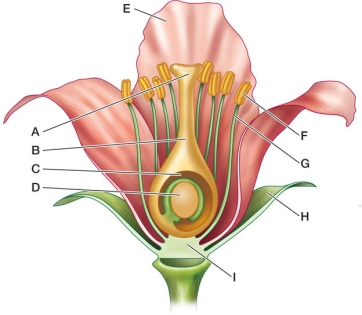 What is the name of the swollen base of the pistil? Identify its label.
 (Multiple Choice)
4.8/5 (75)
(75) A newly discovered fossil layer shows evidence that conifers and cycads flourished when the fossils were laid down.Below this layer there are no conifers or cycads.These fossils are most likely from the
(Multiple Choice)
4.9/5 (70)
(70) A flower whose parts originate from a central point and appear as a mirror image across any diameter has _______ symmetry.
(Multiple Choice)
4.7/5 (85)
(85) Describe how the evolution of seed plants changed Earth's landscape over the course of terrestrial colonization.What benefits seeds confer that seedless vascular plants did not have?
(Essay)
4.7/5 (80)
(80) About 200 mya, dinosaurs were Earth's dominant animals, and _______ were the dominant vegetation.
(Multiple Choice)
5.0/5 (89)
(89) Which structure forms the swollen basal part of the pistil that becomes the fruit?
(Multiple Choice)
4.8/5 (74)
(74) Which of the following is not a major difference between monocots and eudicots?
(Multiple Choice)
4.8/5 (78)
(78) Which of the following gymnosperms retain the ancestral trait of swimming sperm?
(Multiple Choice)
4.8/5 (85)
(85) Despite the fact that only _______ produce true fruits, some conifers are known to produce fleshy rewards encasing their seeds.These tissues serve a similar purpose: to aid in seed dispersal by animal vectors.
(Short Answer)
4.9/5 (82)
(82) You are sent to examine two adjacent farm fields with very similar soil types.Every year, one field is plowed before winter and allowed to sit bare until spring.The neighboring field is planted with a cover crop for winter.What difference would you most likely observe between the two fields?
(Multiple Choice)
4.9/5 (78)
(78) Refer to the figure.  Which term is least likely to be used when speaking of this flower?
 (Multiple Choice)
4.8/5 (82)
(82) Refer to the table. 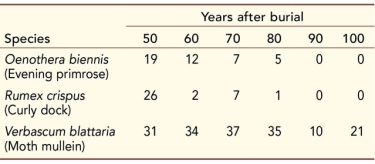 In 1879, W.J.Beal began an experiment that he could not hope to finish in his lifetime.He prepared 20 lots of seeds for long-term storage.Each lot consisted of 50 seeds from each of 23 species.He mixed each lot of seeds with sand and placed the mixture in an uncapped bottle, then buried all the bottles in a sandy knoll.At 5- or 10-year intervals over the next century, biologists excavated a bottle and checked the viability of its contents.The table shows the number of germinating seeds (of the original 50) from three of the species in years 50-100 of this ongoing experiment.Calculate the percentage of the seeds that were still viable for these three species in years 50-100, and graph percent viable seeds as a function of years after burial.
 (Essay)
4.7/5 (79)
(79) The evolution of pollen has enabled seed plants to thrive on Earth because it
(Multiple Choice)
4.9/5 (85)
(85) 
Filters
- Essay(0)
- Multiple Choice(0)
- Short Answer(0)
- True False(0)
- Matching(0)